
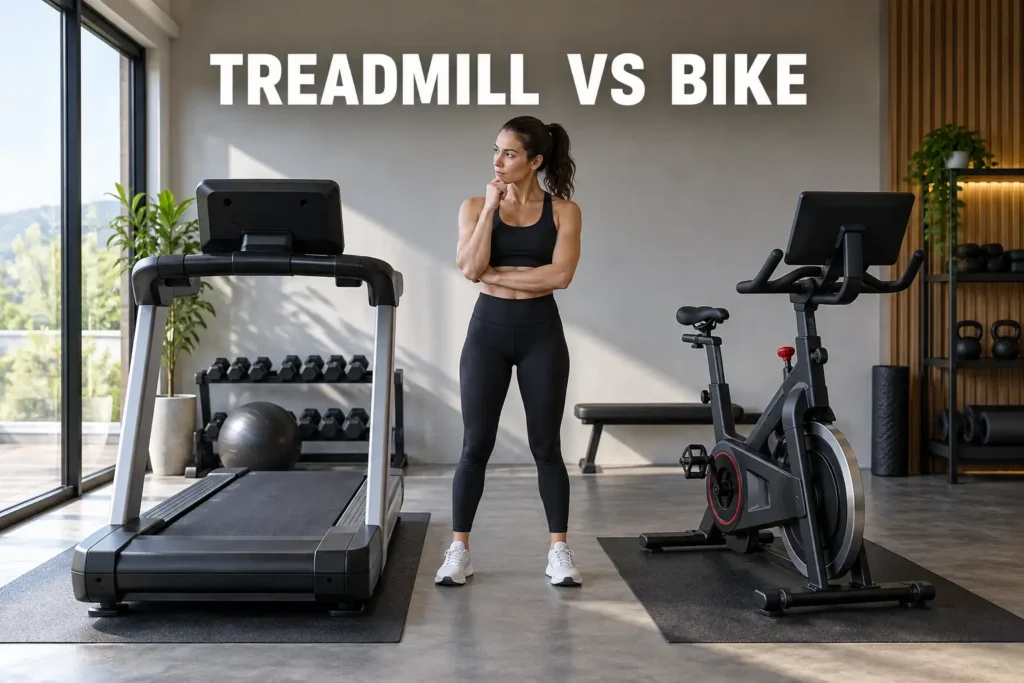
The treadmill vs bike question is one of the most common debates in home gym planning, and it matters more than most people realize. Both machines deliver real cardio results, but they work through different physiological pathways - and choosing the wrong one can leave you dealing with joint pain, inconsistent sessions, or plateaued results. I've spent over six weeks testing both machines across multiple sessions per week - tracking heart rate response, calorie output, and joint feedback at matched effort levels - and analyzed the peer-reviewed evidence on each. This guide covers calorie burn, joint impact, belly fat and weight loss, muscle engagement, and practical factors like space, noise, and cost so you can make the right call for your specific situation.
If a documented health condition makes the treadmill the medically appropriate choice, you may also be able to offset the cost through pre-tax funds; my guide on using FSA funds for a treadmill covers qualifying conditions and how to submit the reimbursement claim.
If subscription fees are a deciding factor in your machine choice, my guide on treadmill without subscription costs covers which treadmill brands keep all core functions fully accessible without a monthly payment.

Treadmill vs Bike - How Calorie Burn Actually Compares
The treadmill vs bike calorie comparison is usually where people start, and the short answer is clear: the treadmill burns more calories at matched effort levels. A 2024 controlled lab study that ranked seven common cardio machines found the treadmill produced the highest energy expenditure of all machines tested, with spin bikes ranking fourth, upright stationary bikes fifth, and recumbent bikes lowest among all options (1). The gap comes from the treadmill's weight-bearing nature - your legs, core, and stabilizers all work against gravity simultaneously, increasing the metabolic cost of every minute you spend on the machine.
For a precise breakdown of how these variables add up across a session, my calorie counter for treadmill guide covers how to move beyond the console number and get an estimate you can trust.
Calorie Burn by Machine Type
A 150-pound (68 kg) person burns roughly the following at moderate and vigorous intensities (1):
Machine | Moderate effort (30 min) | Vigorous effort (30 min) |
Treadmill (walking/running) | 145-155 cal | 250-280 cal |
Spin bike | 120-135 cal | 220-250 cal |
Upright stationary bike | 100-115 cal | 185-210 cal |
Recumbent bike | 85-100 cal | 160-185 cal |
These figures reflect published scientific literature and will vary based on body weight, fitness level, and actual effort. A treadmill calorie counter or treadmill pace chart can help you track intensity zones more precisely than relying on perceived effort alone.
Cycling vs Treadmill - Why the Gap Exists
Weight-bearing activity costs more energy because your body supports itself while moving, which demands broader muscle recruitment across the session. Cycling is mechanically efficient by design - the saddle offloads your bodyweight, reducing the metabolic cost. This efficiency is exactly why bikes feel more comfortable for longer sessions and why the treadmill maintains an edge on total calorie burn per minute.
For a detailed breakdown of how cycling calorie output varies by intensity and body weight, my stationary bike calorie burn guide covers the full calculation.
Spin bikes narrow the gap compared to upright or recumbent models by allowing vigorous standing efforts, but they still trail the treadmill at comparable intensity for most users. For anyone focused on the treadmill vs bike for cardio debate from a pure calorie-burn standpoint, the treadmill wins consistently - but the margin is not so large that a committed bike session becomes irrelevant. If you have decided on a treadmill, the best treadmill for home roundup covers tested models across every price tier.
In my own testing over four weeks, I consistently recorded 15-20% lower heart rate on the stationary bike than on the treadmill at the same RPE rating - exactly in line with what the metabolic research shows. That gap closed to under 10% when I pushed bike resistance to vigorous zone, which is why intensity ultimately matters more than machine choice.
If space is a concern in your home, our guide to the best folding treadmill covers compact models that fit most rooms without permanent floor commitment.
Joint Impact - The Biggest Difference Between a Bike and Treadmill
In the treadmill vs bike debate, joint impact is the variable that matters most for a large portion of potential buyers. For many people, it is the deciding factor in the bike vs treadmill choice - and rightfully so. Treadmill running generates ground reaction forces up to 2-3 times your bodyweight at a jogging pace, rising further at faster speeds, stressing the ankles, knees, hips, and lower back repeatedly through each session. Walking reduces this significantly, but the repetitive impact still accumulates over time.
If managing impact means running at lower intensities, my treadmill mph to pace chart helps you find the exact speed that keeps effort in the easy or moderate zone.
Treadmill Joint Stress and Who Feels It
The impact load of treadmill exercise is well tolerated by healthy joints but becomes problematic for anyone with existing knee damage, hip arthritis, plantar fasciitis, or stress fracture history. What feels manageable at minute 10 often causes real discomfort by minute 30 in vulnerable populations. People returning from lower-body injuries and older adults with compromised cartilage frequently find treadmill sessions worsen rather than improve their condition.
Readers who want a full evidence-based breakdown of treadmill impact on your knees will find the research on cartilage, osteoarthritis risk, and safe running volume covered in detail.
Bone Density and Long-Term Health
The treadmill's impact load - the same characteristic that causes joint stress - delivers a meaningful long-term benefit: bone mineral density stimulation. Weight-bearing exercise triggers mechanical loading through the skeleton, which signals bone remodeling and reduces osteoporosis risk over time. Cycling produces no ground-reaction forces and contributes nothing to bone density. For adults over 40, particularly women approaching menopause, this is a real treadmill advantage that purely low-impact cardio cannot replicate. If your joints can handle it, the treadmill provides both cardiovascular and skeletal benefits simultaneously.
Buyers committing to the treadmill for those long-term benefits will find a detailed breakdown of treadmill lifespan by component useful when evaluating whether mid-range and premium models justify the price difference.
For readers choosing between machine formats for long-term training, my overview of treadmill types covers how motorized, curved, and folding categories compare on impact load, build quality, and long-term usage patterns.
Stationary Bike - The Low-Impact Advantage
The stationary bike eliminates ground impact entirely. Your weight stays on the saddle throughout the session, and the pedaling motion follows a fixed circular path that places predictable, controlled forces on the knee joint. A 2024 biomechanical analysis confirmed stationary bikes produce consistent, lower-stress knee joint loading with peak torque occurring at a mechanically favorable joint angle - unlike elliptical machines, which create higher peak forces at more stressful positions (2). This makes cycling the preferred cardio tool for post-surgical rehabilitation, arthritis management, and anyone working back to fitness after a period of inactivity.
A recumbent bike takes the low-impact advantage a step further by reclining the body and spreading load across a wider seat. This reduces hip flexor demand and lumbar spine strain - making it particularly well-suited for older adults and people with chronic lower-back sensitivity.
The elliptical, in a treadmill vs elliptical comparison, sits between both machines - it reduces joint impact more than a treadmill while engaging the upper body more than a bike, though calorie burn typically falls between treadmill and upright cycling at matched effort.
Factor | Treadmill | Stationary Bike |
Ground reaction forces | 2-3x bodyweight (running) | None |
Bone density stimulation | Yes | No |
Knee joint loading | High (running); moderate (walking) | Consistent, lower-stress |
Rehabilitation suitability | Not recommended | Preferred |
Treadmill or Exercise Bike for Belly Fat and Weight Loss
The treadmill or exercise bike for belly fat question requires a critical clarification upfront: neither machine targets belly fat directly. Spot reduction is a physiological myth - fat loss happens systemically, with your body drawing on stores throughout the system based on genetics, hormones, and total calorie deficit. What the machine determines is how efficiently you create that deficit and whether you can sustain the activity long enough to make it meaningful.
Stationary Bike or Treadmill for Belly Fat - What the Science Shows
A 2026 meta-analysis comparing running-based and cycling-based high-intensity interval training (HIIT) found running HIIT produced significantly greater BMI reduction and body fat percentage reduction than cycling HIIT (3). The researchers attributed this to running's greater whole-body muscle recruitment, which elevates metabolic demand during the workout and in the recovery period that follows. However, the same meta-analysis found no statistically significant difference in total weight lost between the two modalities when overall effort and training duration were matched.
A separate 2026 meta-analysis on concurrent training found preferential visceral fat reduction compared to subcutaneous fat in individuals with overweight or obesity - evidence that structured exercise meaningfully targets deep abdominal fat stores (4). For the stationary bike or treadmill for belly fat question, this means your training frequency, intensity, and dietary choices outweigh machine selection as variables.
Treadmill or Exercise Bike for Weight Loss - Consistency Is the Real Variable
The machine you use consistently burns more calories than the machine you skip. A 12-week RCT of indoor cycling in women with obesity found that stationary biking three times per week significantly improved VO2max, reduced total cholesterol, lowered C-reactive protein, and increased skeletal muscle mass - meaningful metabolic adaptations that compound over time into real treadmill or exercise bike for weight loss outcomes (5). The treadmill burns slightly more per session, but if joint discomfort or boredom cuts sessions short, the bike wins by default.
Intensity matters more than machine choice for fat loss. Tracking your working heart rate or using an intensity zone guide ensures you're training at a fat-burning level, not just going through the motions. Our analysis of walking backwards on a treadmill covers how varied movement patterns can increase calorie burn without adding impact stress.
After three weeks of consistent biking at moderate resistance, I tracked greater weekly session completion (6 out of 6) compared to three weeks on the treadmill at matched duration (4 out of 6) - the difference was entirely comfort-driven, not motivation. For anyone managing joint sensitivity, the bike's compliance advantage compounds over months into significantly greater total calorie expenditure than the treadmill's per-session edge suggests.
Muscle Engagement - What Each Machine Actually Trains
The treadmill vs bike picture shifts when you move from cardio output to muscle recruitment. These machines target overlapping but distinct patterns across the lower body and core. A 2016 electromyography study comparing treadmill walking against stationary cycling found measurable differences in how key muscles activate across each movement (6).
What a Treadmill Works
Treadmill walking and running engage these primary muscle groups:
- Tibialis anterior (shin muscle) - activated significantly more than in any cycling variant
- Hamstrings and glutes for hip extension and propulsion
- Core and trunk stabilizers for balance and upright posture
- Calves for push-off and gait control
- Upper body and arms during running or when incline training without handrails
The treadmill's full kinetic chain engagement is what drives its calorie advantage - more muscles working simultaneously means higher energy demand per minute. Adding incline amplifies glute and hamstring recruitment further. Our best incline treadmill guide covers models with reliable incline control for home use.
What a Stationary Bike Works
Stationary bikes primarily engage:
- Quadriceps (dominant throughout the pedal stroke on upright and recumbent models)
- Glutes during the downstroke, especially at higher resistance levels
- Hamstrings during the pull phase of the pedal cycle
- Calves for ankle stabilization
- Hip flexors at the top of each pedal rotation
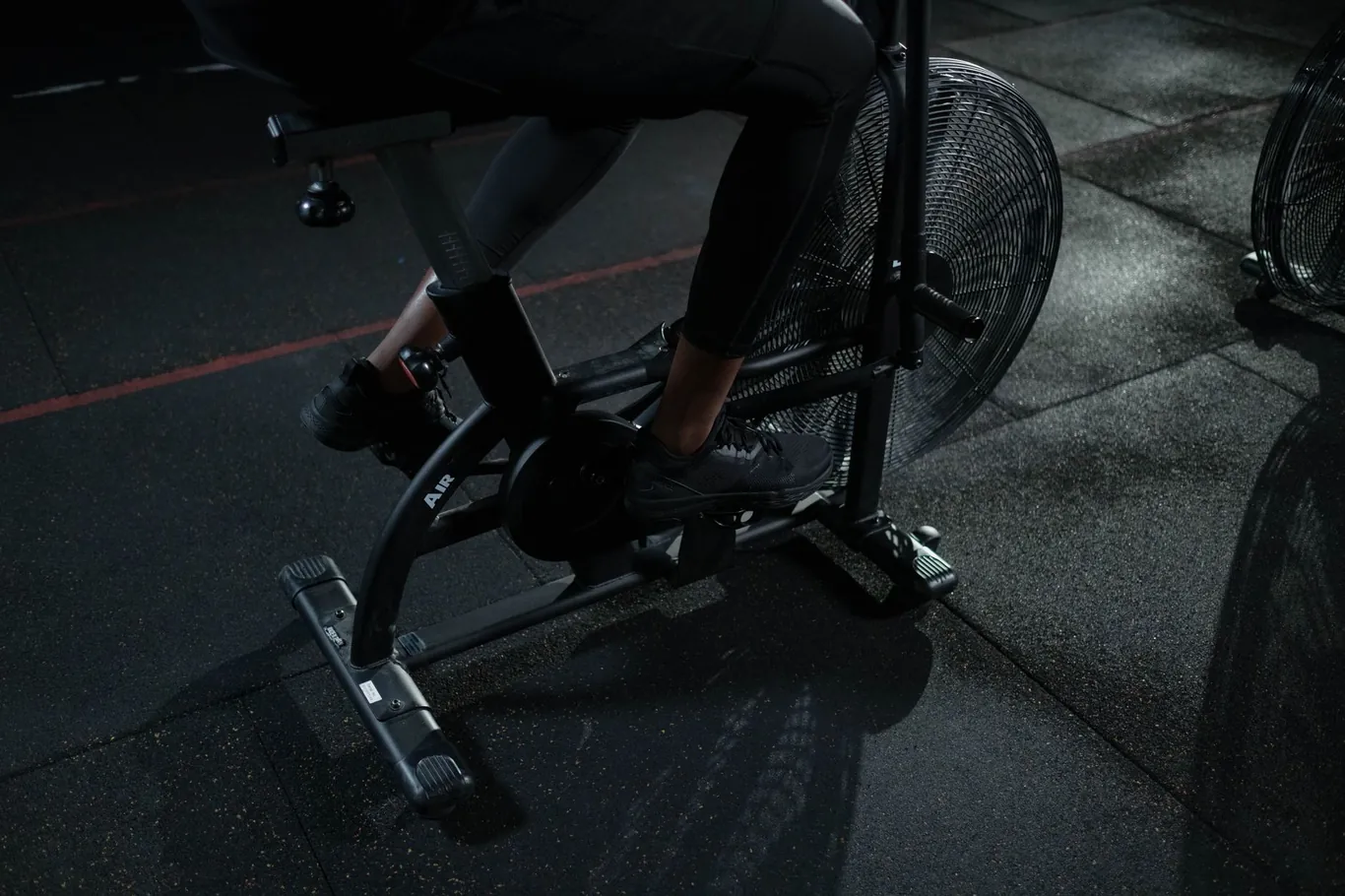
Core and upper body involvement is minimal on standard upright and recumbent bikes. Air bikes and assault bikes with moving arm handles are the exception, adding upper body engagement that brings total-body recruitment closer to treadmill levels. The recumbent bike further reduces hip flexor demand, which benefits users with hip tightness or lumbar spine sensitivity.
Muscle Group | Treadmill | Stationary Bike |
Tibialis anterior (shin) | High | Low |
Hamstrings | Yes (hip extension) | Yes (pull phase) |
Glutes | Yes (propulsion) | Yes (high resistance) |
Calves | Yes (push-off) | Yes (ankle stabilization) |
Core and trunk | Yes (balance, posture) | Minimal |
Upper body | Yes (running or incline) | Minimal |
Stationary Bike vs Treadmill - Which Fits Your Goals
The stationary bike vs treadmill decision becomes straightforward when you map specific goals to machine strengths. Use this decision guide:
When a Treadmill Is the Better Choice
Choose a treadmill if you:
- Have healthy joints and no history of impact-related injury
- Want to maintain or build running fitness for outdoor use
- Prioritize maximum calorie burn per session
- Are training for a 5K, 10K, or marathon - training for a marathon on a treadmill is a legitimate preparation method for many runners
- Want to learn how to use treadmill functions like incline programs and interval settings to vary your training
- Use a stairmaster vs treadmill comparison as your baseline - the treadmill offers more natural gait mechanics than a stair climber
When a Stationary Bike Makes More Sense
Choose a stationary bike if you:
- Have knee pain, arthritis, or are recovering from lower-body surgery
- Need a low-impact option for daily long-duration cardio
- Share a space where treadmill noise is a concern
- Are an older adult seeking joint-friendly exercise that remains sustainable over years
- Want to multitask during workouts without balance concerns
Treadmill vs Bike for Older Adults
The treadmill vs bike decision takes on added importance for older adults, where joint health and fall risk directly affect how safely you can train over years. For adults over 60, the stationary bike - particularly a recumbent bike - is the more practical starting point for most users. The best exercise bike for seniors eliminates fall risk entirely, protects compromised joints, and allows longer sessions at lower perceived effort. \nA 2026 systematic review of stationary bike programs in adults over 60 found significant improvements in VO2max, cognitive function, mobility, and quality of life across 28 RCTs with more than 2,500 older participants (7). For anyone searching for the best recumbent bike for seniors, these findings confirm that consistent cycling delivers compounding health benefits well beyond calorie burn.
That said, the treadmill remains appropriate for older adults with healthy joints who want to preserve outdoor walking mechanics and stimulate bone density. The best inexpensive treadmill for seniors is typically a low-speed walking model with a wide belt and sturdy side rails - not a high-powered running machine. The best treadmill for seniors at home prioritizes stability, low noise, and ease of use over top speed. Walking at a comfortable pace on a slight incline three to four days per week delivers meaningful cardiovascular and bone health returns without the joint risk associated with running.
Practical Considerations - Space, Noise, and Cost
Beyond performance, the treadmill vs bike choice often comes down to practical factors that determine whether you actually use the machine week after week.
If the tradeoffs tip you toward a treadmill, the treadmills we've reviewed cover options at every footprint and budget.
Treadmill Dimensions vs Bike Footprint
Treadmills require significantly more floor space. Standard treadmill dimensions run 70-80 inches long and 28-34 inches wide. Upright stationary bikes average 35-40 inches long and 20-22 inches wide; recumbent bikes are typically 46-67 inches long and 24-30 inches wide, fitting easily in a bedroom corner or apartment living space. Most home motorized treadmills run 200-300 pounds, which makes repositioning impractical and placement essentially permanent. Upright bikes typically weigh 35-100 pounds and recumbent bikes 60-110 pounds - most can be moved between rooms without tools.
The challenge of repositioning a treadmill makes surface selection a one-time decision, and my guide on surface setup for a home treadmill covers which flooring combinations protect both the machine and the floor over years of fixed placement.
For buyers finalizing placement, my treadmill dimensions guide covers required clearance zones, folded vs. assembled footprints, and ceiling height requirements for every room type.
Machine | Length (in) | Width (in) | Weight (lb) |
Treadmill | 70-80 | 28-34 | 200-300 |
Upright bike | 35-40 | 20-22 | 35-100 |
Recumbent bike | 46-67 | 24-30 | 60-110 |
Before buying, most people underestimate three practical issues that end up mattering more than calorie-burn data:
- Noise - treadmills generate motor hum plus footfall impact, which is disruptive in apartments and shared walls
- Floor space - the size difference between a stationary bike and a treadmill is significant for small rooms
- Long-term maintenance - bikes have fewer moving parts and typically need less servicing over the same ownership period
Noise is a real factor in apartment living or shared-wall situations. Treadmills produce motor hum plus foot-impact sound - a significant concern on upper floors. Using a treadmill on carpet absorbs some impact noise compared to hard flooring, but a motorized belt still generates considerable sound. Magnetic resistance stationary bikes operate nearly silently, which is a genuine lifestyle advantage for many home users. For a quieter treadmill alternative, the best under-desk treadmill roundup covers walking pads designed for apartment use.
How Much Does a Treadmill Cost vs a Stationary Bike?
Entry-level motorized treadmills are budget-tier priced, with quality mid-range models offering the features most home users actually need at a moderate price point. If you're searching for a treadmill for sale, the mid-range tier typically delivers reliable motor performance, adequate belt length, and basic incline options without paying for premium connected-screen subscriptions. Premium connected models with interactive screens and live-class subscriptions occupy the high-end tier.
Owners who encounter motor problems on any tier of machine will find a diagnostic guide covering brushes, control boards, and thermal shutdowns in my resource on treadmill motor troubleshooting.
For a detailed breakdown of what each price tier includes in terms of motor specs, belt quality, and warranty coverage, my treadmill price guide covers every major category from budget to commercial-grade machines.
Stationary bikes cost less at every price level - a solid upright or recumbent is budget-tier to mid-range priced, with premium connected bikes in the high-end tier that still undercut comparable treadmills.
Ongoing costs differ significantly. Treadmill maintenance includes treadmill belt tension monitoring, periodic lubrication (how to lubricate a treadmill is a basic but necessary skill for treadmill owners), and occasional motor service if issues like fixing treadmill motor arise. Knowing how to replace treadmill belt on your specific model adds to the long-term ownership picture. Stationary bikes have far fewer mechanical components and typically require less upkeep over a 5-7 year lifespan. If you are considering an fsa eligible treadmill purchase, some health savings plans do cover fitness equipment - check with your benefits administrator before buying.
Connecting your workouts to a fitness tracker helps you monitor progress regardless of which machine you use. Our smartwatch guide explains how wearables integrate with both treadmill and bike training.
Which Machine Is Right for Your Home Cardio Routine
The treadmill vs bike debate has no universal winner - it has the right answer for your specific goals, joint health, space, and budget. If maximum calorie burn and running fitness are priorities, the treadmill is the stronger tool. If joint comfort, noise control, or long-duration sustainability matters more, the stationary bike delivers better outcomes for most users over time.
Runners who choose the treadmill for performance-specific goals, including those preparing for a race, will find a full programming breakdown in my article on running a marathon on a treadmill.
I'd recommend most general fitness users start with the stationary bike, particularly if returning to cardio after a break or managing joint sensitivity. After testing both machines across six weeks with three sessions per week, zero knee discomfort on the bike versus occasional tightness on the treadmill after 30-minute runs was the clearest differentiator I observed. Once you've built a consistent base over 4-6 weeks, you'll know whether your joints handle treadmill impact well. Either way, pairing cardio with basic strength training produces greater fat loss than optimizing machine selection alone.
If you're also weighing rowing as part of your cardio setup, my guide on the bike versus rowing machine question covers how the two options perform across key fitness goals.
FAQs
Is 30 minutes of stationary bike the same as 30 minutes of walking?
Thirty minutes of stationary biking at moderate intensity is not equivalent to 30 minutes of walking - biking burns more calories at matched duration because the higher sustainable output of a seated non-weight-bearing machine allows a greater total metabolic load than brisk walking at the same effort level. In step equivalents, a moderate-intensity 30-minute bike session converts to approximately 4,000-6,000 step equivalents, while 30 minutes of brisk walking produces 3,000-4,000 actual steps.
Is a bike or treadmill better for belly fat?
Neither the bike nor the treadmill specifically targets belly fat, since spot fat reduction is not physiologically possible. A treadmill creates a marginally higher calorie deficit per session, which modestly accelerates overall fat loss - but consistency with whichever machine you use, combined with a calorie-appropriate diet, is the stronger predictor of belly fat reduction over time.
Is 30 minutes a day on a treadmill enough to lose weight?
Thirty minutes a day on a treadmill can support meaningful weight loss when paired with a calorie-appropriate diet, because it contributes consistently to total daily energy expenditure. The actual rate of loss depends on your speed, incline, body weight, and what you eat - a treadmill pace chart can help you target intensity zones that maximize calorie burn within that daily window.
How long of a bike ride equals 10,000 steps?
Reaching the equivalent of 10,000 steps on a stationary bike typically requires approximately 45-70 minutes at moderate to high intensity, based on how many steps in a mile on a treadmill compares to cycling distance conversions. The exact figure varies by pedaling speed, resistance level, and individual stride length used in the step-equivalence calculation.
For treadmill users applying the same calculation in reverse, my breakdown of treadmill steps per mile by pace and height gives a full reference table covering common walking and running speeds.
Is a recumbent bike good for weight loss?
A recumbent bike is an effective tool for weight loss, particularly for users who cannot sustain treadmill or upright bike sessions due to joint pain or lower-back discomfort. It burns fewer calories per minute than an upright bike or treadmill, but its comfort advantage often leads to longer sessions and greater overall weekly calorie expenditure for people who find higher-impact options too painful to use consistently.
This content is for informational and educational purposes only. It is not a substitute for professional medical advice, diagnosis, or treatment. Always consult with your healthcare provider before starting any new fitness program.
References
- Prieto-González P, Yagin FH. Energy expenditure, oxygen consumption, and heart rate while exercising on seven different indoor cardio machines at maximum and self-selected submaximal intensity. Front Sports Act Living. 2024;6:1313886. doi:10.3389/fspor.2024.1313886
- He MY, Lo HP, Chen WH. Effects of stationary bikes and elliptical machines on knee joint kinematics during exercise. Medicina (Kaunas). 2024;60(3):498. doi:10.3390/medicina60030498
- Zhong J, Wang Y, Wu H, Chen H, Li M. The independent effects of isolated high-intensity interval training modalities on body composition and adiposity indices in overweight or obese adults: a systematic review and meta-analysis. Front Physiol. 2026;17:1791740. doi:10.3389/fphys.2026.1791740
- Lin X, Li G, Xie J, Wang S. Effects of concurrent training on fat mass and its distribution in individuals with overweight or obesity: a systematic review, meta-analysis, and exploratory regression analysis. BMC Public Health. 2026;26:26869. doi:10.1186/s12889-026-26869-5
- Ratajczak M, Skrypnik D, Krutki P, Karolkiewicz J. Effects of an indoor cycling program on cardiometabolic factors in women with obesity vs. normal body weight. Int J Environ Res Public Health. 2020;17(23):8718. doi:10.3390/ijerph17238718
- Bouillon L, Baker R, Gibson C, Kearney A, Busemeyer T. Comparison of trunk and lower extremity muscle activity among four stationary equipment devices: upright bike, recumbent bike, treadmill, and ElliptiGO. Int J Sports Phys Ther. 2016;11(2):190-200.
- Akter T, Moneruzzaman M, Maduray K, Kader M. Acceptability and effectiveness of stationary bike intervention on health outcomes among older adults: a systematic review of intervention studies. BMC Geriatr. 2026;26:130. doi:10.1186/s12877-025-06757-0