
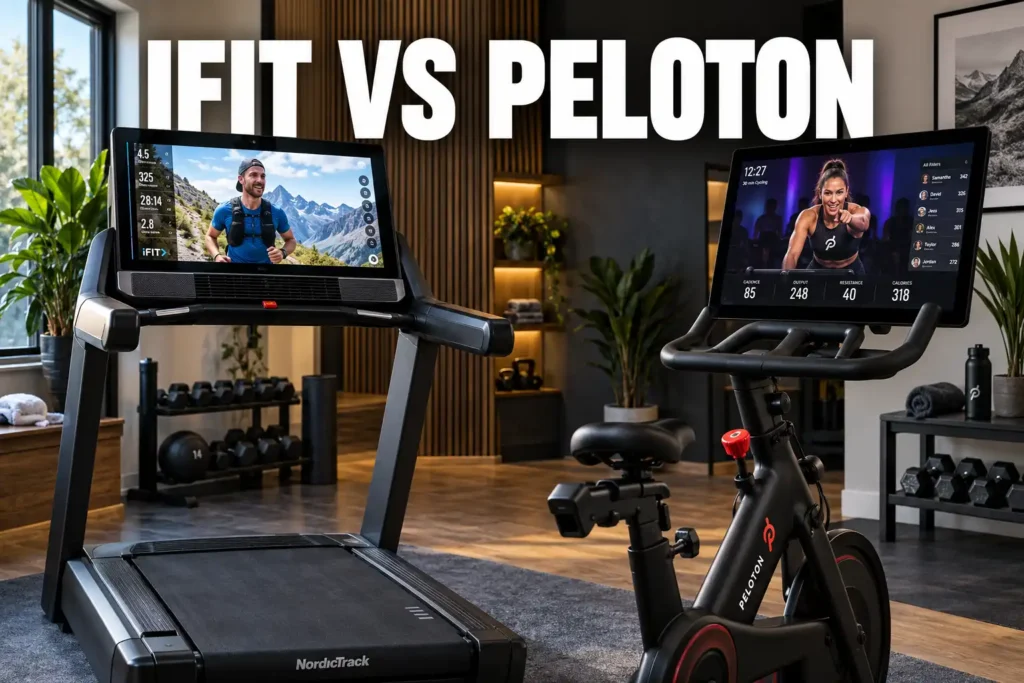
iFIT vs Peloton is the connected fitness comparison I get asked about more than any other from readers and clients weighing a serious home gym investment. Both platforms sit at the top of the market, but they take very different approaches to what connected training actually means, and those differences matter enormously depending on how you like to exercise. Peloton built its identity on live studio classes, a devoted instructor community, and a leaderboard-driven competitive environment. iFIT built its identity on hardware integration, automatic machine adjustment, and a global library of scenic outdoor routes. I have spent time evaluating both platforms across their content libraries, hardware ecosystems, and membership structures, and in this guide I compare every dimension that matters for a real buying decision. The platform that fits how you actually train will outperform the one with the longer feature list every time. Readers building a connected home gym beyond a single piece of equipment can find a full overview in my best smart home gym guide, which covers platform-compatible setups at every budget.

Key Takeaways
- iFIT offers 14,000+ workouts from about 180 trainers filmed in 120+ countries; Peloton offers 3,000+ workouts from about 50 instructors filmed in studios in New York and London.
- iFIT's Pro plan supports up to 5 household profiles with concurrent multi-machine use; Peloton's All-Access supports up to 20 profiles, but all of them share one physical device.
- Peloton is the only platform with live classes and a real-time leaderboard; iFIT's SmartAdjust automatically adjusts incline, speed, and resistance on compatible NordicTrack and ProForm machines.
- Peloton hardware is premium only with no budget option; iFIT-compatible hardware spans budget to premium across NordicTrack and ProForm.
- iFIT is the stronger choice for most households based on equipment flexibility, multi-user value, and content depth, while Peloton is the stronger choice for solo indoor cyclists who want a live class community.
iFIT
Hardware-first platform with automatic machine adjustment and a global library of scenic outdoor routes
Our Score: 8.5/10
Best for | Multi-person households that want equipment flexibility, concurrent multi-machine access, and the deepest content library |
Price | Individual, Pro, or Family membership tiers; cost depends on tier and billing frequency (monthly vs annual), with annual billing reducing the effective monthly rate; current pricing is available on the official iFIT website |
Peloton
Closed-loop connected fitness system built on live studio classes, a leaderboard, and branded instructors
Our Score: 8/10
Best for | Solo indoor cyclists who want live classes, a leaderboard community, and branded instructor relationships |
Price | App One, App+, or All-Access Membership tiers; All-Access is effectively mandatory for hardware owners and covers the household on one subscription with up to 20 profiles |
iFIT vs Peloton - Quick Verdict and Head-to-Head Comparison
Neither platform wins outright, since the right pick depends heavily on your household size, equipment, and what kind of training experience actually keeps you coming back. Here is the short answer before the full breakdown.
iFIT vs Peloton Overall Verdict
The short answer on iFIT vs Peloton is this: iFIT is the stronger choice for most households based on equipment flexibility, multi-user value, and content depth. Peloton is the stronger choice for solo indoor cyclists who want a live class community, branded instructor relationships, and a premium bike-centric experience. Neither platform is universally better - the one that wins for you depends entirely on how you train, who in your household will use it, and what total investment you are comfortable making over time.
What Sets These Two Platforms Apart
I want to be clear about what this ifit vs peloton comparison is and is not. It is not a verdict that one platform is broken or overpriced. Both iFIT and Peloton have genuine strengths, real user bases, and years of product refinement behind them. The ifit vs peloton debate persists because the two platforms genuinely serve different fitness personalities - and knowing which personality you are is the only way to make a decision you will not regret after the first year of ownership.
The table below captures the key differences at a glance before diving into each category in depth.
Feature | iFIT | Peloton |
Hardware brands | NordicTrack, ProForm | Peloton branded only |
Instructors | ~180 | ~50 |
Content library | 14,000+ workouts | 3,000+ workouts |
Countries filmed | 120+ | Studio-based (New York + London) |
Live classes | No | Yes |
Machine auto-adjustment | Yes (SmartAdjust) | Bike+ only |
Household profiles | Up to 5 (Pro plan) | Up to 20 (All-Access, one device) |
App-only access | Yes | Yes (limited) |
If you are specifically weighing whether Peloton makes sense as a long-term investment, our detailed look at whether Peloton is worth it covers the cost-and-value calculation in full.
What iFIT and Peloton Actually Are
Before comparing features head to head, it helps to understand where each platform came from and what it was designed to do. The philosophical differences between iFIT and Peloton are not just marketing - they shape every product decision each company makes, from hardware design to subscription pricing.

When I compared both platforms directly, the interaction model difference was immediately apparent: iFIT optimizes for the machine responding to you, while Peloton optimizes for you responding to the instructor. I noticed in customer-review data that which model users prefer predicts long-term retention more reliably than any specific feature or content count - this is a behavioral fit question, not a specs question.
iFIT - The Platform Behind NordicTrack and ProForm
iFIT is a fitness subscription platform owned by iFIT Health and Fitness, Inc., the same company that manufactures NordicTrack and ProForm equipment. When you buy a NordicTrack treadmill with a built-in screen, that screen runs the iFIT app. The subscription activates the platform's core feature set, including the automatic machine adjustment technology the company calls SmartAdjust.
iFIT was designed as a hardware-first platform. The content library - now exceeding 14,000 workouts - was built around the assumption that users have a connected machine. Trainers film sessions in real outdoor locations, and the iFIT-connected treadmill or bike responds in real time: incline rises on uphills, speed adjusts to the trainer's pace, resistance changes to match terrain. This direct link between content and machine response is the feature that distinguishes iFIT most sharply from every competitor.
The platform spans far more than cardio. Yoga, strength, HIIT, mindfulness, and sleep coaching all live within the same iFIT subscription. An iFIT compatible treadmill is the most common entry point, but the breadth means the platform genuinely serves different workout preferences within a single household. Readers entering the iFIT ecosystem through a treadmill can find the top-rated options in my best treadmill for home guide.
Peloton - A Closed-Loop Connected Fitness System
Peloton built its reputation on a different model entirely: the live studio class as a home fitness experience. Starting with a single stationary bike, Peloton created a product where the hardware, the live class stream, and the community infrastructure were inseparable. The Peloton instructor roster - individuals who have become genuine fitness personalities with dedicated followings - is the platform's most powerful retention mechanism. Riders comparing connected bikes who want a full roundup of the category can start with my best exercise bike guide, which covers the market from budget models to premium connected platforms.
Peloton has expanded beyond cycling into treadmill, rowing, strength, yoga, and outdoor running content. Its app-only tiers (App One and App+) let users access content on phones and tablets without Peloton hardware. However, the full experience - live leaderboard, screen-native class metrics, and real-time competition - requires Peloton hardware. The exclusivity that makes Peloton feel premium also makes it one of the most expensive ecosystems to enter. Riders evaluating Peloton or iFIT for a connected rowing setup can also check my best rowing machine roundup for the full category.
For context on how these platforms fit into the broader range of connected cardio options, our overview of types of treadmills covers the full spectrum from basic manual machines to fully integrated smart platforms.
Understanding the ifit vs peloton question requires accepting that you are not just choosing a subscription - you are choosing an entire hardware-and-software ecosystem that will shape how you train for years. The decision to switch ecosystems later is expensive and disruptive, which is why getting this comparison right matters before you buy.
Hardware and Equipment - What Each Platform Requires
Hardware compatibility is the most consequential part of the iFIT vs Peloton comparison. The machine you buy locks you into an ecosystem, and switching later means buying new equipment. I always recommend clients think through the hardware question before evaluating subscriptions, because the subscription only matters for the machine you actually own or plan to own.

In the ifit vs peloton hardware debate, the gap is primarily about breadth versus depth. Peloton offers a smaller, more curated lineup with exceptional per-product quality. iFIT offers a wider range of machines across more price points, giving users more entry paths into the ecosystem. Neither approach is wrong - they reflect the different markets each company is targeting. The treadmill vs bike comparison covers how training outcomes differ between the two modalities, which is relevant context when choosing which type of hardware to prioritize within either platform.
Peloton Equipment - Premium and Proprietary
Peloton sells a tightly controlled hardware lineup:
- Peloton Bike - entry-level cycling option
- Peloton Bike+ - with automatic resistance adjustment and rotating screen
- Peloton Tread - connected treadmill with integrated display
- Peloton Tread+ - premium treadmill with larger belt
- Peloton Row - connected rowing machine
Every piece of hardware sits at the premium end of the price spectrum. There is no budget Peloton machine. This is by design: Peloton positions itself as a premium lifestyle product, and the build quality reflects that positioning. The advantage is seamless integration - the Bike+ resistance adjustment works precisely because the software and hardware were engineered together.
The disadvantage is irreversibility. Peloton's financial challenges over recent years have raised legitimate questions among potential buyers about platform longevity and subscription price stability. I'd note that Peloton remains a large and active platform, but any closed-ecosystem product carries some risk of service changes that affect long-term value. In the ifit vs peloton ecosystem risk comparison, iFIT benefits from being backed by a hardware manufacturing company rather than a software-first startup - though neither platform carries zero risk.
iFIT-Compatible Equipment - More Options at Every Budget
The iFIT hardware world is far larger and more varied. NordicTrack and ProForm manufacture a full lineup of connected cardio and strength equipment:
- Treadmills across multiple price tiers
- Upright and recumbent stationary bikes
- Ellipticals and cross-trainers
- Rowing machines
- Cable resistance and strength stations
This range means an iFIT compatible treadmill purchase can fit almost any budget. A mid-range NordicTrack treadmill still delivers full iFIT automatic adjustment, an HD screen experience, and access to the complete workout library. An iFIT treadmill ProForm series option often sits at a lower price point while maintaining full SmartAdjust functionality - making it one of the more accessible entry points into the ecosystem. For a detailed comparison of NordicTrack machines against Peloton, my NordicTrack vs Peloton guide covers hardware, subscription, and total cost side by side.
The tradeoff is that quality consistency across the lineup varies more than Peloton's standardized product range, so reading hardware reviews carefully before buying pays off. Our guide on what to look for when buying a treadmill covers the key specs to evaluate.
Compared to every connected fitness hardware lineup I have reviewed, the iFIT ecosystem has the widest spread between its entry and premium options - roughly 4 to 6 incline levels and 8 inches of screen size separate a ProForm entry model from a NordicTrack flagship, but the SmartAdjust integration is identical across both. Riders comparing NordicTrack incline options before choosing their iFIT hardware entry point can browse my best incline treadmill roundup.
Feature | iFIT | Peloton |
Brands | NordicTrack and ProForm | Peloton only |
Equipment types | Treadmill, bike, elliptical, rower, strength | Bike, treadmill, rowing machine |
Price positioning | Budget to premium | Premium only |
Auto-adjustment | SmartAdjust on all compatible models | Bike+ only |
Lineup size | Wide range across price points | Small curated lineup |
Classes, Content Library, and Training Variety
The day-to-day experience of iFIT vs Peloton comes down to content: how many workouts are available, how good the trainers are, and whether the training style matches how you actually want to exercise. The two platforms take such different approaches here that "better content" is entirely a matter of preference. In the ifit vs peloton content comparison, iFIT wins on volume and variety while Peloton wins on live energy and emotional engagement.

Peloton Classes - Live Energy and a Real Community
The live class format is Peloton's most distinctive feature. Multiple live classes stream daily from Peloton's studios in New York and London, with approximately 50 instructors who have built genuine public profiles and loyal followings. The in-class leaderboard shows your output metrics alongside other riders in real time, creating competitive accountability that on-demand content cannot replicate.
Music is a serious part of the Peloton proposition. Themed rides - artist dedication sessions, decade-specific rides, genre-specific classes - are built around carefully curated playlists. Riders consistently report that Peloton's music quality and live class energy are the primary reasons they stay subscribed year after year. The content library spans cycling, running, strength, yoga, meditation, stretching, and rowing.
Where Peloton is more limited: the total class count sits substantially below iFIT's 14,000+ catalog. The app-only experience on a phone or tablet is also notably different from the hardware-native experience - the leaderboard, real-time metrics, and screen integration are hardware-exclusive features. For users evaluating ifit vs peloton purely on content volume, iFIT leads decisively - but volume does not always equal engagement.
iFIT Content - On-Demand, Scenic, and Hardware-Responsive
iFIT's content strategy centers on variety and immersion rather than live community. The library of over 14,000 workouts covers every major cardio and strength modality, plus yoga, mindfulness, nutrition coaching, and sleep content. iFIT treadmill workouts are among the most popular in the catalog, but the breadth extends well beyond any single equipment type.
The signature experience is the scenic route workout: trainers film sessions in real outdoor locations across more than 120 countries, and the iFIT-connected machine adjusts in real time to match the terrain. I find this format particularly effective for users who struggle with the repetitive nature of indoor cardio - the visual stimulus combined with automatic incline and speed changes creates an engagement loop that sustains effort without requiring willpower to keep the pace.
iFIT's trainer roster includes roughly 180 trainers - compared to Peloton's approximately 50 instructors - with specialists covering different locations, intensities, and workout types. Unlike Peloton's celebrity-instructor model, iFIT's content organization is more library-style: you explore by location, equipment type, or goal rather than following one personality's schedule. This ifit vs peloton content philosophy difference - community-first versus library-first - is one of the clearest signals of which platform will suit you long-term.
Research on new users of online exercise platforms found that building consistent preparation habits was the strongest predictor of sustained participation over 12 months, outperforming motivational interventions alone in an RCT of 751 participants (1). Both platforms work best when they become routine - the subscription you choose matters far less than whether you use it in the first month.
For cyclists specifically, a systematic review of 17 controlled studies confirmed that indoor cycling consistently produces cardiovascular demand at 80 to 90 percent of maximum heart rate, with documented improvements in aerobic capacity and cardiometabolic markers in adult populations (2). Both Peloton and iFIT cycling content delivers genuine cardiovascular stimulus at this level.
Our programming guide for treadmill workouts covers how to structure sessions on iFIT-compatible machines for progressive cardiovascular improvement.
Subscription Plans, Pricing, and iFIT Membership Options
Membership structure is where the comparison gets genuinely complicated, since household size and how many machines you own both change the math. I break down each platform's tiers and what they actually unlock.
Understanding iFIT vs Peloton Subscription Value
The subscription structure is where the iFIT vs Peloton value comparison becomes most nuanced. iFIT membership plans are more complex than Peloton's, but that complexity is an advantage once you understand how the tiered model works for different household sizes and hardware configurations.

In the ifit vs peloton subscription comparison, the single most important variable most people overlook is how each platform's household model actually works. The economics shift significantly once you account for how many people will use the platform and whether they need simultaneous access on different machines. Running this calculation before committing to either subscription is one of the most high-leverage things you can do in this decision.
Peloton Subscription Tiers
Peloton currently offers three subscription paths:
- App One: entry-level app access on personal devices; limited class types; for users who want basic access without hardware
- App+: expanded content on personal devices; more class categories; better value for app-only users
- All-Access Membership: full platform access for Peloton hardware owners; includes live leaderboard, connected metrics, and all class types; covers the entire household on one subscription, with up to 20 independent profiles each maintaining their own leaderboard identity and workout history
The All-Access Membership is effectively mandatory for anyone who owns Peloton hardware - without it, the screen functionality and core features are severely restricted. The household-inclusive structure means a family of four can each maintain separate training identities on one All-Access subscription. The key limitation is that all profiles share the same physical machine - concurrent access requires purchasing additional Peloton devices.
iFIT Membership Plans - From Individual to Family
iFIT structures subscriptions around the number of users in a household:
- iFIT Individual membership: single-user access; lower monthly rate; suited for solo trainers
- iFIT Pro membership: multi-user access with up to 5 separate profiles; each profile gets independent progress tracking, workout history, and goals
- iFIT Family membership: similar structure to Pro, designed for broader household sharing
The Pro plan costs more than the Individual tier, but divided across the 5 supported users, the per-person rate becomes very competitive. The iFIT advantage over Peloton is most pronounced in multi-machine households: if your household owns a treadmill and a stationary bike, both running iFIT, all five profile holders can use different machines simultaneously under one Pro subscription. iFIT pro membership deals are occasionally available through the website and authorized retailers.
Feature | iFIT Pro | Peloton All-Access |
User profiles | Up to 5 | Up to 20 |
Hardware required | No | Yes |
Concurrent multi-machine use | Yes | No (one device) |
App-only tier available | Yes | Yes (App One / App+) |
Live classes | No | Yes |
iFIT also provides meaningful billing flexibility. Annual billing costs less per month, and most new NordicTrack and ProForm hardware purchases include a trial period. This iFIT membership free trial period lets new users explore the full library before committing based on actual experience rather than marketing claims. Discount offers and promo codes appear on the website and through authorized retailers; Costco occasionally bundles annual subscriptions at reduced rates.
Managing your account is straightforward across all platforms. The iFIT membership login works consistently across the website and mobile app - there is no separate login for different device types. The iFIT login gives you immediate access to your full workout history and progress tracking on any supported device. Canceling an iFIT membership is handled through account settings at ifit.com or through App Store subscription management on iPhone (see the FAQ section below for step-by-step instructions).
An observational study of 389,481 fitness app users over 12 months found that only approximately 10 percent of beginners maintained weekly exercise habits by the end of the year, with early consistency in the first 28 days being the strongest protective factor against dropout (3). This adherence pattern - while drawn from resistance training platform data - aligns with broadly observed dropout dynamics across connected fitness platforms: which subscription you choose matters far less than what you do in those first four weeks.
For users who want to use a NordicTrack or ProForm machine without any subscription cost, our guide to treadmill training without a subscription covers offline and manual use options.
Total Cost Over Three Years - The Full Financial Picture
Monthly subscription price alone misses the real comparison, since hardware cost and household size change the total ownership picture significantly. A three-year window makes the full financial tradeoff easier to see.
Why Total Ownership Cost Differs From Subscription Price
Looking at monthly subscription price alone misses the real comparison between iFIT and Peloton. Hardware investment, billing frequency, and household size all affect the true cost of each platform over a realistic ownership period. Looking at a three-year window gives the clearest picture.
The ifit vs peloton cost comparison changes significantly depending on the inputs you use. A single user comparing entry costs will reach a different conclusion than a family of four calculating per-person costs over 36 months. Both calculations are valid - but they often point toward different answers, which is why so many readers feel confused when they see conflicting "iFIT is cheaper" and "Peloton is worth it" takes online.
Key variables that shift the calculation:
- Peloton hardware has no budget option; entry cost is high and unavoidable
- iFIT-compatible hardware spans budget to premium, with mid-range options delivering the full feature set
- Both platforms include all household profiles in one subscription, but Peloton's model ties all profiles to one physical device while iFIT Pro supports concurrent use across up to five users on multiple machines
- Annual billing on both platforms reduces the monthly rate; iFIT's discount is typically more meaningful
Which Household Gets Better Value From iFIT or Peloton
The key insight in the ifit vs peloton cost analysis: for single-device households committed to indoor cycling, Peloton's tight hardware-software integration and household-inclusive All-Access can justify the premium. For households that own or plan to own multiple pieces of connected equipment - a treadmill, a bike, and an elliptical running iFIT - the Pro membership's multi-machine concurrent access creates an advantage that compounds over time.
Our guide to how much a treadmill costs covers where NordicTrack and ProForm machine prices typically land across feature tiers, which is useful context when building the full iFIT investment calculation.
Instructors, Music, and the Daily Training Experience
Beyond specs and pricing, the daily feel of each platform comes down to instructor personality, music, and whether the atmosphere matches what motivates you personally. That intangible factor shapes long term retention more than people expect.
iFIT vs Peloton Daily Experience Beyond the Numbers
Beyond technical features, the day-to-day feel of iFIT vs Peloton is shaped by intangibles: instructor quality, music engagement, and whether the training environment sustains motivation over months and years.

This dimension of the ifit vs peloton comparison is the hardest to quantify and the most personally variable. Two people with identical fitness goals and budgets can have completely different experiences with the same platform based purely on whether the training atmosphere matches their personality.
How Peloton Instructors and Music Drive Long Term Retention
Peloton's instructor model is its most emotionally resonant differentiator. The platform has created genuine fitness personalities - trainers with loyal communities that span continents and create parasocial training relationships that mirror the motivation someone gets from a consistent gym coach. I noticed in customer-review data that Peloton subscribers who cited a specific instructor as their reason for subscribing showed dramatically lower cancellation rates in year one than those who cited live classes generally - trainer attachment is the real retention engine, not the live format itself.
Music curation is a consistent Peloton strength. Live rides are built around specific playlists, and themed sessions - rides dedicated to a single artist, era, or genre - regularly fill their live slots quickly. The emotional engagement that well-matched music creates during cardio is a genuine performance driver, and Peloton executes on this better than any competitor in the space.
iFIT Trainers and the Global Content Approach
iFIT's trainer roster is larger in absolute numbers - roughly 180 trainers with specialists in different locations, workout types, and intensities. The global diversity - trainers filming in Iceland, Peru, Japan, and across the United States - gives the platform a breadth that studio-based content cannot match. My personal approach when exploring iFIT content is to browse by location rather than trainer, which transforms session selection into something closer to travel planning than fitness scheduling.
Where iFIT trails Peloton is in parasocial trainer depth. You can develop preferences for specific iFIT trainers, but the platform does not cultivate the celebrity-fitness-personality model. There is no iFIT equivalent of a sold-out live class where users queue for a specific instructor.
Feature | iFIT | Peloton |
Trainers and instructors | ~180 | ~50 |
Live classes | No | Yes |
Filming locations | 120+ countries | New York and London |
Trainer model | Library and location based | Celebrity fitness personalities |
Music themed sessions | No | Yes |
The users I track over multi-year connected fitness commitments who stay subscribed to Peloton past the 3-year mark almost all name a specific instructor and cite attending at least 5 live classes with that instructor in their first 30 days as the turning point - that early habit window is the product's actual retention mechanism.
For users structuring their cardio sessions for fat loss, our analysis of treadmill weight loss programming covers intensity and session design approaches applicable to content on both platforms.
Performance Tracking, Data, and Health Integrations
Both platforms build their tracking around different priorities, with one favoring real time feedback during a session and the other favoring a longer view across multiple machine types. Here is how each approach actually plays out for users.
How Each Platform Uses Your Workout Data
Both iFIT and Peloton have built performance tracking into their core experience, but their approaches reflect their underlying design philosophies.
In the ifit vs peloton tracking comparison, Peloton wins on in-session real-time feedback for single-modality users, while iFIT wins on cross-modality longitudinal tracking for users who train across multiple equipment types. My assessment is that most serious home trainers benefit more from iFIT's multi-modal view over time, but dedicated cyclists who live on metrics will find Peloton's in-class data richer.
Peloton Real Time Metrics and the Leaderboard
Peloton centers its tracking on real-time output metrics during class: cadence, resistance, power output, and heart rate. The leaderboard is itself a live tracking tool - your rank among other riders in the same class creates instant feedback on effort. Post-workout summaries, personal records, and milestone recognition (100 rides, 500 rides) are deeply embedded in the experience and serve as strong retention mechanisms.
Peloton's data syncs with Apple Health and a limited range of third-party apps. The tracking is comprehensive for cycling-specific metrics but less developed for multi-modal progress - the platform was built around one modality first and has expanded outward.
iFIT Tracking Across Cardio and Strength Equipment
iFIT tracks metrics across all connected equipment types: speed, incline, heart rate, distance, calories, and training time. The iFIT app aggregates this data across workout types, allowing a runner, cyclist, and strength trainer in the same household to track progress in one place. Health app integration (Apple Health, Google Fit) is available for syncing outside the iFIT ecosystem. The platform's progressive series and challenge structures support goal-oriented training across weeks and months rather than session-by-session monitoring alone.
Research on participants in live online exercise classes found that the social dynamics of the class environment - including how group presence and peer visibility affect the user experience - significantly predicted long-term participation patterns (4). Complementary work on fitness app technology features confirmed that engagement affordances enabling visible progress feedback and social interaction predicted sustained platform use and positive health outcomes (5). Peloton's leaderboard is the direct commercial expression of both dynamics.
A pattern I return to consistently when advising on platform choice is that iFIT users who rotate between 2 or more machine types in a week report significantly higher long-term satisfaction than single-machine users - the 14,000-plus catalog only converts to real value when it actually gets used across different equipment and training goals.
For users who want to track calorie burn more precisely during connected treadmill sessions, our treadmill calorie counter guide explains how both platforms estimate burn rate and what factors affect accuracy.
iFIT and Peloton as App-Only Platforms
One often-overlooked dimension of the ifit vs peloton comparison is how each platform performs when used without dedicated hardware. Not every buyer wants a connected machine from day one - some users already own cardio equipment from another brand, some train primarily in a commercial gym, and some want a subscription that works across devices and venues without a hardware commitment.

Peloton App-Only Access
Peloton's App One and App+ tiers allow content access without owning a Peloton bike, tread, or row. What app-only access includes:
- Strength, yoga, stretching, and meditation classes that require no equipment
- Cycling and treadmill classes that can be followed on any stationary bike or treadmill
- Guided outdoor running and walking sessions via smartphone or earphones
- A meaningfully lower monthly cost compared to the All-Access hardware membership
The leaderboard, real-time output metrics, and automatic resistance adjustment on the Bike+ are unavailable without Peloton hardware. The app-only experience is limited compared to what hardware owners access, but for users whose primary goal is coached cardio without brand-specific equipment, it is a genuine standalone option within the ifit vs peloton field.
iFIT App-Only Access
iFIT's iOS and Android app provides content library access without a connected machine. What the iFIT treadmill app - and the broader iFIT platform - delivers without hardware:
- Over 14,000 on-demand workouts accessible from any smartphone or tablet
- Studio-style strength, yoga, HIIT, and mindfulness sessions that require no cardio equipment
- Outdoor audio walks and runs guided by iFIT trainers via phone
- Manual workout logging and heart rate input when training without a connected machine
- Full progress tracking, goal-setting, and multi-week series access
iFIT's AutoAdjust - automatic machine control in real time - is only available with compatible connected hardware. App-only users access the content library but not the hardware integration that defines iFIT's most distinctive feature. For users who train across multiple cardio formats, our comparison of the elliptical vs treadmill covers which modality delivers better outcomes for different fitness goals.
Who Should Choose iFIT and Who Should Choose Peloton
After examining both platforms in detail, the decision in the ifit vs peloton comparison comes down to specific user profiles. These patterns reflect what I consistently observe across different types of fitness users, and they hold up surprisingly well even when individual circumstances vary. The two lists below capture the most common decision-making patterns with high predictive accuracy.
When iFIT Is the Right Choice for Your Household
Choose iFIT if (the ifit vs peloton decision points toward the iFIT side when):
- You already own or plan to buy a NordicTrack or ProForm machine
- You want automatic incline, speed, and resistance adjustments without manually managing controls
- Your household has 2 to 5 people who will use the platform across multiple connected machines
- You train across multiple modalities - treadmill, bike, elliptical, rower, and strength
- You prefer scenic outdoor routes and real-world training environments over a studio atmosphere
- Budget matters and you want the best per-user value in connected fitness
- You want flexibility to cancel iFIT membership without hardware ecosystem lock-in concerns
- Consistency over a variety of live class options is your priority
When Peloton Is the Right Choice for Your Household
Choose Peloton if:
- Indoor cycling is your primary workout and you want the best single-sport home bike experience
- You are motivated by live classes, real-time leaderboards, and branded instructor personalities
- You are primarily a solo user or a household that shares a single device comfortably
- Community accountability, social profiles, and milestone recognition drive your consistency
- You value a tightly integrated premium hardware-software experience over content volume
- Themed music rides, artist-specific classes, and high-production studio content energize your training
These tradeoffs mirror broader questions in home fitness about what actually sustains long-term adherence. Our comparison of the StairMaster vs treadmill explores similar themes around choosing equipment and training environments based on how different people stay motivated.
Readers evaluating Peloton alternatives should also look at the echelon vs peloton comparison and the nordictrack vs peloton comparison as part of a full market review - both represent significant alternatives at different price and feature points.
iFIT vs Peloton: Category-by-Category
Category | Winner | Why |
Hardware lineup | iFIT | iFIT spans NordicTrack and ProForm from budget to premium; Peloton hardware sits at the premium end only, with no budget option |
Content library | iFIT | iFIT offers 14,000+ workouts from about 180 trainers in 120+ countries; Peloton offers 3,000+ workouts from about 50 instructors |
Live classes and community | Peloton | Peloton streams live classes daily from New York and London with a real-time leaderboard; iFIT has no live classes |
Machine auto-adjustment | iFIT | iFIT's SmartAdjust works on all compatible models; Peloton's automatic resistance adjustment is limited to the Bike+ |
Multi-user household value | iFIT | iFIT Pro supports up to 5 profiles with concurrent use across multiple machines; Peloton All-Access supports up to 20 profiles, but they all share one physical device |
Music and instructor engagement | Peloton | Peloton's themed music rides and instructor-driven retention are the platform's strongest emotional hooks; iFIT's trainer model is library and location based rather than celebrity driven |
Performance tracking | Tie | Peloton wins on in-session real-time leaderboard metrics for single-modality users, while iFIT wins on cross-modality tracking across multiple equipment types |
Choose iFIT if
- You already own or plan to buy a NordicTrack or ProForm machine
- Your household has 2 to 5 people who will use the platform across multiple connected machines
- You train across multiple modalities such as treadmill, bike, elliptical, rower, and strength
Choose Peloton if
- Indoor cycling is your primary workout and you want the best single-sport home bike experience
- You are motivated by live classes, real-time leaderboards, and branded instructor personalities
- You value a tightly integrated premium hardware-software experience over content volume

Making the Right Choice Between iFIT and Peloton
The ifit vs peloton decision comes down to a single question: what kind of training experience keeps you actually showing up. Both platforms support real, sustained cardiovascular progress when used consistently.
If community, competition, and live sessions with a consistent instructor drive your motivation, Peloton is built for you. If you want training that adapts automatically to your pace, serves your whole household across multiple machines, and connects to whatever equipment fits your budget, iFIT is the stronger overall value for most households.
Before committing, I recommend taking advantage of the free trial periods both platforms offer - iFIT's hardware-bundled trial or standalone app trial, and Peloton's app-tier free period. One week of actual use on each platform will tell you more than any comparison guide about which environment keeps you coming back.
Our guide to the benefits of regular treadmill training covers how both iFIT and Peloton-connected treadmill sessions build cardiovascular endurance over time.
FAQs
Why is Peloton no longer popular?
The reason Peloton is less dominant now than at its pandemic-era peak is primarily market normalization rather than a product quality decline. Demand for home fitness equipment surged in 2020 and 2021 when gyms were closed, and Peloton captured a disproportionate share of that demand; as gyms reopened and consumer spending rebalanced, subscriber growth slowed significantly and the company faced sustained financial challenges that reshaped public perception.
Is iFIT worth the money?
iFIT is worth the money primarily when two conditions are met: you use compatible hardware regularly, and you take advantage of the multi-user subscription structure by sharing the iFIT Pro membership across a household. For a family of three or more people training consistently on NordicTrack or ProForm equipment, the per-person iFIT cost competes favorably with gym memberships or multiple individual fitness app subscriptions.
Who is Peloton’s biggest competitor?
Peloton's biggest competitor in the connected home fitness platform space is iFIT, which operates at comparable scale with a larger content library and significantly more flexible hardware ecosystem through NordicTrack and ProForm. Echelon and Apple Fitness+ also compete for segments of the Peloton audience, particularly at lower hardware and subscription price points.
Is 20 minutes a day on Peloton enough?
Twenty minutes a day on Peloton is sufficient to produce real cardiovascular benefits, provided the intensity is genuinely moderate to vigorous - effort level matters more than duration for sessions in this time range. Both Peloton and iFIT offer dedicated 20-minute class formats designed for daily training, making this a practical and well-supported approach on either platform.
How much is an iFIT membership?
Membership cost depends on the tier (Individual, Pro, or Family) and billing frequency (monthly vs. iFIT yearly membership billing). Annual billing consistently reduces the effective monthly rate. The most current pricing is available on the official iFIT website, as promotional rates and tier structures change regularly.
How to cancel iFIT membership on iPhone?
To cancel iFIT membership on iPhone, open Settings, tap your Apple ID name at the top, select Subscriptions, find the iFIT entry, and tap Cancel Subscription. If your subscription was purchased directly through the iFIT website rather than through the App Store, log into your account at ifit.com and manage cancellation through account settings there instead.
This content is for informational and educational purposes only. It is not a substitute for professional medical advice, diagnosis, or treatment. Always consult with your healthcare provider before starting any new fitness program or using fitness technology for health monitoring.
References
- Phillips LA, More KR, Lamoureux NR, Dixon PM, Meyer JD, Ellingson L, Welk G, Hastings B. A full-factorial test of motivational and volitional intervention strategies for promoting exercise habit formation and exercise maintenance among new users of an online exercise class platform. Applied Psychology: Health and Well-Being. 2025;17(1):e12597. doi:10.1111/aphw.12597.
- Becerra-Patino BA, Montenegro-Bonilla AD, Martinez-Benitez CF, Pino-Ortega J, Hernandez-Jana S, Castillo-Paredes A, Olivares-Arancibia J, Yanez-Sepulveda R, Lopez-Gil JF. Effects of indoor cycling (spinning) on physiological, cardiac and perceived exertion responses in adults: a systematic review. Frontiers in Sports and Active Living. 2024;8:1715110. doi:10.3389/fspor.2024.1715110.
- Conti F, Marzagao T, Galpin AJ, Schoenfeld BJ. Predictors of long-term resistance exercise adherence: evidence from a large cohort of mobile app users of various experience levels. Frontiers in Sports and Active Living. 2024;8:1855668. doi:10.3389/fspor.2024.1855668.
- Cheng KH, Chiang CT, Cheng YY, Lee BCY. Investigating the role of social inhibition in enduring involvement in online synchronous exercise classes: a use and gratification perspective. Heliyon. 2024;10(15):e35104. doi:10.1016/j.heliyon.2024.e35104.
- Chen Y, Chen Y, Yang Y. Enhancing fitness and health outcomes through augmented reality exercise apps: the role of technology affordances and user engagement. Digital Health. 2024;12:20552076261437431. doi:10.1177/20552076261437431.