
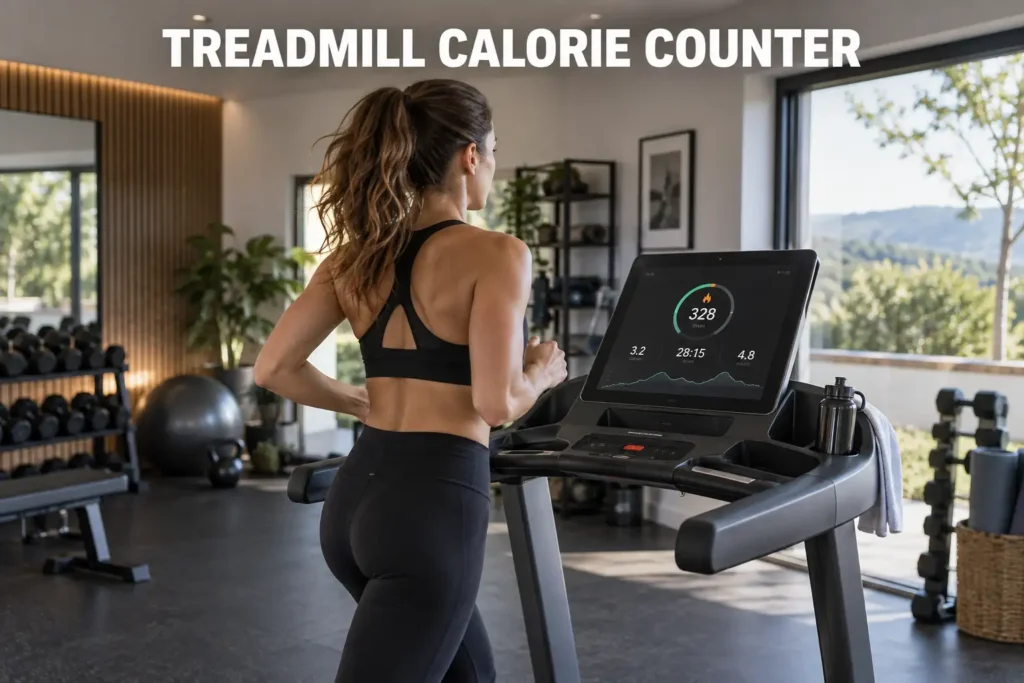
The treadmill calorie counter gives you a number after every session, but that number is almost always wrong. Research confirms that actual calorie burn differs substantially from treadmill display figures - one independent study measuring actual expenditure across seven cardio machines found treadmills generate the highest real calorie burn of any machine tested, yet display figures consistently diverge from measured output.[1] Reported overestimation margins in consumer testing typically range from 13% to 40% depending on model and inputs. Most people never question it. If you are using those numbers to plan your diet or track progress toward a goal, you may be working with badly skewed data.
This guide explains how the treadmill calorie counter works, what makes it inaccurate, how to use a treadmill calorie calculator for more realistic estimates, and how to calibrate your treadmill and Apple Watch to get closer to your true burn.
Medical Disclaimer: This content is for informational and educational purposes only. It is not a substitute for professional medical advice, diagnosis, or treatment.

Treadmill Calorie Counter - Why the Numbers Are Usually Wrong
The treadmill calorie counter does not measure how many calories you actually burn. It estimates calorie expenditure using a built-in formula based on your speed, your time on the machine, and sometimes your body weight if you entered it manually before the workout.
The core calculation relies on METs (metabolic equivalents) - a standardized measure of exercise intensity. The problem is that this formula is blunt: it assumes a generic body type, a consistent running economy, and full effort throughout. Real humans vary enormously on all three fronts.
How Much Do Treadmill Calorie Counters Overestimate?
Treadmill calorie counters consistently overestimate burn, and the error is large enough to affect dietary decisions. This section breaks down the documented range and the individual factors that widen or narrow it.
The Documented Overestimation Range
The inaccuracy range is well-documented. Reported overestimation margins typically run from 13% to 40%, with some machines exceeding that range depending on how much personal data was entered before the session.[1] In real-world gym use, the error tends to run toward the higher end. Many users skip the weight entry step entirely, the machine applies a default assumption (often around 155 pounds), and anyone significantly above or below that average sees compounded error in both directions.
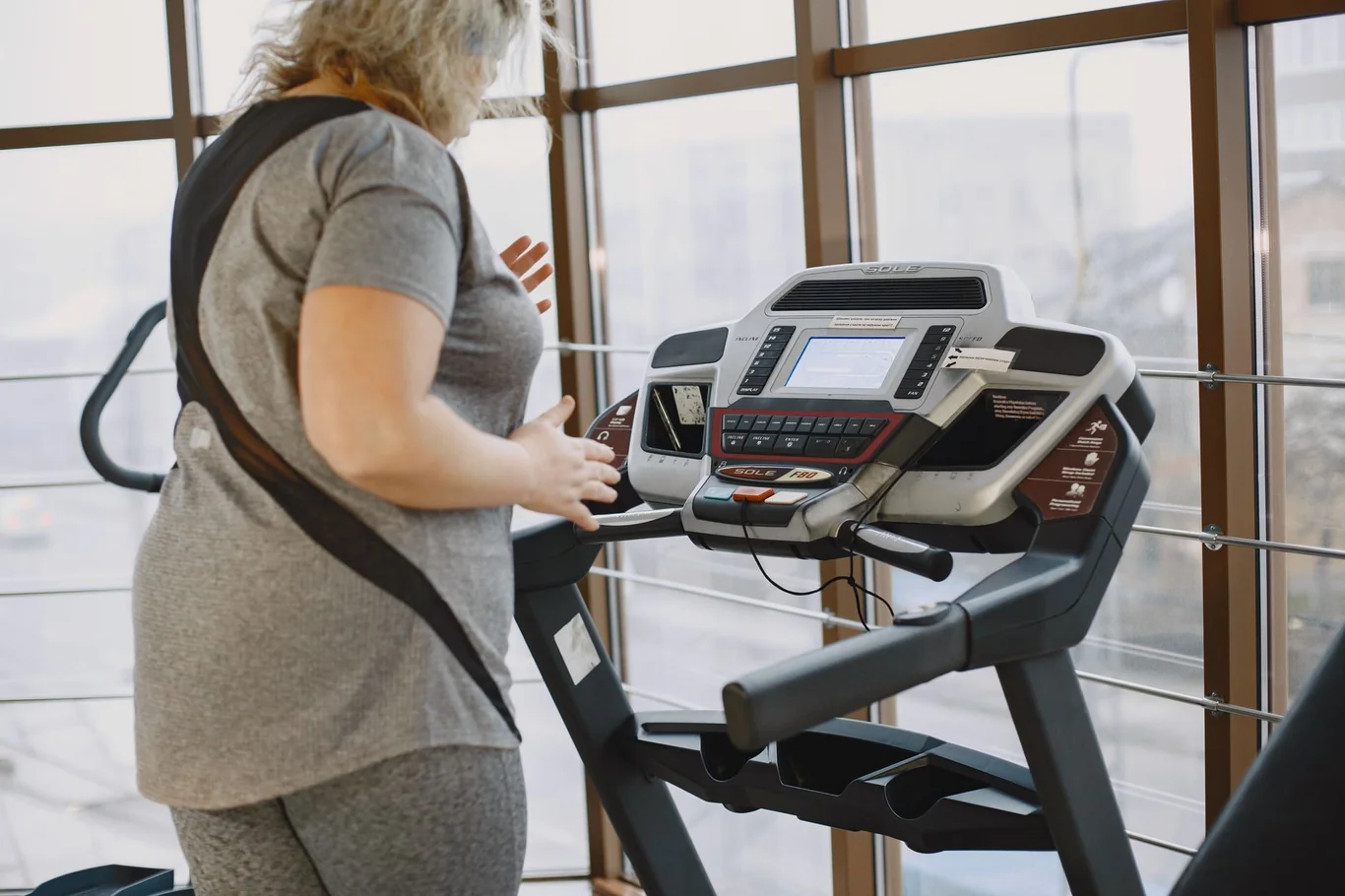
The treadmill calorie counter is especially unreliable for users who hold the handrails. Gripping the side rails reduces actual mechanical effort but does nothing to reduce the displayed calorie number - the machine still records full credit for the displayed speed. If your goal involves a calorie deficit, this matters directly: eating back calories shown on the console that you never actually burned can erase an entire session's deficit without you realizing it. In my view, the most underestimated factor is running economy - users who train consistently often show lower actual calorie burn than the machine predicts because their stride efficiency has improved. For wearables that measure burn more reliably across activity types, our guide to the best calorie tracker covers devices that consistently outperform treadmill display accuracy.
Key Factors That Throw Off Treadmill Calorie Accuracy
The treadmill calorie counter cannot account for the variables that most strongly influence actual calorie burn:
- Body composition: Two people at the same body weight but different muscle-to-fat ratios burn different amounts; the machine only reads the total number
- Running economy: A more efficient stride burns fewer calories per mile; the console has no way to detect this
- Handrail use: Gripping the rails reduces actual physical work but the machine records full-speed effort
- Age and biological sex: These are either not entered or only partially factored into the machine's default formula
- Height: Affects stride length and per-step energy cost; most defaults assume a runner around 5 feet 9 inches
- Cardiovascular fitness: A well-trained runner's heart stays lower at the same pace, burning fewer actual calories than the formula predicts
In a 2024 study of post-stroke patients, adding individual demographic variables - BMI, age, and sex - to calorie estimation models reduced prediction error by 36% compared to heart rate alone.[2] The treadmill calorie counter captures almost none of those refinements. Treadmill calorie counters are not accurate enough to use as dietary guidance. The research says no - the error range is too wide for the number to be treated as a fixed fact. Treadmill distances are not always accurate either - a belt running slower than the display shows creates compounding error in both speed and calorie estimates, which is why calibration matters alongside formula limitations.
For context on how total calorie output compares across different cardio machines at the same session length, my stairmaster and treadmill calorie comparison shows how much the machine choice affects the numbers.
To see how your speed translates to a per-mile or per-kilometer pace alongside those calorie numbers, my treadmill speed to pace chart covers every speed from walking to sprint with both metric and imperial equivalents.
What Are METs on a Treadmill - and Why They Matter
METs stands for Metabolic Equivalents of Task. One MET equals the baseline oxygen consumption of a person at rest - roughly 3.5 milliliters of oxygen per kilogram of body weight per minute. An activity rated at 5 METs demands five times your resting metabolic rate.

The Calorie Formula Your Treadmill Uses
The calculation your treadmill uses silently looks like this:
Calories = MET value x body weight (kg) x duration (hours)
For example: a 9.8 MET activity (approximately running at 6 mph) for an 80-kilogram person lasting 30 minutes = 392 estimated calories. This formula is useful and scientifically grounded, but standard MET values were derived from population averages. Your individual MET at a given pace may differ by 10-20% depending on your fitness level, body mechanics, and aerobic conditioning. Understanding how to structure your treadmill workout around METs helps you target specific intensity zones rather than chasing a calorie number that may be off by a meaningful margin.
If you also track step count alongside calorie data, my breakdown of how many steps in a mile on a treadmill shows how distance, pace, and stride length interact.
Speed | MET | 70 kg / 30 min (kcal) | 90 kg / 30 min (kcal) |
3.0 mph | 3.5 | 122 | 157 |
3.5 mph | 4.3 | 150 | 193 |
4.0 mph | 5.0 | 175 | 225 |
5.0 mph | 6.0 | 210 | 270 |
6.0 mph | 9.8 | 343 | 441 |
7.0 mph | 8.3 | 290 | 374 |
Values are estimates at 0% incline. Add 30-50% for sessions at 5% grade.
Using MET Values to Sharpen Your Burn Estimate
The calories burned on treadmill workouts scale directly with body weight - a 90 kg person burns roughly 28-30% more than a 70 kg person at the same pace. I find it useful to reference the MET table when setting intensity targets, because aiming for a specific MET range is more consistent than chasing a calorie number the machine may significantly miscount. When you see METs displayed on the treadmill console, you can use the formula above with your actual body weight to produce a marginally more accurate estimate than the displayed calorie number, particularly if you did not enter your weight at the start of the session.
Treadmill Calorie Calculator - A More Accurate Way to Estimate Your Burn
A third-party treadmill calorie calculator applies the same underlying formula but lets you input your actual weight, height, age, and sometimes heart rate - producing estimates meaningfully more accurate than the console readout. Tools from Fitness Volt, Omni Calculator, and RunDida use ACSM (American College of Sports Medicine) formulas that return estimates within 5-10% of actual burn when all inputs are accurate, versus the 13-40% error range of the machine display. Using a treadmill calculator calorie estimate rather than relying on the console is especially useful if you did not enter your weight before the session or trained at variable inclines.
My guide on treadmill setup and usage covers how to enter weight correctly at session start and how to configure incline settings for accurate tracking.
What to Enter for the Most Accurate Calculator Result
Treadmill calorie calculator accuracy improves with each additional variable you provide - a calculator using only body weight and time may still be off by 15-20%, while one that also incorporates heart rate and incline narrows the error to 5-10%. In my experience, combining a standalone calculator with wearable heart rate data is the most accurate approach available outside of a metabolic lab. The best treadmill calorie calculator options use ACSM-derived MET formulas with incline adjustments. To calculate calories burned on a treadmill accurately using a standalone calculator, enter the following:
- Your actual body weight - not a rounded estimate
- Your age and biological sex
- Your average workout speed (not the peak speed for the session)
- Total duration of the session
- Your average incline percentage throughout
A treadmill calorie calculator height weight combination narrows the error margin significantly compared to weight-only or time-only inputs - stride length affects energy cost per step in ways the basic formula misses. This matters most for users who are significantly shorter or taller than average, since stride length directly affects how many steps - and therefore how much energy - a given distance requires. For the type of machine that best supports accurate incline-based training, our best incline treadmill guide covers models with reliable grade display and calibration support.
Treadmill Calorie Calculator With Incline - How Grade Changes the Numbers
Incline is one of the most undercounted variables in treadmill calorie output. The section below shows how each additional grade percentage changes your actual burn and where sensor accuracy falls short.
If you are weighing total calorie burn across cardio options, my treadmill vs bike comparison covers how each machine handles calorie tracking and overall burn rate.
How Incline Percentage Changes Your Calorie Burn
Incline is one of the biggest variables in calorie expenditure, and the treadmill calorie counter on most machines handles it inconsistently. A 2% incline increases calorie burn by approximately 10-15% over flat walking at the same speed. A 5% incline adds 30-50%.
Any treadmill calorie calculator incline model applies the ACSM running formula to add grade-based expenditure on top of the flat-surface MET value. Without entering your actual incline into the calculator, the output will undercount your true burn. Sensor-based devices show this clearly at higher grades - accelerometer accuracy falls to only ICC 0.504 at 6% incline, compared to ICC 0.877 on flat ground, with error rates climbing from 2.3% at 0% grade to nearly 21% at 6%.[3] A dedicated calculator handles incline more reliably than any built-in accelerometer.
Incline | MET | Calories / 30 min (70 kg) |
0% | 4.3 | 150 |
2% | 5.0 | 175 |
5% | 6.0 | 210 |
8% | 7.5 | 262 |
10% | 8.5 | 297 |
12% | 9.5 | 332 |
Values based on 3.5 mph walking speed, 70 kg body weight.
One underrated benefit of incline walking is what it does to your foot mechanics - our article on the benefits of walking backwards on a treadmill covers how directional variation on incline affects muscle activation and calorie demand in ways the standard counter never sees.
How to Calibrate a Treadmill for More Accurate Calorie Readings
When you calibrate treadmill speed, you correct mechanical errors that compound on top of the formula-based inaccuracies described above. Calibrating a treadmill takes about 10 minutes and can be done with a tape measure, a marker, and a stopwatch. A belt running 5% slower than the display shows means every calorie estimate is also undercounting by 5% before the formula error even enters. Regular treadmill maintenance should include a periodic speed calibration check, especially if the machine is more than two years old or has logged heavy use.
Signs Your Treadmill Needs Calibration
Signs your machine needs calibration before you count any calories burned on treadmill workouts:
- The belt feels slower than the speed displayed on the console
- Your wearable consistently reads more than 25% below the machine's calorie number
- The belt slips, hesitates, or makes an unusual noise at a steady speed setting
- The machine has not been serviced in over a year of regular use under moderate load
Step by Step Treadmill Calibration Process
Steps for treadmill calibration:
- Measure your belt's total length with a tape measure (one full loop around both rollers)
- Place a small piece of tape on the belt as a reference marker
- Set the speed to a consistent pace - 6 mph works well for this test
- Count exactly 15 belt revolutions while timing with a stopwatch
- Calculate actual speed: multiply belt length (in inches) by number of revolutions, divide by 12, then divide by elapsed time in minutes
- Compare the result to what the console displays
If the console reads 6.0 mph but your calculation returns 5.7 mph, the machine overreports speed - and therefore overreports calorie burn. Many NordicTrack, Sole, and Horizon models allow speed calibration adjustments through the console settings menu; check your owner's manual for model-specific steps. Note that calibrating a treadmill corrects mechanical errors but does not fix the underlying formula limitations in the calorie estimate. I'd recommend running this check every six months on a machine you use regularly - the 10-minute test is worth it for the consistency improvement in your data over time.
How to Calibrate Apple Watch for Treadmill Workouts
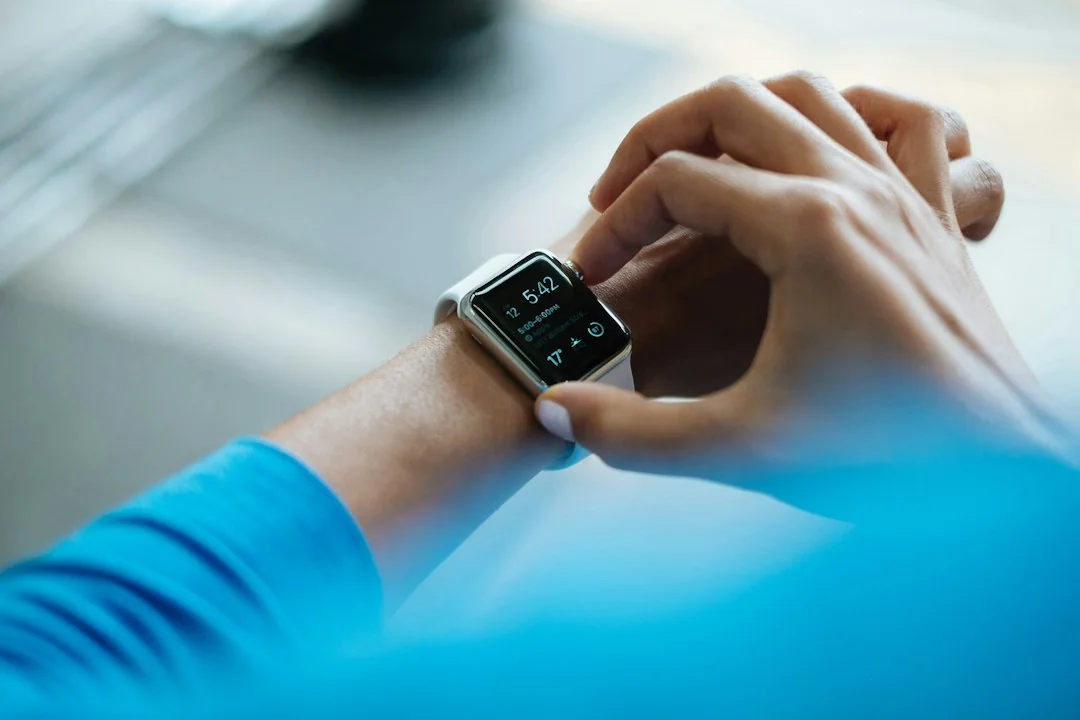
Apple Watch treadmill accuracy improves meaningfully with calibration, but requires a specific setup process to get there. The watch uses its accelerometer to estimate arm swing and step cadence during indoor sessions - less precise than the GPS it relies on outdoors. Understanding how your smartwatch calculates these metrics is useful context; our guide on what a smartwatch does covers the sensor stack behind calorie and distance estimates.
How to Set Up Apple Watch for Treadmill Calibration
Steps to calibrate Apple Watch for treadmill:
- Enable Motion Calibration and Distance in iPhone Settings, then Privacy and Security, then Location Services, then System Services
- Take the watch outdoors and complete a 20-minute walk or run at your normal pace in an area with a clear GPS signal
- If you train at different speeds - such as both walking and running - complete a separate 20-minute outdoor calibration for each speed zone
- For treadmill sessions, select Indoor Run or Indoor Walk in the Workout app (not Outdoor Run)
- Wear the watch on your wrist with a natural arm swing - never rest your arm on the handrails during the workout
- Aim for sessions of at least 20 minutes for the calibration data to apply effectively
Apple Watch Calorie Accuracy After Calibration
Research comparing Apple Watch against metabolic cart measurement found it achieves heart rate accuracy within 1.14-6.70% of laboratory reference - but calorie estimation error ranged from 14% to 210% depending on exercise intensity.[4] After calibration, accuracy improves noticeably. Studies show individual calibration reduces heart rate-based calorie error to under 5%, versus 3-20% error with generic group calibration methods.[5] For treadmills with NFC tap connectivity, touching your watch to the console pulls speed and distance data directly from the machine, which is the most accurate approach currently available.
How Many Calories Does 30 Minutes on a Treadmill Burn?
If you're asking how many calories do I burn on the treadmill in 30 minutes, the honest answer depends on your body weight, speed, incline, and aerobic fitness level. The table below gives realistic estimates to help you calculate calories burned on a treadmill for a 30-minute session across three common body weights - the lower speeds also reflect typical output from under-desk treadmills and walking pads:
Speed | 130 lbs (59 kg) | 155 lbs (70 kg) | 185 lbs (84 kg) |
3.0 mph | 85 | 107 | 122 |
3.5 mph | 105 | 125 | 150 |
4.0 mph | 125 | 147 | 175 |
5.0 mph | 175 | 210 | 250 |
6.0 mph | 289 | 343 | 412 |
Estimates based on MET values at 0% incline. Add 30-50% for sessions at 5% grade.
The 12/3/30 Workout Calorie Burn Explained
For the 12/3/30 workout - 12% incline, 3 mph, 30 minutes - research shows a burn rate of approximately 10.23 kcal per minute under controlled lab conditions.[6] That puts a full 30-minute session at roughly 280-310 calories for an average-weight adult. The 12/3/30 protocol also produces higher fat oxidation (40.6% fat utilization versus 33.1% during self-paced running at matched total calorie output), making it a solid option for body composition goals even though the burn rate is lower per minute than running. Your treadmill calorie counter on a machine running this protocol will often display a significantly higher number than reality.
I'd encourage you to treat the console number as a directional signal, not a dietary prescription. Use it to compare sessions against each other rather than taking the absolute figure at face value. Research using gold-standard doubly-labeled water methodology found that combined heart rate and motion sensing models achieve correlation coefficients of 0.76-0.83 with actual energy expenditure[7] - meaningfully better than the machine display alone. Pairing your treadmill with a properly calibrated wearable and a treadmill calorie calculator cross-check gives you the most reliable picture currently possible outside a metabolic lab. For users focused on weight loss goals, our deep-dive on how to use a treadmill for weight loss covers the workout structures that produce the most reliable calorie deficit outcomes.
Getting the Most From Your Treadmill Calorie Data
The treadmill calorie counter is a useful reference tool, not a precision instrument. A calibrated machine with your correct body weight entered can get within 15-20% of your true burn - good enough to track relative trends across sessions, but not accurate enough to use as the sole basis for a calorie deficit calculation. If space is a constraint at home, our best folding treadmill roundup covers compact models that still deliver reliable speed readouts for calorie tracking.
For better precision, pair three approaches together: enter your body weight correctly at the start of every session, use a heart-rate-monitoring wearable with proper calibration, and cross-check with a treadmill calorie calculator using your actual speed, incline, and duration after each workout. I find the cross-check takes under two minutes and is worth doing once a week to catch any drift between the machine readout and wearable estimate.
If you are following a structured training plan, my guide on training for a marathon on a treadmill covers how to pace sessions and align calorie targets with mileage goals.
If you are shopping for a new machine, our best treadmill for home roundup covers models with reliable speed calibration and wearable sync - worth a look if you want hardware that keeps display error as low as possible.
FAQs
Is the calorie counter on a treadmill accurate?
The calorie counter on a treadmill is generally not accurate - most machines overestimate burn by 13% to 42% depending on the model and how much personal data was entered before the session. The main sources of error are the generic MET formula (which assumes a standard body type and running economy), missing individual variables like body composition and fitness level, and handrail use that reduces actual effort without changing the displayed number.
How many calories will 30 minutes on a treadmill burn?
The calories 30 minutes on a treadmill burns range from about 85 to 290 depending on your body weight and pace - a 155-pound person burns roughly 125-244 calories walking or running at a moderate speed on flat ground. At the 12% incline setting used in the 12/3/30 workout, research puts the burn rate at approximately 10 kcal per minute, placing a 30-minute session at 280-310 calories for an average-weight adult.
Does 12/3/30 actually work?
The 12/3/30 workout does produce meaningful calorie expenditure and cardiovascular benefit - research confirms a burn rate of approximately 10.23 kcal per minute and a higher proportion of fat use (40.6% fat oxidation) compared to running at the same total calorie output. Results for weight loss depend entirely on your overall calorie balance, but the protocol is a legitimate moderate-intensity workout that the standard treadmill calorie counter tends to overstate by a meaningful margin.
How to track calories on a treadmill?
To track calories on a treadmill more accurately, combine these three approaches: enter your correct body weight and age in the machine settings before every session, use a heart-rate-monitoring wearable that has been calibrated to your individual physiology through an outdoor calibration run, and cross-check with a third-party treadmill calorie calculator using your actual speed, incline, and session duration after each workout. The combination gives you a more reliable estimate than the console display alone.
References
- Prieto-González P, Yagin FH. Energy expenditure, oxygen consumption, and heart rate while exercising on seven different indoor cardio machines at maximum and self-selected submaximal intensity. Front Sports Act Living. 2024;6:1313886. doi:10.3389/fspor.2024.1313886
- Cataldo AR, Fei J, Hutchinson KJ, Sloutsky R, Starr J, De Rossi SMM, Awad LN. Enhancing heart rate-based estimation of energy expenditure and exercise intensity in patients post stroke. Bioengineering. 2024;11(12):1250. doi:10.3390/bioengineering11121250
- Chang CH, Lin KC, Ho CS, Huang CC. Accuracy of the energy expenditure during uphill exercise measured by the waist-worn ActiGraph. J Exerc Sci Fitness. 2019;17(2):62-66. doi:10.1016/j.jesf.2019.01.003
- Dooley EE, Golaszewski NM, Bartholomew JB. Estimating accuracy at exercise intensities: a comparative study of self-monitoring heart rate and physical activity wearable devices. JMIR mHealth uHealth. 2017;5(3):e34. doi:10.2196/mhealth.7043
- Klass M, Faoro V, Carpentier A. Assessment of energy expenditure during high intensity cycling and running using a heart rate and activity monitor in young active adults. PLoS ONE. 2019;14(11):e0224948. doi:10.1371/journal.pone.0224948
- Wong MWH, Davis DW, Perez OR, Weyers B, Green DM, Garcia AV, Navalta JW. An exploratory study comparing the metabolic responses between the 12-3-30 treadmill workout and self-paced treadmill running. Int J Exerc Sci. 2025;18(6):56-64. doi:10.70252/UBIX5911
- Brage S, Westgate K, Franks PW, Stegle O, Wright A, Ekelund U, Wareham NJ. Estimation of free-living energy expenditure by heart rate and movement sensing: a doubly-labelled water study. PLoS ONE. 2015;10(9):e0137206. doi:10.1371/journal.pone.0137206