
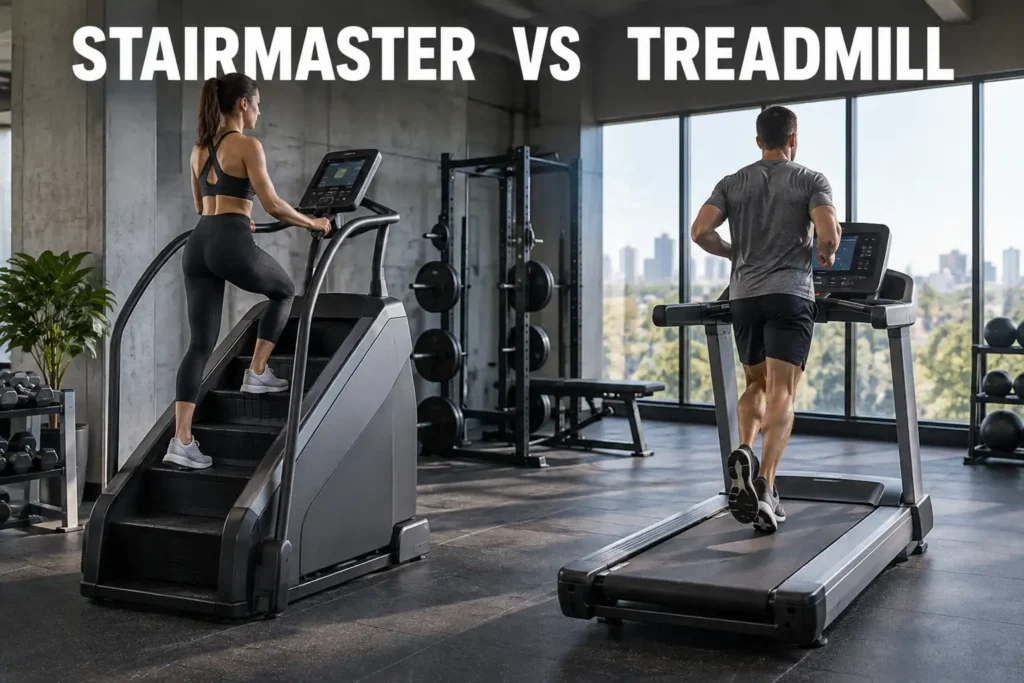
Stairmaster vs treadmill is one of the most debated topics in cardio training, and the debate persists because both machines deliver genuine results. They differ in the muscles they recruit, the caloric demand they create, and the stress they place on your knees and ankles.
I've spent considerable time reviewing the research and tracking real-world performance data on both machines, including monitoring heart rate output across 20-minute test sessions at matching perceived exertion levels. The right machine for fat loss, lower-body strength, or time-efficient cardio depends on your specific goals, joint health, and how hard you are willing to push.
In this guide, we compare calorie burn, muscle engagement, fat loss potential, and joint impact so you can decide which machine earns a place in your routine.

Key Takeaways
- The treadmill placed first for calorie burn in a 2024 comparative study, but the StairMaster burns significantly more calories per minute than flat treadmill walking at the same duration
- The StairMaster delivers simultaneous cardiovascular and lower-body strength stimulus in sessions as short as 20 minutes, with EMG research confirming robust muscle recruitment across the full lower extremity
- Neither machine can spot-reduce belly fat - what matters is total caloric deficit sustained over time, which both machines produce through elevated calorie expenditure
- The StairMaster is low-impact with no landing force or foot strike shock, but can aggravate patellofemoral conditions through repeated deep knee flexion under load
- The treadmill supports the widest range of training goals of any cardio machine, from 2 mph recovery walking to 10+ mph sprinting on a single machine
StairMaster
Calorie-dense, strength-building lower-body cardio
Our Score: 8.5/10
Best for | Time-efficient fat loss and lower-body strength |
Price | $500 - $3,500 |
Treadmill
The widest intensity range of any cardio machine
Our Score: 8.5/10
Best for | Runners, beginners, and varied training goals |
Price | $400 - $4,000 |
Stairmaster vs Treadmill - How Each Machine Works
Understanding what each machine actually asks of your body makes the comparison easier to apply to your own training.
How the StairMaster Works
The StairMaster (also called a stair stepper or stair climber machine) simulates continuous stair climbing. Reciprocating pedals require you to push down and slightly back with each step, driving hip extension and knee flexion through a meaningful range of motion. Your feet stay on the pedals throughout the entire session.
Core demands on a StairMaster machine:
- Continuous glute and quad drive through every step cycle
- Elevated heart rate from moving your full body weight vertically with each step
- Low-impact joint loading since there is no landing phase or foot strike
- Core activation required to maintain an upright posture without leaning on the handrails
- Cardiovascular conditioning that approaches the intensity of moderate running despite lower speed
The low-impact nature of stair climbing is one of its most cited advantages for people who want an intense cardiovascular session without the repeated landing force of running. For home users researching the right cardio setup, our best treadmill for home guide covers top-rated models across all price tiers for comparison.
How the Treadmill Works
A treadmill uses a motorized belt to let you walk, jog, or run in place with adjustable speed and incline. This flexibility is the treadmill's defining advantage over more specialized machines. Training for a marathon on a treadmill and a gentle 20-minute morning walk are both achievable on the same machine by adjusting a single dial.
Core demands on a treadmill:
- Variable intensity from a 2 mph recovery walk to a 10+ mph sprint
- Incline options that shift more load to glutes and calves with increasing grade
- Natural running gait with a flight phase at jogging and running speeds, creating brief ground impact per stride
- Full-body engagement during high-speed running, including upper-body arm drive and trunk rotation
Treadmill dimensions vary widely - from compact folding models and under-desk walking pads to full commercial units that require dedicated floor space. Setting up a treadmill on carpet requires an equipment mat underneath to protect both the belt and the flooring and prevent slippage. The treadmill serves more training goals than any other cardio machine because the intensity floor and ceiling are both wide. That range is also what makes it harder to push at peak effort consistently.
Stairmaster vs Treadmill - Which Burns More Calories?
Calorie burn is the most common comparison made between these two machines. A 2024 comparative study published in Frontiers in Sports and Active Living measured energy expenditure across seven indoor cardio machines at both maximal and submaximal intensity. The results placed the treadmill first and the stair climber second for energy expenditure and heart rate response (1). The gap is meaningful but not extreme. The stairmaster vs treadmill calorie data shows both machines push your cardiovascular system hard enough to make either a legitimate choice for regular cardio training.

General calorie burn estimates by body weight across 30-minute sessions:
Activity | 130 lbs (59 kg) | 155 lbs (70 kg) | 185 lbs (84 kg) |
StairMaster, moderate (MET 8.8) | 260 kcal | 309 kcal | 369 kcal |
Treadmill, walking 3.5 mph (MET 4.3) | 127 kcal | 151 kcal | 180 kcal |
Treadmill, jogging 5 mph (MET 8.3) | 245 kcal | 292 kcal | 348 kcal |
Treadmill, running 7.5 mph (MET 10.7) | 375 kcal | 450 kcal | 538 kcal |
Estimates derived from MET values. Individual results vary with fitness level, body composition, and effort.
The clearest takeaway: the StairMaster burns substantially more calories than flat treadmill walking at the same duration. Running on a treadmill at moderate-to-high speeds burns more than the StairMaster at steady-state effort. The comparison shifts once you factor in intensity level and whether you are walking or running.
A scoping review covering 24 stair-climbing intervention studies found improvements in aerobic capacity of 2-5 mL/kg/min after 8+ weeks of regular sessions, along with measurable improvements in blood glucose and lipid profiles, after just 4-8 weeks (2). Stair climbing's metabolic efficiency is real even at moderate session lengths.
A note on machine readouts: the built-in treadmill calorie counter on most cardio equipment overestimates true burn by 10-20% because most algorithms do not account for individual fitness level or efficiency (1). Tracking effort via heart rate gives a more accurate picture than relying on the console number alone. A treadmill pace chart alongside a heart rate monitor is a more honest tool for gauging progress over time.
Stairmaster vs Treadmill for Fat Loss and Belly Fat
The research on both machines supports genuine fat loss outcomes, and the differences come down to calorie efficiency per session and how hard each machine forces you to work.
Does the StairMaster or Treadmill Target Belly Fat?
Neither machine can spot-reduce belly fat. Fat loss is systemic - your body draws on energy reserves from across the body, not specifically from the area being exercised. The idea that the StairMaster uniquely burns belly fat is a misconception that persists across fitness forums, but the physiology does not support it.
When people compare stairmaster or treadmill for belly fat, the answer is the same: what matters for belly fat reduction is total caloric deficit sustained over time. Both machines produce that deficit through elevated calorie expenditure. The question of which creates a larger deficit per session is covered in the calorie comparison above.
What the Research Shows on Fat Loss Results
A 2021 randomized controlled trial assigned adult women to home-based stair climbing five days per week for eight weeks. Results showed a reduction in body weight of 0.99 kg, measurable improvements in body fat percentage, and improved serum lipid profiles in the stair-climbing group compared to controls (3). The stairmaster or treadmill for weight loss comparison ultimately comes down to which machine you will consistently use at sufficient intensity.
A separate pilot randomized controlled trial tested short bouts of vigorous stair climbing in women with overweight and found a 10% increase in VO2peak and significant reductions in waist circumference after just four weeks of 10-minute daily sessions (4). Waist circumference reduction reflects visceral fat loss, which is the fat most associated with metabolic risk. For those tracking stairmaster before and after 1 month, this trial confirms that measurable improvements in waist circumference and aerobic capacity are realistic within a four-week window when sessions are consistent.
Users tracking stairmaster before and after pictures typically document changes in quad and glute definition alongside waist measurements over six to eight weeks - a timeline supported directly by the intervention literature.
For incline treadmill-specific fat loss evidence, research on whether an incline treadmill is better than running covers important nuance: incline treadmill walking at moderate speeds creates a caloric demand much closer to StairMaster training than flat treadmill walking does, closing the gap between the two machines considerably.
When choosing stairmaster or treadmill for fat loss, I weigh the StairMaster more heavily for efficiency in shorter sessions. The machine forces meaningful metabolic effort even at lower speed settings. On a treadmill, it is easy to choose a comfortable walking speed that keeps heart rate low and calorie burn minimal. The StairMaster has a higher floor for effort.
Stairmaster vs Treadmill - Muscle Engagement and Lower Body Strength
This is where the two machines separate most clearly. Stair climbing functions as both a cardiovascular exercise and a resistance stimulus, building functional lower-body strength while keeping heart rate elevated. Most treadmill training does not replicate that combination.
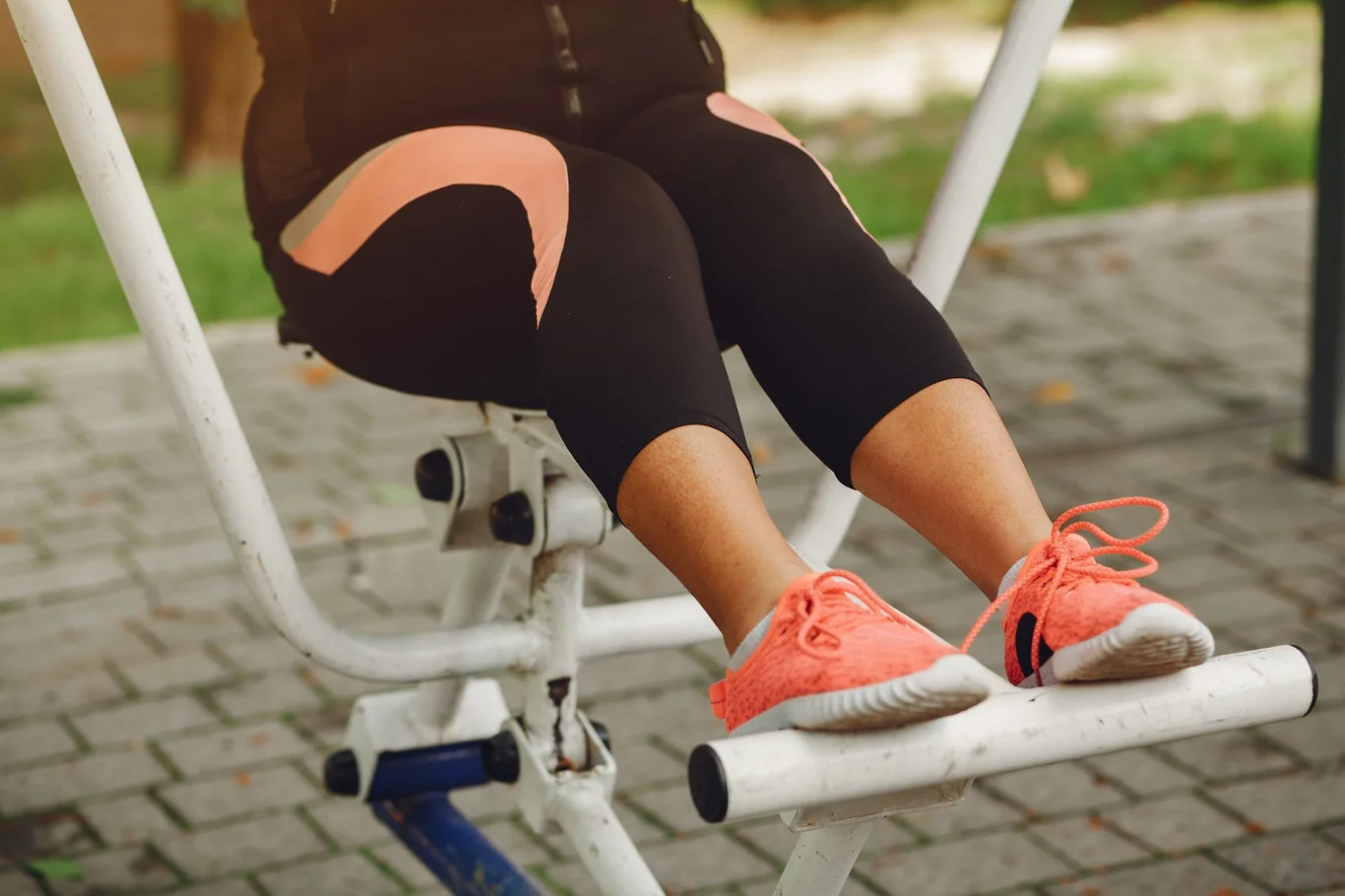
Muscles Worked by the StairMaster
- Gluteus maximus and medius (primary drivers with each push-down step)
- Quadriceps (knee extension through the full step cycle)
- Hamstrings (eccentric control during each step's descent phase)
- Gastrocnemius and soleus (plantarflexion on push-off)
- Hip flexors (lifting the leg in the step phase)
- Core stabilizers (maintaining upright posture without relying on handrails)
An electromyography study measuring lower-extremity muscle activation during stair climbing found high cross-correlation coefficients of 0.84-0.90 for the rectus femoris, biceps femoris, and tibialis anterior, confirming robust, coordinated muscle recruitment across the full lower extremity during stair climbing (5). This level of coordinated muscle activation is not replicated by flat treadmill walking.
Muscles Worked by the Treadmill
- Quadriceps (stance phase during walking and running)
- Hamstrings (swing phase acceleration, most active at running speeds)
- Gastrocnemius (push-off phase)
- Glutes (more active on incline and at running speeds)
- Core stabilizers (especially during running)
The treadmill shares many of the same muscle groups but with a key distinction: flat treadmill walking provides substantially less hip extension and glute loading than stair climbing. Using incline narrows that gap considerably. Our best incline treadmill guide compares models with adjustable grade up to 15% for standard residential treadmills (premium commercial units may exceed this) for those focused on maximizing glute and calorie demand from treadmill training.
Muscle activation comparison by movement type:
Muscle Group | StairMaster | Flat Walk | Incline Walk | Treadmill Run |
Glutes | High | Low | Moderate | Moderate-High |
Quadriceps | High | Moderate | Moderate-High | High |
Hamstrings | Moderate | Low | Low-Moderate | High |
Calves | Moderate | Moderate | Moderate | High |
Core | Moderate | Low | Low-Moderate | Moderate-High |
For the debate around lower-body development, the StairMaster wins. If running performance, sprint training, or running-specific muscle development are priorities, the treadmill takes it.
Stairmaster vs Treadmill - Pros and Cons
Understanding the advantages and drawbacks of each machine in plain terms helps you match the right tool to your current training phase.

StairMaster Pros and Cons
Pros:
- Higher calorie burn per minute than walking or moderate-pace treadmill work
- Simultaneous cardiovascular and lower-body strength stimulus
- Low-impact - no landing force or foot strike shock
- Time-efficient: 20-minute sessions produce measurable cardiovascular and body composition gains
- Higher metabolic floor - harder to coast at low effort
Cons:
- High perceived exertion makes it difficult for beginners to sustain sessions beyond 15-20 minutes
- Aggravates patellofemoral conditions (runner's knee, chondromalacia) with repeated deep knee flexion
- Limited training variety - speed and step height are the only meaningful variables
- Large footprint relative to training versatility
- Less suitable for running-event training or sprint development
Treadmill Pros and Cons
Pros:
- Widest intensity range of any cardio machine - from 2 mph recovery walk to 10+ mph sprint
- Suitable for nearly all fitness levels and training goals
- Running-specific training that transfers directly to outdoor performance
- Incline feature creates a training bridge toward StairMaster-level calorie output
- Walking backwards on a treadmill adds a rehabilitation and knee-deloading option unavailable on the StairMaster
Cons:
- Flat-surface walking burns significantly fewer calories per minute than stair climbing
- Ongoing maintenance demands include checking treadmill belt tension and knowing how to lubricate a treadmill every few months to prevent premature wear
- Larger footprint than compact gym equipment, though treadmill dimensions vary significantly by model
- Higher joint impact at running speeds compared to stair climbing
- Easy to underwork - comfort settings reduce calorie burn without the user noticing
Stairmaster vs Treadmill - Joint Impact and Injury Risk
Both machines carry different joint demands, and understanding those differences helps you choose based on your current injury history and long-term training tolerance.
If low impact tips the decision your way, the treadmill models we've tested are worth comparing before you decide.
StairMaster and Knee Stress
The StairMaster is consistently categorized as low-impact because your feet remain on the pedals throughout, eliminating the landing shock associated with running and even brisk walking on hard surfaces. This characteristic makes it a reasonable option for people with mild joint sensitivity who still want a challenging cardiovascular session.
The important caveat: stair climbing places significant compressive force on the patellofemoral joint (the joint behind the kneecap) during the flexed-knee push-down phase. Users with existing patellofemoral syndrome, chondromalacia, or runner's knee may find that high-volume stair climbing aggravates rather than spares their symptoms. Proper form is the key protective factor. Keep your chest tall, limit handrail use to balance rather than weight-bearing, and avoid extreme forward knee travel.
Brief high-intensity stair climbing has been studied even in cardiac rehabilitation populations, producing significant improvements in VO2peak without adverse joint events, supporting its use across a broad range of physical conditions (6).
Treadmill Joint Impact
Running on a treadmill generates ground reaction forces of approximately 2-3 times body weight per foot strike (7). Sustained high-volume treadmill running is associated with overuse injuries in the knees, shins, hips, and ankles, particularly for runners who increase mileage too rapidly or who have biomechanical asymmetries that go uncorrected.
Walking on a treadmill, by contrast, carries relatively low joint loading and is appropriate for nearly all fitness levels and age groups. One technique variation worth noting is walking backwards on a treadmill, which shifts load away from the knee extensors and onto the hamstrings. This approach has applications in joint rehabilitation settings and for anyone managing anterior knee pain.
The full picture on treadmill joint stress, including how running speed and surface interact with long-term injury risk, is covered in my guide on whether treadmills are bad for your knees.
The treadmill's key advantage in the joint impact comparison: you can reduce intensity and impact simply by slowing your speed or reducing incline. The StairMaster offers fewer meaningful downward intensity adjustments before the session loses its cardiovascular benefit entirely.
Stairmaster vs Elliptical vs Treadmill - Where Each Machine Fits
The stairmaster vs elliptical comparison adds a third machine worth placing in context. The elliptical trainer occupies a middle ground between stair climbing and treadmill running in terms of both joint impact and muscle demand.

Compared to the other two:
- The elliptical has lower impact than treadmill running since the foot pedal traces a fixed arc with no landing phase
- The elliptical creates less hip-extension and glute demand than the StairMaster because the push-pull motion is less vertically loaded
- The elliptical produces calorie burn comparable to the StairMaster at similar effort levels, with the difference driven by resistance and stride speed settings
- The elliptical typically produces less post-workout muscle soreness than stair climbing for users new to either machine
All three machines, compared side by side:
Machine | Best Use Case | Main Limitation |
StairMaster | Time-efficient fat loss and lower-body strength | High intensity barrier; aggravates patellofemoral conditions |
Elliptical | Low-impact moderate cardio for injury-prone users | Less glute loading; less transferable to running performance |
Treadmill | Running training, variable intensity, flexibility | Higher joint impact at running speeds; easy to underwork |
A stair-treadmill hybrid machine combines treadmill belt motion with stair-climbing steps and is a fourth option in this space, though availability has become limited. These hybrids offer lower impact than running while hitting a wider muscle range than flat walking. For most users, the standard StairMaster achieves a similar stimulus more reliably.
For users also weighing treadmill vs bike as a comparison, the logic mirrors the stairmaster vs treadmill decision: each machine has a distinct muscle focus, impact profile, and calorie range. The best machine is the one you will push yourself on at adequate intensity.
Who Should Choose the StairMaster vs Treadmill?
The right machine depends on your training goal, joint health, and how consistently you can push yourself on each one.
Choose the StairMaster If You
- Want lower-body strength development alongside cardiovascular conditioning in a single session
- Prefer shorter, high-intensity sessions of 20-30 minutes over longer moderate efforts
- Have healthy knees with no history of patellofemoral problems
- Are focused on glute and quad development
- Want time-efficient fat loss cardio without running
- Are looking for stairmaster before and after body composition changes rather than just scale weight
Choose the Treadmill If You
- Are training for a running event or building running-specific endurance
- Have existing patellofemoral conditions that worsen with stair climbing
- Need variable intensity training from easy walking to interval sprinting
- Are new to structured cardio and want an accessible starting point - knowing how to use treadmill at any pace is intuitive from the first session
- Are comparing how much does a treadmill cost versus a StairMaster and need a budget-friendly home option
- Want one machine that supports multiple training goals across a week
- Need to know how much does a treadmill weigh before planning your home gym - most residential models run 200-300 lbs, which affects flooring and placement decisions
- Are investigating whether an fsa eligible treadmill purchase applies under your healthcare plan
A note on long-term ownership: home treadmill maintenance is more involved than it first appears. Periodic tasks such as how to replace treadmill belt and addressing issues like fixing treadmill motor problems are common after three to five years of regular use. Budgeting time and service cost for upkeep is part of the full treadmill ownership calculation.
Goal-to-machine decision matrix:
Training Goal | Best Machine |
Belly fat and overall fat loss | Either; StairMaster edges out on calorie efficiency per minute |
Lower-body strength and glute development | StairMaster |
Running event preparation | Treadmill |
Low-impact recovery cardio | Treadmill (walking) or Elliptical |
Short, intense sessions under 30 minutes | StairMaster |
Beginner cardio entry point | Treadmill |
Cardiac rehab or joint sensitivity | Consult physician; StairMaster studied safely in CAD patients |
For space-conscious home gym setups, our best folding treadmill guide covers models that fold flat for storage.
For tracking heart rate and session metrics across either machine, a quality fitness wearable makes meaningful progress tracking easier and helps you stay in your target intensity zone.
StairMaster vs Treadmill: Category-by-Category
Category | Winner | Why |
Calorie Burn | Treadmill | Treadmill placed first in a 2024 Frontiers study; running at moderate-to-high speeds burns more than the StairMaster at steady-state effort, though the StairMaster beats flat treadmill walking |
Muscle Engagement | StairMaster | EMG research confirmed cross-correlation coefficients of 0.84-0.90 across rectus femoris, biceps femoris, and tibialis anterior - a level of coordinated lower-body activation not replicated by flat treadmill walking |
Fat Loss Efficiency | StairMaster | The StairMaster has a higher metabolic floor and is harder to coast at low effort, making it more time-efficient for fat loss in shorter sessions compared to treadmill walking |
Joint Impact | StairMaster | The StairMaster eliminates landing shock because feet stay on the pedals throughout; running generates ground reaction forces of approximately 2-3 times body weight per foot strike |
Training Variety | Treadmill | The treadmill covers the full range from 2 mph recovery walk to 10+ mph sprint and supports running-specific training, incline work, and backwards walking rehabilitation - none of which the StairMaster offers |
Beginner Friendliness | Treadmill | High perceived exertion makes it difficult for beginners to sustain StairMaster sessions beyond 15-20 minutes; knowing how to use a treadmill at any pace is intuitive from the first session |
Choose the StairMaster If
- You want lower-body strength development alongside cardiovascular conditioning in a single session
- You prefer shorter, high-intensity sessions of 20-30 minutes over longer moderate efforts
- You have healthy knees with no history of patellofemoral problems
- You are focused on glute and quad development
- You want time-efficient fat loss cardio without running
Choose the Treadmill If
- You are training for a running event or building running-specific endurance
- You have existing patellofemoral conditions that worsen with stair climbing
- You need variable intensity training from easy walking to interval sprinting
- You are new to structured cardio and want an accessible starting point
- You want one machine that supports multiple training goals across a week
Making the Right Cardio Call
The stairmaster vs treadmill question does not have a single correct answer. The right answer comes from matching each machine's strengths to your current goals.
The StairMaster is the better choice for anyone who wants a calorie-dense, strength-building, lower-body-focused session in under 30 minutes. The research on stair climbing consistently shows measurable body composition and cardiovascular gains in intervention periods as short as four to eight weeks.
The treadmill is the better choice for runners, beginners, and anyone who values training flexibility across intensity levels. From a slow morning walk to incline intervals that approach StairMaster intensity to a 7-minute-mile run, the treadmill handles it without requiring a second machine. A stairmaster or incline treadmill for fat loss can both work - the difference is how hard you are willing to push and what your joint health permits.
I run three StairMaster sessions paired with two treadmill sessions most weeks. That combination consistently keeps my heart rate in zone 3-4 across the StairMaster sets while the treadmill days handle running-specific conditioning and pace work. Tracking how many steps in a mile on a treadmill or pace-based targets makes the treadmill the natural progress tracker for running goals; the StairMaster handles the intensity work.
FAQs
Is 20 minutes on StairMaster enough?
Twenty minutes on a StairMaster at moderate-to-high intensity is enough to produce meaningful cardiovascular and calorie-burning effects. Research on brief stair-climbing sessions consistently shows improvements in aerobic capacity and body composition with sessions as short as 10-20 minutes when performed consistently over four to eight weeks.
What are the disadvantages of StairMaster?
The primary disadvantages of the StairMaster machine include its high perceived intensity, which causes many beginners to drop out early, and its potential to aggravate patellofemoral joint conditions through repeated deep knee flexion under load. It also offers less training variety than a treadmill and can become monotonous for sessions lasting longer than 30 minutes.
Does StairMaster help lose belly fat?
The StairMaster contributes to overall fat loss, including abdominal fat, by creating a significant caloric deficit over time. No machine can spot-reduce belly fat specifically, but consistent high-intensity stair climbing combined with a calorie-controlled diet produces measurable reductions in waist circumference, as demonstrated in peer-reviewed research.
What is 10 minutes on the StairMaster equivalent to?
Ten minutes on the stairmaster at moderate intensity is roughly equivalent in calorie burn to 20-25 minutes of moderate-pace flat treadmill walking, reflecting the StairMaster's higher metabolic demand per unit of time. The actual equivalence depends on your body weight, your set speed on each machine, and your fitness level.
Is the StairMaster good for weight loss?
The StairMaster is effective for weight loss because it combines meaningful calorie expenditure per session with lower-body muscle development that elevates resting metabolic rate over time. When used consistently alongside a caloric deficit from diet, stairmaster training supports measurable fat loss in a time-efficient format.
This content is for informational and educational purposes only. It is not a substitute for professional medical advice, diagnosis, or treatment. Always consult your healthcare provider before starting a new fitness program.
References
- Prieto-Gonzalez P, Yagin FH. Energy expenditure, oxygen consumption, and heart rate while exercising on seven different indoor cardio machines at maximum and self-selected submaximal intensity. Frontiers in Sports and Active Living. 2024;6:1313886. doi:10.3389/fspor.2024.1313886
- Ghosal AM, Chandrasekaran B. Stair-climbing interventions on cardio-metabolic outcomes in adults: A scoping review. Journal of Taibah University Medical Sciences. 2023;19(1):136-150. doi:10.1016/j.jtumed.2023.10.003
- Michael E, White MJ, Eves FF. Home-based stair climbing as an intervention for disease risk in adult females; a controlled study. International Journal of Environmental Research and Public Health. 2021;18(2):603. doi:10.3390/ijerph18020603
- Yun JE, Wen X, Han M, Cho S, Kuk JL, Lee S. Effect of short bouts of vigorous stair climbing on cardiorespiratory fitness in women with overweight and obesity: a pilot feasibility study. Journal of Obesity and Metabolic Syndrome. 2023;32(4):346-352. doi:10.7570/jomes23024
- Geiger DE, Behrendt F, Schuster-Amft C. EMG muscle activation pattern of four lower extremity muscles during stair climbing, motor imagery, and robot-assisted stepping: a cross-sectional study in healthy individuals. BioMed Research International. 2019;2019:9351689. doi:10.1155/2019/9351689
- Dunford EC, Valentino SE, Dubberley J, et al. Brief vigorous stair climbing effectively improves cardiorespiratory fitness in patients with coronary artery disease: a randomized trial. Frontiers in Sports and Active Living. 2021;3:630912. doi:10.3389/fspor.2021.630912
- Nilsson J, Thorstensson A. Ground reaction forces at different speeds of human walking and running. Acta Physiologica Scandinavica. 1989;136(2):217-227. doi:10.1111/j.1748-1716.1989.tb08655.x