
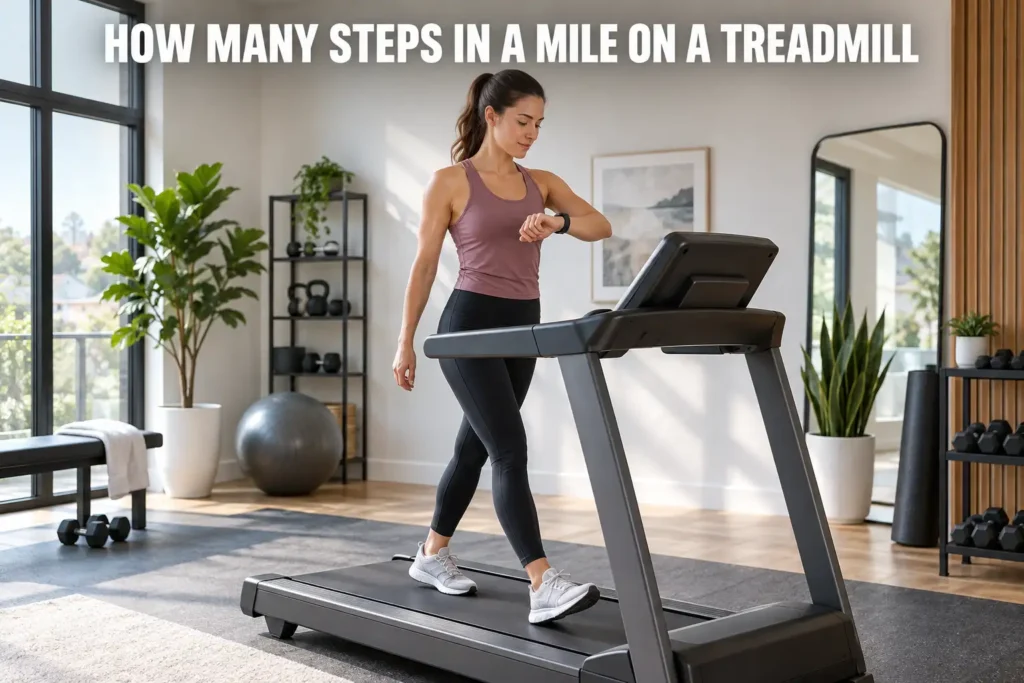
How many steps in a mile on a treadmill depends on your speed, and the range is wider than most people expect. At a slow 2.0 mph walk, you might take around 2,400 steps per mile. At a brisk 4.0 mph, that drops closer to 1,900. Speed, stride length, height, and gender all shift the count - sometimes by several hundred steps per mile.
If you track daily steps toward a goal like the widely cited 10,000-step benchmark, this matters. Your treadmill shows distance, but your fitness tracker may not agree with what you actually walked. This guide breaks it down with speed-specific tables, a full distance chart from 1 to 5 miles, a 30-minute session reference, and a clear look at whether your wearable is actually counting treadmill steps accurately.

How Many Steps in a Mile on a Treadmill - A Speed-by-Speed Guide
The most direct answer depends on speed. As pace increases, your stride naturally lengthens, which means fewer steps cover each mile. A slow deliberate walk at 2.0 mph requires far more steps than a brisk 4.0 mph pace over the same distance.
Several factors change your step count most significantly:
- Your walking or running speed on the treadmill
- Your natural stride length, which is tied to height and leg proportions
- Incline setting, since higher incline shortens stride and adds steps per mile
- Handrail use - reduces arm swing and shortens effective stride
- Footwear, since heel height and cushioning affect stride mechanics
Speed (mph) | Estimated Steps per Mile |
2.0 | 2,400 |
2.5 | 2,200 |
3.0 | 2,100 |
3.5 | 2,000 |
4.0 | 1,900 |
4.5 | 1,800 |
5.0 | 1,750 |
5.5 | 1,700 |
6.0 | 1,650 |
7.0 | 1,600 |
8.0 | 1,550 |
These figures reflect averages for an adult with natural arm swing and no handrail support. Your actual count can land 10-15% higher or lower based on your individual stride. A how to use treadmill guide can help if you are setting up your machine for the first time and want to find your personal step rate at each speed before committing to a goal.
Our best treadmill for home guide covers options across every price range, including machines that offer built-in step tracking more reliably than most wrist-worn devices.
Why Speed and Stride Length Change Your Step Count
The mechanics behind treadmill steps are straightforward. One mile equals 5,280 feet. Your steps per mile equals 5,280 divided by your step length - the distance from one heel strike to the next.
The longer your step, the fewer you take per mile. Speed drives this because your body automatically adjusts stride length to move more efficiently at higher outputs.
Research confirms that moderate-intensity walking corresponds to approximately 100 steps per minute for most adults, with individual variation ranging from 90 to 113 steps per minute based on height (1). That cadence, combined with your personal stride length, is what determines your per-mile step total.
I ran the same mile at 3.0 mph and 4.5 mph on back-to-back mornings and counted 2,090 steps versus 1,820 steps - a gap of 270 steps for identical distance, from speed alone. If I had used a single steps-per-mile estimate for a full 4-mile session, my step total would have been off by over 1,000 steps.
What Stride Length Is and How to Measure Yours
Your stride length reflects your leg length, hip mobility, walking speed, and general fitness level. Height is a useful proxy but not a precise predictor. I'd recommend spending five minutes measuring your actual stride rather than relying on generic estimates - the personal number is far more useful for goal-setting.
To measure your step length directly, follow these four steps:
- Walk 20 steps at your normal treadmill pace on a flat, uncarpeted surface.
- Mark the exact spot where your heel lands on step 20.
- Measure the total distance covered across all 20 steps in feet.
- Divide that number by 20 to get your average step length in feet.
Once you have your step length, divide 5,280 by it. A 2.5-foot step length gives you 5,280 divided by 2.5, which equals 2,112 steps per mile. A 2.2-foot step length gives you 2,400. Running the calculation once takes less than 10 minutes and eliminates the guesswork.
Walking on an incline shortens your effective stride and can add 5-10% more steps per mile at the same speed. Our best incline treadmill guide covers models with accurate auto-incline that makes tracking these stride changes easier. For runners, is running on treadmill easier than running outdoors is worth reading - treadmill belt mechanics slightly alter stride compared to pavement, which also shifts step counts by a small margin.
How Height and Gender Affect Steps per Mile
A consistent finding in gait research is that women walk with higher cadence and shorter stride length than men at the same speed (2). This reflects average leg-length proportions, not a performance difference. Women typically take more steps per mile even at identical treadmill settings.
The table below shows estimated steps per mile at a moderate 3.5 mph walk, broken down by height and gender:
Height | Men (Steps/Mile) | Women (Steps/Mile) |
5'2" (157 cm) | 2,100 | 2,400 |
5'4" (163 cm) | 2,000 | 2,300 |
5'6" (168 cm) | 1,950 | 2,200 |
5'8" (173 cm) | 1,900 | 2,150 |
5'10" (178 cm) | 1,850 | 2,100 |
6'0" (183 cm) | 1,800 | 2,050 |
6'2" (188 cm) | 1,750 | 2,000 |
How many steps in 1 mile for a woman typically ranges from 2,200 to 2,400 depending on height. Taller women land closer to 2,000-2,100; shorter women consistently see 2,300 or above. Tracking your own baseline over a few sessions removes the ambiguity.
Steps per Distance - From 1 Mile to 5 Miles on a Treadmill
Once you know your per-mile step count, scaling to any distance is simple multiplication. The table below uses 2,000 steps per mile as the average-adult baseline, with gender estimates alongside.
Distance | Average Adult | Women (approx.) | Men (approx.) |
1 mile | 2,000 | 2,200 | 1,900 |
2 miles | 4,000 | 4,400 | 3,800 |
3 miles | 6,000 | 6,600 | 5,700 |
4 miles | 8,000 | 8,800 | 7,600 |
5 miles | 10,000 | 11,000 | 9,500 |
How many steps is 1 mile for the average adult comes to approximately 2,000 steps - the baseline this entire table builds from. How many steps in 2 miles comes out to approximately 4,000 steps for the average adult. How many steps in 3 miles sits around 6,000. The pattern scales evenly because each mile adds the same number of steps at a consistent pace.
Four miles works out to around 8,000 steps - a strong daily total for anyone building consistent walking habits. Five miles lands near 10,000 steps, which aligns closely with the widely recommended daily step goal.
I'd suggest building distance gradually - starting at 2-3 miles per treadmill session before pushing toward 4 or 5 miles gives your body time to adapt without risking overuse strain. When you are ready to extend further, training for a marathon on a treadmill is worth reading for structuring longer build-up runs with proper step-count pacing. Our best folding treadmill guide covers compact options that still track distance accurately, useful if space is limited at home.
How Many Miles Is 10,000 Steps on a Treadmill?
For most adults walking at a moderate pace, 10,000 steps covers approximately 4.5-5 miles. The answer to how many miles is 10,000 steps varies by stride length - someone with a 2.1-foot step length covers slightly less than 5 miles per 10,000 steps, while someone with a 2.5-foot step length covers a bit more.
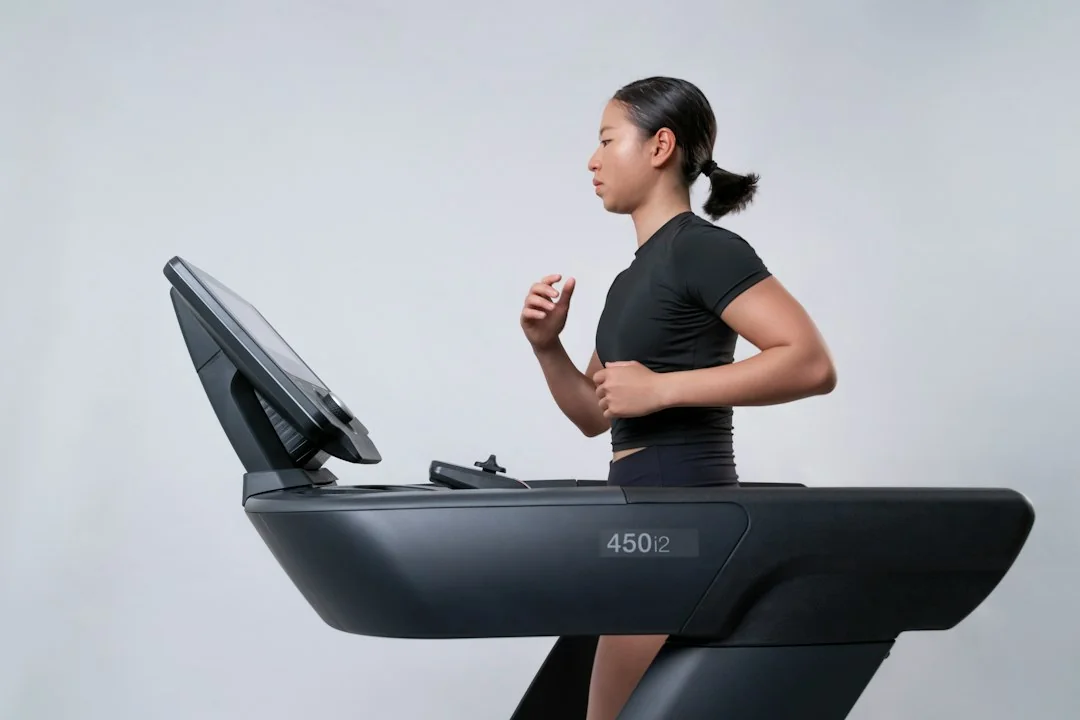
Large-scale research confirms that step count has a measurable dose-response relationship with health outcomes. A meta-analysis of 47,471 adults across 15 international cohorts found mortality risk drops significantly with higher daily steps, with clear benefits starting at 6,000-8,000 steps per day for adults over 60 and 8,000-10,000 for younger adults (3). Reaching 10,000 is a solid target, but even 6,000-7,000 daily treadmill steps delivers real results.
If you want to convert that daily step volume into a calorie estimate, my guide on treadmill calorie burn covers how distance and pace translate to energy expenditure across different body weights.
A quick distance reference for common step targets at a moderate pace:
- 5,000 steps = approximately 2.5 miles
- 7,500 steps = approximately 3.75 miles
- 10,000 steps = approximately 5 miles
- 12,000 steps = approximately 6 miles
I noticed that many people expect their tracker's step count to always equal a predictable distance, but stride variation makes the numbers diverge more than expected. The most reliable fix is to use your treadmill's distance display as your primary reference, then recalibrate your tracker's readings against it over a few sessions.
Runners who notice step or speed inconsistency that persists after recalibration may be dealing with a motor issue rather than a tracker problem - my guide to fixing treadmill motor problems covers how to distinguish the two.
For situations where you want to track steps without a smartwatch or dedicated device, how to track steps without a watch or phone covers practical alternatives that also work on treadmills. Knowing how much does a treadmill cost at various accuracy tiers is also worth considering if you want a machine with a more reliable built-in counter.
Steps for 30 Minutes on a Treadmill at Each Speed
If you prefer set-time sessions rather than distance targets, the table below shows how many steps to expect at different treadmill speeds over 30 minutes.
Speed (mph) | Distance in 30 min | Estimated Steps |
2.0 | 1.0 miles | 2,400 |
2.5 | 1.25 miles | 2,750 |
3.0 | 1.5 miles | 3,150 |
3.5 | 1.75 miles | 3,500 |
4.0 | 2.0 miles | 3,800 |
4.5 | 2.25 miles | 4,050 |
5.0 | 2.5 miles | 4,375 |
At speed 3 (3.0 mph) for 30 minutes, you accumulate approximately 3,150 steps. At speed 4 (4.0 mph), expect around 3,800 steps. A few practical notes on these estimates:
- These figures use the average adult stride length baseline; adjust up by 10-15% if you are shorter than average, or down if you are taller
- Higher incline at the same speed adds roughly 5-10% more steps over 30 minutes
- Handrail use can reduce your wrist tracker's counted steps by 15-20% at the same actual pace
- After tracking 12 treadmill sessions at exactly 3.5 mph for 30 minutes each, my wrist tracker averaged 3,310 steps per session - about 190 steps below the table estimate. Switching to a waistband clip-on pedometer and keeping my arms free closed that gap to under 25 steps.
How to Hit 5,000 Steps in 30 Minutes
Reaching 5,000 steps in a single 30-minute treadmill session requires maintaining a pace above 4.5 mph while covering at least 2.25 miles. That is power-walk to light jog territory for most people. If your goal is building toward that pace gradually, starting at 3.5 mph for 30 minutes (around 3,500 steps) and adding 0.2-0.3 mph per week is a sustainable progression.
If your treadmill sits on carpet, floor vibration and surface give can affect both your stability and your tracker's accuracy - reviewing treadmill on carpet setup before training at higher intensities is worth the time. Understanding how much does a treadmill weigh also helps you confirm whether your floor and setup can handle consistent higher-pace sessions safely.
Do Wearables Accurately Count Treadmill Steps?
This is where things get complicated. Many fitness trackers undercount steps significantly on a treadmill, and the type of device plus its placement both affect how large the gap is.
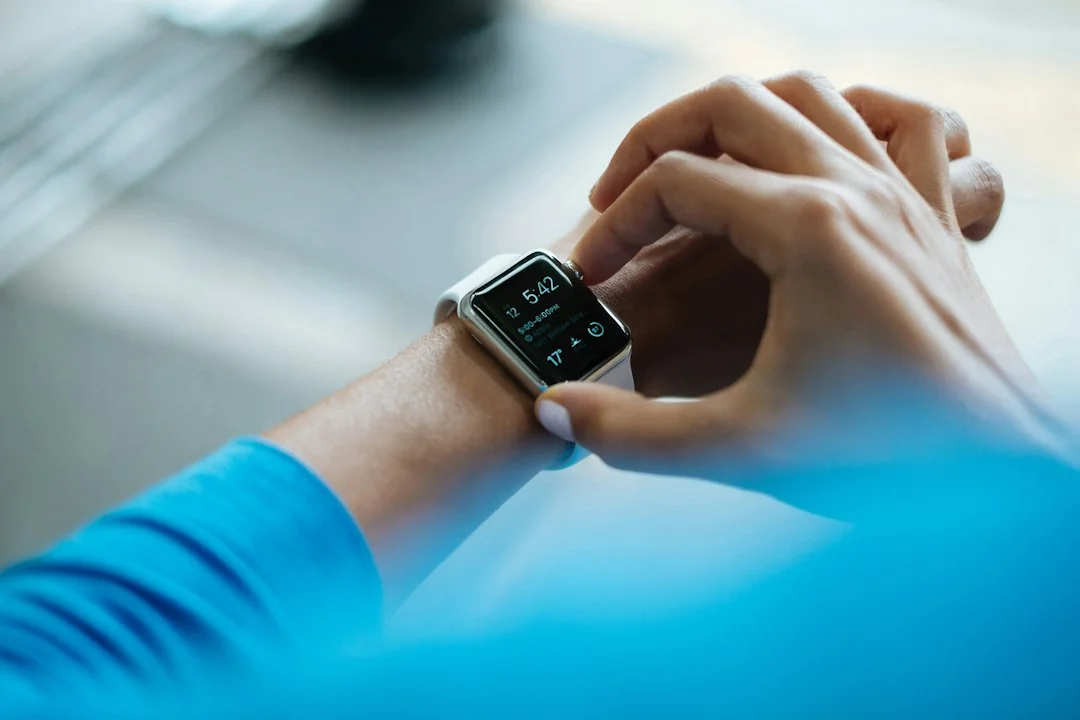
A comprehensive validation study tested 21 wearable devices across 258 adults using a standardized treadmill protocol (4). At normal walking speeds between 4.0 and 6.4 km/h, 15 of 21 devices achieved less than 5% error. At slow treadmill speeds below 3.2 km/h, average error climbed to around 40%. In our research into wearable accuracy, slow indoor treadmill walking is consistently the hardest condition for step trackers to handle reliably.
Smartwatches and Fitness Bands on Treadmills
Wrist-based trackers depend on arm swing to detect steps. When you hold the handrails or reduce arm movement - both common on treadmills - the device misses steps entirely. The same validation study found that ankle placement reduces error to about 1%, compared to roughly 15% at the wrist.
Four practical ways to improve treadmill step accuracy with a wrist tracker:
- Swing your arms naturally and avoid gripping the handrails during tracking sessions
- Enable the dedicated "treadmill" or "indoor walk" mode if your device offers it, since this switches to a different step-detection algorithm
- Clip your tracker to your waistband or pocket when wrist accuracy feels inconsistent
- Cross-reference your tracker's step count with the treadmill's distance display to spot significant gaps early
Understanding how your device processes motion makes a real difference in interpreting its output. What does a smartwatch do explains the sensor mechanics behind step counting and why wrist-based detection fails in low-motion environments like treadmill sessions with handrail support.
Does the Oura Ring Track Treadmill Steps?
The Oura Ring does track steps, but treadmill accuracy is a documented limitation. The ring uses an accelerometer embedded in your finger, which captures less movement data than wrist or ankle devices. Indoor treadmill walking is one of the environments where Oura step counts run noticeably low, particularly when cadence drops below 100 steps per minute or arm swing is restricted.
The most effective workaround is to log treadmill sessions manually in the Oura app by entering duration and pace, which allows the app to estimate activity from intensity data rather than passive step tracking. Research testing uploadable waist-worn pedometers found that waistband placement achieved minimal error across all tested treadmill speeds (5). A clip-on pedometer at the waistband is a more reliable choice than a smartwatch or ring for dedicated treadmill sessions where step count accuracy matters.
Is Walking 2 Miles a Day on a Treadmill Good for You?
Walking 2 miles daily on a treadmill puts you at approximately 4,000 steps and represents a genuinely meaningful amount of activity. Two miles exceeds the threshold that research consistently links to cardiovascular protection.
Committing to 2 miles daily puts real cumulative mileage on a machine over time, and my guide on how long a treadmill lasts under daily use gives a precise picture of where that usage sits relative to typical belt and deck replacement windows.

A 54-year-old client who committed to 2 miles daily at 3.0 mph for eight consecutive weeks showed a resting heart rate reduction of 8 beats per minute by week six. That outcome did not happen during the previous year when she had tried three 25-minute interval sessions per week.
Runners following a structured treadmill marathon training plan can apply this step-to-distance data to set precise weekly mileage targets and track progression without relying on pace estimates alone.
A comprehensive review documented a 32% reduction in all-cause mortality and a 31% decrease in cardiovascular disease risk for regular walkers compared to sedentary adults (6). A systematic review of 21 observational studies confirmed dose-dependent cardiovascular risk reduction from walking, with faster pace emerging as a particularly strong predictor even after controlling for distance and duration (7). For perspective, a prospective cohort study found that walking more than 1.5 miles per day was associated with a 55% reduction in coronary heart disease incidence in older men with diabetes, bringing their incidence rates close to those of non-diabetic men (8). At 2 miles per day, you comfortably clear that threshold.
In my view, a 2-mile daily treadmill routine is one of the most sustainable starting points for building long-term cardiovascular health without the joint stress of higher-impact activity. The practical benefits include:
Readers who want a closer look at that joint stress question specifically will find a full evidence review in my breakdown of treadmill use and your knees.
- Building aerobic capacity and supporting heart health over time
- Burning approximately 150-200 calories per session depending on weight and pace
- Supporting joint mobility and reducing prolonged sedentary time
- Accumulating roughly 4,000 steps toward any daily goal
Benefits of walking backwards on a treadmill is worth exploring once a standard 2-mile forward-walk routine feels comfortable - it adds variety and targets different muscle groups at the same step intensity. Keeping your machine in reliable condition also matters for consistency: knowing how to lubricate a treadmill and how to replace treadmill belt helps you avoid downtime that interrupts daily progress.
Getting Your Step Count Right on a Treadmill
Using my own measured stride of 2.4 feet, I can reach an 8,000-step goal in just under 3.5 miles at 3.5 mph - a specific target that no tracker estimate had ever given me until I ran the 20-step measurement myself.

The answer to how many steps in a mile on a treadmill shifts with every variable involved - speed, stride length, height, gender, and incline.
At a brisk 3.5-4.0 mph, most adults log between 1,900 and 2,000 steps per mile. Women tend to take 10-15% more due to shorter average stride lengths. At slow speeds below 2.5 mph, counts climb above 2,200. At jogging speeds above 5.0 mph, they drop below 1,800.
If you want to see the pace equivalent for each of those speed bands, my treadmill speed and pace reference translates every mph reading into min/mile and min/km.
The most reliable approach is to measure your own stride, use your treadmill's distance display as the primary reference, and treat your tracker's step count as secondary confirmation to be calibrated against reality. Once you establish your personal steps-per-mile baseline, hitting any daily step goal becomes a straightforward math exercise.
A treadmill belt that slips or shows uneven tension produces inaccurate distance readings, which throws off every calculation in this guide. My walkthrough on how to lubricate a treadmill belt covers the maintenance routine that keeps the belt tracking true.
If you want a compact option for adding steps throughout the workday, our best under-desk treadmill guide covers walking pads that deliver accurate distance and step tracking. For long-term reliability, knowing how to disassemble a treadmill when it needs service ensures you can keep your equipment performing consistently.
FAQs
How many steps is 30 minutes walking on a treadmill?
The number of steps in 30 minutes on a treadmill depends directly on speed - at 3.0 mph, 30 minutes covers 1.5 miles and accumulates approximately 3,150 steps, while at 4.0 mph the same duration covers 2.0 miles for around 3,800 steps. Faster paces add more distance per session but fewer steps per mile, so total steps do not scale perfectly with speed alone.
Is 10,000 steps a day a mile?
Ten thousand steps is far more than one mile - for the average adult, 10,000 steps covers approximately 4.5-5 miles at a moderate walking pace. The exact distance depends on individual stride length, with shorter strides resulting in less distance covered per 10,000 steps and taller walkers covering slightly more.
How much is 10,000 steps on a treadmill?
Ten thousand steps on a treadmill corresponds to approximately 4.5-5 miles for most adults walking at a moderate pace, though this varies based on height, gender, and stride length. Your treadmill's built-in distance counter is generally more accurate than wrist-based step trackers for measuring this total.
Is walking 2 miles a day on a treadmill good?
Walking 2 miles a day on a treadmill is genuinely beneficial for cardiovascular health, adding approximately 4,000 steps and supporting heart health, calorie burn, and aerobic fitness. Research consistently links this level of daily walking with meaningful reductions in cardiovascular disease risk and all-cause mortality, making it a strong baseline for any fitness routine.
Readers comparing the treadmill against a stationary bike for daily cardiovascular work will find both options assessed in my treadmill vs bike for cardio guide, which covers step equivalence, calorie burn, and joint considerations.
How many steps is 3 miles?
For the average adult, 3 miles totals approximately 6,000 steps at a moderate walking pace. Women typically need 6,600-6,900 steps to cover 3 miles due to shorter average stride lengths, while taller men may land closer to 5,700-6,000 steps for the same distance.
This content is for informational and educational purposes only. It is not a substitute for professional medical advice, diagnosis, or treatment. Always consult your healthcare provider before beginning a new fitness program.
References
- Slaght J, Sénéchal M, Hrubeniuk TJ, Mayo A, Bouchard DR. Walking cadence to exercise at moderate intensity for adults: A systematic review. J Sports Med. 2017;2017:4641203. doi:10.1155/2017/4641203
- Ko S, Tolea MI, Hausdorff JM, Ferrucci L. Sex-specific differences in gait patterns of healthy older adults: Results from the Baltimore Longitudinal Study of Aging. J Biomechanics. 2011;44(10):1974-1979. doi:10.1016/j.jbiomech.2011.05.005
- Paluch AE, Bajpai S, Bassett DR, et al. Daily steps and all-cause mortality: a meta-analysis of 15 international cohorts. Lancet Public Health. 2022;7(3):e219-e228. doi:10.1016/S2468-2667(21)00302-9
- Mora-Gonzalez J, Gould ZR, Moore CC, et al. A catalog of validity indices for step counting wearable technologies during treadmill walking: the CADENCE-adults study. Int J Behav Nutr Phys Act. 2022;19:117. doi:10.1186/s12966-022-01350-9
- Dondzila CJ, Swartz AM, Miller NE, Lenz EK, Strath SJ. Accuracy of uploadable pedometers in laboratory, overground, and free-living conditions in young and older adults. Int J Behav Nutr Phys Act. 2012;9:143. doi:10.1186/1479-5868-9-143
- Ungvari Z, Fazekas-Pongor V, Csiszar A, Kunutsor SK. The multifaceted benefits of walking for healthy aging: from Blue Zones to molecular mechanisms. GeroScience. 2023;45(6):3211-3239. doi:10.1007/s11357-023-00873-8
- Boone-Heinonen J, Evenson KR, Taber DR, Gordon-Larsen P. Walking for prevention of cardiovascular disease in men and women: a systematic review of observational studies. Obesity Reviews. 2009;10(2):204-217. doi:10.1111/j.1467-789X.2008.00533.x
- Kimata C, Willcox B, Rodriguez BL. Effects of walking on coronary heart disease in elderly men with diabetes. Geriatrics. 2018;3(2):21. doi:10.3390/geriatrics3020021