
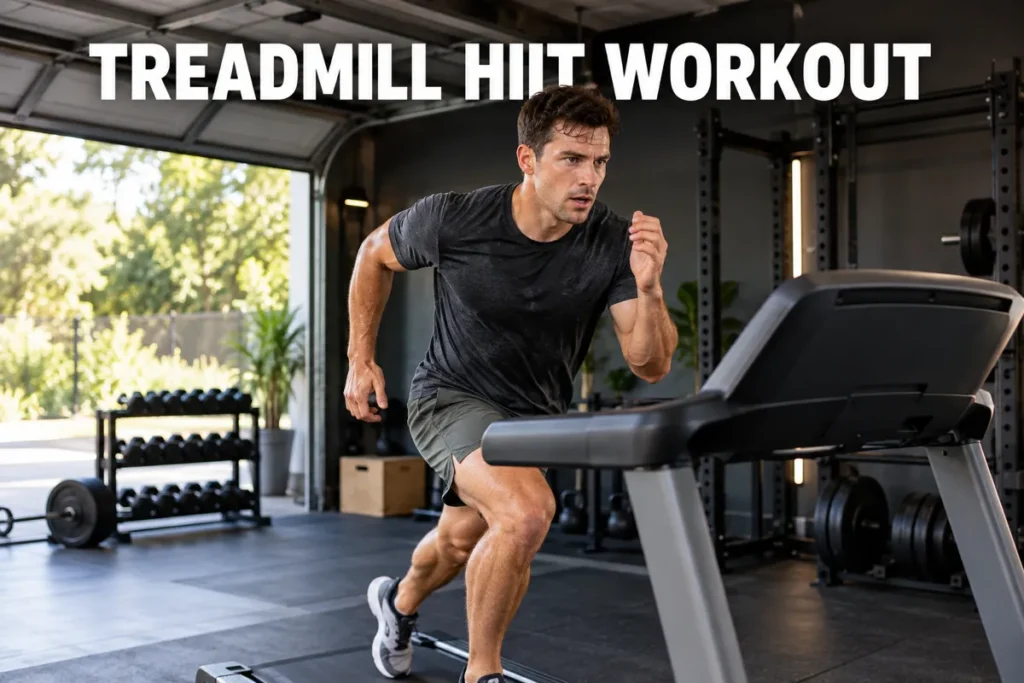
A treadmill HIIT workout delivers more fat-burning stimulus per minute than most forms of steady-state cardio, and I have relied on it as a cornerstone of client programming for years at every fitness level. As an ISSA Elite Trainer and certified nutritionist with a master's degree in physical education, I structure interval training around one principle: controlled intensity fluctuations force the body to adapt in ways that sustained moderate effort cannot match. High-intensity interval training alternates short, hard work periods with active recovery, pushing your heart rate up and down in a controlled pattern that stresses both the aerobic and anaerobic energy systems. This guide covers six complete treadmill HIIT workout plans - beginner through advanced - with exact speed, incline, and timing blocks so you can start today.

Treadmill HIIT Workout - What It Is and Why the Science Supports It
A treadmill HIIT workout is built on a measurable physiological principle: the harder you push during short intervals, the longer your body keeps burning fuel to recover afterward. That is a quantifiable metabolic response. I want to explain the two main mechanisms behind that response before you get into the plans, because understanding them changes how you pace each interval and how you think about recovery between sessions.
Any motorized treadmill will work for these protocols, though machines with a responsive speed range make work-to-recovery transitions faster and cleaner. Our best treadmill for home guide covers models tested specifically for interval performance, including speed responsiveness and belt cushioning under repeated high-intensity efforts.
A treadmill HIIT workout produces four primary physiological adaptations that distinguish it from steady cardio:
- Elevated EPOC: your body keeps burning fuel for hours after the session ends
- VO2max improvements: repeated maximal efforts expand your aerobic ceiling
- Fat oxidation increase: alternating intensity zones teaches the body to burn more fat at rest
- Anaerobic threshold shift: you can sustain harder efforts before accumulating lactate
The EPOC Effect - Why You Keep Burning Fat After the Workout
Excess post-exercise oxygen consumption (EPOC) is the elevated calorie burn that continues after your workout ends as your body restores oxygen debt, repairs muscle tissue, and returns its systems to baseline. A 2024 Scientific Reports study comparing interval running to isocaloric continuous running found that the interval group produced 23% greater EPOC (66.20 vs. 53.91 kcal) and a 33% higher lipid oxidation rate during the 30-minute recovery window (1). A separate 2025 RCT confirmed that HIIT produced 89% higher EPOC volumes than moderate-intensity continuous training under matched calorie expenditure conditions (2).
In practical terms, a treadmill HIIT workout keeps burning fat for hours after you step off the belt - the afterburn effect is real, measurable, and not a marketing phrase. I cover the research behind treadmill weight loss strategies in a separate guide.
HIIT vs. Steady-State Cardio - Which Burns More Fat
A 2023 meta-analysis of 29 randomized controlled trials found that HIIT produced a 0.48% greater reduction in percent fat mass and a 0.96 cm greater reduction in waist circumference compared to moderate-intensity continuous training, while matching or exceeding VO2peak improvements in less total training time (3). I find this data particularly useful with time-constrained clients because it quantifies what most trainers observe anecdotally: shorter, harder sessions produce comparable or superior body composition outcomes.
Metric | HIIT | MICT |
EPOC (30-min post-workout) | 66.20 kcal | 53.91 kcal |
Lipid oxidation rate | 33% higher | Baseline |
Percent fat mass reduction | 0.48% greater reduction | Lower reduction |
Waist circumference reduction | 0.96 cm greater | Lower |
Benefits of a Treadmill HIIT Workout
My experience programming treadmill interval training for competitive athletes and recreational fitness clients has consistently shown visible adaptations within four to six weeks when sessions are performed consistently. Based on the current research and my program design history, these are the benefits that appear first:

Cardiovascular Fitness and Fat Loss Gains
Improved VO2max and cardiovascular capacity: A 2024 RCT tracking once-weekly HIIT at 95% maximal work rate found a 13% increase in maximal oxygen uptake, a 27% increase in maximal ventilation, and structural cardiac changes indicating real training adaptation (4).
Superior fat loss efficiency: A six-week supervised hiit treadmill workout for fat loss study in cardiac rehabilitation patients found 4.5% body fat reduction versus 3.2% in the moderate-intensity group, alongside greater waist circumference improvement (5). The difference is meaningful over a consistent training block.
Time Efficiency and Metabolic Adaptations
Time efficiency: The same cardiovascular adaptations achievable through 45-60 minute steady-state runs can be matched in 20-30 minutes of a well-structured treadmill interval workout - the primary reason I use this format with clients who have limited weekly training hours.
Metabolic flexibility: Alternating between high and low intensity zones trains your body to switch between carbohydrate and fat as primary fuel sources, improving aerobic efficiency in every subsequent workout regardless of modality.
Scalability across fitness levels: Every plan in the next section adjusts through speed, incline, or work-to-rest ratio. The treadmill HIIT format genuinely serves a first-week beginner and a competitive runner on the same machine.
For a broader look at how consistent treadmill training changes fitness markers over time, our treadmill benefits guide covers the cardiovascular, metabolic, and joint health outcomes with detailed evidence.
6 Treadmill HIIT Workout Plans for Every Fitness Level
These six programs cover the full range of fitness levels and training goals. Before you start, here is what each plan focuses on:
- Plan 1 - Beginner treadmill HIIT workout (20 min): 30-second work intervals, 90-second recovery, 6 rounds
- Plan 2 - Intermediate treadmill HIIT workout (25 min): 45-second work intervals, 75-second recovery, 8 rounds
- Plan 3 - Advanced treadmill HIIT workout (30 min): 40-second sprints, 50-second recovery, 10 rounds
- Plan 4 - 20-minute fat-burning HIIT (20 min): 1:1 work-to-rest ratio, optimized for EPOC
- Plan 5 - 30-minute fat burning treadmill workout (30 min): pyramid structure, maximum calorie burn
- Plan 6 - Incline treadmill HIIT for fat loss (29 min): joint-friendly, gradient-based intervals
Safety guidelines for all plans: Attach the safety key clip to your clothing before stepping on a moving belt. Use handrails only for brief balance during speed transitions - not as support during work intervals. If you feel sharp joint pain, chest pressure, or dizziness, reduce speed immediately and step off. Adjust all speeds to your personal fitness level. The effort level matters more than the number on the display. Our treadmill workout guide provides foundational programming if you need to build baseline fitness before starting these interval plans.
Plan | Duration | Work Interval | Rest Interval |
Beginner (Plan 1) | 20 min | 30 sec | 90 sec |
Intermediate (Plan 2) | 25 min | 45 sec | 75 sec |
Advanced (Plan 3) | 30 min | 40 sec | 50 sec |
20-Min Fat Burning (Plan 4) | 20 min | 45 sec | 45 sec |
30-Min Fat Burning (Plan 5) | 30 min | Pyramid | Pyramid |
Incline HIIT (Plan 6) | 29 min | Gradient | Rest |
Plan 1 - Beginner Treadmill HIIT Workout (20 Minutes)
This is my standard starting point for clients new to treadmill interval training. The 30-second work interval is brief enough to allow near-maximum effort without early burnout, and the 90-second recovery ensures the heart rate drops enough before the next push. This 20-minute structure is the hiit treadmill workout for beginners I return to again and again precisely because it builds the interval habit without the injury risk that comes from extending work periods too soon. For beginners preparing for these intervals, I explain proper form and speed selection in my guide to how to run on a treadmill.
Beginner scaling option: If 5.5 mph is too fast, starting at a brisk 4.0-4.5 mph walk-jog is completely valid. Target a rate of perceived exertion of approximately 8 out of 10 during work intervals - challenging but not a collapse-level sprint. Safety note: beginners should keep one hand near (not on) the handrail for the first two sessions until they are confident with speed transitions.
Plan 2 - Intermediate Treadmill HIIT Workout (25 Minutes)
For runners who have trained consistently for four to eight weeks, this plan extends the work interval while tightening recovery, keeping the cardiovascular system at a higher average intensity throughout the session. The cumulative work time increases significantly compared to Plan 1 even though the total session adds only five minutes.
Adding 2-3% incline to the work intervals in this plan increases cardiovascular demand without requiring higher speeds - a useful adjustment on days when legs feel heavy from prior training. Machines with motorized incline adjustment make this transition smooth; my guide to the top incline treadmills covers models with the grade range and motor consistency that this kind of use demands.
Plan 3 - Advanced Treadmill HIIT Workout (30 Minutes)
This is the most demanding program in the set. I use it with clients who have a solid running base and can sustain near-maximum sprint efforts repeatedly without form breakdown. Do not begin this plan after a training gap of more than four weeks - rebuild through Plan 2 first.
Safety note for advanced speeds: At 8.5+ mph, form breakdown sharply increases fall risk. If you notice your shoulders rounding, stride shortening, or arms crossing the midline late in the set, reduce speed by 0.5-1.0 mph rather than stopping abruptly. The deceleration phase is itself a training load; use it. I use my treadmill speed to pace chart to show how belt speeds translate into running pace.
Plan 4 - 20-Minute Fat-Burning HIIT Treadmill Workout
A 1:1 work-to-rest ratio is the interval structure that maximizes EPOC within a minimal session window. I designed this hiit treadmill workout 20 minutes program specifically for the 20-minute training slot - from belt startup to cool-down, it fits in under 30 minutes total. The equal work-rest periods keep intensity high throughout because rest time never fully allows heart rate to return to baseline. If you want an even shorter all-out format, I break down the 4-minute Tabata workout in its own guide.
For those pairing this plan with a calorie-managed eating approach, the same EPOC-focused interval principles apply across cardio modalities. An exercise bike workout for weight loss uses the same work-to-rest structure with significantly lower joint impact - a practical swap on high-mileage training weeks.
Plan 5 - 30-Minute Fat Burning Treadmill Workout
This pyramid interval structure builds work duration through the middle of the session and tapers back down. The psychological advantage is that each interval after the peak feels progressively more manageable, which improves completion rates in real training. I prioritize this 30 minute fat burning treadmill workout structure with clients who want maximum single-session calorie expenditure alongside variety in their interval programming. I list more 30 minute treadmill workout options for fat loss in a separate article.
Plan 6 - Incline Treadmill HIIT Workout for Fat Loss
Incline-based intervals are lower-impact than flat-speed sprints because they reduce heel-strike force while keeping cardiovascular effort high. This incline treadmill workout for fat loss format is also well-suited to beginners managing knee or hip concerns, and a useful cross-training variation for intermediate runners who want additional stimulus without increasing max speed further. I compare incline treadmill versus running in a separate article.
If Plan 6 is your primary format and you want room to progress to steeper grades over time, our best folding treadmill guide covers compact models with motorized incline ranges up to 12-15% that fit apartment and small home gym setups.
How Many Calories Does a Treadmill HIIT Workout Burn
Calorie burn during a treadmill HIIT workout depends on body weight, current fitness level, the speeds and inclines selected, and the work-to-rest ratio. These are estimates - individual metabolic rates vary, and the values below are approximations based on standard MET values for treadmill running at varying intensities. I explain treadmill calorie counter accuracy and how to calibrate your machine in a separate guide.

The main variables that move these estimates up or down:
- Body weight: heavier individuals burn more calories per unit time at the same speed
- Work interval speed: adding 1 mph to your sprint speed increases calorie burn per interval by roughly 10-15%
- Incline: a 5% grade at the same speed increases oxygen demand by approximately 20-25%
- Fitness level: fitter individuals are more efficient, which slightly reduces calorie burn at a given absolute speed
How EPOC Adds to Your Calorie Total
These figures exclude EPOC. Based on the research reviewed earlier, add an estimated 15-25% to account for elevated post-exercise fat oxidation over the hours following your session.
A 165 lb (75 kg) person completing Plan 4 (20 minutes, 8 x 45-second sprints at 7.5 mph with equal rest) burns an estimated 260-310 calories during the session itself. The EPOC component, based on Jiang et al. (2024) (1), adds roughly 60-70 additional kilocalories in the 30-minute recovery window alone, with fat oxidation continuing beyond that point.
Calorie tracking accuracy improves when you pair a chest strap heart rate monitor with your treadmill sessions rather than relying on wrist-based sensors during high-intensity intervals. A reliable best calorie tracker gives you the feedback loop needed to adjust volume and intensity as your fitness improves. For tracking, I rank fitness trackers for runners that suit running workouts.
How to Stay Safe During Treadmill HIIT
Plateaus and injuries in treadmill interval training almost always trace to execution, not program design. I see the same six mistakes across gym settings, and they are all correctable.
Workout Execution Mistakes to Avoid
Skipping the warm-up: Starting sprint intervals on a cold cardiovascular system raises soft tissue injury risk meaningfully. Every plan above includes a three-minute warm-up walk - extend it to five minutes by adding 10 leg swings, 10 hip circles, and 10 ankle rotations after the walk. Do not shorten the warm-up even if you are pressed for time.
Using the handrails as support: Holding the rails during work intervals reduces lower-body and cardiovascular demand, alters posture under load, and stresses the wrists and elbows over repeated sessions. Use handrails only to step on and off the belt safely. I explain the controls and safety key in my breakdown of how to use a treadmill.
Ignoring form breakdown late in sets: Overstriding, head dropping forward, and arms crossing the midline are clear signals to reduce speed or end the current round rather than grinding through with compromised mechanics.
Training Load and Recovery Mistakes
Training HIIT daily: Two to three treadmill HIIT sessions per week with at least 48 hours between them is the recommended standard for most adults. The body adapts between sessions, not during them.
Confusing joint pain with muscle fatigue: Burning in your quads or lungs during a hard interval is a normal training response. Sharp pain in a knee, hip, or ankle is a stop signal - not something to manage through.
Skipping the cool-down: Stopping a treadmill HIIT workout abruptly raises blood-pooling risk and can cause dizziness in some runners. Spend two to three minutes walking at 2.5-3.0 mph after your final interval, then add 30 seconds each of standing quad stretch, calf stretch, and hip flexor stretch before stepping off the belt.
Symptoms That Mean Stop Immediately
When to stop immediately and consult a healthcare provider: chest pressure, irregular heartbeat, sudden sharp joint pain, dizziness, or numbness in any extremity. These require a full stop and clearance before the next session.
Keeping your treadmill belt properly lubricated reduces drag at high running speeds and ensures consistent speed control during HIIT protocols. My treadmill maintenance guide covers the lubrication schedule, deck cleaning, and belt tension checks that extend equipment life and prevent mid-session speed irregularities.
Making Treadmill HIIT a Sustainable Long-Term Practice
Finishing the six plans is the starting point, not the finish line, and lasting progress depends on how you progress load and recover between sessions. I cover how to advance safely and what to do on lower-impact days.
Progressive Overload for Continued Gains
The six plans above are starting points, not a ceiling. Once you complete a plan at the prescribed intensities without form breakdown, progressive overload is the next step - increase speed by 0.5 mph, shorten rest periods by 10 seconds, or add one additional round every two to three weeks.
To build sustainable progress without overuse injury:
- Start with one treadmill HIIT session per week and add a second only after four consecutive weeks of consistent completion at the same plan
- Alternate between speed-based plans (Plans 1-4) and Plan 6's incline focus to distribute impact load across different movement patterns
- Keep one session per week as steady-state cardio at moderate intensity to support your aerobic base without adding to total HIIT recovery demand
- Log your sessions - which plan, which speeds, how rounds 7-10 felt - and advance one variable only after three to four weeks at the same load
Alternative Cardio for Lower Impact Recovery Days
For cross-training variety that reduces treadmill impact on heavy weeks, a HIIT rowing workout delivers full-body cardiovascular stimulus without any lower-limb ground reaction force. On active recovery days between sessions, walking backwards on a treadmill activates the posterior chain in a novel movement pattern that complements forward-running HIIT work without adding impact stress. For complete beginners or those following a treadmill workout for weight loss beginner plan, a structured beginner exercise bike workout builds the cardiovascular foundation needed to step into treadmill intervals with lower joint risk.
FAQs
Here are answers to the most common questions about treadmill HIIT workout programming, safety, and related training methods.
Is HIIT on a treadmill effective?
HIIT on a treadmill is highly effective for improving cardiovascular fitness and reducing body fat compared to longer steady-state sessions. A meta-analysis of 29 RCTs found that HIIT produced greater reductions in waist circumference and percent fat mass than moderate-intensity continuous training while achieving comparable or superior VO2peak improvements in less total training time (3). A dedicated hiit running workout treadmill routine performed two to three times per week consistently outperforms steady-state cardio for fat loss efficiency when sessions are matched for duration.
What is the 5 4 3 2 1 treadmill workout?
The 5-4-3-2-1 treadmill workout is a descending-interval method where you run progressively shorter work bouts - five minutes, four minutes, three minutes, two minutes, and one minute - separated by brief recovery walks, typically increasing speed or incline as the intervals shorten. I use this format as a bridge protocol for clients transitioning from steady-state running into the shorter, higher-intensity work of a standard treadmill HIIT workout.
What is the 12-3-30 workout method on a treadmill?
The 12-3-30 treadmill workout sets the incline to 12%, the speed to 3 mph, and holds that pace for 30 minutes - it is a walking-based incline protocol rather than traditional interval training, but the sustained gradient creates meaningful cardiovascular and caloric demand without the sprint intensity of a treadmill HIIT workout. Many people pair the treadmill workout 12-3-30 method with a separate 30 minute treadmill workout on alternate training days to maintain both incline endurance and speed-based fitness.
Does the 12/3/30 really work?
The 12/3/30 method produces real cardiovascular and fat-loss benefits, particularly for people newer to regular cardio or managing joint concerns that limit higher-impact sprint-based training. Its outcomes depend on frequency and individual body weight, and it is less time-efficient than true interval training for improving VO2max, but it is a practical entry point for building consistent treadmill habits.
Medical disclaimer: This content is for informational and educational purposes only. It is not a substitute for professional medical advice, diagnosis, or treatment. Always consult with your healthcare provider before starting any new fitness program or using fitness technology for health monitoring.
References
- Jiang L, Zhang Y, Wang Z, Wang Y. Acute interval running induces greater excess post-exercise oxygen consumption and lipid oxidation than isocaloric continuous running in men with obesity. Sci Rep. 2024;14:9178. doi:10.1038/s41598-024-59893-9.
- Faleiro V, Gurgel AV, Guimarães TT, et al. Isocaloric High-Intensity Interval and Circuit Training Increases Excess Post-Exercise Oxygen Consumption and Lipid Oxidation Compared to Moderate-Intensity Continuous Training. Sports (Basel). 2025;13(10):355. doi:10.3390/sports13100355.
- Guo Z, Li M, Cai J, Gong W, Liu Y, Liu Z. Effect of High-Intensity Interval Training vs. Moderate-Intensity Continuous Training on Fat Loss and Cardiorespiratory Fitness in the Young and Middle-Aged: A Systematic Review and Meta-Analysis. Int J Environ Res Public Health. 2023;20(6):4741. doi:10.3390/ijerph20064741.
- Ito G, Feeley M, Sawai T, et al. High-intensity interval training improves respiratory and cardiovascular adjustments before and after initiation of exercise. Front Physiol. 2024;15:1227316. doi:10.3389/fphys.2024.1227316.
- Gonçalves C, Raimundo A, Abreu A, Pais J, Bravo J. Effects of High-Intensity Interval Training vs Moderate-Intensity Continuous Training on Body Composition and Blood Biomarkers in Coronary Artery Disease Patients: A Randomized Controlled Trial. Rev Cardiovasc Med. 2024;25(3):102. doi:10.31083/j.rcm2503102.