
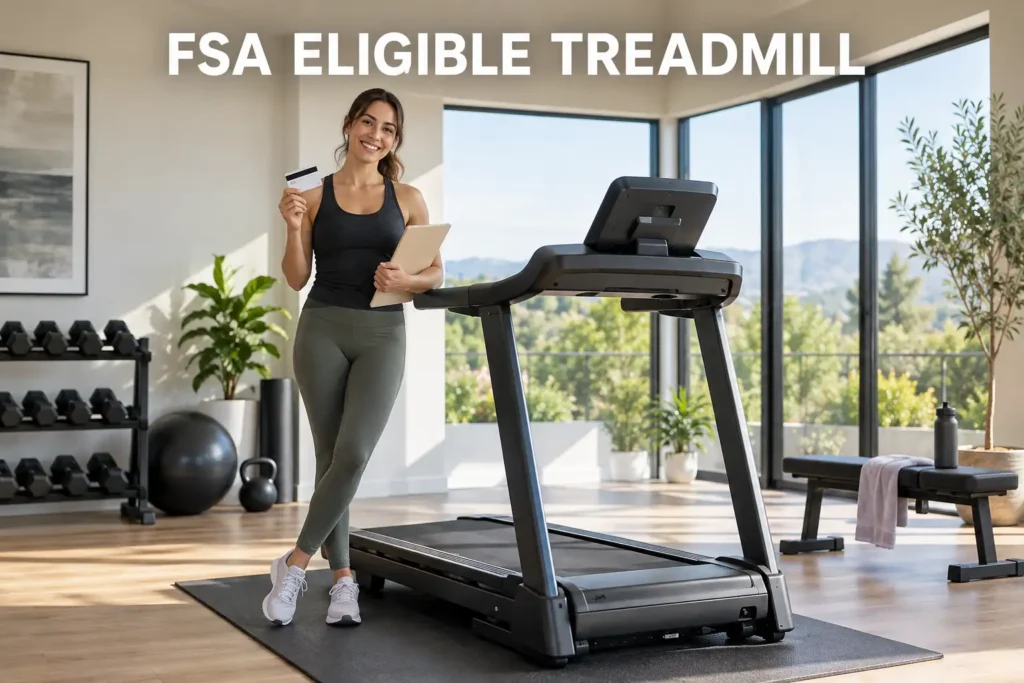
An fsa eligible treadmill can cut your total equipment cost by 20 to 35 percent when you use pre-tax FSA or HSA funds, but the process is not as simple as swiping your benefit card. Most people assume home fitness equipment qualifies automatically, the same way bandages or cough medicine do. It does not. The IRS treats treadmills as personal expenses unless a physician documents a specific medical reason for the purchase.
For cost-conscious buyers, pairing FSA or HSA reimbursement with a subscription-free treadmill eliminates both the upfront and ongoing costs that push most home gym budgets past the intended limit.
Before applying for FSA or HSA coverage, it helps to understand the full price landscape; my guide on how much does a treadmill cost covers the complete price range from budget walking machines to commercial-grade models, including delivery and maintenance costs.
This guide covers the exact eligibility rules, how to obtain the required documentation, which equipment types qualify, and what to do if your plan administrator denies a claim.

FSA Eligible Treadmill Rules - What the IRS Actually Allows
An fsa eligible treadmill does not fall into the routine health maintenance category. The IRS classifies home fitness equipment as a personal expense unless a licensed healthcare provider establishes that the device treats or prevents a specific diagnosed medical condition. That distinction drives every other rule in this guide.
When FSA or HSA funds go toward general fitness goals, the IRS treats that as a taxable distribution. When the same equipment treats a condition your doctor has formally documented, the purchase shifts into the medical-expense category and qualifies for pre-tax reimbursement. Understanding this upfront changes how you approach the entire purchase. Explore your options in our best treadmill for home guide before taking any of the documentation steps below.
How FSA, HSA, and HRA Accounts Differ
Three account types commonly cover large medical expenses. Each has a different relationship with fitness equipment reimbursement.
Account | Who Contributes | Rollover | Requires LMN for Treadmill |
FSA (Flexible Spending Account) | Employer and/or employee | Limited (~$640 in 2024) | Yes, always |
HSA (Health Savings Account) | Employee, employer, or both | Unlimited year to year | Yes, always |
HRA (Health Reimbursement Arrangement) | Employer only | Varies by plan | Yes, always |
LPFSA (Limited Purpose FSA) and DCFSA (Dependent Care FSA) do not cover fitness equipment at all under any circumstances. Standard FSA, HSA, and most employer-funded HRA plans do, provided you have the right documentation.
HSA accounts offer a particular advantage for large equipment purchases. Unused balances roll over indefinitely, so if your HSA does not have enough to cover a treadmill today, you can build the balance over several months before buying.
What a Letter of Medical Necessity Does
The Letter of Medical Necessity (LMN) is the document that converts a treadmill from a personal expense into a deductible medical item. It is a written statement from your licensed healthcare provider that explains:
- Your specific diagnosed medical condition
- Why structured walking or treadmill exercise treats that condition
- That the equipment serves a medical purpose, not primarily a fitness one
- How long the use is expected to continue
Without an LMN, most FSA and HSA plan administrators automatically deny fsa eligible treadmill and fitness equipment claims. The letter is mandatory, not optional, and getting it right the first time saves weeks of appeals processing.
How to Get a Letter of Medical Necessity for a Treadmill
Getting an LMN is a clinical process. Your doctor needs a genuine medical basis to write one, and the strongest cases involve diagnosed conditions where evidence clearly supports structured walking or treadmill exercise.

Truemed, a telehealth platform that connects patients with LMN-experienced providers, reports the most common qualifying diagnoses are cardiovascular disease, Type 2 diabetes, obesity, peripheral artery disease, and post-surgical rehabilitation. The research behind these claims is substantial. Walking consistently reduces HbA1c in people with Type 2 diabetes, with one meta-analysis of 20 randomized controlled trials reporting a 0.50% reduction alongside meaningful improvements in BMI and diastolic blood pressure (1). A separate systematic review and meta-analysis of aerobic exercise in prediabetes found fasting blood glucose reduced by 1.33 mmol/L and HbA1c by 1.05% (2). These outcomes make a fsa eligible treadmill medically defensible for people managing these conditions.
If you want a compact option well-suited to a physician-prescribed walking program, our best folding treadmill guide covers the space-efficient options that work well in home settings.
Which Medical Conditions Qualify
Not every health goal produces an approvable LMN. The conditions with the strongest documented relationship to structured walking or treadmill exercise are the ones most likely to yield approval.
If your diagnosis involves knee or joint conditions, my guide on treadmills and knee health covers what the research shows about impact, cushioning, and long-term joint effects, information that can support the medical case in your LMN.
Medical Condition | Evidence Linking It to Treadmill Use |
Type 2 diabetes | Walking significantly reduces HbA1c and fasting glucose in RCT meta-analyses (Qiu et al., 2014) |
Prediabetes | Aerobic exercise reverses glucose abnormalities across multiple RCTs (Jiang et al., 2024) |
Cardiovascular disease | Dose-dependent CVD risk reduction with walking in systematic reviews (3) |
Peripheral artery disease | Supervised treadmill exercise improves functional walking capacity in RCTs (4) |
Hypertension | 12-week treadmill program produced significant reductions in cardiometabolic risk markers (5) |
Obesity (BMI 30 or above) | Regular treadmill walking reduces fat mass and body weight significantly |
Post-surgical rehabilitation | Home-based exercise programs are effective substitutes for facility-based rehab (6) |
Metabolic syndrome | Treadmill exercise produces improvements across glucose, lipids, and blood pressure markers |
Research consistently demonstrates that faster walking pace is associated with a 46% lower risk of coronary artery disease events compared to the slowest walking groups, based on a meta-analysis of over 160,000 participants (7). This evidence base makes cardiovascular diagnoses particularly well-suited for fsa eligible treadmill LMN requests.
How to Approach Your Doctor
Most primary care physicians will write an LMN when a relevant diagnosis is already documented. A few steps make the conversation more productive:
- Schedule a dedicated appointment rather than raising it at the end of an unrelated visit. The request deserves focused time and your doctor needs to document it properly.
- Bring your diagnosis records. Lab results showing elevated glucose, recent blood pressure readings, or a documented BMI above 30 give your doctor something concrete to reference.
- Explain the access barrier. Physicians respond better when patients describe a specific reason home equipment is necessary - cost, travel time, schedule conflicts with gym hours, or weather limitations to outdoor walking.
- Ask specifically for a Letter of Medical Necessity for FSA or HSA reimbursement purposes. Physicians unfamiliar with the term may call it a physician's letter of necessity; both work.
- Request equipment-specific language. The letter should name the exact device type - "motorized treadmill" or "walking pad" - and not just reference "home exercise equipment" generically.
If your primary care doctor is hesitant, a cardiologist, endocrinologist, or physical therapist may have more experience writing these letters for fitness equipment. Telehealth platforms like Truemed and Sesame specialize in LMN-experienced providers and typically charge $50 to $200 per visit. At a 30% effective tax rate, a $1,500 fsa eligible treadmill generates roughly $450 in tax savings, which makes even a $200 telehealth visit a worthwhile investment.
When I went through this process myself, I came prepared with six months of bloodwork showing elevated fasting glucose and received the LMN the same day - the documentation appointment took under 15 minutes once my doctor had the records in front of her.
How to Use FSA or HSA Funds to Buy a Treadmill
Once you have an LMN, the actual fsa eligible treadmill purchase has two paths. Which one applies depends on whether the retailer accepts FSA or HSA payment cards directly. Every fsa treadmill claim requires the LMN to be ready before you submit for reimbursement, regardless of which path you take.
Option 1 - Pay Directly With Your FSA or HSA Debit Card
Several major fitness retailers accept FSA and HSA cards at checkout. When a merchant's system recognizes the item code as a qualifying medical expense, the transaction processes without any additional paperwork at the point of sale. Common retailers that support this include:
- Amazon - search for an fsa treadmill amazon listing by filtering for FSA or HSA-eligible products in the search results
- NordicTrack direct website (dedicated FSA and HSA checkout support)
- Sunny Health & Fitness (HSA and FSA-eligible product category pages)
- WalkingPad official website (explicit FSA and HSA payment support)
- Rogue Fitness - rogue fitness fsa eligible equipment is accepted at checkout with a valid LMN
Keep a copy of your LMN available even after a smooth card transaction. Many administrators audit purchases after the fact and may request documentation weeks or months later. Storing your LMN, receipt, and product description in one digital folder prevents problems down the line.
Option 2 - Pay Out of Pocket and Submit for Reimbursement
For retailers that do not accept FSA or HSA cards directly, you pay with a personal card and submit a reimbursement claim through your plan's online portal. A complete claim typically requires:
- A copy of your signed LMN
- An itemized purchase receipt showing the treadmill specifically
- A completed reimbursement claim form from your plan administrator
- Occasionally: proof of delivery or a product description matching your LMN
Processing time varies. Most plans complete reimbursement within 5 to 15 business days for complete, clearly documented claims. My own reimbursement claim cleared in 8 business days because I uploaded all three required documents at once rather than submitting them separately. If you want an option that works for more intensive rehabilitation protocols, our best incline treadmill guide covers models suited to physician-specified incline training.
One timing rule matters: some FSA plans require the LMN to be dated before the purchase. Confirm your plan's documentation requirements with your administrator before you buy, not after.
FSA Eligible Walking Pads and Under-Desk Treadmills
An fsa eligible walking pad follows exactly the same rules as a full motorized treadmill. The equipment type itself does not change your eligibility. What matters is whether the device serves a documented medical purpose for your specific diagnosis, and the compact form factor of a walking pad does not disqualify it.

Walking pads have become an increasingly common fsa approved treadmill alternative because they are compact, quieter than full-size machines, and well-suited to desk-based use. A physician prescribing daily step accumulation for metabolic syndrome or cardiovascular risk management can specify a walking pad just as easily as a traditional treadmill. A meta-analysis of 13 studies found that treadmill desks significantly increased energy expenditure (approximately 105 kcal per hour more than sitting) and reduced daily sitting time in sedentary adults (8). Shoppers looking for a walking pad fsa eligible amazon option can filter Amazon's health and household category the same way as full-size machines.
An fsa eligible under desk treadmill also tends to cost less than a full motorized machine, which lowers the cost-benefit threshold for pursuing LMN documentation in the first place.
Key differences across compact equipment types:
- Walking pads typically max out at 3 to 4 mph and have no incline, which suits walking-only prescriptions
- Under-desk treadmills are designed for simultaneous work use and may have lower handrail configurations or no console
- Full-size motorized treadmills support running speeds and incline adjustment, which some rehabilitation protocols specifically require
- Non-motorized treadmills (curved decks) follow the same eligibility rules but are rarely specified in physician prescriptions
Any of these can qualify as an hsa/fsa eligible treadmill or walking pad with the right LMN in place. The fsa eligible treadmill category encompasses the full range from compact walking pads to incline-capable full-size machines. Adding variety to a walking prescription, such as learning the benefits of walking backwards on a treadmill, can enhance the therapeutic value of your home walking program.
What to Do If Your FSA Claim Is Denied
Plan administrators have discretion, and some apply stricter standards than others. A denial is not always the end of the process. I recommend working through this sequence rather than accepting the initial decision as final:
- Request the denial reason in writing. Administrators are required to provide a specific reason. Common causes include an LMN that lacks detail, equipment that does not match the LMN description, or a missed submission deadline.
- Contact the appeals department. Most FSA and HSA plans have a formal appeal process with a 30- to 90-day window from the denial date.
- Supplement your LMN if the denial cited insufficient documentation. Return to your doctor for a more detailed letter that names the exact equipment type, the diagnosis code, and the evidence supporting home use for your specific condition.
- Involve your HR team. For employer-provided FSAs, your HR department can sometimes facilitate the appeal or clarify what your specific plan administrator requires to approve the claim.
- Escalate to your state insurance commissioner if you believe the denial violated your plan's own terms. This is rare but available as a last option for clear-cut cases.
- Consult a tax advisor. If FSA reimbursement does not go through, a medical expense deduction on Schedule A may still apply if your total out-of-pocket medical costs exceed 7.5% of your adjusted gross income.

Keeping a daily exercise log serves two purposes: it demonstrates that the equipment is being used for its stated medical purpose, and it provides evidence for any future appeal. A smartwatch or fitness tracker is one of the simplest ways to generate that documentation automatically. Our guide to what a smartwatch does explains which health metrics modern wearables track and which are most useful for documenting a walking program.
Practical Steps to Maximize Your FSA or HSA Treadmill Purchase
A few practical habits protect your investment and your account, regardless of whether you buy a full motorized machine or a compact walking pad.
If you are new to the compact format and want to understand what a walking pad is before making a purchase decision, my walking pad overview covers how these machines work, what their specs look like, and how the format compares to standard motorized treadmills.
- Buy your fsa eligible treadmill before your FSA deadline. Most FSAs reset on a calendar year with a December 31 deadline. December purchases are risky; building your LMN and researching equipment in October or November gives you room to handle any delays.
- Save all documentation digitally. Your LMN, purchase receipt, and claim form should be stored somewhere you can access them for at least three years, which aligns with the standard IRS audit window for medical deductions. I keep mine in a single cloud folder - when my plan administrator followed up 14 months after my purchase, I uploaded everything in under two minutes.
- Log your sessions from day one. Consistent session records support any future claim review by showing the treadmill is being used for its documented medical purpose, not sitting unused.
- Match the equipment to your prescription language. If your LMN specifies "low-impact walking at 2 to 3 mph," a walking pad covers that. A more aggressive rehabilitation protocol with incline requirements might justify a full motorized treadmill.
- Check your plan's grace period. Some FSA plans extend the spending window by 2.5 months into the new year, which means eligible purchases made in February may still qualify against the prior year's balance.
Treadmill FSA Eligibility - What to Remember
An fsa eligible treadmill is available to anyone with a documented medical need and a plan administrator willing to approve the expense. The key requirement is a Letter of Medical Necessity from a licensed healthcare provider, not a specific brand, price tier, or equipment model. Any fsa eligible treadmill claim - whether for a full motorized machine, a walking pad, or an under-desk option - rests entirely on that documentation.
Before beginning the LMN process, my guide on how much a treadmill costs helps you identify which price tier matches your medical use case and budget, since FSA and HSA balances vary significantly across account holders.
Confirm your specific plan's requirements before purchasing rather than assuming the process is identical across employers. Administrator discretion creates real variation in approval rates, and checking documentation requirements before you buy prevents the most common denial causes.
A treadmill purchased with FSA or HSA funds is a long-term medical investment; my guide on how long treadmills last covers realistic lifespan expectations by build quality and what maintenance habits protect that investment.
FAQs
What is surprisingly FSA eligible?
Many products qualify for FSA spending that most people assume are personal expenses, including SPF 15 or higher sunscreen, acne treatments, contact lens solution, heating pads, menstrual care products, and pregnancy tests. The broader category is any product that diagnoses, cures, mitigates, treats, or prevents a medical condition, which is why some fitness equipment also qualifies when paired with a Letter of Medical Necessity from a physician.
Is the Peloton treadmill FSA approved?
The Peloton Tread and Tread+ can be purchased with FSA or HSA funds when you provide a valid Letter of Medical Necessity from a licensed healthcare provider. Peloton does not pre-approve its own products for FSA or HSA coverage; eligibility comes entirely from your plan administrator's acceptance of your supporting medical documentation.
What exercise equipment can you buy with FSA?
FSA funds can cover treadmills, stationary bikes, ellipticals, rowing machines, and similar aerobic equipment when a physician documents that the equipment treats a specific diagnosed condition. An fsa eligible treadmill or walking pad qualifies under the same rules when an LMN supports the purchase; the equipment category matters less than the medical documentation.
Will my FSA pay for a gym membership?
FSA and HSA funds generally do not cover gym membership fees because ongoing membership costs do not qualify as medical expenses under IRS guidelines. The IRS makes a narrow exception only when a membership is specifically prescribed to treat a particular diagnosed disease, and most plan administrators decline those claims even with a physician's letter supporting them.
Are walking pads FSA eligible?
Walking pads are FSA eligible under the same rules that apply to full treadmills. A walking pad qualifies when a licensed healthcare provider issues a Letter of Medical Necessity establishing that the device treats a diagnosed medical condition such as cardiovascular disease, Type 2 diabetes, or obesity; the compact form factor of a walking pad does not affect the eligibility criteria.
This content is for informational and educational purposes only. It is not a substitute for professional medical advice, diagnosis, or treatment. Always consult with your healthcare provider before starting any new fitness program.
References:
- Qiu S, Cai X, Schumann U, Velders M, Sun Z, Steinacker JM. Impact of Walking on Glycemic Control and Other Cardiovascular Risk Factors in Type 2 Diabetes: A Meta-Analysis. PLoS One. 2014;9(10):e109767. doi:10.1371/journal.pone.0109767
- Jiang T, Ye Z, Lu Q, Cheng P, Gao Q. Effect of Aerobic Exercise on Blood Glucose Among Those with Prediabetes: A Systematic Review and Meta-Analysis. Life (Basel). 2024;15(1):32. doi:10.3390/life15010032
- Boone-Heinonen J, Evenson KR, Taber DR, Gordon-Larsen P. Walking for prevention of cardiovascular disease in men and women: a systematic review of observational studies. Obes Rev. 2009;10(2):204-217. doi:10.1111/j.1467-789X.2008.00533.x
- McDermott MM, Kibbe MR, Guralnik JM, et al. Durability of Benefits From Supervised Treadmill Exercise in People With Peripheral Artery Disease. J Am Heart Assoc. 2018;8(1):e009380. doi:10.1161/JAHA.118.009380
- Kim J, Lee S, Jee YS. Effect of treadmill walking on cardiometabolic risk factors and liver function markers in older adults with MASLD: a randomized controlled trial. BMC Sports Sci Med Rehabil. 2025;17:93. doi:10.1186/s13102-025-01156-9
- Amorese AJ, Ryan AS. Home-Based Tele-Exercise in Musculoskeletal Conditions and Chronic Disease: A Literature Review. Front Rehabil Sci. 2022;3:811465. doi:10.3389/fresc.2022.811465
- Nurrobi YAS, Winston K, Rahman AL, et al. Footsteps to Wellness: A Systematic Review and Meta-Analysis of Walking Pace and Coronary Artery Disease Event. Cureus. 2024;16(3):e56926. doi:10.7759/cureus.56926
- Oye-Somefun A, Azidi Z, Ardern CI, Rotondi MA. A systematic review and meta-analysis of the effect of treadmill desks on energy expenditure, sitting time and cardiometabolic health in adults. BMC Public Health. 2021;21:2082. doi:10.1186/s12889-021-12094-9