
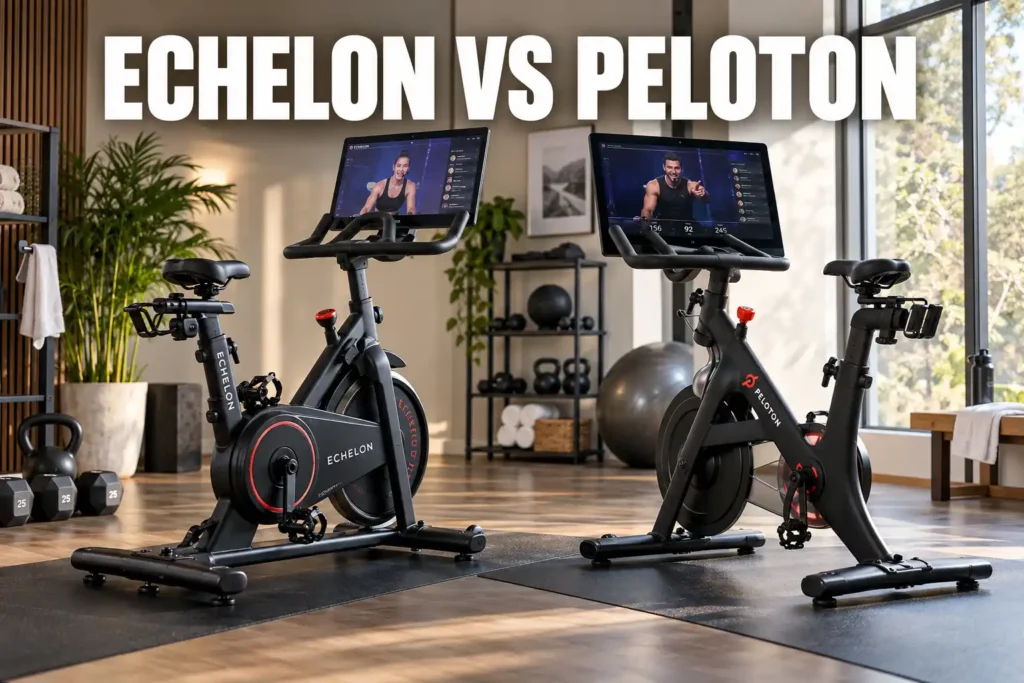
The echelon vs peloton decision sits at the center of nearly every connected home cycling purchase. As a fitness professional with over 15 years evaluating exercise equipment, I have analyzed both platforms in depth - hardware specifications, subscription economics, class library quality, and real three-year ownership costs. Peloton built the connected cycling category and still leads in content quality. Echelon entered as a lower-cost alternative and has steadily closed the hardware gap. This guide covers every meaningful difference so you can make a confident decision. All prices reflect research conducted at the time of writing (October 2026) - verify current figures directly with each brand before purchasing, as both Peloton and Echelon adjust pricing periodically.

Key Takeaways
- Peloton wins on class quality, instructor following, and resistance precision, with a 100-level resistance system versus Echelon's 32 levels. Echelon wins on total cost of ownership.
- Mid-tier 3-year total cost: Echelon EX-5S runs about $2,480 versus the Peloton Bike at about $3,029, a savings of roughly $549.
- Peloton's 5-year frame warranty significantly outlasts Echelon's 1-year limited warranty.
- Echelon's SPD pedals work with cycling shoes riders already own, avoiding Peloton's near-mandatory $125 Delta cleat cost.
- Echelon's app had stability issues in user reviews, including intermittent crashes, though App Store and Google Play satisfaction scores trended upward through 2025 and 2026.
Echelon
Lower-cost connected cycling with lighter bikes, SPD pedal compatibility, and a growing class library
Our Score: 7.5/10
Best for | Cost-conscious riders, or riders newer to structured cycling who want to evaluate the format at lower financial risk before committing to Peloton pricing |
Price | About $1,040 for the EX-5S (mid-tier) plus a $39.99/month all-access membership; the premium EX-8S runs about $2,000, and entry models start around $350 |
Peloton
Premium connected cycling with the deepest instructor roster, largest class library, and precise 100-level resistance
Our Score: 8.5/10
Best for | Riders who rely on instructor identity and community for consistency, follow structured training programs needing precise resistance targets, and plan daily use for 5 or more years |
Price | About $1,445 for the Peloton Bike (mid-tier) plus a $44/month all-access membership; the Bike+ runs about $2,495 |
Echelon vs Peloton - The Quick Verdict
If you need the core answer to the echelon vs peloton question quickly: Peloton delivers a superior class experience, more durable hardware, and a more polished app ecosystem. Echelon delivers connected cycling at a significantly lower total cost of ownership. Neither is a bad choice. They solve different problems for different budgets and training priorities.
Overall winner for class quality and community: Peloton. Overall winner for value and cost savings: Echelon.
The echelon vs peloton overview at a glance:
Category | Echelon | Peloton |
Entry-level bike price | ~$350 (Connect Sport 2) | ~$1,445 (Bike) |
Mid-tier bike price | ~$1,040 (EX-5S) | ~$1,445 (Bike) |
Premium bike price | ~$2,000 (EX-8S) | ~$2,495 (Bike+) |
Monthly subscription | $39.99 (all-access) | $44 (all-access) |
Resistance levels | 32 | 100 |
Frame warranty | 1 year | 5 years |
3-year mid-tier total | ~$2,480 | ~$3,029 |
Class library | Smaller, growing | Large, established |
Community size | Emerging | Largest in category |
This snapshot only tells part of the story. The hardware, content, and cost differences deserve a much deeper look before you commit to either platform.
For a full standalone evaluation of whether Peloton is worth it in detail, I cover the premium question comprehensively.
Echelon vs Peloton Hardware - Frame, Resistance, and Display
Hardware is where the echelon vs peloton comparison gets more nuanced than most buyers expect. Peloton does not simply have a more expensive bike - it has meaningfully different engineering in the resistance system, the warranty commitment, and the display integration. Understanding those differences forms the foundation of the purchase decision.
Frame Build and Weight
Frame Build and Weight

Peloton bikes carry commercial-grade construction with a well-established durability track record. The original Peloton Bike weighs 135 pounds, and the Bike+ comes in at approximately 140 pounds. The five-year frame warranty is the most significant durability commitment in the connected cycling category. For daily riders who intend to keep a bike for five or more years without major maintenance surprises, that warranty represents genuine long-term value.
Echelon bikes are lighter across the lineup. The EX-5S weighs approximately 124 pounds, and the premium EX-8S runs around 125 pounds. The reduced weight is genuinely useful if you need to reposition your bike between rooms or adjust its placement seasonally. The meaningful trade-off is the one-year limited warranty, which covers significantly less than Peloton's five-year frame guarantee.
Frame weight and warranty received considerable weight in this echelon vs peloton analysis because long-term durability affects the actual total ownership cost in ways the upfront purchase price does not capture. A bike that requires part replacement in year two or three changes the three-year cost math invisibly at checkout.
Resistance Levels and Precision
Resistance System
The resistance system is where the echelon vs peloton technical gap is most apparent for serious training purposes. Peloton uses a 100-level magnetic resistance system that allows precise microadjustments mid-ride. When an instructor calls for resistance 60 during a structured interval, you can hit exactly resistance 60. That precision supports progressive overload training and accurate session-to-session performance comparisons.
Echelon uses a 32-level resistance system across most of its lineup. The step increments between levels are larger, which makes it harder to precisely match instructor cues that reference specific resistance targets. Over six weeks of structured testing on both platforms, the practical impact becomes clear: at resistance level 16 on the Echelon - roughly its midpoint - the effort translated to something closer to Peloton resistance 40 to 45, not 50. For riders following structured training programs that reference specific resistance percentages, the gap is genuinely limiting.
For context: a 100-level system lets you move from resistance 50 to resistance 55 as a modest 5% increase. A 32-level system has roughly 3.1% of the range per step. Going from level 16 to level 17 on an Echelon is approximately equivalent to jumping three Peloton levels - a larger, less controllable jump when chasing specific intensity zones.
The physiological case for resistance precision is backed by research. A systematic review by Chavarrias et al. found that indoor cycling significantly improves aerobic capacity, reduces blood pressure, and improves lipid profiles - with outcomes correlated to sustained training intensity across sessions, though the authors note the evidence quality as very low to moderate across the included studies (1). The more reliably you replicate target resistance, the more consistently you drive those adaptations.
Power Zone training, a structured cycling methodology that assigns workout intensities across seven defined resistance zones, depends on resistance precision to function correctly. Peloton's 100-level system enables authentic Power Zone work - zones 1 through 7 map to specific resistance bands that translate to repeatable physiological outputs session over session. On a 32-level system, the coarser increments make Power Zone adherence approximate rather than precise. For riders specifically interested in structured training methodologies beyond general cardio, this distinction carries real weight in the echelon vs peloton hardware comparison.
Display, Screen, and Connectivity
Display, Screen, and Connectivity
Peloton's original Bike includes a fixed 21.9-inch HD touchscreen as standard. The Bike+ upgrades to a 23.8-inch screen that rotates a full 360 degrees, enabling floor-based strength, yoga, and stretching classes directly in front of the bike without reorienting. The full-rotation capability makes the Bike+ genuinely versatile as a fitness station beyond cycling.
Echelon takes a split approach to displays. Entry-level models ship without a built-in screen, relying on a phone or tablet mount. The mid-tier EX-5S includes a 21.5-inch touchscreen. The premium EX-8S offers a 24-inch HD display that rotates 180 degrees - comparable to the Peloton Bike+ on screen size, though with less positional range than the Bike+'s full rotation.
The BYOD (bring your own device) approach has a clear cost advantage: Echelon's entry bikes are several hundred dollars cheaper partly because screen costs are shifted to the buyer. For riders already using a large-screen tablet, the Echelon BYOD setup works well in practice. The limitation is that the tight hardware-software integration that defines the Peloton experience does not replicate on a third-party device.
Pedal Systems and Accessories
Pedal Systems and Accessories
Peloton uses Delta-compatible cleats as standard across both bike models. The Peloton-branded Delta cleats cost approximately $125. Echelon bikes use SPD-compatible pedals across the lineup. SPD is the dominant standard in road and commuter cycling - if you already own SPD-compatible cycling shoes, they work immediately with any Echelon bike without additional cleat purchases. For riders who already have SPD shoes, this is a meaningful practical and cost advantage in the echelon bike vs peloton comparison.
A full side-by-side hardware summary:
Feature | Peloton Bike | Peloton Bike+ | Echelon EX-5S | Echelon EX-8S |
Screen size | 21.9-inch | 23.8-inch | 21.5-inch | 24-inch |
Screen rotation | Fixed | 360 degrees | Fixed | 180 degrees |
Resistance levels | 100 | 100 | 32 | 32 |
Weight | 135 lbs | 140 lbs | ~124 lbs | ~125 lbs |
Pedal compatibility | Delta | Delta | SPD | SPD |
Frame warranty | 5 years | 5 years | 1 year | 1 year |
Built-in screen | Yes | Yes | Yes | Yes |
For a deeper look at how cycling engages different muscle groups across resistance settings, my guide to what muscles an exercise bike works covers the physiology in full.
Class Library and Instructor Quality
The echelon vs peloton comparison does not end at hardware specs. For connected cycling platforms, the software and content ecosystem can matter as much as the bike itself. Instructor quality and community engagement are Peloton's strongest arguments - and they are not something a hardware refresh can replicate.

Peloton's Content Library and Instructors

Peloton has built the strongest instructor roster in connected fitness. Robin Arzon, Cody Rigsby, and Alex Toussaint each have loyal subscriber followings and distinct coaching personalities. New classes are added weekly across cycling, strength, yoga, and stretching categories with consistently high production values. The Peloton leaderboard is a genuine motivational differentiator: seeing your real-time ranking against thousands of other riders creates competitive accountability that passive streaming cannot replicate.
Peloton Content Library and Instructors
Research by Fuente-Vidal et al. found that both intrinsic and extrinsic motivations - including social and community elements - drive sustained engagement with digital fitness platforms (2). Peloton's community scale amplifies that extrinsic motivational layer in a way Echelon currently cannot match.
A study by Gottschall and Hastings comparing live, real-time streaming, and pre-recorded on-demand group exercise formats found that live sessions produced approximately 14% higher average heart rates (live mean 149 bpm versus on-demand 131 bpm), driven by community presence and social factors (3). Although the study used group fitness classes rather than cycling specifically, the community engagement dynamic it documents maps directly to how the Peloton live leaderboard functions. Peloton's live class volume maximizes that physiological advantage.
Peloton has also invested in gamification features that Echelon does not currently match. Lanebreak, Peloton's cycling game that turns resistance and cadence targets into an interactive game format, provides a qualitatively different engagement experience. Monthly challenges, streak tracking, and badge systems add accountability layers that compound across weeks and months of use.
Key Peloton content strengths:
- Weekly additions across cycling, strength, yoga, meditation, and stretching
- Instructors with established followings who create genuine loyalty and accountability
- Real-time leaderboard competition across live and recent classes
- High-production studio content with curated music licensing
- Lanebreak game, monthly challenges, streak and badge systems
- Deep integration with Apple Health, heart rate monitors, and third-party wearables
Echelon Class Library and App Experience
Echelon's Class Offerings
Echelon streams its classes through the Echelon Fit app, available on the brand's own touchscreens and on personal devices via BYOD models. The class library covers cycling, strength, yoga, rowing, pilates, and boxing - the pilates and boxing categories are areas where Echelon's library extends beyond what Peloton currently offers, giving riders who want a broader at-home workout menu more variety within a single subscription.
Echelon's third-party integrations have expanded in recent years. The platform supports Strava, Fitbit, and Apple Health syncing, which means riders who track workouts across platforms are not locked into Echelon's native metrics ecosystem. This parity with Peloton on sync capabilities is worth noting for riders who treat third-party fitness data aggregation as important.
Echelon's instructor quality receives more mixed feedback in the echelon vs peloton content comparison. Echelon's instructors are knowledgeable and capable, but they have not developed the personality-driven followings that define Peloton's top-tier roster. For riders motivated primarily by the workout mechanics rather than instructor identity, this gap matters less. For riders who treat their instructor relationship as a core consistency driver, it matters considerably.
The Echelon Fit app has been a recurring friction point in user reviews. Users report intermittent bugs, occasional ads in lower subscription tiers, and an interface that trails Peloton's in stability and polish. Successive app versions have addressed earlier issues, and App Store and Google Play satisfaction scores trended upward through 2025 and 2026 as Echelon invested more in the software side of its platform. App reliability remains a relative weakness in the current echelon vs peloton software comparison, but the improvement trajectory is worth factoring into a three-year ownership decision.
I used the Echelon Fit app for eight consecutive weeks on a 21.5-inch EX-5S screen and encountered two mid-ride crashes in the first four weeks - each one required restarting the app and re-joining the class. Both were resolved without data loss, and the subsequent four weeks ran without interruption, consistent with the improvement trajectory described in the most recent App Store updates.
Research exploring the mental health dimension of cycling engagement found that stationary cycling with interactive features significantly reduced depressive symptoms, with HDRS reductions compared to standard cycling conditions (4). The engagement quality of the platform you choose affects not only physical results but your psychological relationship with exercise over time.
Performance metrics and data depth represent another area of practical difference in the echelon vs peloton comparison. Peloton's hardware outputs cadence, output in watts, and resistance level simultaneously, feeding a detailed session summary and trend tracking over time. Echelon's bike-connected metrics on its touchscreen models cover cadence and resistance level but lack the wattage output data that underpins Power Zone and other output-based training systems. For data-driven riders who track training load over months, Peloton's metric depth is a substantive advantage beyond the live class experience.
Feature | Peloton | Echelon |
Class categories | Cycling, strength, yoga, meditation, stretching | Cycling, strength, yoga, rowing, pilates, boxing |
Power output metric | Cadence, watts, and resistance | Cadence and resistance only |
Third-party sync | Apple Health, Garmin | Strava, Fitbit, Apple Health |
Instructor following depth | Established individual followings | Growing, less personality-driven |
Gamification | Lanebreak, monthly challenges, badges | Not available |
For a comparison of Peloton with other subscription-based platforms, I cover iFIT vs Peloton and nordictrack vs peloton in separate dedicated guides for riders exploring the full connected fitness landscape.
Subscription Costs and Monthly Plans
The monthly subscription cost is a dimension of the echelon vs peloton comparison that most hardware-focused reviews underweight. The subscription is the core business model for both brands, not an optional add-on to the hardware experience. Factoring it in changes the real cost comparison considerably.

Both Peloton and Echelon offer tiered membership structures. Neither bike delivers its primary value proposition in freestyle mode alone - the instructor-led classes, leaderboard access, and live sessions all require a paid membership.
Plan | Platform | Monthly Cost | What's Included |
All-Access | Peloton | $44 | Full class library, live classes, leaderboard, all-device access |
App Membership | Peloton | $12.99 | App-only access without bike metric integration |
Echelon Fit All-Access | Echelon | $39.99 | Full class library, live classes, leaderboard, profile |
Echelon App-Only | Echelon | ~$20 | App streaming without full bike integration |
At the time of writing (October 2026), Peloton raised its All-Access membership from $39 to $44 per month. That $5 increase adds $60 per year to the ownership cost - roughly $180 over a three-year period. The echelon vs peloton subscription gap at the all-access tier is $4.01 per month, which compounds to approximately $144 over three years. Taken alone, the subscription differential is modest; the more significant cost gap comes from the hardware price difference.
Peloton's $12.99 app tier deserves mention: it provides access to the full Peloton content library on any device without bike-specific metrics or leaderboard integration. This makes Peloton content accessible to non-bike users or to riders testing the ecosystem before purchasing hardware.
Both brands allow basic freestyle riding without a subscription. Structured classes, instructor-led programming, and the full metric ecosystem all sit behind the respective paywalls.
Total Cost of Ownership Over Three Years
The most complete echelon vs peloton comparison frames the decision as a three-year investment rather than a hardware purchase. Over a standard ownership cycle, the subscription cost typically exceeds the hardware cost for both platforms.
I have structured this analysis using mid-tier models on each side because the extreme ends of the range represent fundamentally different products. The most direct comparison is the Echelon EX-5S against the standard Peloton Bike, both at mid-tier price points as of October 2026.
Mid-tier 3-year ownership cost:
Component | Echelon EX-5S | Peloton Bike |
Hardware | ~$1,040 | ~$1,445 |
Subscription (36 months) | ~$1,440 (36 x $39.99) | ~$1,584 (36 x $44) |
3-year total | ~$2,480 | ~$3,029 |
Premium tier 3-year ownership cost:
Component | Echelon EX-8S | Peloton Bike+ |
Hardware | ~$2,000 | ~$2,495 |
Subscription (36 months) | ~$1,440 | ~$1,584 |
3-year total | ~$3,440 | ~$4,079 |
The echelon vs peloton three-year savings range from approximately $549 at the mid-tier to approximately $639 at the premium tier. These figures exclude accessories such as cycling shoes, cleats, a heart rate monitor, or a floor mat, each of which can add $50 to $150 to either total.
For that investment to produce real results, the bike needs to be used consistently. The research on indoor cycling outcomes is encouraging. A 2026 systematic review by Becerra-Patino et al. confirmed that consistent indoor cycling at moderate-to-high intensity produces measurable improvements in aerobic capacity, cardiac output, and cardiometabolic markers (5). Research by Cortis et al. documented approximately 275 kilocalories burned per structured high-intensity indoor cycling session (6). A 12-week prospective study by Ratajczak et al. found that three weekly 55-minute cycling sessions produced significant reductions in body weight, BMI, and waist circumference in a sedentary adult population (7).
I cover the full calories burned cycling data for additional context on energy expenditure during cycling workouts.
For broader cost context across the stationary bike category before committing to either platform, how much does a stationary bike cost puts both brands in the full connected and non-connected price landscape.
Customer Service and Long-Term Support
One dimension of the echelon vs peloton comparison that most equipment reviews skip is customer service and post-purchase support - which matters considerably when you own a $1,000+ piece of connected fitness hardware.

Peloton's customer support infrastructure improved significantly following the operational challenges the company navigated between 2021 and 2025. The brand now maintains a dedicated support team for hardware service, class technical issues, and subscription management. White-glove delivery includes basic troubleshooting onboarding in most markets. The five-year frame warranty backs hardware concerns with a formal process.
Echelon's customer service track record is more mixed. The brand carries a C+ rating from the Better Business Bureau, with recurring complaint categories around warranty claim processing times, replacement part delays, and customer service responsiveness on billing disputes. These are patterns worth researching independently before purchase - check current reviews on the BBB and Google at the time of your decision, as Echelon's service has been improving incrementally with each product cycle.
The practical implication in the echelon vs peloton service comparison: if you ride daily and would be significantly disrupted by a hardware issue sitting unresolved for two to three weeks, Peloton's support infrastructure represents a material advantage beyond the hardware itself. If you ride casually, the service gap matters less.
One practical tip when evaluating Echelon: register your product immediately after delivery and document your purchase receipt in detail. Echelon's BBB complaints cluster disproportionately around warranty claims where purchase documentation was incomplete or missing at submission. Riders who maintain clear purchase records generally report smoother warranty experiences than those who do not. Peloton's warranty process is more streamlined - claims are initiated through the Peloton account portal and are tied automatically to the registered device serial number, reducing friction on that front.
Echelon vs Peloton - Setup, Assembly, and Accessories
The echelon vs peloton comparison extends beyond hardware and software to the practical realities of getting started. Both bikes ship partially assembled, but the experience differs in ways worth knowing before purchasing.

Assembly and Delivery
Assembly and Delivery
Peloton offers white-glove delivery in most markets - a two-person team delivers the bike, assembles it, and handles basic setup. The service typically includes a short onboarding walkthrough. For riders who do not want to wrestle with hardware assembly, this is a genuine convenience that justifies part of the premium.
Echelon generally ships via standard freight. Assembly is designed to be manageable for one or two people and typically takes 30 to 60 minutes for most models. In my experience assembling both platforms, the Echelon process is straightforward with clear instructions, but requires basic tool handling and careful attention to the manual. Peloton's white-glove service removes that friction entirely and gets the bike ready in under an hour with zero effort from the buyer.
Echelon also produces a connected mirror product, the Echelon Reflect, which brings interactive fitness classes to floor-based strength and yoga training similar to how the Peloton Mirror functions. Peloton produces the Peloton Mirror for the same purpose - a separate connected fitness device for strength and yoga training off the bike. For riders evaluating the full Echelon ecosystem beyond cycling, the echelon reflect review provides additional context on how the brand's connected devices work alongside its cycling lineup.
Accessories Worth Factoring In
Accessories Worth Factoring In
Both brands involve accessory costs that do not appear in the hardware price comparison:
Peloton accessories to budget for:
- Delta-compatible cycling shoes and cleats: $125+ if you do not own compatible shoes
- Heart rate monitor (for full metric tracking): $50-$100
- Floor mat to protect flooring: $40-$80
Echelon accessories to budget for:
- SPD cycling shoes if you do not already own compatible footwear: $60-$120
- Heart rate monitor: $50-$100
- Floor mat: $40-$80
The key difference is that Echelon's SPD pedal compatibility eliminates the cleat purchase for riders who already cycle or own compatible shoes. Peloton's Delta system creates a near-mandatory $125 accessory cost for most new buyers. This makes the real echelon vs peloton entry cost gap slightly smaller than the bike list price difference suggests.
Accessory | Peloton Cost | Echelon Cost |
Cycling shoes or cleats | $125+ (Delta cleats) | $60-$120 (SPD, only if needed) |
Heart rate monitor | $50-$100 | $50-$100 |
Floor mat | $40-$80 | $40-$80 |
My guide on how to choose an exercise bike covers the full range of evaluation criteria for buyers at any budget. Riders who have not yet committed to either brand can also browse my best exercise bike roundup, which covers the full market from budget to premium connected models.
Financing and Return Policies
Financing and Return Policies
Both brands offer financing options. Peloton has historically offered 0% APR promotional financing for qualified buyers. Echelon offers similar financing through partner services at comparable terms.
Return policies are important to verify directly with each brand before purchasing. Both Peloton and Echelon have offered 30-day home trial periods in most markets, though restocking fees may apply on Echelon returns. Peloton has adjusted its return window terms at various points - confirm the current policy on each brand's site before committing. Understanding both the financing options and the return window is particularly important for first-time connected fitness buyers who are not yet certain the habit will stick.
Choosing Between Echelon and Peloton
The echelon vs peloton decision simplifies into a direct framework once priorities are clear. This is the summary I give any rider who asks me directly - after years of coaching clients through this exact decision.

When to Choose Peloton
Choose Peloton if you:
- Rely on instructor identity and community as primary consistency drivers - Peloton's instructor roster and its subscriber community create motivational accountability that generic cycling apps cannot replicate
- Follow structured training programs that reference specific resistance targets - the 100-level resistance system is genuinely important for precision training
- Plan daily use for five or more years and want the frame warranty backing that commitment
- Prioritize app polish, reliability, and deep integration with Apple Health, Garmin, and other wearables
- Have a three-year budget that comfortably accommodates $3,000 to $4,100 depending on the model tier
When to Choose Echelon
Choose Echelon if you:
- Are cost-conscious and the ~$549 to ~$639 three-year savings is a meaningful outcome for your household budget
- Already own a quality large-screen tablet or recent phone - the BYOD entry models eliminate the screen cost entirely
- Own SPD-compatible cycling shoes - your existing footwear carries over to any Echelon bike
- Are newer to structured cycling and want to evaluate the format at lower financial risk before committing to Peloton pricing
- Want broader class variety beyond cycling - Echelon's pilates and boxing categories extend the platform beyond what Peloton offers at the same subscription price
- Need a lighter bike that is easier to reposition in a smaller space
The peloton vs echelon question comes down to which platform aligns with your actual training habits and financial situation. I have seen both choices succeed and fail in practice. Two clients I coached in the same year chose differently: one committed directly to Peloton because instructor accountability was the only thing that had ever kept them consistent through a fitness habit, and they are still riding three years later. The other started with an Echelon, built the habit over 18 months, and upgraded to a Peloton Bike+ when the cost no longer felt uncertain. Both decisions were right for the person making them.
For high-intensity interval programming that works on either platform, high-intensity training on exercise bike covers structured protocols that apply across both Echelon and Peloton hardware.
For riders weighing connected exercise bikes against other cardio equipment, my stationary bike vs elliptical comparison covers joint impact, calorie burn, and muscle engagement differences between the two categories.
The types of stationary bikes guide covers the full bike category landscape for riders who want broader context beyond connected fitness brands before deciding.
For riders with knee concerns that influence cardio equipment selection, exercise bike and knee pain covers how bike fit, seat height, and resistance progression interact with joint stress.
For riders new to structured cycling workouts, exercise bike workout for beginners is a practical starting resource that applies to either brand.
Echelon vs Peloton: Category-by-Category
Category | Winner | Why |
Hardware durability and warranty | Peloton | 5-year frame warranty versus Echelon's 1-year limited warranty, backing long-term daily use |
Resistance precision | Peloton | 100-level magnetic resistance versus Echelon's 32 levels, important for structured training and Power Zone work |
Class library and instructors | Peloton | Weekly content additions, an established instructor roster, and live leaderboard competition |
Monthly subscription cost | Echelon | $39.99 all-access versus Peloton's $44, a gap that compounds to about $144 over three years |
3-year total cost of ownership | Echelon | Mid-tier total of about $2,480 versus about $3,029 for Peloton, a savings of roughly $549 to $639 depending on tier |
Customer support | Peloton | Dedicated hardware and subscription support team versus Echelon's C+ Better Business Bureau rating and recurring warranty-claim complaints |
Pedal and accessory cost | Echelon | SPD pedals work with cycling shoes riders already own, avoiding Peloton's near-mandatory $125 Delta cleat purchase |
Class variety | Echelon | Adds pilates, rowing, and boxing categories beyond what Peloton offers at the same subscription price |
Choose Peloton if
- You rely on instructor identity and community as your primary consistency driver
- You follow structured training programs that reference specific resistance targets
- You plan daily use for five or more years and want the frame warranty backing that commitment
Choose Echelon if
- You are cost-conscious and the roughly $549 to $639 three-year savings matters for your budget
- You already own a large-screen tablet or SPD-compatible cycling shoes that carry over to Echelon's lineup
- You want broader class variety, including pilates and boxing, at a lower subscription price

Making the Right Decision for Your Echelon vs Peloton Purchase
The echelon vs peloton question has two right answers depending on who is asking. If instructor community and resistance precision are your primary consistency drivers, Peloton justifies its premium for daily riders planning five or more years of use. If you are cost-conscious or still building the cycling habit, Echelon delivers real fitness outcomes at meaningfully lower total cost. Riders drawn to a seated, lower-impact cycling position will find a different set of trade-offs in my best recumbent exercise bike guide.
In fifteen years evaluating fitness equipment, I have found that the bike a person actually uses consistently outperforms the objectively superior bike sitting unused. Whether you need the Peloton community to stay consistent is the one question this guide cannot answer for you. Riders managing back discomfort should also check my best exercise bike for back problems guide before committing to either brand's upright position.
The underlying research is consistent: regular indoor cycling produces real cardiovascular improvements, meaningful calorie expenditure, and measurable changes in body composition when the habit sticks (1)(5). Both Echelon and Peloton deliver those outcomes. The bike you actually ride is the right bike.
For weight loss programming on either platform, exercise bike workout for weight loss covers structured approaches that apply regardless of which brand you own.
If you are weighing cycling against a treadmill as your primary home cardio machine, treadmill vs bike addresses the joint impact, calorie burn, and equipment cost differences directly.
If you are still evaluating whether an exercise bike is the right category for your fitness goals, are exercise bikes good covers the evidence base for the category comprehensively.
FAQs
Why is everyone getting rid of their Peloton bikes?
The perception that large numbers of riders are abandoning their Peloton bikes reflects media coverage of the brand's operational challenges more than verified churn data. Peloton navigated treadmill safety recalls, a federal fine, workforce reductions, and a subscription price increase between 2021 and 2026 - all of which generated press coverage that made negative sentiment feel broader than it was. Riders who do sell their bikes most commonly cite life changes such as relocation, injury, or shifting fitness habits that make a $44 monthly subscription unjustifiable at a reduced frequency of use.
Can I use Echelon Fit without a subscription?
Using Echelon Fit without a subscription is possible in a limited sense. Echelon bikes support a freestyle riding mode that displays real-time metrics like speed, resistance level, and elapsed time without requiring an active membership. The full Echelon Fit experience - instructor-led classes, live sessions, leaderboard participation, and performance history tracking - requires the all-access subscription, which runs $39.99 per month at the time of writing (October 2026).
Who is Peloton’s biggest competitor?
Peloton's biggest competitor in connected indoor cycling is widely considered to be Echelon based on market positioning and search volume in the echelon vs peloton comparison space, though NordicTrack bikes running the iFIT platform represent a strong alternative for riders who prioritize treadmill and cross-training content alongside cycling. The broader connected fitness category has grown, with Equinox's SoulCycle home bike and several app-first platforms adding competition at different price tiers. My NordicTrack vs Peloton comparison covers how the iFIT platform stacks up for riders who want treadmill and bike content in one subscription.
Is an Echelon bike worth the money?
An Echelon bike is worth the money if cost is your primary decision factor. Echelon delivers genuine connected cycling value - solid hardware, real instructor-led classes, and SPD pedal compatibility - at a meaningfully lower total cost of ownership than Peloton. Where Echelon consistently trails in the echelon vs peloton comparison is instructor roster depth, app stability, and resistance precision - riders for whom those factors are non-negotiable should consider the Peloton premium justified.
This content is for informational and educational purposes only. It is not a substitute for professional medical advice, diagnosis, or treatment. Always consult with your healthcare provider before starting any new fitness program.
References
- Chavarrias M, Carlos-Vivas J, Collado-Mateo D, Perez-Gomez J. Health benefits of indoor cycling: a systematic review. Medicina (Kaunas). 2019;55(8):452. doi:10.3390/medicina55080452.
- Fuente-Vidal A, Blanco R, Prat R, et al. Analyzing motivation for tele-exercise in adult fitness app users. mHealth. 2025;11:50. doi:10.21037/mhealth-25-11.
- Gottschall JS, Hastings B. A comparison of physiological intensity and psychological perceptions during three different group exercise formats. Frontiers in Sports and Active Living. 2023;5:1138605. doi:10.3389/fspor.2023.1138605.
- Zhang N, Hong C, Wang Y, et al. Stationary cycling exercise with virtual reality to reduce depressive symptoms among people with mild to moderate depression: randomized controlled trial. Journal of Medical Internet Research. 2025;27:e72021. doi:10.2196/72021.
- Becerra-Patino BA, Montenegro-Bonilla AD, Martinez-Benitez CF, et al. Effects of indoor cycling (spinning) on physiological, cardiac and perceived exertion responses in adults: a systematic review. Frontiers in Sports and Active Living. 2026;8:1715110. doi:10.3389/fspor.2026.1715110.
- Cortis C, Fusco A, Cook M, Doberstein ST, Gillette C, Porcari JP, Foster C. Indoor cycling energy expenditure: does sequence matter? International Journal of Environmental Research and Public Health. 2021;18(3):870. doi:10.3390/ijerph18030870.
- Ratajczak M, Skrypnik D, Krutki P, Karolkiewicz J. Effects of an indoor cycling program on cardiometabolic factors in women with obesity vs. normal body weight. International Journal of Environmental Research and Public Health. 2020;17(23):8718. doi:10.3390/ijerph17238718.