
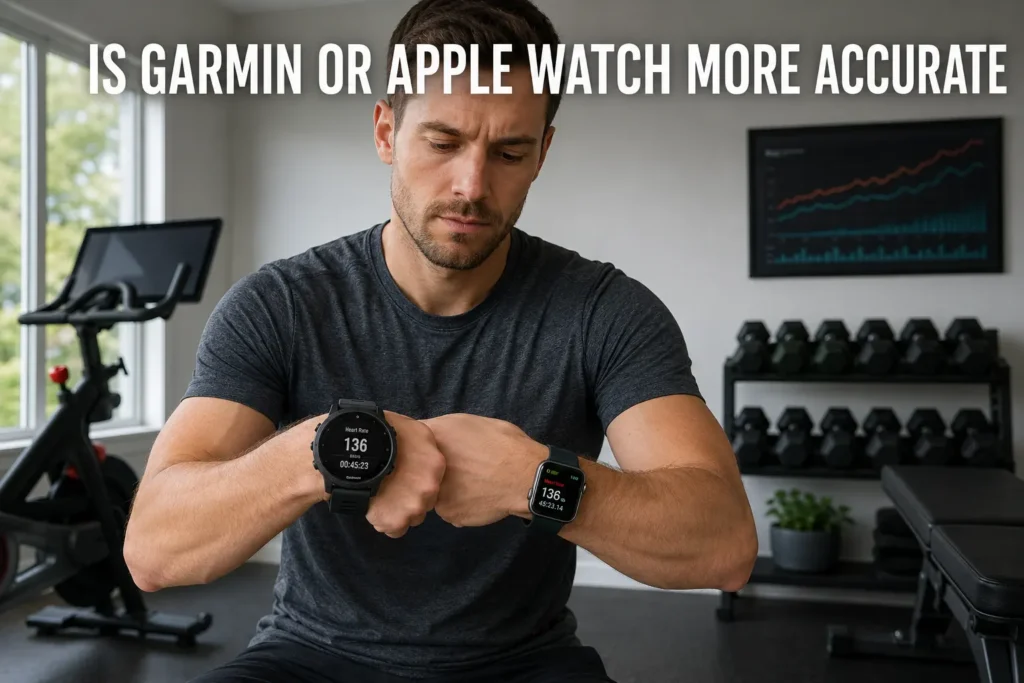
Is Garmin or Apple Watch more accurate for the fitness metrics that matter most to you? The honest answer depends on which measurement you are trying to nail down. Both brands invest heavily in sensor technology, but peer-reviewed research reveals clear differences across heart rate monitoring, GPS distance, step counting, calorie estimation, and sleep tracking. In our research into this comparison, we found that no single watch dominates every category. This guide breaks down what the science actually shows so you can match the right device to your specific fitness goals.

Is Garmin or Apple Watch More Accurate for Heart Rate Tracking?
Heart rate accuracy is where most anyone starts, and with good reason. It drives training zones, calorie calculations, and recovery scores on both platforms.
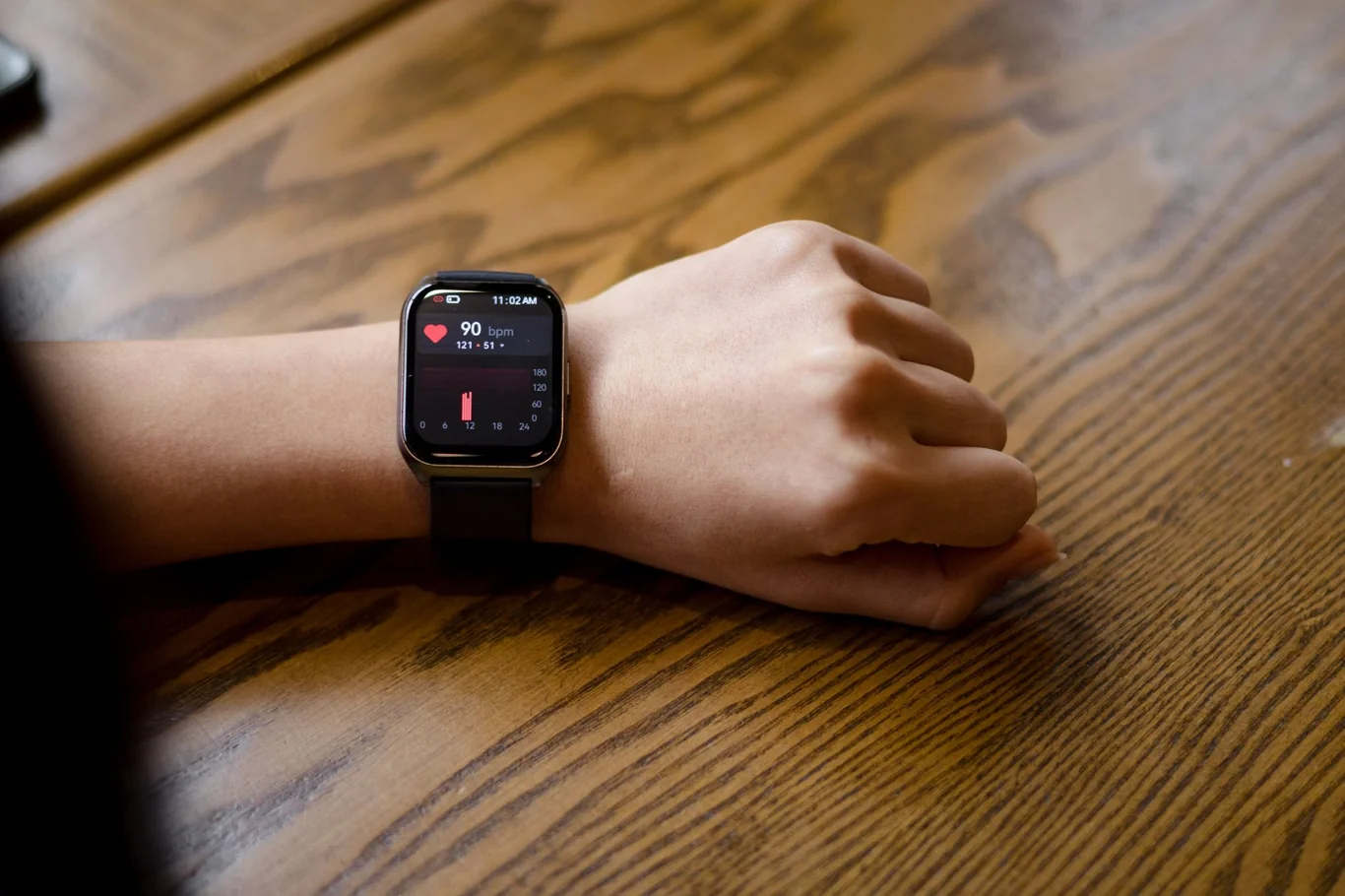
A 2026 systematic review of 216 wearable devices found Apple Watch Series 6 and 9 achieved excellent heart rate validity (r=0.98) with a mean bias of only -0.11 bpm against medical-grade reference devices (1). Garmin vívosmart 4 and 5 also met the clinical threshold in the same analysis, though with a larger mean bias of 1.76 bpm and an intraclass correlation coefficient of 0.76. Both watches passed, but Apple Watch edged ahead on this metric.
A controlled study in 50 Special Forces soldiers during high-intensity combat training found Apple Watch Series 5 delivered valid heart rate data, with 97.5% of readings within ±3 bpm of a Polar chest strap reference (2). A separate study of 260 cardiac patients confirmed Apple Watch achieved excellent heart rate validity (ICC > 0.95) across rest, light exercise, and recovery phases (3).
Garmin's optical sensors are competitive in their own right. A laboratory study testing the Garmin Vivosmart HR+ in 40 adults across treadmill, cycling, and elliptical activities found mean absolute percentage error between 3.77% and 4.73%, depending on participant age (4). That is well within the acceptable range for practical fitness monitoring.
Condition | Apple Watch | Garmin | Edge |
Resting heart rate | Bias -0.11 bpm, r=0.98 | Bias 1.76 bpm, ICC=0.76 | Apple Watch |
Steady-state cardio | 97.5% within ±3 bpm of chest strap | MAPE 3.77-4.73% | Comparable |
High-intensity intervals | Some lag on rapid spikes | Conservative on rapid spikes | Neither |
Cardiac population use | ICC > 0.95 across conditions | Limited clinical data | Apple Watch |
The key caveat for both devices: During rapid heart rate spikes, such as sprint intervals or circuit training, wrist-based optical sensors lag behind the actual value. A chest strap is still the gold standard for interval training accuracy. For steady-state cardio and daily resting heart rate monitoring, both watches are reliable for practical purposes.
For athletes who want a secondary check against wrist sensor data, my guide on how to check heart rate on iPhone covers five methods including camera-based apps and Bluetooth chest strap pairing that deliver accurate spot readings without a wearable.
During sleep, where movement artifacts are minimal, Apple Watch accuracy improves considerably, as my Apple Watch sleep tracking breakdown covers in detail.
For those who want to see how accuracy considerations shape broader purchasing decisions, our best fitness tracker for men guide applies this same research lens to a wider range of devices.
GPS Tracking - How Accurate Are Garmin and Apple Watch?
GPS accuracy matters most if you track outdoor runs, cycling routes, or hikes. Both watches use multi-constellation satellite systems, but Garmin invests more deeply in multi-band GNSS technology on its premium models.
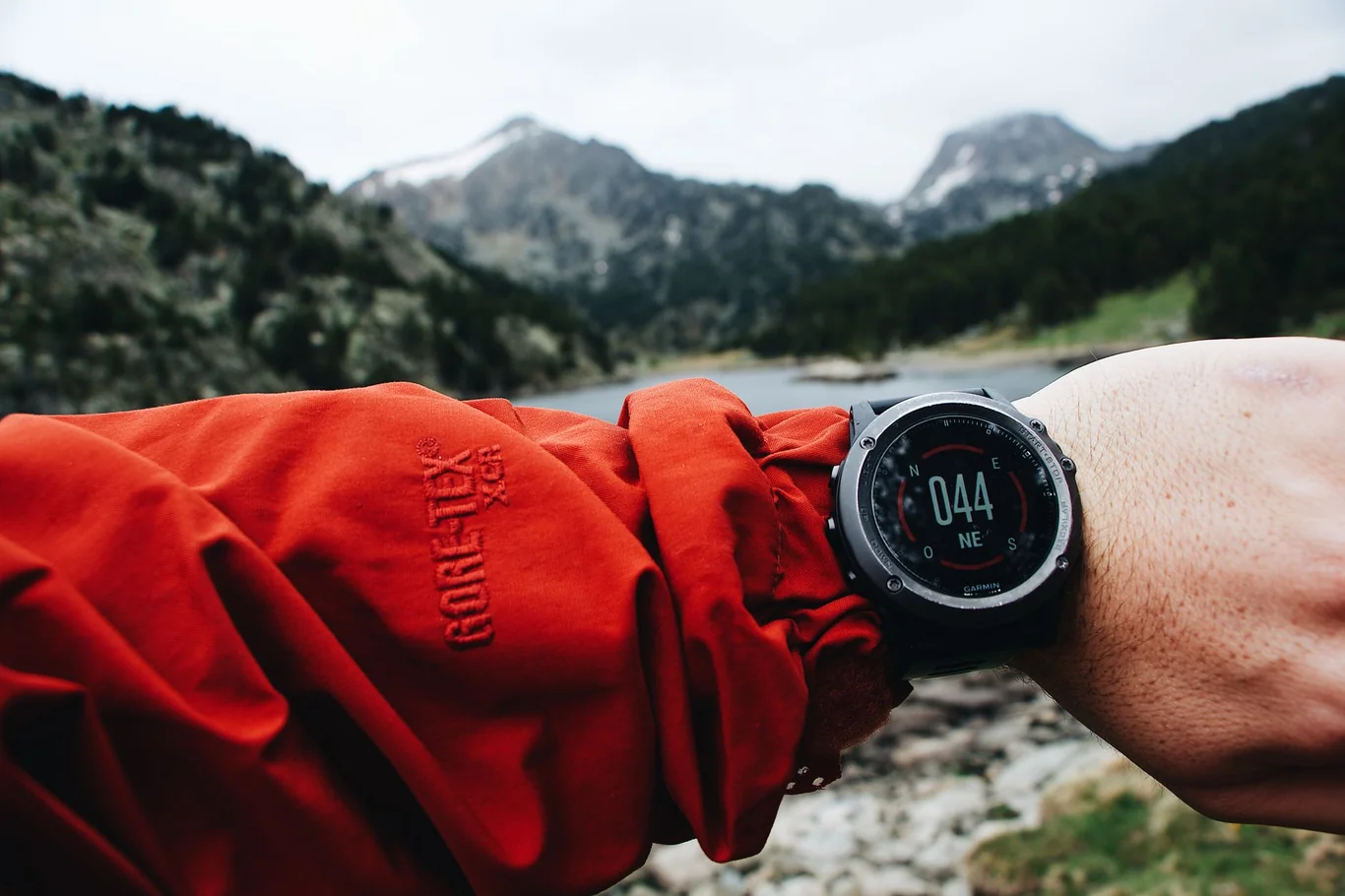
In real-world half-marathon testing, Garmin devices typically recorded distances within 0.05 miles of an official course measurement. Apple Watch showed similar performance on standard road routes but demonstrated more signal drift on winding trails or in dense urban canyons, where satellite interruptions are more frequent. The Garmin Forerunner line, which uses GPS combined with GLONASS and Galileo systems simultaneously on higher-end models, shows a measurable advantage in environments where single-band receivers struggle.
For a full breakdown of how Apple Watch hardware and GPS capabilities have evolved, my Apple Watch model history maps every series in chronological order.
Runners who need reliable GPS for training logs and race analysis will find the most relevant options in my running fitness tracker guide.
Tips for maximizing GPS accuracy on either watch:
- Wait 15-30 seconds after starting the workout before moving: both watches need a full satellite lock
- Keep the watch face oriented upward and away from large metal objects during outdoor use
- Update firmware regularly: both brands push algorithm improvements that affect GPS calculation
- For trail running or hiking, Garmin's offline topographic maps provide a practical navigation advantage beyond raw accuracy
- In open-sky conditions like track running or road cycling, the difference between the two brands is minimal
Garmin's GPS edge is most meaningful for trail sports, alpine activities, and structured outdoor training. For urban runs on standard measured courses, the practical difference is small. Our best budget fitness tracker guide covers how entry-level GPS options compare on the same accuracy criteria.
Step Counting - Which Watch Tracks Daily Activity More Accurately?
Step counting is often underestimated in high-tech comparisons, but it matters for anyone using a daily step goal as a health benchmark. When evaluating the most accurate step counter watch options, both brands perform well, though in slightly different scenarios.
For a broader comparison of how different device types and placements affect counting precision, my most accurate step counter guide covers what the research shows across smartwatches, clip-ons, and phone apps.
For users who find the smartwatch feature set broader than their needs, my comparison of fitness trackers versus smartwatches covers which category delivers more value for health-focused buyers.
A controlled comparison using a mechanical shaker table found Apple Watch Series 7 demonstrated superior accelerometry accuracy (ICC=0.99) compared to Garmin Vivoactive 4S (ICC=0.88) under laboratory conditions (5). However, real-world results in everyday free-living conditions present a more nuanced picture.
A study of 104 healthy adults over 24 hours of free-living wear found Apple Watch 6 achieved strong step-count validity (r=0.986, MAPE 6.4%) against a research-grade accelerometer reference (6). Independent hands-on testing has consistently placed Garmin Forerunner models at the top for running step accuracy, with some models recording as few as 1-15 steps of variance over a 6,000-step test.
Where both watches undercount steps regardless of brand:
- Pushing a stroller or shopping cart: arm movement does not match leg movement
- Elliptical machine sessions: the motion pattern confuses both acceleration algorithms
- Carrying items in both hands: reduced arm swing lowers detection rates
- Slow shuffling or pacing in place: neither device reliably counts steps below a certain movement threshold
We found that the most consistent recommendation across user testing data points to the premium Garmin Forerunner line for athletes focused on running accuracy, while Apple Watch performs comparably well for general daily activity tracking. For people exploring ankle-based sensor alternatives, the best ankle fitness tracker guide covers devices that place sensors closer to the foot for more consistent all-day step counts.
Calorie Burn Estimates - Where Both Watches Fall Short
This is the one category where both Garmin and Apple Watch deserve honest scrutiny. Calorie estimation is the least accurate metric on any wrist-worn device, and treating these numbers as precise is a mistake regardless of which brand you choose.
Fitbit has the same limitation across its lineup, and my Fitbit models guide covers which current devices perform best for the metrics that do hold up to scrutiny.
For those deciding between the two on price, my guide to how much do Apple Watches cost breaks down every model tier alongside where Garmin equivalents land.
For those still deciding whether the investment makes sense, my breakdown of whether a smartwatch is worth buying works through the categories of users who get consistent long-term value.
A controlled outdoor study found Apple Watch Series 6 showed a 19.8% mean absolute percentage error for walking energy expenditure and a 24.4% error for running, measured against indirect calorimetry (7). Garmin FENIX 6 in the same study showed 32.0% error for walking and 21.8% for running. A high-intensity military training study reinforced this finding: Apple Watch Series 5 overestimated energy expenditure by 11.3%, while Garmin Forerunner 935 overestimated by 15.3% (Macêdo et al., 2024). Neither watch met accepted accuracy standards for energy expenditure in either study.
Why calorie estimates are always imprecise on wrist devices:
- Wrist-based sensors cannot measure actual metabolic rate: they use acceleration and heart rate as proxies
- Individual differences in body composition, fitness level, and metabolism create large variability
- Both brands use proprietary algorithms that have not been independently validated across all activity types
- Ambient temperature, skin tone, tattoos, and wrist position all affect optical sensor readings
Garmin algorithms incorporate VO2 max estimates, Training Load, and personalized performance baselines, which can improve relative calorie trend tracking over time for consistent exercisers. Apple Watch uses a model that does not personalize as deeply for athletic performance contexts. Neither is accurate enough for precise dietary planning. Use both as directional estimates only, not as a calorie budget you plan meals around.
If tracking output alongside a weight-management goal, pairing your watch data with a dedicated best calorie tracker approach and understanding these limitations will give you a more realistic picture than relying on wrist data alone.
Sleep Tracking - What Garmin and Apple Watch Can and Can't Do
Sleep tracking accuracy is harder to evaluate than heart rate or steps because validated sleep measurement requires clinical polysomnography: a medical standard no consumer wearable meets. We want to be upfront about what these devices actually measure versus what they estimate from movement and heart rate data.
Blood pressure detection has the same gap between clinical standard and wearable estimation, and my do apple watches measure blood pressure guide draws that line clearly.
An independent analysis of Apple Watch 2 across multiple activity states found sleep duration measurement showed a mean absolute percentage error of 0.11, which means it performed reasonably well at tracking total time asleep but showed less reliability when distinguishing detailed sleep stages (8). Standard Apple Watch sleep tracking uses movement patterns to infer sleep versus wake states. The dedicated Sleep app added in later watchOS versions improved detection, but the fundamental wrist-based measurement limitation remains.
For sleep tracking as the primary use case, my guide to the best fitness trackers for sleep monitoring covers the devices with the most validated staging data.
Garmin's approach on premium models like the Forerunner 970, Fenix 8, and Venu 4 includes:
- REM, light, and deep sleep stage estimation using movement and heart rate combined
- Body Battery recovery score that integrates sleep quality into next-day readiness
- Overnight blood oxygen monitoring on supported models
- HRV (heart rate variability) tracking throughout the night for stress and recovery insight
The honest limitation both brands share: Wearable devices measure movement and infer sleep from physiological proxies. Subjective sleep quality often diverges from what either watch reports. If you wake multiple times during the night, both devices tend to undercount those interruptions. Neither watch replaces a clinical sleep study.
Users who want sleep data without the power demands of a full smartwatch will find purpose-built alternatives in my top fitness tracker guide.
Garmin offers a richer sleep interface and more data points on its premium tier, which makes it the stronger choice if sleep and recovery analysis are primary goals. For populations where easy-to-read overnight data is a priority, our best fitness tracker for seniors guide covers how sleep tracking holds up across age groups with different needs.
Which Is More Accurate Overall - Garmin or Apple Watch?
Neither watch is universally more accurate than the other. The answer depends on which metrics you prioritize and how you train.
For readers ready to choose, my guide to the best fitness watches for accuracy covers the top-performing models across GPS, heart rate, and sleep categories.
Metric | More Accurate Watch | Research Confidence |
Resting heart rate | Apple Watch (slight edge) | High |
Steady-state active heart rate | Comparable | High |
Interval training heart rate | Comparable, both lag | Moderate |
GPS distance (open sky) | Comparable | Moderate |
GPS distance (trail and urban canyon) | Garmin | Moderate |
Step counting during running | Garmin (slight edge) | Moderate |
Step counting during daily activity | Comparable | High |
Calorie estimation | Neither is accurate | High, both overestimate |
Sleep duration | Comparable | Moderate |
Sleep stage analysis | Garmin (premium models) | Moderate |
SpO2 monitoring | Comparable | Moderate |
Choose Garmin If
- You train for running, cycling, triathlon, hiking, or multi-sport events
- Offline topographic maps and trail navigation matter for your activities
- Training Load, Body Battery, and detailed recovery metrics are part of your routine
- You use an Android phone or want a watch that is not tied to the Apple ecosystem
- Battery life extending beyond two days is a non-negotiable priority
- You want the most detailed sports-specific sensor optimization for swimming, trail running, and cycling
Choose Apple Watch If
- You are deeply integrated into the Apple ecosystem with an iPhone, iPad, or Mac
- Seamless notifications, Siri access, and third-party app connectivity on your wrist matter
- AFib detection and ECG functionality are medically relevant to your health situation
- General health monitoring matters more than sport-specific performance tracking
- You prioritize how accurate smartwatches are for heart rate in everyday and clinical contexts, where Apple Watch has the most validation data
- The watchOS app ecosystem and Apple Health integration are part of your daily workflow
The Bottom Line on Accuracy
Garmin holds a meaningful edge in GPS performance for challenging terrain, sports-specific sensor optimization, and step counting during runs. Apple Watch leads in heart rate accuracy in stable and clinical conditions, and integrates more seamlessly with the Apple ecosystem for general health monitoring. On calorie burn, both brands overestimate, and neither deserves your full confidence.
The deeper question behind this comparison is addressed in my guide on how accurate are smart watches for heart rate, which covers the research across devices, activities, and skin tones.
Our recommendation: base your choice on how you actually train. If fitness tracking is casual and you value a connected daily companion, Apple Watch is the stronger everyday device. If structured athletic training with detailed performance recovery data drives your workout decisions, Garmin's investment in sensor precision and sports analytics pays off.
For those new to the category, my overview of what a smartwatch does beyond accuracy metrics covers the full feature range across both platforms.
A useful tip we carry from our review methodology: check your heart rate device against a simple chest strap for two weeks before trusting wrist data for training zones. Both watches have earned that trust in steady-state conditions, but knowing your own watch's behavior under your specific training style is more valuable than any brand comparison.
Once you have picked your platform, the next step is structured in my guide on workout tracking methods, which covers how to get consistent, comparable data from whichever device you choose.
Our best fitness tracker for women guide applies these same accuracy principles to specific real-world use cases. Building your decision around the metrics you actually track, rather than which brand name sounds more precise, is the most practical approach for long-term satisfaction.
FAQs
Do cardiologists recommend Apple Watch?
Cardiologists cautiously recommend Apple Watch for general cardiovascular health screening, specifically for its ECG feature and irregular rhythm notifications available on Apple Watch Series 4 and later models. However, they are clear that the optical heart rate sensor is not a diagnostic device and should not replace clinical evaluation or medical-grade monitoring equipment for patients with known cardiac conditions.
Which smartwatches are most accurate?
The most accurate smartwatches for combined fitness metrics include the Garmin Forerunner 970 for sports-specific accuracy across heart rate, GPS, and step counting, and the Apple Watch Ultra for ecosystem integration alongside strong heart rate sensor performance in everyday conditions. The best choice for accuracy depends on the specific metric and activity type you are measuring.
For Android users working through this decision, my guide on Apple Watch ecosystem compatibility covers the full picture of what features depend on iPhone and which alternatives close the gap.
Is Garmin worth it over Apple Watch?
Garmin is worth choosing over Apple Watch if you train seriously for running, cycling, triathlon, or outdoor sports that benefit from offline navigation, detailed recovery metrics, and extended battery life. For general health tracking, daily notifications, and iPhone ecosystem integration, Apple Watch delivers comparable core accuracy with a more connected user experience at a similar investment level.
Apple Watch also carries a 50-meter water resistance rating across all current models, and my guide on Apple Watch water resistance covers what that rating actually means for swimmers and open-water athletes.
What can a Garmin do that an Apple Watch can’t?
Garmin offers offline topographic maps and turn-by-turn navigation without a cellular connection, which Apple Watch does not support. It also provides Training Load, Body Battery, and more than 30 dedicated sport profiles covering activities from trail running to kayaking to golf. Garmin's multi-band GNSS on flagship models improves GPS accuracy in dense terrain, its flagship battery life reaches 14 or more days, and it works with Android and non-Apple smartphones without any feature restrictions.
For a full ranking of how that battery advantage compares across Garmin, COROS, and Amazfit, my smartwatch battery life guide covers the top performers in each category.
We are always looking for expert inputs to make our content even better and more useful.
References:
- Alharbi M, Kaewkannate K, Albakri A, et al. Selecting Wearable Devices to Measure Cardiovascular Functions in Community-Dwelling Adults: Application of a Practical Guide for Device Selection. Sensors. 2024;24(3):750. doi:10.3390/s24030750
- Macêdo TM, Martins RL, Freire PM, et al. Validity of Apple Watch, Garmin Forerunner 935 and GENEActiv for estimating energy expenditure during close quarter battle training in Special Forces soldiers. Eur J Sport Sci. 2024;24(3):447-456. doi:10.1080/17461391.2024.2304356
- Khalife B, Keshavarz M, Ghavamzadeh S, et al. Accuracy of Apple Watch to Measure Cardiovascular Indices in Patients with Cardiac Diseases: Observational Study. JMIR Cardio. 2024;8(1):e55324. doi:10.2196/55324
- Lee JM, Kim Y, Seo DI, et al. Accuracy of Optical Heart Rate Sensing Technology in Wearable Fitness Trackers for Young and Older Adults: Validation and Comparison Study. JMIR Mhealth Uhealth. 2020;8(4):e14684. doi:10.2196/14684
- Dondzilo CJ, Strath SJ, Swartz AM. Comparison of raw accelerometry data from ActiGraph, Apple Watch, Garmin, and Fitbit using a mechanical shaker table. JMIR mHealth uHealth. 2024;12(1):e48269. doi:10.2196/48269
- Shin JI, Kim JH, Choi JW, et al. Apple Watch 6 vs. Galaxy Watch 4: A Validity Study of Step-Count Estimation in Daily Activities. Sensors. 2024;24(14):4658. doi:10.3390/s24144658
- Huang Y, Wang C, Pan Y, et al. Validity of three smartwatches in estimating energy expenditure during outdoor walking and running. J Sports Sci Med. 2022;21(1):117-125.
- Düking P, Achtzehn S, Holmberg HC, Sperlich B. Evaluating the Validity of Current Mainstream Wearable Devices in Fitness Tracking Under Various Physical Activities: Comparative Study. JMIR mHealth uHealth. 2018;6(12):e10872. doi:10.2196/10872