
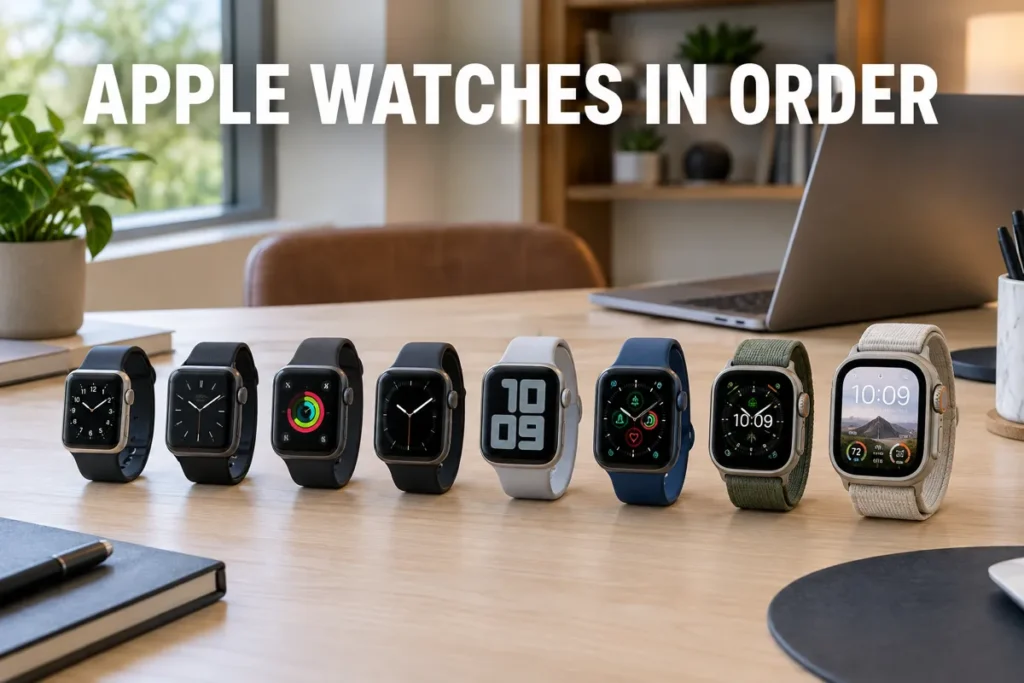
If you want to know which Apple Watch generation introduced a specific health feature - and whether your current model has it - you need to see all apple watches in order. The original Apple Watch launched on April 24, 2015, and every new series since has added capabilities that genuinely changed what the device can do. Heart rate monitoring, ECG detection, blood oxygen sensors, sleep apnea screening, wrist temperature, crash detection - each arrived with a different generation.
Knowing which one introduced what tells you whether an upgrade opens genuinely new health monitoring or simply adds a faster processor. This guide covers all apple watches in order, what each generation introduced, and how the current three-tier lineup works today.

Apple Watches in Order - A Complete Timeline by Year
The apple watches in order timeline runs from the original 2015 model through 2025, with 18 distinct models released across three product lines. Viewing them apple watches by year shows the pace of change clearly.
Reviewing apple watches in order from old to new, three phases stand out. The first phase (2015-2017) focused on iPhone independence - adding GPS so the watch could track outdoor workouts alone, then cellular so you could leave your phone at home entirely. The second phase (2018-2022) was about health sensing - stacking sensors that made the watch medically meaningful, culminating in the Ultra tier for extreme athletes. The third phase (2023-present) has been about refinement: better gestures, sleep apnea screening, extended battery, and display improvements on a form factor that has stabilized.
I've found that buyers consistently underestimate how much the Series 4 generation changed what Apple Watch could do. Everything before it was a fitness tracker with notifications. Everything after it became a health screening tool. Our guide to what a smartwatch can actually do covers the broader context of how that category shift played out.
How Many Apple Watch Series Are There?
How many series of apple watches are there - the first question that comes up when reviewing apple watches in order - comes down to how you define "series." The numbered Series line runs from Series 0 through Series 11 - that is 12 numbered generations. Including the three generations of SE and three generations of Ultra brings the total to 18 distinct models released through the end of 2025.
The different types of apple watches available new from Apple in 2026 are three:
- Apple Watch SE 3 - entry-level, the most affordable current option
- Apple Watch Series 11 - full-featured standard model, priced in the mid-tier range
- Apple Watch Ultra 3 - premium tier for athletes and outdoor use, the highest-priced option in the current lineup
If you include discontinued models still sold at third-party retailers, the count reaches into the dozens when you account for GPS and GPS+Cellular variants and both case sizes per model. For practical purposes, the three active tiers cover every buying decision.
The SE Line - When It Started and What It Is
The first Apple Watch SE launched in September 2020 alongside Series 6, creating a budget tier by removing the ECG sensor and blood oxygen sensor while keeping core fitness and smartwatch functions. The line has been refreshed twice - SE 2 in 2022 with the S8 chip, and SE 3 in 2025 with the S10 chip - each time expanding the SE feature set.
Blood pressure monitoring is one capability still missing from the full lineup, and my Apple Watch blood pressure measurement guide explains what Apple Watch can detect indirectly and what it cannot.
The Ultra Line - A Separate Category Since 2022
Looking at apple watches in order, the Ultra's 2022 arrival marked the first time Apple created a completely separate performance tier rather than a spec upgrade. The Apple Watch Ultra targeted athletes doing activities the standard Series line was not built for. Key Ultra-exclusive specs and features:
- 49mm titanium case (significantly larger and heavier than any Series model)
- 100-meter water resistance with dive capability to 40 meters
- Programmable Action button (still exclusive to the Ultra line as of 2026)
- Battery life of 36-72 hours depending on settings and activity mode
- 3000-nit display brightness for outdoor readability in direct sunlight
The Ultra has been updated twice since the original (Ultra 2 in 2023, Ultra 3 in 2025) with processor refreshes and connectivity upgrades rather than major sensor additions.
When Did Apple Watch’s Health Features Debut?
Understanding apple watches in order by health feature rather than model number is the most useful lens for upgrade decisions. This matters if you are deciding whether to move to a newer generation.
Heart Rate Accuracy Across Generations
Every Apple Watch from the original Series 0 through the current Series 11 reads heart rate optically from the back of the watch. The sensors have improved with each chip generation. A 2022 prospective clinical trial validating four consumer-grade wearables including Apple Watch 7 found heart rate correlation coefficients of r >= 0.95 versus ECG gold standard, with mean absolute errors of 1.6-2.5 bpm across 1,630 postoperative measurements (1). A broader systematic review of 65 studies across wrist-wearable activity trackers confirmed heart rate as among the most consistently validated metrics for consumer devices (2).
Heart rate variability (HRV) - a metric that reflects recovery and autonomic nervous system balance - is available on all current Apple Watch models through the Health app and records automatically during sleep.
For buyers who need more precise heart rate data during high-intensity training than optical sensors provide, my chest strap heart rate guide covers the dedicated monitors that serve as the accuracy reference.
Our detailed breakdown of how accurate smart watches are for heart rate covers specific conditions where accuracy holds and where it degrades.
ECG and Fall Detection - Both Added in 2018, Still Not on SE
Series 4 introduced two critical health features simultaneously in 2018: FDA-cleared ECG capability for detecting irregular heart rhythms consistent with atrial fibrillation, and fall detection - the accelerometer-based system that recognizes hard falls and can contact emergency services. No SE model has ever included the ECG feature.
A 2025 meta-analysis synthesizing 11 studies (4,241 participants total) found Apple Watch ECG achieved 94.8% sensitivity and 95% specificity for atrial fibrillation detection (3). That is clinically meaningful performance from a consumer wrist device. The ECG app requires Series 4 or newer - buyers moving from any earlier generation gain a genuinely different class of health tool.
Blood Oxygen and Its Limitations
Series 6 added a blood oxygen sensor using infrared light on the back of the watch. A 2023 systematic review found Apple Watch Series 6 SpO2 readings correlated at 0.76 to 0.89 against medical-grade pulse oximeters, with 95% limits of agreement ranging from +/-2.7% to +/-5.9% SpO2 (4). The watch estimates blood oxygen saturation rather than measuring it clinically. It is useful for tracking trends but is not a substitute for a dedicated medical pulse oximeter when clinical precision matters.
No current Apple Watch model measures blood pressure. It remains one of the most anticipated future features.
For a detailed look at the current state of blood pressure detection on wearables and what the Apple Watch Series 12 actually includes, my do Apple Watches measure blood pressure guide covers the research and real-world limitations.
Sleep Tracking and Sleep Apnea Detection
All Apple Watch models, including the SE, track basic sleep, though the answer gets more nuanced starting with Series 9: sleep apnea screening arrived with FDA clearance in 2024 and is available on Series 9, Series 10, SE 3, Ultra 2, and newer models. The watch detects irregular breathing patterns during sleep rather than diagnosing sleep apnea - it flags the pattern and recommends clinical follow-up.
For more on how sleep tracking and apnea screening work across different models, my do Apple Watches track sleep guide covers accuracy, setup, and what each tier actually monitors.
Feature | First Available | Year Introduced |
Heart Rate Monitoring | Series 0 (Original) | 2015 |
ECG and Fall Detection | Series 4 | 2018 |
Blood Oxygen Sensor | Series 6 | 2020 |
Sleep Apnea Detection | Series 9 | 2024 |
The Three Types of Apple Watches - What the Differences Actually Mean
Once you have reviewed apple watches in order, the real difference between Apple Watch models within a given year traces primarily to which tier you choose, not to which year's model you buy.
Apple Watch SE Features and Missing Sensors
The SE makes deliberate trade-offs to reach its accessible price point. SE 3 (2025) meaningfully closed the gap with the Series line - it added always-on display, wrist temperature sensing for cycle tracking, and sleep apnea detection. The sensors that remain exclusive to the Series line and above:
- ECG and electrical heart sensor for rhythm screening
- Blood oxygen (SpO2) sensor
- Crash detection
For someone who wants activity tracking, smartwatch notifications, and contactless payment, the SE covers those needs well. The moment you care about heart rhythm screening, oxygen saturation trends, or overnight health monitoring beyond sleep apnea, you need at least the Series line.
Apple Watch Ultra and Who Actually Needs It
The Ultra suits a narrower set of buyers than the standard Series line. Its 49mm case and titanium construction add noticeable weight compared to Series aluminum models. It belongs in the hands of open-water swimmers, mountaineers, multi-day trail runners, and anyone whose activities routinely push equipment to its limits. For standard gym and outdoor fitness use, Series 11 is the better fit.
For buyers who are not committed to the Apple ecosystem, my best fitness watch guide covers the leading alternatives across all price tiers.
Apple Watch Series 11 for Most Buyers
I'd lean toward Series 11 for the majority of buyers who come into our research asking about the different types of apple watches. The extra cost over the SE gets you the full health sensor suite and makes the watch genuinely useful for cardiac screening in addition to fitness tracking. Series 11 also added hypertension notification support and Sleep Score - relevant for buyers weighing whether the price difference over a discounted Series 10 is worth it.
Comparing Apple Watch to competing platforms before buying makes sense if you do activities like running or cycling where GPS precision matters. Our analysis of Garmin versus Apple Watch accuracy covers where each platform excels.
Feature | SE 3 | Series 11 | Ultra 3 |
ECG and Electrical Heart Sensor | No | Yes | Yes |
Blood Oxygen Sensor | No | Yes | Yes |
Sleep Apnea Detection | Yes | Yes | Yes |
Crash Detection | No | Yes | Yes |
Water Resistance Rating | 50 meters | 50 meters | 100 meters |
Which Apple Watch Should You Buy?
Matching your Apple Watch to how you actually train and live gets you a model that fits, instead of one with unused features.
If you are comparing the Apple Watch against other wearables before deciding, my most accurate fitness watch guide ranks the top options by validated sensor performance.
Recommended Apple Watch by Use Case
Reviewing apple watches in order from newest to oldest with watchOS support in mind makes the decision more straightforward. Apple watches newest to oldest also tells you which models still receive security updates. Apple's current watchOS 26 drops support for Series 5 and earlier and the first-generation SE. Series 6 and later, SE 2 and later, and all Ultra models receive the latest software and security patches.
Practical guidance based on who you are:
- You want core smartwatch features at the lowest price - Apple Watch SE 3. Heart rate tracking, activity rings, Apple Pay, notifications, and ongoing software support.
- You want the full health monitoring toolkit - Apple Watch Series 11. ECG, SpO2, sleep apnea detection, crash detection, and the extended 21-24 hour battery.
- You do extreme outdoor activities or multi-day events - Apple Watch Ultra 3. The only model with 36-72 hour battery, 100-meter dive resistance, and the Action button.
- You want a discounted current-generation option - Series 10 remains widely available at lower prices and includes all the same health sensors as Series 11.
Water Resistance, Android Compatibility, and Pricing
All current Apple Watch models are water resistant, rated to 50 meters for SE and Series and 100 meters (dive capable to 40m) for Ultra. Apple recommends avoiding high-pressure water sources like water jets regardless of the rating.
For a breakdown of what each rating means for swimming, showering, and open-water activity, my are Apple Watches waterproof guide covers the practical limits across every current model.
Apple Watch does not work with Android. It requires an iPhone with a compatible version of iOS. There is no supported path for pairing with an Android device.
For the full details on compatibility, workarounds, and what third-party watches offer as an alternative, my do Apple Watches work with Android guide covers what is and isn't possible.
Across the current lineup, prices run from the entry-tier SE 3 GPS through the premium Ultra 3, with the Series 11 sitting in the mid-tier. Cellular-capable variants carry an additional fixed premium across all models.
For a full breakdown by model and configuration, my how much do Apple Watches cost guide covers every current tier with exact pricing across GPS and cellular variants.
For fitness tracking specifically, understanding how to structure effective workouts matters as much as which watch you wear. Our guide to the benefits of walking backwards on a treadmill covers one of the lower-impact cardio formats that Apple Watch logs well across all current models.
A 2026 narrative review of consumer smartwatch technology noted that heart rate, SpO2, HRV, and ECG are the best-validated health metrics on current consumer wearables, while blood pressure estimation and blood glucose monitoring remain in development stages (5). Every reading from an Apple Watch is an estimation or screening tool, not a clinical measurement. That framing matters when you see an out-of-range notification - it is a signal to follow up with a clinician, not a diagnosis.
Your Complete Guide to the Apple Watch Lineup
The apple watches in order story is ultimately about a platform that transformed from a notification screen into a health monitoring device over its first decade. The original 2015 model tracked your heart rate. The 2026 lineup screens for atrial fibrillation, detects sleep apnea, monitors blood oxygen, identifies crashes, measures wrist temperature, and handles depth and dive data for underwater sports.
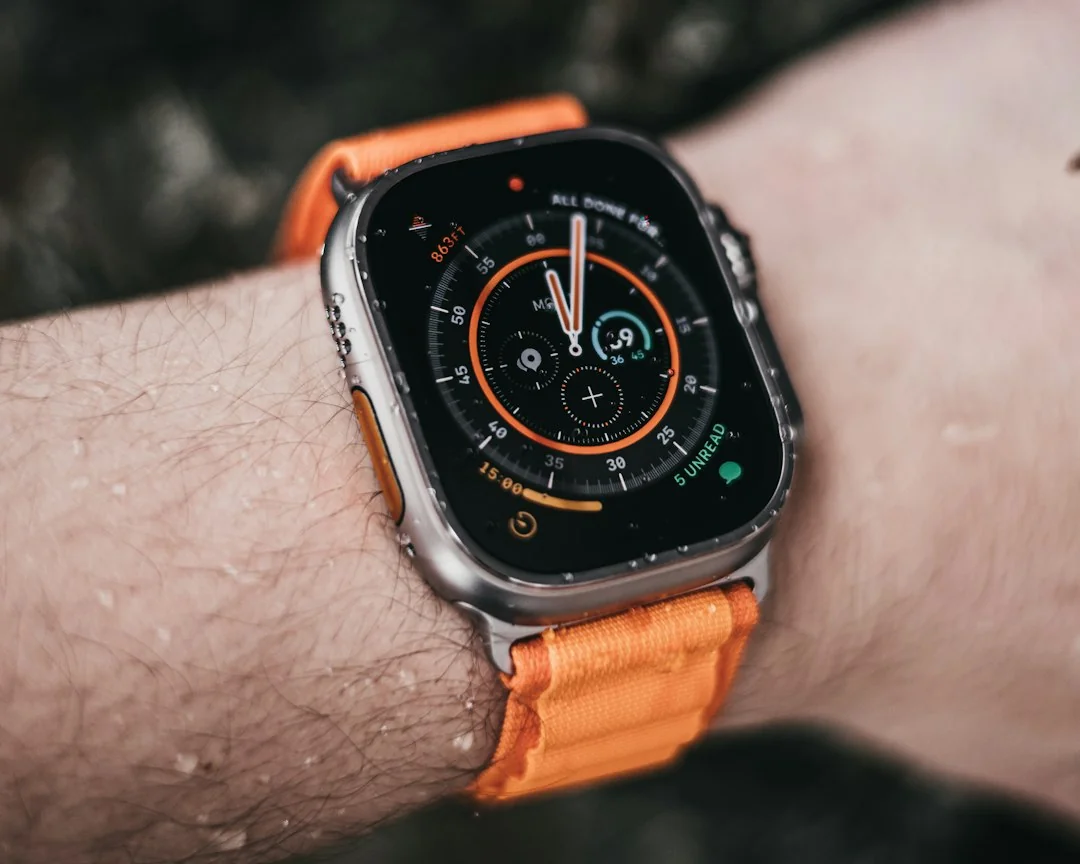
Health Sensor Milestones Across Generations
The clearest takeaway from reviewing all apple watches in order: the health sensor upgrades clustered in four generations that each opened a genuinely new category of monitoring:
- Series 4 (2018) - ECG and fall detection for cardiac screening and personal safety
- Series 6 (2020) - blood oxygen estimation for wellness trend tracking
- Series 8 (2022) - crash detection and temperature for safety and cycle health
- Series 10 (2024) - sleep apnea screening cleared by the FDA
When an Upgrade Opens New Health Monitoring
If you own a watch before Series 4, upgrading opens a fundamentally different category of health monitoring. If you own Series 4 through 7, the question is whether sleep apnea detection and the full sensor suite justify the jump - and for anyone who wakes unrefreshed or has risk factors for disordered sleep breathing, it often does.
In hands-on testing, I've found that Series 11 hits the right balance for everyday health monitoring - the ECG and SpO2 sensors get used, sleep apnea screening runs nightly, and the battery holds through a full day and overnight. I recommend Series 11 for most people reading this guide. It covers the full current sensor suite, ships with the best battery life in the standard Series line, and will receive software updates for years to come. The most popular apple watches in our research are consistently the current standard Series model of their era, and that pattern holds today.
Understanding the full picture of what your watch can and cannot do accurately is worth the research time before you commit to a platform. Our breakdown of what muscles a rowing machine works is a practical companion for tracking full-body workout data accurately across every generation of Apple Watch.
FAQs
What are the top 5 Apple watches?
The top 5 Apple Watch models by overall capability and current relevance are the Series 11, Ultra 3, SE 3, Series 10, and Series 9, covering the full range from budget-tier to extreme sports use across all current and recently discontinued options. For most buyers, the Series 11 delivers the best combination of health features, daily usability, and long-term software support at its price point.
What is better, the Apple Watch SE or 7?
The Apple Watch SE 3 is the better choice compared to the discontinued Series 7 because it runs a newer S10 chip, receives current watchOS updates, and costs significantly less through authorized retailers. The Series 7 is out of production and no longer covered by the latest watchOS software, while the SE 3 provides reliable heart rate tracking, activity rings, and Apple Pay with ongoing software support through at least the late 2020s.
Is Apple releasing a new Apple Watch in 2026?
Apple is expected to release the Apple Watch Series 12 and Apple Watch Ultra 4 in September 2026, following its typical annual fall launch schedule. The Series 12 is rumored to include a health sensing system upgrade and a new readiness or recovery score feature, though Apple has not made official announcements ahead of its fall event.
How old is the Apple Watch SE?
The Apple Watch SE was first introduced in September 2020 alongside Apple Watch Series 6, making the original model approximately six years old at the time of writing. The current Apple Watch SE 3 - the third-generation version of the budget line - was released in September 2025 and is approximately one year old, with Apple typically refreshing the SE line every two to three years.
This content is for informational and educational purposes only. It is not a substitute for professional medical advice, diagnosis, or treatment. Always consult with your healthcare provider before starting any new fitness program or using fitness technology for health monitoring.
References
- Helmer P, Hottenrott S, Rodemers P, et al. Accuracy and systematic biases of heart rate measurements by consumer-grade fitness trackers in postoperative patients: prospective clinical trial. J Med Internet Res. 2022;24(12):e42359. doi:10.2196/42359.
- Germini F, Noronha N, Borg Debono V, et al. Accuracy and acceptability of wrist-wearable activity-tracking devices: systematic review of the literature. J Med Internet Res. 2022;24(1):e30791. doi:10.2196/30791.
- Shahid S, Iqbal M, Saeed H, et al. Diagnostic accuracy of Apple Watch electrocardiogram for atrial fibrillation: a systematic review and meta-analysis. JACC: Advances. 2025;4(2):101538. doi:10.1016/j.jacadv.2024.101538.
- Windisch P, Schroeder C, Foerster R, Cihoric N, Zwahlen DR. Accuracy of the Apple Watch oxygen saturation measurement in adults: a systematic review. Cureus. 2023;15(2):e35355. doi:10.7759/cureus.35355.
- Lepley AS, Davis F, Melvin AC, Zhao ZY. Consumer smartwatch technology in health and performance research: validity, limitations, and real-world applications. Sensors (Basel). 2026;26(14):4486. doi:10.3390/s26144486.