
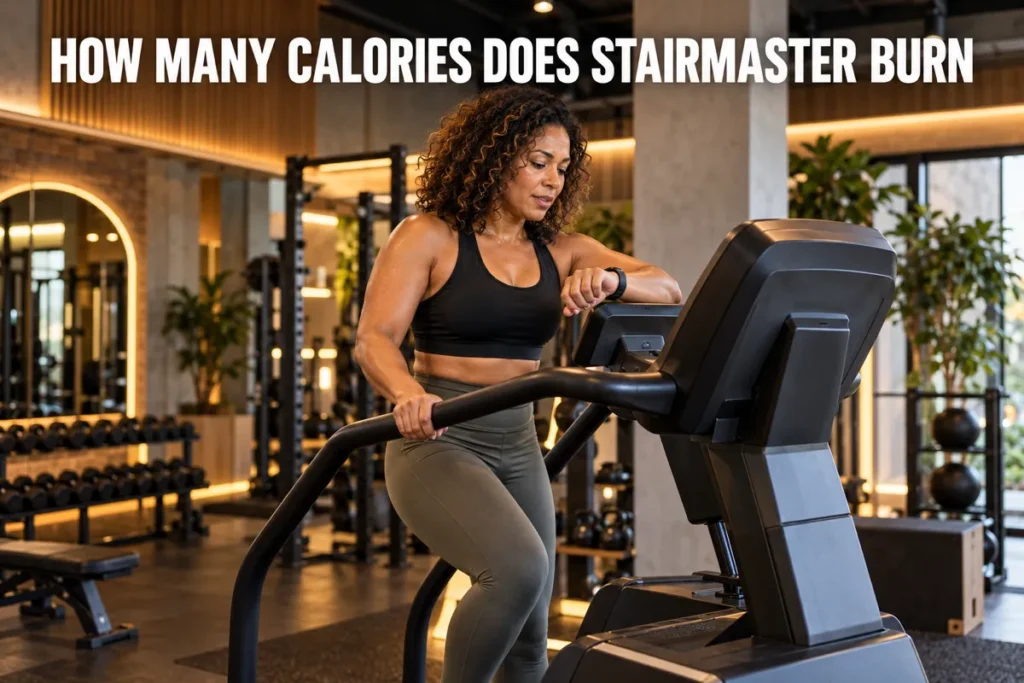
For a 155-pound person stepping at moderate pace (level 7) for 30 minutes, the realistic estimate is 241 to 251 calories - though your weight, the level you choose, and whether you grip the handrails can shift that figure by 30% or more in either direction. I have spent 15 years coaching clients on the StairMaster for high-calorie cardio without the joint impact of running, and the biggest mistake I see is trusting the machine's built-in display as though it were precise.
This guide covers calorie estimates by body weight, intensity level, and session length. I also explain why the machine's readout tends to overestimate, which machine type you are actually on, and how these numbers translate into realistic weight-loss results.

How Many Calories Does StairMaster Burn by Weight and Duration
The StairMaster stepmill ranks among the most calorie-intensive cardio machines available. A 2024 study measured direct energy expenditure on a stair climber at controlled intensities, finding 13.35 kcal per minute at very hard effort (RPE 17) and up to 15.16 kcal/min at maximum intensity, placing the stair climber second only to treadmill running among seven common machines (1). The estimates below use MET-based calculations (Metabolic Equivalent of Task) calibrated to that data and adjusted across common intensity levels.
For a direct comparison of how this output stacks up session to session, a StairMaster vs treadmill analysis shows the stepmill delivers calorie output comparable to a moderate treadmill run while keeping ground reaction forces significantly lower.
The stepmill's high calorie output comes directly from what it demands of your lower body. Every step requires your glutes, quadriceps, hamstrings, and calves to drive your full body weight vertically against gravity, with no passive momentum between steps. This continuous recruitment of large lower-body muscle groups is why the stepmill produces calorie burn comparable to running at a fraction of the joint impact.
Readers who want to understand the full picture of what the stepmill delivers will find the evidence in my stairmaster benefits guide.
The lower-body muscles responsible for that output are covered in detail in my stairmaster muscles guide.
Stairmaster Calories Burned in 30 Minutes - by Level and Body Weight
These estimates assume continuous stepping without handrail support. All values represent the midpoint of the expected kcal range for each weight and level combination.
Level | 130 lb / 59 kg | 155 lb / 70 kg | 180 lb / 82 kg | 205 lb / 93 kg |
Level 5 (easy) | 145-155 | 170-180 | 200-210 | 228-238 |
Level 6 (moderate-low) | 175-185 | 206-216 | 242-252 | 277-287 |
Level 7 (moderate) | 200-212 | 241-251 | 283-293 | 322-332 |
Level 8 (moderate-high) | 232-242 | 277-287 | 326-336 | 370-380 |
Level 10 (high) | 262-272 | 312-322 | 366-376 | 417-427 |
Estimates based on MET range 5-9, adjusted by body weight. Expect ±10-15% variance based on individual metabolism, conditioning level, and step technique.
How Many Calories Does StairMaster Burn in 10, 20, and 60 Minutes
The table below uses moderate effort - approximately level 7 - as the baseline for each weight group. For a harder session, scale up using the level-by-level table above.
Body Weight | 10 min | 20 min | 30 min | 60 min |
130 lb / 59 kg | 65-72 | 133-143 | 200-212 | 400-424 |
155 lb / 70 kg | 80-88 | 160-172 | 241-251 | 482-502 |
180 lb / 82 kg | 94-104 | 189-199 | 283-293 | 566-586 |
205 lb / 93 kg | 107-115 | 215-225 | 322-332 | 644-664 |
Level 7, hands-free. Values are estimates; individual results vary.
Answering how many calories does stairmaster burn in 10 minutes honestly means giving a range, not a single number. A 130-pound person at level 7 burns roughly 65-72 calories in 10 minutes; a 205-pound person burns 107-115 in the same window at the same level. How many calories does stairmaster burn in 20 minutes scales proportionally - doubling the duration approximately doubles the output for the same body weight and effort. The 30-minute mark is the most practical planning benchmark for most gym-goers: at level 7, the 155-pound person example produces roughly 241-251 calories. Calories burned on stair climber machines in general follow the same body-weight-and-intensity logic, but the stepmill variant produces the highest output within that category.
Readers comparing the elliptical for calorie output will find the evidence in my elliptical machine benefits guide.
The stairmaster calories burned calculator approach used here is more reliable than the machine's built-in display because it accounts for actual body weight and a validated MET value, rather than the machine's internal estimate which often lacks individual weight input and uses manufacturer-optimistic step-rate assumptions.
What Affects How Many Calories You Burn on the StairMaster
The StairMaster calorie readout calculates from stepping rate and, if you entered it, your body weight. It does not account for several factors that significantly change actual output. I always tell clients that the display is a ceiling estimate, not a ground truth - and the real number is almost always lower.
Here are the primary variables that change your actual stairmaster calories burned:
- Body weight - heavier individuals burn more calories per minute at the same level, because more mass requires more energy to move vertically against gravity
- Handrail use - resting body weight on the rails reduces effective calorie burn by 20-40%; this is the most underestimated variable in gym cardio tracking
- Fitness and conditioning level - as you get fitter, your body moves more efficiently through the same workload, gradually reducing calorie burn per minute at a given level
- Step cadence - a higher personal step rate at the same machine level increases intensity; slower foot placement reduces it
- Body composition - greater lean muscle mass slightly elevates calorie burn during exercise and significantly raises resting metabolic rate
For accurate step-based calorie tracking across activities, understanding 10,000 steps calorie equivalents puts your StairMaster output in context relative to daily movement goals.
How Handrail Use Changes Your StairMaster Calorie Burn
This single variable accounts for more discrepancy between machine display and actual burn than any other factor. When you support a portion of your body weight through your arms, you remove that load from your legs' working effort. Research on stair climbing suggests that bearing full body weight through your lower limbs is the primary driver of calorie expenditure per step (2). Reducing that load proportionally reduces calorie burn.
The grip-style reductions below are based on coaching observation and field measurement rather than a controlled laboratory study, and should be treated as practical estimates:
- Fingertip contact only - less than 5% reduction; acceptable form
- Light palm rest - roughly 10-15% reduction; noticeable over a 30-minute session
- Full grip, forward lean - 25-35% reduction; commonly seen in beginner steppers
- Arms supporting significant body weight - up to 40% reduction; makes the machine display essentially meaningless
I prioritize coaching clients away from handrail dependence before increasing level. Getting from level 6 hands-free to level 7 hands-free adds more calorie burn than going from level 6 to level 9 while gripping the rails.
Intensity Level, Step Rate, and Calories Burned on StairMaster Level 7
The level number controls step speed in steps per minute. On most StairMaster models, level 1 runs approximately 24 steps per minute; the upper levels (12-20) exceed 100 steps per minute. Research comparing single-step and double-step strategies found that taking larger steps (double-step) produced 1.0-1.3 kcal/kg/h greater energy expenditure and greater ankle and knee extensor activation compared to standard single-step climbing (3). This matters for calorie burn at stairmaster level 7: your foot placement pattern and stride amplitude affect output as much as the level number itself.
My how to use a stairmaster guide covers foot placement, handrail protocol, and level progression in full detail.
Calories burned on stairmaster level 7 for a 155-pound person over 30 minutes sits at 241-251; doubling to 60 minutes brings the total to approximately 482-502. At level 8, a 155-pound person burns 277-287 calories in 30 minutes hands-free; at level 6 the number drops to 206-216, and at level 10 it climbs to 312-322. The linear relationship between level and output makes the tables above a reliable planning reference.
Machine Type Matters - Stepmill, Stepper, and Vertical Climber
StairMaster is a brand name that covers two distinctly different machine designs. Comparing calories between them as though they were equivalent produces inaccurate estimates.
My stair climber machine guide breaks down the full category so readers can identify which format they are actually using.
Readers comparing the StairMaster to the rowing machine on calorie output will find that data in my stairmaster vs rowing machine comparison.

The StairMaster Stepmill
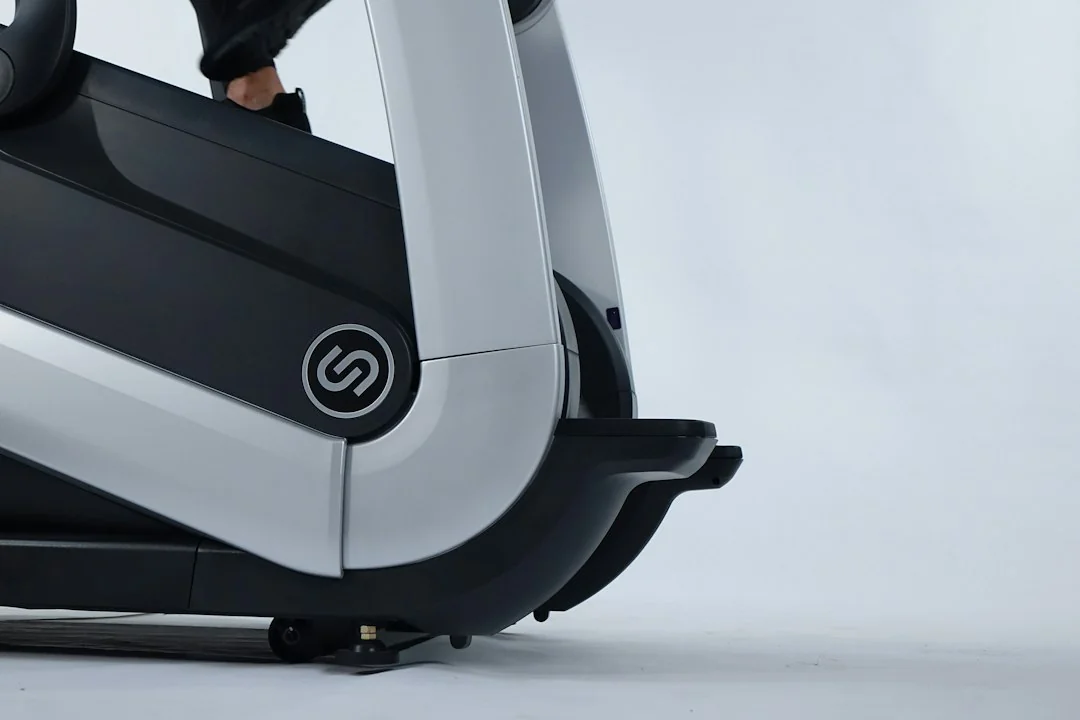
The stepmill (models like the StairMaster 8 Series or Gauntlet) uses a revolving staircase. You climb actual stairs that cycle beneath you at the set speed. Every step requires full leg drive against your body weight. This is the machine the calorie tables in this guide describe, and it produces the highest calorie burn of any stair-format machine.
The StairMaster Stepper
The stepper uses two independent pedals that move up and down in alternating opposition. The range of motion is smaller, the movement pattern recruits less gluteal activation, and the calorie output is typically 15-25% lower than a stepmill at equivalent perceived effort. Many older gym machines labeled "stair stepper" fall into this category. In 15 years of programming cardio for clients, I have never seen the two machines feel equivalent at the same display level - the stepmill is consistently harder.
The Vertical Climber
The vertical climber (such as the VersaClimber) is a different machine entirely - a full-body movement combining simultaneous arm and leg climbing. It burns more calories per minute than the stepmill on average, but it is not a StairMaster product and shares no meaningful direct comparison.
Readers who also use the treadmill for calorie management will find a full analysis in my treadmill benefits guide.
Understanding how to use a stairmaster correctly - including knowing which machine type you are on, maintaining upright posture with hips over ankles, and keeping contact with the rails to a minimum - determines whether your actual output matches these estimates. A stairmaster calories calculator that does not specify stepmill versus stepper will produce estimates that are 15-25% off for stepper users.
How to Calculate Stairmaster Calories Burned - The MET Method
Working out your own calorie estimate takes just three numbers and one formula, rather than trusting whatever the console displays. I'll walk through the math step by step using a real example.
The MET Formula
The stairmaster calorie calculator formula uses MET (Metabolic Equivalent of Task) values to estimate output from any machine:
Calories = MET x body weight (kg) x time (hours)
Worked Example at Level 7 for 30 Minutes
A worked example for a 155-pound person at level 7 for 30 minutes:
- Identify the MET for level 7 moderate stepping: approximately 7.0
- Convert weight to kilograms: 155 / 2.2 = 70.5 kg
- Convert session time to hours: 30 / 60 = 0.5 hours
- Calculate: 7.0 x 70.5 x 0.5 = 246 calories
This matches the level 7, 30-minute estimate in the table above. I use this calculation with every client who wants to cross-reference their machine's display, because it produces a consistently more conservative and accurate result than the onboard estimate.
The stairmaster calories calculator approach uses the same MET framework as other cardio estimation tools. The treadmill calorie counter methodology follows identical logic and lets you benchmark your StairMaster sessions against treadmill output side by side.
StairMaster and Weight Loss - What the Numbers Actually Mean
Consistent stepping sessions translate into real deficits over time, but the number on the console tells only part of the story. Here is what the research actually shows about fat loss outcomes and how the StairMaster stacks up against other machines.
Readers still choosing between machines for their fat loss goals will find the full comparison in my best cardio machine guide.
Readers stacking it up against the elliptical specifically will find that comparison in my stairmaster vs elliptical analysis.
What Research Shows About Stair Climbing and Weight Loss
A consistent StairMaster practice produces meaningful weekly calorie deficits when combined with managed nutrition. An 8-week randomized controlled trial using progressive stair climbing found significant reductions in body weight (-0.99 kg), LDL cholesterol, and triglycerides, alongside a measurable improvement in aerobic fitness (+1.63 mL/kg/min VO2max) (4). A scoping review of 24 stair climbing intervention studies found aerobic capacity gains of 8 to 33 mL/kg/min across trials lasting 4 to 8 weeks (5).
How StairMaster Compares to Other Cardio Machines
Here is how the StairMaster stepmill compares to other common cardio machines for calorie output at moderate effort (30 minutes, 155-pound person):
Machine | Approximate Calories (30 min, 155 lb, moderate effort) |
Treadmill (moderate run, 6 mph) | 300-330 |
StairMaster stepmill (level 7) | 241-251 |
Elliptical (moderate resistance) | 265-285 |
Rowing machine (moderate) | 250-275 |
Stationary bike (moderate) | 215-245 |
Estimates based on MET values for each activity at equivalent perceived effort. Individual results vary.
The StairMaster lands in the upper tier of cardio machines by calorie output per session. How many calories does rowing burn at comparable effort is a question worth understanding here - rowing and stepping produce similar output, but stepping offers greater lower-body muscle activation while rowing recruits more upper-body and core. For reference, calories burned cycling at equivalent perceived effort runs notably lower because cycling is a seated, non-weight-bearing activity that reduces the metabolic demand per minute.
Three Factors That Determine Weight Loss Results
For weight loss specifically, I find that three factors determine results more than which machine you choose:
- Total weekly calorie deficit - no individual cardio session replaces dietary awareness; the machine is a tool, not a solution
- Session frequency and consistency - three to four 20-40 minute sessions per week is a practical sustainable target for most people
- Progressive intensity over time - increasing level or duration every two to four weeks prevents metabolic adaptation and keeps output growing
Adding interval structure - alternating hard effort (level 9-12) with recovery periods (level 4-5) - can increase total work output per session and extend the post-exercise calorie burn, though the afterburn effect is modest relative to total session expenditure. A systematic review of 25 stair climbing studies found that acute bouts may reduce postprandial blood glucose in individuals with impaired glycemic control, and that chronic training shows a positive trend on multiple cardiometabolic risk factors, though effects on glycaemia and lipidaemia in healthy adults remained less consistent across trials (6).
Putting StairMaster Calorie Data into Practice
The number that matters most is the consistent weekly output you accumulate over months. I find the StairMaster earns its reputation because it is genuinely difficult to reduce effort without it showing immediately in your form and heart rate.
For practical calorie tracking, I recommend using the MET formula with your actual body weight rather than the machine display, recording your actual level and duration rather than the displayed calorie count, and reducing your MET estimate by 10-15% for light to moderate handrail contact or 25-30% for full-grip use. For clients setting step-based rather than calorie-based targets, tracking steps per mile on a treadmill equivalents can provide a useful parallel metric when rotating between machines.
For beginners, level 4-5 for 20 minutes is the right starting point before building toward the moderate-intensity ranges in this guide. For experienced users focused on maximizing output, level 8-10 for 30-40 minutes without handrail support is the range I consistently see producing strong weekly calorie totals with manageable recovery demands. My background at the Faculty of Sport and Physical Education in Novi Sad and over 15 years of coaching clients on cardio equipment consistently points me toward the same conclusion: precision matters less than consistency, and a sustainable level you execute three times per week beats an ambitious level you quit after two.
FAQs
How to burn 1000 calories in a day?
Burning 1,000 calories in a single day is achievable through a combination of structured exercise and routine daily movement rather than one long session. For most people, a 60-90 minute StairMaster session at hard effort (level 9-12) combined with normal walking throughout the day will approach that total, though the exact number depends heavily on individual body weight, conditioning level, and daily baseline activity. Tracking both structured cardio and incidental movement together gives a far more accurate picture than focusing on machine calories alone.
Is StairMaster good for losing weight?
The StairMaster is an effective weight-loss tool because it burns a relatively high number of calories per session while keeping joint impact lower than running. Its effectiveness depends on session consistency, total weekly calorie expenditure, and whether the output creates a real deficit against your total daily intake - the machine alone does not guarantee results without attention to nutrition. Three to four sessions per week at moderate to hard intensity, combined with a modest dietary deficit, is a practical starting framework for most people.
Readers deciding between HIIT and steady-state sessions on the StairMaster will find the calorie and fat-loss comparison in my HIIT vs steady state cardio guide.
Does the StairMaster flatten your belly?
The StairMaster contributes to overall body fat reduction, which includes abdominal fat, but it cannot target belly fat specifically because spot reduction is not supported by exercise science. Consistent calorie-burning cardio combined with an appropriate dietary deficit is what drives visible changes in the midsection over time, with fat loss occurring throughout the body rather than in a single area. Visible abdominal changes typically require several weeks of consistent deficit and sufficient total fat loss to show through the midsection.
Readers also using the elliptical for fat loss can find a targeted guide in my elliptical for weight loss guide.
How to burn 1000 calories on StairMaster?
Burning 1,000 calories in a single StairMaster session requires approximately 90 to 120 minutes at hard to very hard intensity (level 8-14) for someone weighing 155 to 185 pounds, and is not a realistic or advisable target for most people in a single workout. A more sustainable approach is building toward three to four sessions per week that each burn 300-450 calories, which accumulates 900-1,800 calories of weekly deficit from the machine alone. Adding interval structure - alternating hard and recovery effort levels within each session - can increase total output without requiring the same duration at flat high intensity.
My stairmaster workout guide covers the exact session formats that use interval protocols to maximize total output.
How many calories burned on stairmaster level 5?
At level 5, a 130-pound person burns approximately 145-155 calories in 30 minutes; a 155-pound person burns 170-180 calories; a 180-pound person burns around 200-210 calories; and a 205-pound person burns approximately 228-238 calories. Level 5 represents easy effort and is a useful starting point for beginners building StairMaster tolerance before progressing to more productive intensity ranges. These estimates assume hands-free stepping; using the rails at level 5 reduces output by roughly 10-25% depending on how much body weight is shifted to the arms.
This content is for informational and educational purposes only. It is not a substitute for professional medical advice, diagnosis, or treatment. Always consult with your healthcare provider before starting any new fitness program.
References
- Prieto-González P, Yagin FH. Energy Expenditure, Oxygen Consumption, and Heart Rate While Exercising on Seven Different Indoor Cardio Machines at Maximum and Self-Selected Submaximal Intensity. Front Sports Act Living. 2024;6:1313886. doi:10.3389/fspor.2024.1313886.
- Halsey LG, Watkins DAR, Duggan BM. The Energy Expenditure of Stair Climbing One Step and Two Steps at a Time: Estimations from Measures of Heart Rate. PLOS ONE. 2012;7(12):e51213. doi:10.1371/journal.pone.0051213.
- Gottschall JS, Aghazarian GS, Rohrbach EA. The Metabolic and Muscular Differences Between Two Stair-Climbing Strategies of Young Adults. J Strength Cond Res. 2010;24(9):2558-2563. doi:10.1519/JSC.0b013e3181e83a6f.
- Michael E, White MJ, Eves FF. Home-Based Stair Climbing as an Intervention for Disease Risk in Adult Females; A Controlled Study. Int J Environ Res Public Health. 2021;18(2):603. doi:10.3390/ijerph18020603.
- Ghosal AM, Chandrasekaran B. Stair-climbing Interventions on Cardio-metabolic Outcomes in Adults: A Scoping Review. J Taibah Univ Med Sci. 2023;19(1):136-150. doi:10.1016/j.jtumed.2023.10.003.
- Hong JY, Li YJ, Metcalfe RS, Chen YC. Effects of Acute and Chronic Stair-Climbing Exercise on Metabolic Health: A Systematic Review. J Sports Sci. 2024;42(6):498-510. doi:10.1080/02640414.2024.2345414.