

No trial has tested elliptical training alone for weight loss in healthy adults, so nobody can say how much weight you will lose on it. What can be estimated is energy use, about 180 calories in 30 minutes at moderate effort for a 70 kg (155 lb) person, and across 116 trials of aerobic exercise in general, in adults with overweight or obesity, more weekly minutes were associated with lower body weight.
Elliptical for weight loss rests on one estimate and one open question. The estimate is energy use at a given effort, and the table below gives it in calories at four body weights. The open question is whether that energy use becomes lost weight, and no study cited here tracked the weight of healthy adults who trained on an elliptical alone.
This page sorts what studies measured on an elliptical from general evidence on exercise and body weight, and it ends with a plan that is my judgement and promises nothing.
Elliptical for Weight Loss - Does the Science Actually Support It?
Is elliptical good for weight loss? The evidence answers a smaller question. Aerobic fitness rose in the 12-week elliptical trial in healthy women described below, and no trial has tested elliptical training alone for weight loss in healthy adults.
The elliptical selection page lists elliptical models to compare.
In 22 moderately active women who trained three days a week for 12 weeks, maximal oxygen uptake on a cycle test rose from 36.9 to 39.6 ml/kg/min in the 8 women who trained on an elliptical, and the gain was not significantly different from the treadmill running group (40.7 to 43.4) or the stair-climber group (37.4 to 39.2) (1). Heart rate during a fixed submaximal test fell from week 0 to 4 and again from week 4 to 8 in every group. The sessions started at 70 to 80% of maximum heart rate for 30 minutes and progressed to 80 to 90% for 40 minutes, so that is that trial's protocol and not a dose tested on every reader. The results cited here include no body weight or body fat figure, and every group trained, so there is no non-exercising group to compare.
In a 12-week pilot of 16 adults with prediabetes or type 2 diabetes, elliptical interval training three times a week was followed by significant improvement in fasting glucose, waist and hip circumference, appendicular fat mass, leg and appendicular lean mass, systolic blood pressure, resting heart rate and maximal oxygen uptake (2). The pilot had one group and no comparison group, and the results cited here include no body weight figure, so it cannot show that the intervals caused those changes or that body weight fell. People with diabetes are not healthy adults; if you have diabetes or heart disease, train only as your care team directs.
For the stair-machine alternative, the stairmaster muscle guide covers what a StairMaster works.
General exercise evidence is stronger than elliptical evidence, and it comes from trials about aerobic exercise as a whole, not about ellipticals. In 116 randomized trials of supervised aerobic exercise lasting at least 8 weeks, in 6,880 adults with overweight or obesity, each 30 minutes a week of aerobic exercise was associated with 0.52 kg lower body weight, and clinically important reductions may need more than 150 minutes a week at moderate intensity or higher (3). The results cited here are not broken down by machine.
The HHS Physical Activity Guidelines state that physical activity and caloric intake both must be considered when trying to control body weight, and that people vary a great deal in how much physical activity they need to achieve and maintain a healthy weight. Combining caloric restriction and physical activity tends to be most beneficial for weight loss, compared with either alone (4).
The best elliptical machine guide covers current models.
How Many Calories Does an Elliptical Burn for Weight Loss?
The calorie figures on this page come from the 2024 Compendium of Physical Activities, which lists two elliptical entries: 5.0 METs at moderate effort and 9.0 METs at vigorous effort (5). Calories equal METs times body weight in kilograms times hours. The calories the elliptical burns guide covers the estimates in more depth. The table gives estimates for 30 minutes, rounded to the nearest 10:
| Body weight | Moderate effort (5.0 METs), estimate | Vigorous effort (9.0 METs), estimate |
|---|---|---|
| 59 kg (130 lb) | 150 calories | 270 calories |
| 70 kg (155 lb) | 180 calories | 320 calories |
| 84 kg (185 lb) | 210 calories | 380 calories |
| 100 kg (220 lb) | 250 calories | 450 calories |
A lab measurement is a different basis from those estimates, and the two should not be mixed. In 30 recreationally active men aged 35 to 49 with more than 10 years of experience on indoor machines, a very hard effort (RPE 17) used 12.82 kcal a minute on one elliptical, against 15.18 on a treadmill, 13.35 on a stepper, 11.45 on a rower and 11.07 to 12.45 on three bikes, with one machine of each type (6). Those are measured rates for those men at that effort, so they do not convert into a calorie table for you.
Treating the console calorie total as a food allowance. A console figure is the maker's estimate, and in the studies cited here it read higher than the lab measurement.
Calories burned are one side of weight change. In weight-loss studies reviewed by the American College of Sports Medicine (ACSM), 150 to 250 minutes a week of moderate-intensity activity gave only modest weight loss, more than 250 minutes a week was associated with clinically significant weight loss, and 150 to 250 minutes improved weight loss in studies that used moderate diet restriction but not severe diet restriction (7). The HHS adds that losing more than 5 percent of body weight may need more than 300 minutes of moderate-intensity activity a week (4). For scale, 150 minutes at moderate effort is about 880 calories at 70 kg by that estimate, and the Compendium does not say how much of that shows on the scale.
The stairmaster calories per session guide covers calorie estimates for a stair machine.
A compact elliptical used while seated is a different case. In 32 inactive adults pedalling one compact elliptical (a Stamina InMotion E-1000) while seated at a pace they chose, energy use in a laboratory test was a median of 87.9 kcal an hour above sitting, with a range of 19.7 to 178.6 (8). Any weight change from that extra energy use is a projection that assumes every other part of energy balance stays constant, and it was not measured.
The best under desk elliptical guide covers compact models for seated use.
Treadmill or Elliptical for Weight Loss - What the Research Shows
The studies that compared the two machines measured energy use at matched effort and not weight loss, and they do not all agree.
The stairmaster vs elliptical guide compares the elliptical with a stair machine.
At a moderate felt effort (RPE 12 to 13), oxygen use and energy use did not differ between a treadmill and an elliptical in 18 untrained college-age adults (9). Among 18 trained runners working at the same share of each machine's peak workload, oxygen use, heart rate and fat and carbohydrate oxidation did not differ between a treadmill, an elliptical and a stepper (10). At a very hard effort, the 30 men above used 15.18 kcal a minute on the treadmill and 12.82 on the elliptical, so the treadmill was 18% higher and the elliptical 16% lower (6). The studies matched effort in different ways and tested different people, so none of them settles which machine is better for weight loss.
The studies of joint load have two halves. In 15 men, the vertical force on the pedal and the rate at which load built up were smaller on an elliptical than the ground force in walking, but the knee-straightening and hip-bending moments were larger (11). In three people aged 67 to 83 with an instrumented knee replacement, peak knee force on an elliptical was 2.24 times body weight, against 2.05 in treadmill walking, and jogging was consistently greater than 4 times body weight (12). The post Is the Elliptical Good for Knees covers joint loading in more depth.
In my view a machine you keep using matters more than a small difference in one session, which is my judgement and not a trial result.
The stairmaster benefits overview covers the stair machine as another option.
The is the elliptical good cardio guide covers the aerobic fitness evidence in more depth.
In nine healthy men, the peak rate of fat burning during a test was higher on a treadmill (0.61 g a minute) than on an elliptical (0.41) or a rower (0.40) (13). That is the fuel mix during exercise, not body fat lost.
The stair climber training guide covers workouts on a stair climber.
Effort and weekly minutes are what both machines share, and at a moderate felt effort the study above found no difference in energy use between them.
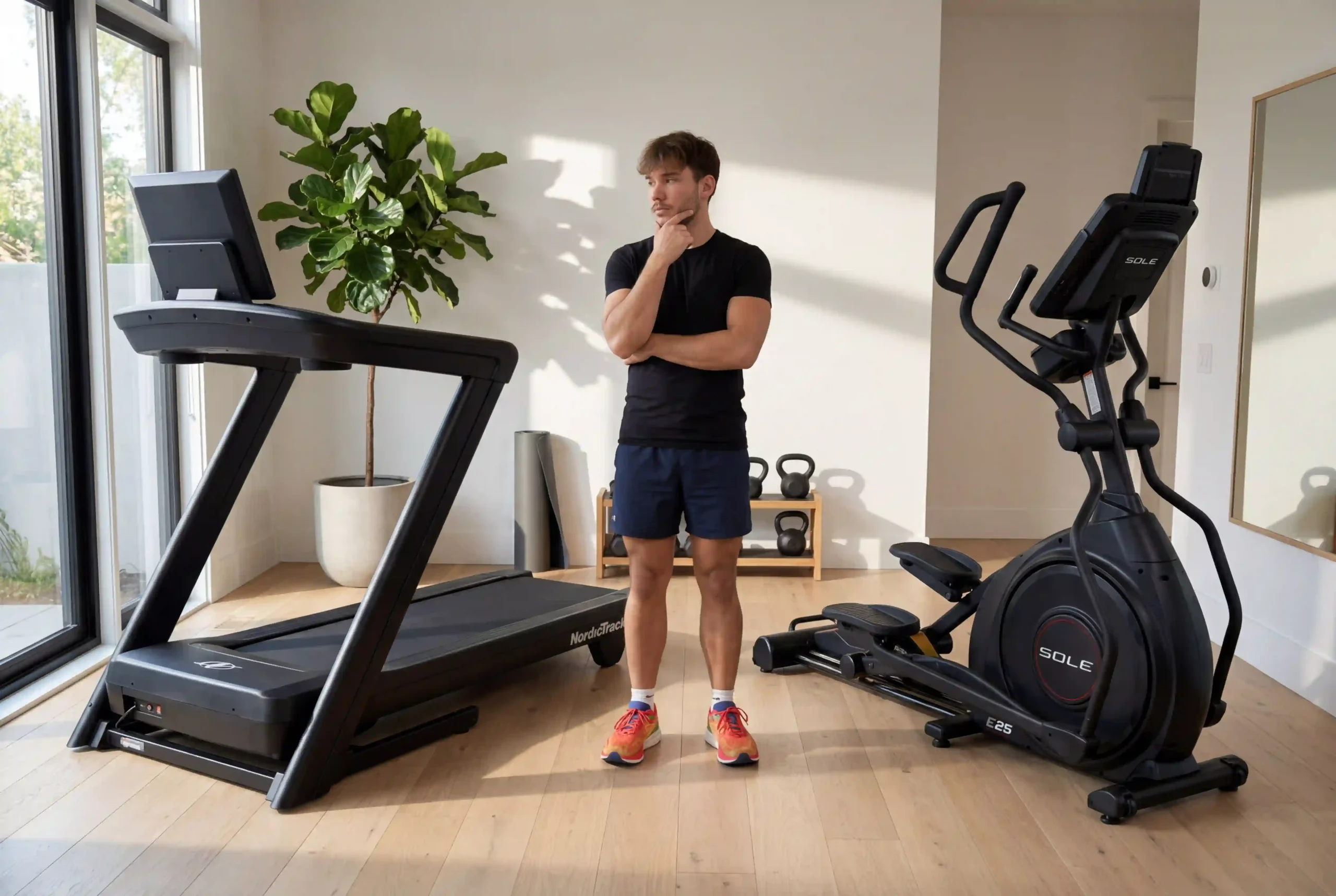
Stairmaster, Bike, or Elliptical for Weight Loss
No trial cited here compared a stair machine, a bike and an elliptical for weight loss. What exists are energy-use comparisons at set efforts, shown below by basis.
The guide to using the stairmaster covers technique on that machine.
At a very hard effort in the 30 men, a stepper (a Life Fitness Integrity CLSS) used 13.35 kcal a minute against 12.82 on the elliptical (6). On the Compendium, the stair treadmill ergometer is 9.3 METs, about 330 calories in 30 minutes at 70 kg, against 320 for the vigorous elliptical entry; the stair entry names no effort level, so that pairing is rough (5).
The stairmaster workout guide covers workouts on that machine.
The stairmaster vs treadmill for weight loss guide compares a stair machine with a treadmill.
On the Compendium at 70 kg and 30 minutes, general stationary cycling (6.8 METs) is about 240 calories and a spin class (9.0 METs) about 320, against 180 and 320 for the elliptical at moderate and vigorous effort (5). At a very hard effort in the 30 men, the elliptical's 12.82 kcal a minute was close to a spin bike (12.45) and above an upright bike (11.94) and a recumbent bike (11.07) (6).
A rowing machine at moderate effort (5.0 METs) matches the moderate elliptical at 180 calories for 30 minutes at 70 kg, and vigorous rowing (7.3 METs) gives about 260 (5). The rowing machine benefits guide covers rowing in more depth.
Elliptical Workouts for Weight Loss - HIIT vs. Steady-State
Interval and steady training have been compared in trials of adults with overweight or obesity, and these trials did not test ellipticals.
Use the talk test. At moderate effort you can talk but not sing, and at vigorous effort you cannot say more than a few words without a breath.
In 13 trials of adults aged 18 to 45 with overweight or obesity, averaging 10 weeks of three sessions a week, interval and steady training both reduced whole-body fat mass and waist circumference, with no significant difference between them and about 40% less training time for intervals (14). Those modest changes in body composition came without accompanying changes in body weight. The running programs reduced fat mass and the cycling programs did not.
What the HHS says about amounts and about intervals:
- Minutes: 150 to 300 minutes a week of moderate-intensity aerobic activity, or 75 to 150 minutes of vigorous-intensity activity, or an equivalent combination, preferably spread through the week (4)
- Strength: muscle-strengthening activity of moderate or greater intensity on 2 or more days a week (4)
- Intervals: high-intensity interval training alternates short periods of maximal effort with less intense recovery, and there are no universally accepted lengths for either period, number of cycles or session length (4)
Vigorous minutes can shorten a session inside those ranges, but no trial cited here tested an elliptical interval program for weight loss.
Whether to use intervals depends on what you can repeat. For inactive people and those with low activity levels, the HHS advice is to start with relatively moderate-intensity activity and avoid relatively vigorous activity (4).
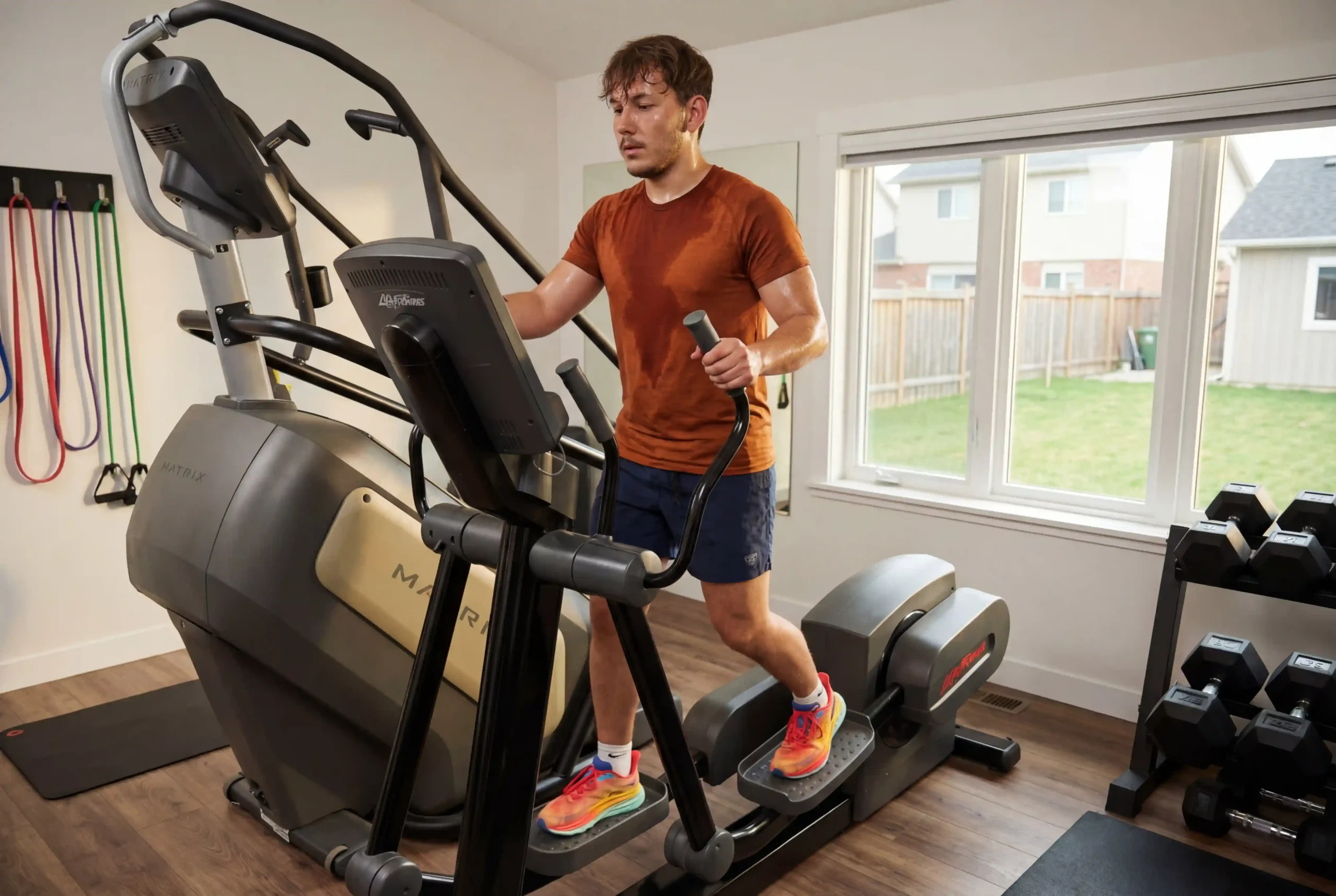
Elliptical Workout for Weight Loss - Three Sample Sessions
No trial cited here tested an elliptical workout for weight loss in healthy adults, so none of the three sessions below is proven. They are my judgement, built on the HHS wording and the talk test, and they promise no result.
Session 1: steady effort, 30 minutes
For newcomers and for anyone returning after a break.
- Warm up by exercising slowly for the first few minutes, then pick up the pace (15)
- Middle of the session: moderate effort, where you can talk but not sing
- Cool down by ending at a slower pace for the last 5 to 10 minutes (15)
Session 2: intervals
For after several weeks of regular moderate sessions: the HHS advice is to raise the minutes and the days first and the intensity later, if you want to (4).
- Warm up by exercising slowly for the first few minutes, then pick up the pace
- Work for about one minute at a vigorous effort, where you can say only a few words, then recover for about two minutes at an easy pace where you can talk; repeat four times
- Cool down by ending at a slower pace for the last 5 to 10 minutes
This is my judgement and not a protocol tested in any trial. People with a chronic condition or symptoms should be under a health care provider's care and can ask which types and amounts of activity suit them, and seeking advice is particularly appropriate when contemplating vigorous-intensity activity (4).
Session 3: building minutes
For anyone who starts with little activity.
- Start with a small, comfortable amount of light to moderate activity; the HHS example is walking 5 to 15 minutes per session, 2 to 3 times a week (4)
- First raise the minutes per session and the days per week, and raise intensity later if you want to (4)
- Keep each weekly rise small compared with what you already do: 20 more minutes is a 10% rise on 200 minutes a week and a 50% rise on 40 (4)
The best incline treadmill guide covers treadmills with an incline.
Elliptical Resistance Level for Weight Loss
No study cited here tested a resistance level for weight loss. What was measured is oxygen use: in 26 adults on an elliptical, raising the stride rate from 110 to 134 strides a minute raised it, and so did raising the resistance setting from 2 to 5 to 8 (16).
Oxygen use at the same settings varied widely from person to person, and predicting the metabolic cost for one individual was judged not appropriate, so a calorie figure for a given level is a rough average at best (16). A level is the maker's own number, and no source cited here converts levels into watts or calories.
Three points instead of a level chart, which are my judgement:
The best elliptical for seniors guide covers models for older users.
How to Use an Elliptical Machine for Weight Loss
No study cited here tested technique for weight loss. The one technique study cited here varied hand position, speed and stride length in 40 healthy young men: the buttock muscles were consistently more active on an elliptical than in walking, average lower-back flexion and rotation were generally greater, and hand position, speed and stride length each changed the result (17).
In 22 adults, adding the moving arm poles raised oxygen use, breathing and perceived effort at every tested setting, while heart rate was not higher; no percentage for the arms is given in the results cited here (16).
The is a rowing machine bad for your back guide covers rowing and back pain.
Check the machine before you rely on it: it should fit you, be in good working condition and be used correctly and consistently, and lessons can help if the movement is new (15).
You should never feel pain when exercising, and if you feel pain, stop right away. Go to the hospital right away or call 911 or the local emergency number if you have chest pain during or after exercise (15).
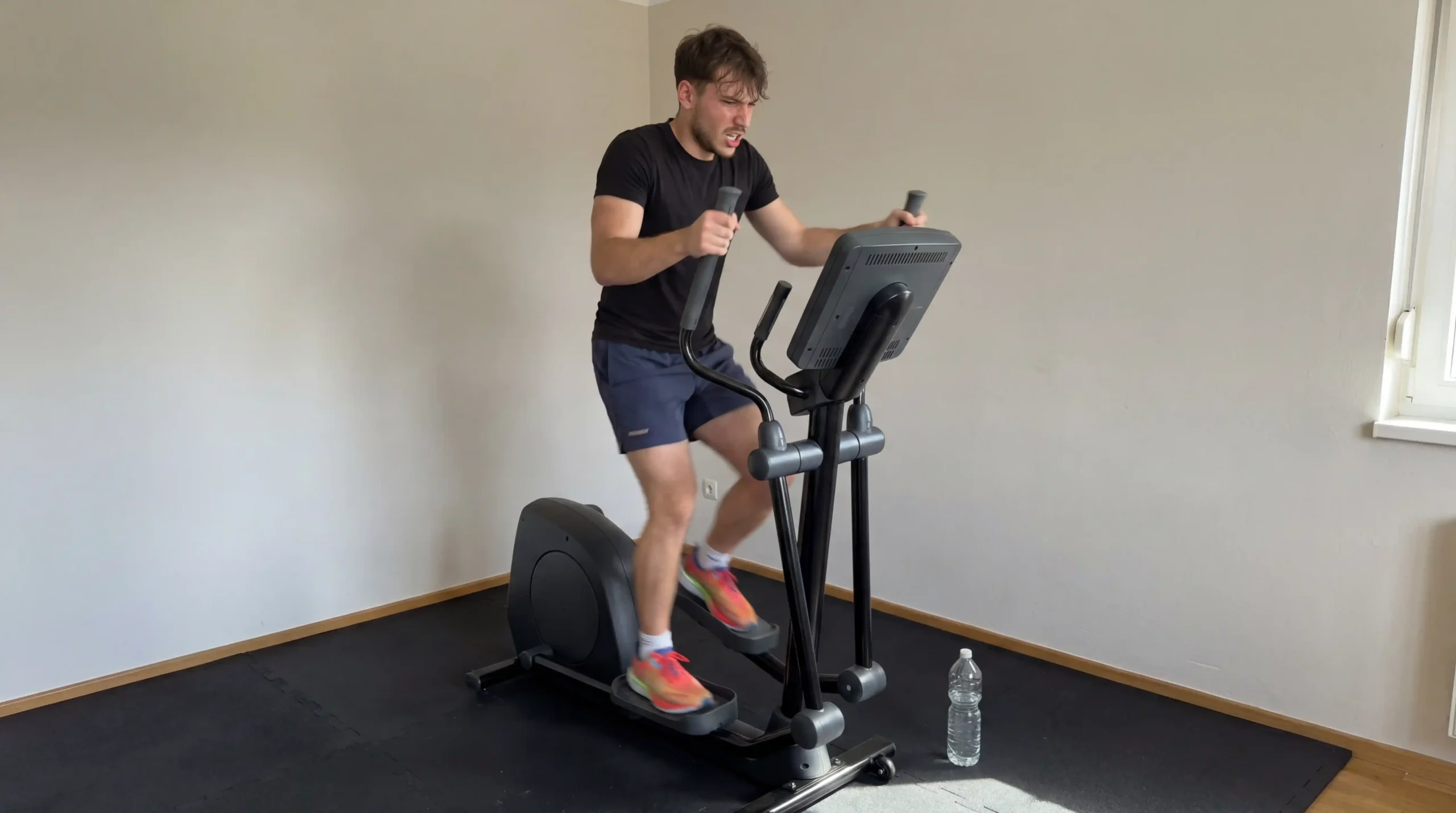
Elliptical Workouts for Weight Loss for Beginners - Where to Start
Inactive people are advised to start low and go slow: begin with lower-intensity activities and gradually increase how often and how long you are active (4). No study cited here tested a beginner elliptical program for weight loss, so the plan below is my judgement.
The Sunny Smart Upright Elliptical is one upright model listed in the shop.
The overview of the elliptical machine covers how the machine works and what to look for when choosing one.
Three mistakes worth avoiding at the start:
1. Starting too hard. The risk of injury to bones, muscles and joints is directly related to the gap between your usual activity and the new level, and the HHS advice is to start with relatively moderate-intensity activity and avoid relatively vigorous activity (4).
2. Pushing through pain. Sore muscles after a workout are expected, but you should never feel pain when exercising, and if you feel pain you should stop right away (15).
3. Changing everything at once. Avoid raising the number of days, the length of time and how hard you work out all in the same period (15).
A starting plan for the first weeks, which is my judgement and not a tested program:
- Weeks 1 and 2: 10 to 15 minutes per session, 3 days a week, at an easy to moderate effort
- Weeks 3 and 4: add about 5 minutes per session, still 3 days a week, and keep the effort where you can talk
- After that: raise minutes and days before effort, and repeat a stage if it felt hard, since the HHS notes that older adults appear to need 2 to 4 weeks to adapt to a new level of activity (4)
In the dose-response meta-analysis above, body weight, waist circumference and body fat measures fell in step with rising weekly aerobic exercise up to 300 minutes a week, in trials of at least 8 weeks (3). No source cited here tested a week-by-week build-up on an elliptical, so this plan is a safe-start idea and not a weight-loss schedule.
Rest matters too: not resting between workouts is one cause of exercise injuries, and being tired all the time can be a sign that you are overdoing it (15).
The treadmill workout guide covers sessions on a treadmill.
Elliptical Routine for Weight Loss - Building a Weekly Plan
A sample week built from the HHS ranges, which is my judgement and not a program tested in any trial:
| Day | Session | Duration | Effort or focus |
|---|---|---|---|
| Monday | Steady elliptical | 30 min | Moderate: talk but not sing |
| Tuesday | Muscle-strengthening, off the elliptical | Your choice | One of the 2 or more strengthening days |
| Wednesday | Steady elliptical | 30 min | Moderate: talk but not sing |
| Thursday | Steady elliptical | 30 min | Moderate: talk but not sing |
| Friday | Muscle-strengthening, off the elliptical | Your choice | The second strengthening day |
| Saturday | Steady elliptical, or the interval session | 30 min | Intervals only after weeks of regular moderate sessions |
| Sunday | Steady elliptical, or rest | 30 min | Easy to moderate; rest instead if you are tired all the time |
With all five elliptical sessions the week is 5 x 30 = 150 minutes, the low end of the HHS range for moderate-intensity aerobic activity, and with Sunday as rest it is 4 x 30 = 120 minutes, below that range. The two strengthening days meet the advice of 2 or more days a week (4). That is also the amount at which the ACSM review found only modest weight loss (7).
A short log keeps the plan honest. Four things worth writing down each week, which is my judgement:
- Minutes at moderate effort, the unit the HHS ranges use
- How the sessions felt on the talk test
- Strengthening days done, since the HHS asks for 2 or more days a week
- Body weight, if you choose to track it, knowing that it also depends on what you eat
In my view minutes and effort together tell you more than either one alone, because a long easy session and a short hard one are different things; this is my judgement.
The treadmill benefits guide covers aerobic training on a treadmill.
Elliptical or Walking for Weight Loss
Both are aerobic exercise, and the comparison below uses the Compendium's estimates at the same body weights, not a weight-loss trial.
At 59, 70, 84 and 100 kg, brisk walking at 3.5 to 3.9 mph (4.8 METs) gives about 140, 170, 200 and 240 calories in 30 minutes, against 150, 180, 210 and 250 for moderate elliptical effort and 270, 320, 380 and 450 for vigorous effort (5). At those entries brisk walking and moderate elliptical exercise sit close together, and the vigorous elliptical entry is well above both.
The is a rowing machine good for weight loss guide covers rowing and weight loss.
Walking is an easy physical activity to begin and maintain, needs no special skills or facilities, and has a low risk of injury (4).
In my view the better choice is the one you will do for the minutes the HHS ranges ask, and for many people that is a mix of both; this is my judgement, not a trial result.
The best under desk treadmill guide covers compact treadmills for adding walking minutes.
When Weight Loss Feels Slow on an Elliptical
Look at the whole energy balance first. Physical activity and caloric intake both must be considered, and many people need more than 150 minutes of moderate-intensity activity a week to maintain their weight (4).
The post on what the elliptical is good for covers other uses of the machine.
Pictures and stories labelled elliptical weight loss before and after show one person's result, not what a trial measured. The measured before and after results on an elliptical cited here are the fitness trial in 22 women and the 16-adult diabetes pilot, and neither reports body weight.
A console's calorie total is not a food allowance. In 34 adults on one Precor EFX 883 with no body weight entered, the console read higher than the lab measurement over 30 minutes of moderate exercise (18). Other machines were not tested in that study, so use the console number to compare your own sessions on the same machine.
When progress stalls, check these first:
- Minutes: count the minutes at moderate effort against the 150 to 300 range; more than 250 minutes a week was associated with clinically significant weight loss in the ACSM review (7)
- Food: combining caloric restriction and physical activity tends to be most beneficial for weight loss (4)
- Effort: an easy effort uses less energy than a hard one, and at 70 kg the Compendium gives 180 and 320 calories in 30 minutes (5)
- Daily movement: the HHS asks adults to move more and sit less throughout the day, beyond planned sessions (4)
The best treadmill for home guide covers treadmills for home use.
Elliptical Training and Your Weight Loss Goals
What is known: the Compendium rates elliptical exercise at two effort levels, maximal oxygen uptake rose over 12 weeks of elliptical training in 8 women, and across 116 trials of aerobic exercise in general, in adults with overweight or obesity, more weekly minutes were associated with lower body weight. What is not known: how much weight healthy adults lose on an elliptical alone, because no trial cited here measured it.
The budget tracker picks guide covers fitness trackers.
In order, my judgement: start with steady moderate sessions, add minutes and days before effort, keep two strengthening days, and treat any change in weight as the combined result of food and activity.
The elliptical buying guide covers how to choose a machine.
The best folding treadmill guide covers treadmills that fold for storage.
Frequently Asked Questions
How long on an elliptical is equal to 10,000 steps?
No source cited here converts elliptical minutes into steps, because the studies measured oxygen and energy use and not step counts. Minutes at a moderate effort count toward the 150 to 300 minutes a week in the HHS guideline, which is the measure that guideline uses.
What are the disadvantages of using an elliptical?
At the knee, peak force on an elliptical was not lower than in treadmill walking in three people with knee replacements, and in 15 men the smaller pedal force came with larger knee-straightening and hip-bending moments. No trial has tested elliptical training alone for weight loss in healthy adults, and the console calorie total read higher than the lab measurement in the studies cited here.
Do I need to stretch before an elliptical?
MedlinePlus advises warming up by exercising slowly for the first few minutes and then picking up the pace, and it says it is unclear whether stretching reduces injury. If you do stretch, do not stretch cold muscles.
Which is healthier, a treadmill or an elliptical?
No study cited here compared long-term health on the two machines, so none can name the healthier one. In the one 12-week trial of 22 women, fitness gains did not differ between the treadmill and elliptical groups, and the treadmill used more energy at a very hard effort in 30 recreationally active men.
Is it better to go fast or slow on an elliptical?
In 26 adults, a faster stride rate and a higher resistance both raised oxygen use, so neither speed nor resistance alone tells you how hard you are working. No trial compared fast and slow elliptical training for weight loss, and the talk test is the HHS rule of thumb for judging effort.
 Tech Fitness Lab
Author
Vanja Vukas
I founded Tech Fitness Lab and hold a master's degree from the Faculty of Sport and Physical Education in Novi Sad. I have competed in sport and coached clients, and my writing has appeared on Fitness Volt and BOXROX. I research products from their manuals, spec sheets and warranty terms, and I flag thin evidence.
References
- Egaña M, Donne B. Physiological changes following a 12 week gym based stair-climbing, elliptical trainer and treadmill running program in females. J Sports Med Phys Fitness. 2004;44(2):141-146.
- Fex A, Leduc-Gaudet JP, Filion ME, Karelis AD, Aubertin-Leheudre M. Effect of elliptical high intensity interval training on metabolic risk factor in pre- and type 2 diabetes patients: a pilot study. J Phys Act Health. 2015;12(7):942-946. doi:10.1123/jpah.2014-0123
- Jayedi A, Soltani S, Emadi A, Zargar MS, Najafi A. Aerobic exercise and weight loss in adults: a systematic review and dose-response meta-analysis. JAMA Netw Open. 2024;7(12):e2452185. doi:10.1001/jamanetworkopen.2024.52185
- US Department of Health and Human Services. Physical Activity Guidelines for Americans. 2nd ed. US Department of Health and Human Services; 2018. Chapters 2, 4 and 7.
- Herrmann SD, et al. 2024 Adult Compendium of Physical Activities. J Sport Health Sci. 2024;13(1):6-12. doi:10.1016/j.jshs.2023.10.010
- Prieto-González P, Yagin FH. Energy expenditure, oxygen consumption, and heart rate while exercising on seven different indoor cardio machines at maximum and self-selected submaximal intensity. Front Sports Act Living. 2024;6:1313886. doi:10.3389/fspor.2024.1313886
- Donnelly JE, Blair SN, Jakicic JM, Manore MM, Rankin JW, Smith BK; American College of Sports Medicine. American College of Sports Medicine Position Stand. Appropriate physical activity intervention strategies for weight loss and prevention of weight regain for adults. Med Sci Sports Exerc. 2009;41(2):459-471. doi:10.1249/MSS.0b013e3181949333
- Rovniak LS, Denlinger L, Duveneck E, et al. Feasibility of using a compact elliptical device to increase energy expenditure during sedentary activities. J Sci Med Sport. 2014;17(4):376-380. doi:10.1016/j.jsams.2013.07.014
- Brown GA, Cook CM, Krueger RD, Heelan KA. Comparison of energy expenditure on a treadmill vs. an elliptical device at a self-selected exercise intensity. J Strength Cond Res. 2010;24(6):1643-1649. doi:10.1519/JSC.0b013e3181cb2854
- Bosch AN, Flanagan KC, Eken MM, Withers A, Burger J, Lamberts RP. Physiological and metabolic responses to exercise on treadmill, elliptical trainer, and stepper: practical implications for training. Int J Sport Nutr Exerc Metab. 2021;31(2):135-142. doi:10.1123/ijsnem.2020-0155
- Lu TW, Chien HL, Chen HL. Joint loading in the lower extremities during elliptical exercise. Med Sci Sports Exerc. 2007;39(9):1651-1658. doi:10.1249/mss.0b013e3180dc9970
- D'Lima DD, Steklov N, Patil S, Colwell CW. The Mark Coventry Award: in vivo knee forces during recreation and exercise after knee arthroplasty. Clin Orthop Relat Res. 2008;466(11):2605-2611. doi:10.1007/s11999-008-0345-x
- Filipovic M, Munten S, Herzig KH, Gagnon DD. Maximal fat oxidation: comparison between treadmill, elliptical and rowing exercises. J Sports Sci Med. 2021;20(1):170-178. doi:10.52082/jssm.2021.170
- Wewege M, van den Berg R, Ward RE, Keech A. The effects of high-intensity interval training vs. moderate-intensity continuous training on body composition in overweight and obese adults: a systematic review and meta-analysis. Obes Rev. 2017;18(6):635-646. doi:10.1111/obr.12532
- MedlinePlus. How to avoid exercise injuries. Review date July 15, 2026.
- Mier CM, Feito Y. Metabolic cost of stride rate, resistance, and combined use of arms and legs on the elliptical trainer. Res Q Exerc Sport. 2006;77(4):507-513. doi:10.1080/02701367.2006.10599385
- Moreside JM, McGill SM. How do elliptical machines differ from walking: a study of torso motion and muscle activity. Clin Biomech (Bristol). 2012;27(7):738-743. doi:10.1016/j.clinbiomech.2012.03.009
- Glave AP, Didier JJ, Oden GL, Wagner MC. Caloric expenditure estimation differences between an elliptical machine and indirect calorimetry. Exerc Med. 2018;2:8. doi:10.26644/em.2018.008