
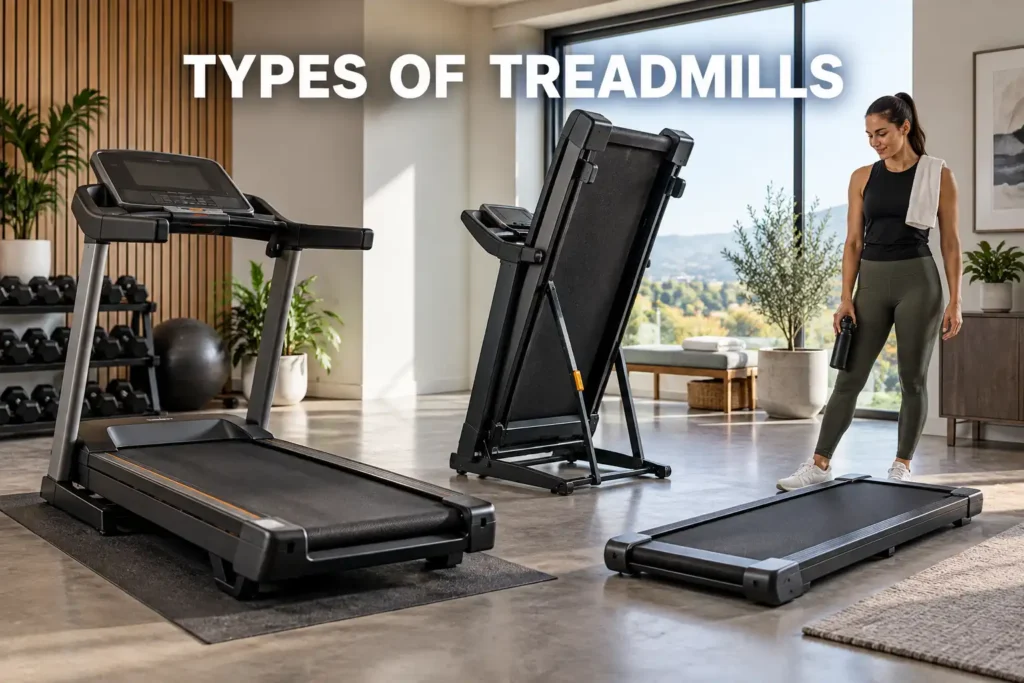
The main types of treadmills are motorized flat-belt, manual flat-belt, curved, slat-belt, folding, walking pad and anti-gravity. Pick a motorized flat-belt or folding model for steady walking and running at home, a curved model for short hard intervals, and a walking pad for easy walking at a desk.
The types of treadmills available today range far beyond the standard motorized deck found at most gyms. From self-powered curved runners to compact walking pads designed for office desks, each category serves a distinct training goal and living situation.
A manual curved model and a motorized folding machine share almost nothing, from how the belt moves to the upkeep each one needs. The main types of treadmills each fit a different job. In my view, matching the design to your main goal is the first decision to make, before brand or features.
Models that work without a subscription have their own page: non-subscription treadmill options.
This guide covers each type, shows one exact model for each type with its maker specs, and helps you decide which fits your goals and space.
Types of Treadmills - Your Complete Guide to Every Category
Understanding the different types of treadmills starts with the belt, the frame, how often the machine is used and whether it is built for home or commercial settings. Those four factors define what each category can and cannot do.
Start-up and control basics have their own page: treadmill operation and technique.
Motorized (Flat-Belt) Treadmills
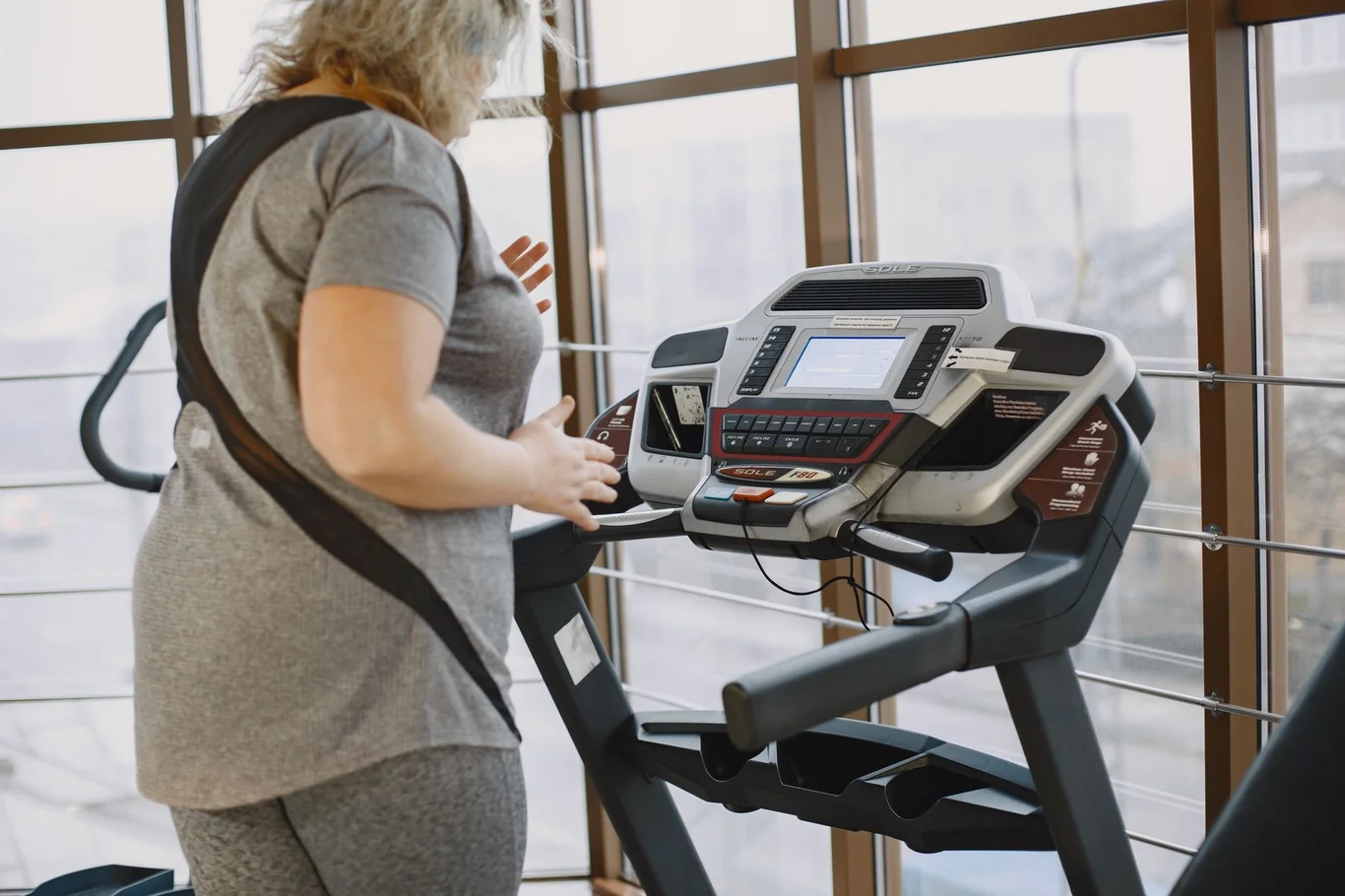
A motorized treadmill has an electric motor that drives the belt at the speed you set on the console. That makes a steady pace easy to hold. In my view it is the baseline the other types are compared with.
The belt can slip or drift off centre, and then it needs adjusting: motorized treadmill belt tension has the steps.
How Motor Power and Specifications Define Performance
Continuous horsepower (CHP) is the rating that matters for long sessions, because a peak figure describes a brief burst. The Life Fitness Club Series+ shows why the label matters: the maker lists a 4 hp AC peak performance motor and, separately, an IE2 efficiency rating at 2 hp. I compare continuous ratings and treat a peak figure on its own as incomplete.
Motor faults have their own page: fixing a treadmill motor.
Key specs for a motorized treadmill such as the Life Fitness Club Series+, a heavy, non-folding machine that Life Fitness sells for home use (US model). Lighter home models exist, so compare these figures with the exact model you are considering:
- Running surface: 22 by 60 inches
- Speed: 0.5 to 12 mph
- Incline: 0 to 15%
- Motor: 4 hp AC peak performance, IE2 efficiency rated at 2 hp
- Weight: 400 lb maximum user weight, 434 lb unit weight, 120 volt (US) supply
A meta-analysis of 33 studies with 494 healthy adults found that most biomechanical outcomes did not differ between motorized treadmill running and overground running. The foot met the belt at a lower sagittal angle on the treadmill (mean difference 9.8 degrees, low-certainty evidence), and knee flexion range from footstrike to peak during stance also differed. Only non-inclined, non-cushioned treadmill conditions were included (1).
Manual Treadmills - What They Are and Who They Work For
A manual treadmill has no motor: the belt moves only when your feet drive it, so you set and sustain the pace yourself. Manual machines come in two forms, flat-belt and curved-belt, and the next sections treat them separately.
A flat-belt manual treadmill is the simple version: a flat belt that moves only under your own push. I rate it as a walking and light-activity machine, not a running machine, because holding a steady running pace without a motor is hard. The weight limit, belt length and incline differ from model to model, so check the exact model before you decide.
Cost differs between categories and has its own page: treadmill cost by tier.
What to Expect on Flat Belt Manual Treadmills
What the design means in use:
- The belt moves only while you drive it.
- Pace follows your effort, so a steady speed takes constant attention.
- There are no speed buttons, so interval timing is yours to manage.
- It suits walking and light cardio; I would not choose it as a running machine.
A flat-belt manual treadmill fits casual walking where you want no motor. For hard intervals, the curved design in the next section is the one to look at.
Curved Treadmills - Biomechanics, Benefits, and Trade-offs
A curved treadmill uses a self-powered, concave belt. There is no motor: you drive the belt with each stride, so the surface moves only as fast as you push it.
Why Are Some Treadmills Curved
On a flat motorized belt the motor sets the belt speed. On a curved belt you set it: the faster you drive, the faster the belt moves. That one difference explains the findings below.
A curved treadmill such as the AssaultRunner Pro uses no electricity for the belt, and its console needs only four AA batteries. Assault lists a 17 by 62 inch black TPU running surface with 62 slats, a 350 lb user limit, a 280 lb assembled weight, and a warranty of 7 years on the frame, 3 years on moving parts and a 150,000-mile belt. The studies below used curved and non-motorized machines in general, and the Assault AirRunner in one case, so their results describe the curved design, not this exact model.
In a study of 27 recreational runners, a curved non-motorized treadmill produced lower tibia peak acceleration (mean effect size 0.45) and a lower head acceleration rate (0.86) than a motorized treadmill at the same running speeds, while heart rate and perceived effort were higher on the curved belt (2). The study measured impact acceleration, not injury, so it does not show fewer injuries.
Curved Treadmill vs Flat Treadmill - Performance Comparison
The curved treadmill vs flat treadmill decision comes down to training priority rather than a simple better-or-worse verdict.
Choosing between a treadmill and a stair climber has its own page: stairmaster vs treadmill comparison.
In 14 trained runners, running at a set speed on a curved non-motorized treadmill took a higher share of peak oxygen uptake than motorized treadmill running (about 16 percentage points more) and than overground running (about 22 points more), and heart rate was 22 beats per minute higher than on the motorized treadmill; lighter runners paid a larger penalty (3). A pilot study of four recreationally active young women on an Assault AirRunner also found higher oxygen uptake and heart rate than on a motorized treadmill at matched speeds (4). With four participants it shows direction only.
In my view, a curved belt suits short, hard work such as sprint intervals. For long steady aerobic work I would pick a motorized belt, because a curved belt cannot lock a pace and costs more effort at the same speed. Interval sessions have their own page: treadmill interval workouts.
A treadmill pace and speed chart converts mph settings into minutes per mile, which helps when you compare a motorized pace with effort on a curved belt.
Key trade-offs for curved treadmills:
- Higher heart rate and oxygen cost at the same running speed than a motorized belt
- No speed buttons: pace comes from your own drive
- The belt needs no outlet, and the AssaultRunner Pro console runs on batteries
- Pace control takes practice before intervals feel repeatable
- Heavy to move: the AssaultRunner Pro weighs 280 lb assembled
- A poor fit for long steady runs, because the pace cannot be locked
Types of Treadmill Belts - Flat Rubber vs Slat
Belt design separates two kinds of machine: the continuous rubber belt and the slat belt.
A flat rubber belt is a single loop of rubber over a deck, and the care it needs depends on the model. ProForm allows no silicone spray or other substances on the Pro 2000 belt or platform unless an authorized service representative says so. Belt tension and centring are set at the idler roller screws on the Pro 2000, and a correctly tightened belt lifts 2 to 3 inches at each edge.
Lubrication rules differ by model, so the manual comes first; how to lubricate a treadmill covers the method.
Replacing a worn belt has its own page: guide to replacing a treadmill belt.
A slat belt is built from individual linked slats instead of one rubber loop. Woodway rates its treadmills for 150,000 miles. Slat belt does not mean maintenance-free: the Woodway 4Front manual calls for the four axle bearings to be greased once a year, says the belt teeth are lubricated at the factory and need grease only if noise develops, and requires maintenance and technical safety checks by trained and authorized personnel every year. The 4Front has a 68 by 22 inch running surface, a 0 to 12.5 mph speed range, 0 to 15% incline and a 445 lb unit weight.
| Feature | Flat Rubber Belt | Slat Belt (Woodway 4Front) |
|---|---|---|
| Construction | Single loop of rubber over a deck | Linked slats driven by toothed belts |
| Belt care | Set by the model: ProForm Pro 2000 forbids silicone unless service says so | Grease four axle bearings yearly; grease belt teeth only if noise develops |
| Where the work sits | On the Pro 2000: tension and centring at the idler roller screws | Yearly maintenance and safety checks by trained personnel |
| Maker rating | Set per model; no type-wide figure | Woodway rates its treadmills for 150,000 miles |
Are Slat Treadmills Better Than Flat-Belt Models
A slat belt changes which jobs you do, not whether you do any. In my view it makes sense for heavy daily use, while a motorized rubber belt covers walking and moderate running well. Specific models are compared in best slat belt treadmills.
Types of Treadmills for Home - Folding and Compact Options
When space is the main limit, the types of treadmills worth evaluating narrow to folding motorized models and walking pads. Both save floor space, and each gives up something different.
Footprints differ by model, so check the exact model; treadmill dimensions has its own page.

Folding Treadmills - The Space-Smart Choice
A folding treadmill has a hinged deck that lifts and locks for storage. The ProForm PRO 2000 (model PFTL12820.8, a 2023 model, not the newer Carbon Pro 2000) shows what the fold asks of the owner. Set the incline to zero, remove the key and unplug the cord, hold the metal frame rather than the plastic foot rails, raise the frame until the storage latch locks, and do not leave the treadmill in the storage position above 85 F (30 C). The user limit is 300 lb, and the person raising it must be able to lift 45 lb safely. ProForm says the folded unit needs less than half the floor space of other treadmills. The fold is the part of the design you use every day, so a latch you can work alone matters as much as the motor.
Weight varies widely by type: the WalkingPad C2 is 55 lb, the AssaultRunner Pro is 280 lb and the Woodway 4Front is 445 lb. The page on treadmill weight by type covers weights across types.
What to check before choosing a folding treadmill:
- Deck length: compare the running surface of the exact model with your stride
- Fold lock: the storage latch must lock before you let go, as on the ProForm Pro 2000
- Motor: look for a continuous rating, not a peak figure
- Moving it: you must be able to lift 45 lb safely to raise the ProForm Pro 2000
- User limit: set by the model, for example 300 lb on the ProForm PRO 2000 (model PFTL12820.8)
Specific folding models are compared in best folding treadmill.
Walking Pads and Under-Desk Treadmills - Low-Profile Cardio
A walking pad is a compact belt for walking at a desk or in a small room, not for running. The WalkingPad C2, for example, has a top speed of 4 mph in its maker's US store (other regions give 6 km/h, about 3.7 mph), so check current terms before you buy. It supports 220 lb, has a 47.2 by 15.7 inch walking surface and weighs 55 lb. Its maker says the 4 mph top speed means it is not designed for running. Folded it measures 32.5 by 20.4 by 5.4 inches. Models to compare are in best under-desk treadmill.
The category has its own page: what is a walking pad.
The use I rate highest for a walking pad is easy walking through a seated workday, not replacing a workout. I would not count desk walking as a substitute for a dedicated session.
A stationary bike is the other low-impact way to add daily movement, and the bike vs treadmill breakdown compares the two.
Expected burn by speed, incline and body weight is on the treadmill calorie estimator page.
Backward walking is covered separately: benefits of walking backwards on a treadmill.
Different Types of Treadmills at the Gym
Two types are found mostly outside the home: heavy-use commercial motorized machines and anti-gravity units.
Commercial Treadmills
Woodway builds its treadmills for both commercial and home use, and the 4Front shows what a heavy-use machine asks for. It is rated for runners up to 400 lb at speeds above 4 mph and for walkers up to 800 lb at speeds up to 4 mph, and it needs yearly maintenance by trained and authorized personnel.
In a study of nine recreational runners, muscle activity in the lower limb differed between overground running and three treadmills: a mid-size commercial research treadmill, a small home exercise treadmill and a large research treadmill. The differences between the treadmills themselves were mainly in rectus femoris activity just before heel strike at faster speeds (5). The gap between treadmill and ground was the larger one in that study.
What Is an Anti-Gravity Treadmill
An anti-gravity treadmill such as the AlterG NEO uses differential air pressure in a pressurized air chamber to reduce the load on the body. The maker lists unweighting of up to 80% of body weight in 1% steps, a speed range of -3 to 10 mph and 0 to 15% incline.
The maker presents the system for clinicians, patients and athletes and says it is in over 5,000 facilities.
In 26 healthy, physically active adults at 8 km/h on a microgravity treadmill, carrying 80%, 60% and 40% of body weight lowered tibial acceleration, with the largest drops at 60% and 40%. The authors suggest that about 80% of body weight, which means unloading about 20%, may balance load reduction with natural running mechanics (6). The study measured shin acceleration at one speed in healthy adults, not injury or rehabilitation outcomes, and it used a different maker's machine than the NEO.
The maker presents these systems for clinicians, so most people meet them in a clinic or training facility. If a clinician advises reduced-load running, ask which clinics offer it.
Which Type of Treadmill Fits Your Training Goals
Three questions narrow the choice: what you want to train, how much floor space you have and how much upkeep you will do. The table sets each type beside one example model.
Floor type matters for any of them: treadmill on carpet has its own page.
| Type | Best For | Example Model | Check First | Limit |
|---|---|---|---|---|
| Motorized flat-belt | Steady walking and running at a set pace | Life Fitness Club Series+ (22 by 60 in, 0.5 to 12 mph) | Continuous motor rating | 400 lb user weight |
| Manual flat-belt | Casual walking without a motor | No single model; designs vary widely | Weight limit and belt length of the exact model | Hard to hold a steady running pace |
| Curved slat-belt | Sprint intervals and short hard sessions | AssaultRunner Pro (17 by 62 in belt) | Pace control takes practice; heavy to move | 350 lb user weight |
| Folding motorized | Homes with limited floor space | ProForm Pro 2000 (model PFTL12820.8) | Storage latch must lock; lift 45 lb to raise | 300 lb user weight |
| Walking pad | Easy walking at a desk | WalkingPad C2 (47.2 by 15.7 in surface) | Top speed 4 mph in the US (check current terms); not for running | 220 lb user weight |
| Commercial motorized | Heavy daily use | Woodway 4Front (68 by 22 in slat belt; built for commercial and home use) | Yearly service by trained staff | 400 lb running, 800 lb walking |
| Anti-gravity | Reduced-load running in clinics | AlterG NEO (unweights up to 80% of body weight) | Access through a clinic or training facility | No user weight limit given by the maker |
Upkeep differs by model more than by type, so read the manual of the exact model. ProForm forbids silicone on the Pro 2000 belt unless service says so, and Woodway asks for yearly bearing grease and a yearly service on the 4Front. Wearables that track treadmill sessions are covered in what a smartwatch does.
Incline and Decline Treadmills - Training on a Grade
Incline is a common control on motorized treadmills, and decline is rarer. The Life Fitness Club Series+ and the Woodway 4Front both list 0 to 15% incline, and Woodway lists an incline range of -3% to 22% as a custom option on the 4Front.
Without air resistance a treadmill costs less energy than outdoor running at the same speed. In nine trained male runners on 6-minute runs at about 6.5 to 11.2 mph, a 1% treadmill grade matched the oxygen cost of running on a level road (7). The evidence on the 1% grade is mixed, so treat it as a starting point. Models with wide grade ranges are compared in best incline treadmill.
Choosing the Right Type for Your Situation
The main types of treadmills each fit a different job. Motorized flat-belt models cover the broadest range of uses. Manual flat belts suit casual walking without a motor. Curved treadmills suit short, hard intervals. Folding treadmills trade a locking fold for floor space. Walking pads add easy movement to a desk day. Slat-belt models change the upkeep tasks. Anti-gravity units reduce body load and sit mostly in clinics.
Defaulting to a motorized flat-belt machine without asking whether the main goal needs a different design.
Models within a type are collected on the treadmill models we've profiled.
Start with the main use: walking, jogging, sprinting or reduced-load work. Choose the type that fits it, then compare exact models on their specs.
In my view, motorized flat-belt, folding motorized and walking pad models are the practical starting points for a home. Move to a specialized design (curved, slat belt, anti-gravity) when the goal calls for it. Connected features are a separate question: smart and regular treadmills is its own page.
Marathon preparation on a treadmill has its own page: preparing for a marathon on a treadmill.
Frequently Asked Questions
What are the different types of folding treadmills?
Folding treadmills differ mainly in motor, incline range and deck length, and they share a hinged deck that locks upright for storage. A folding treadmill such as the ProForm PRO 2000 (model PFTL12820.8) locks the raised frame with a storage latch and carries a 300 lb user limit, so check each model's limit and fold steps.
Is a flat or curved treadmill better?
A motorized flat treadmill holds a set pace and suits steady walking and running, while a curved treadmill raises heart rate and oxygen cost at the same speed and suits short, hard intervals. In my view the motorized flat belt is the more versatile choice for most homes.
Which type of treadmill is best?
In my view no single type is best, because each one fits a different goal. I'd pick a motorized flat-belt model for steady walking and running, a curved model for short hard intervals, a folding model or walking pad for tight space and an anti-gravity unit only for reduced-load work a clinician advises.
Which treadmill is best for running at home?
A motorized flat-belt model, folding or fixed, is the practical choice for running at home because it holds a set pace. Compare the exact model's continuous motor rating, its deck length against your stride and its speed range.
Are curved treadmills better for knees?
The evidence does not prove it: in 27 recreational runners a curved non-motorized treadmill produced lower tibia peak acceleration (effect size 0.45) than a motorized treadmill at the same speeds, but the study measured shin acceleration, not knee pain or injury. If your knees hurt, a clinician should guide the choice.
 Tech Fitness Lab
Author
Filip Marić
I am a strength and conditioning coach and I work with professional tennis players. I hold three ISSA certifications and worked as a fitness coach at the Tipsarevic Academy. I also write for Fitness Volt. I judge equipment as a coach: what it trains, how far it lets you progress and what its numbers mean.
Medical Disclaimer: This content is for informational purposes only and does not constitute medical advice. Consult a physician or licensed physical therapist before beginning any new exercise program, particularly if you are recovering from an injury or managing a medical condition.
References
- Van Hooren B, Fuller JT, Buckley JD, et al. Is motorized treadmill running biomechanically comparable to overground running? A systematic review and meta-analysis of cross-over studies. Sports Med. 2020;50(4):785-813. doi:10.1007/s40279-019-01237-z
- Encarnacion-Martinez A, Catala-Vilaplana I, Berenguer-Vidal R, et al. Treadmill and running speed effects on acceleration impacts: curved non-motorized treadmill vs. conventional motorized treadmill. Int J Environ Res Public Health. 2021;18(10):5475. doi:10.3390/ijerph18105475
- Edwards RB, Tofari PJ, Cormack SJ, Whyte DG. Non-motorized treadmill running is associated with higher cardiometabolic demands compared with overground and motorized treadmill running. Front Physiol. 2017;8:914. doi:10.3389/fphys.2017.00914
- Morrow N, Weighart H, Alonzo D, Mitchell K, Ives SJ. Physiological responses to speed-matched running on non-motorized Assault AirRunner versus traditional treadmills in active females: a pilot study. Int J Exerc Sci. 2022;15(4):1262-1273. doi:10.70252/HCKO2954
- Kaltenbach C, Gollhofer A, Nigg BM, Asmussen MJ. Comparison of muscle activity of the lower limbs while running on different treadmill models. Front Hum Neurosci. 2024;18:1341772. doi:10.3389/fnhum.2024.1341772
- Oleksy L, Mika A, Sopa M, et al. Effects of body weight unloading and treadmill belt surface on tibial acceleration-based loading indicators during running on a microgravity treadmill. J Clin Med. 2026;15(10):3654. doi:10.3390/jcm15103654
- Jones AM, Doust JH. A 1% treadmill grade most accurately reflects the energetic cost of outdoor running. J Sports Sci. 1996;14(4):321-327. doi:10.1080/02640419608727717