
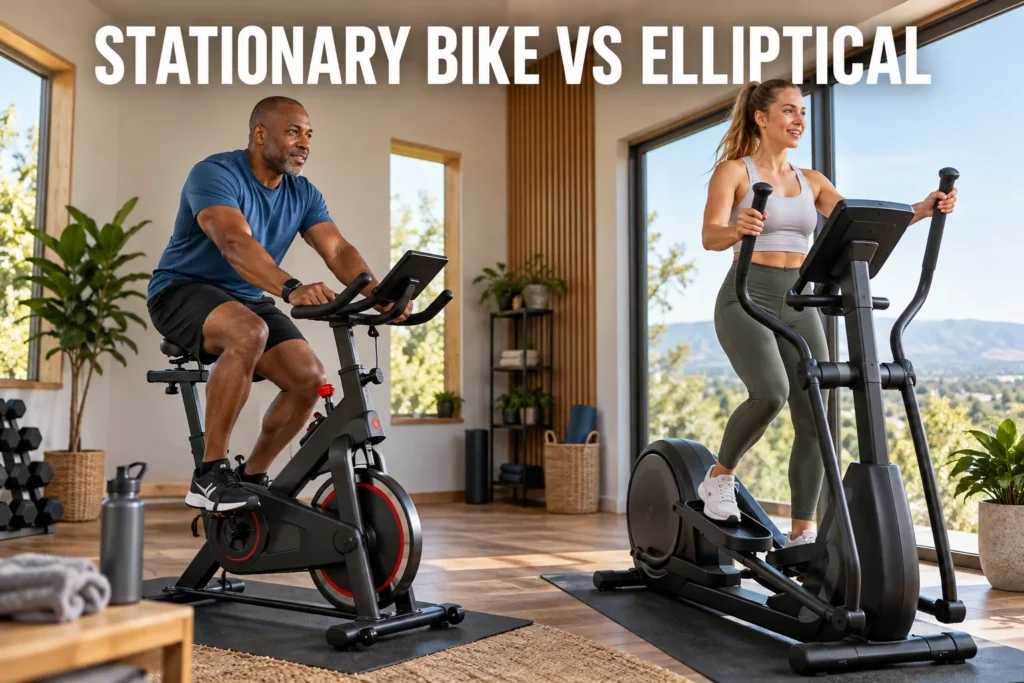
The stationary bike vs elliptical choice comes down to one trade-off: a seated, fully supported ride or a standing stride that brings your arms into the work. I have trained on both machines for years and set them up for clients with sore knees, tight hips, and weight-loss goals, and the better pick depends far more on the person than on the calorie readout. Both deliver low-impact cardio that is kind to your joints, but they load your body differently and cost different amounts to buy. My honest framing is that the better machine is the one a person still uses in month three. Below, I compare calorie burn, joint loading, muscle engagement, and the cardiovascular research, then walk you through the decision framework I use with my own clients.

Stationary Bike vs Elliptical: How They Stack Up Side by Side
A stationary bike seats you and drives the lower body through a circular pedaling motion. An elliptical trainer puts you in a standing position and mimics a gliding walking-and-climbing stride, with handles that move the arms in a synchronized push-pull rhythm. These different movement patterns produce genuinely different results in the body: distinct muscles work, joints load differently, and each machine suits a different type of user.

Here is how the stationary bike vs elliptical compare across the metrics that matter most when you are choosing for a home gym:
Stationary Bike | Elliptical | |
Body position | Seated | Standing |
Weight-bearing | Non-weight-bearing | Partial weight-bearing |
Upper body involvement | Minimal | Active (synchronized handles) |
Primary muscles | Quads, hamstrings, calves | Quads, glutes, core stabilizers, arms |
Joint stress | Very low | Low |
HIIT intervals | Excellent | Moderate |
Bone-loading benefit | None | Mild |
Footprint | Compact | Larger |
Entry-level cost | Lower | Higher |
Learning curve | Minimal | 2-3 sessions |
The biggest structural difference between an elliptical versus stationary bike is weight-bearing status. On the bike, the seat absorbs your body weight. On the elliptical, your legs bear load through the entire stride - quietly, but consistently. That distinction matters more than calorie numbers for many users.
Calorie Burn: Which Machine Works Harder for Fat Loss
Calorie burn is the first metric most people check when comparing the stationary bike vs elliptical, and the honest answer is: both machines burn meaningful calories, but the elliptical holds a moderate edge under matched conditions. The driver is upper body involvement. When you actively push and pull the elliptical's handles, you recruit more total muscle mass, which increases energy expenditure.

Energy Expenditure at Moderate vs High Intensity
A 2024 study by Prieto-Gonzalez and Yagin used indirect calorimetry - the gold-standard measurement method for energy expenditure - to compare caloric output across seven cardio machines at two intensity levels. Their data showed that the elliptical and stationary bike produced similar outputs at self-selected moderate effort, with the elliptical producing higher values when arm drive was fully engaged (1).
Realistic ranges for a 155-pound person doing 30 minutes:
Intensity Level | Stationary Bike | Elliptical |
Light (50-60% max HR) | 160-200 kcal | 170-215 kcal |
Moderate (60-75% max HR) | 210-260 kcal | 225-280 kcal |
Vigorous (75-85% max HR) | 300-370 kcal | 320-400 kcal |
These are estimates - the actual numbers shift based on several variables that the table above cannot fully capture:
- Body weight: The single biggest variable; heavier users burn more on both machines at every intensity level
- Resistance setting: Higher resistance increases calorie burn disproportionately, especially on the bike during interval efforts
- Arm engagement on the elliptical: Passive arm-resting removes the upper body advantage entirely
- Session duration: Longer sessions amplify the calorie gap between machines
- Fitness level: More conditioned athletes work at higher absolute intensities, burning more per minute
A 200-pound person burns roughly 25-30% more than a 155-pound person at the same effort level on either machine.
When the Calorie Gap Closes
The elliptical's calorie advantage disappears in two situations. First, when you let your arms rest passively on the stationary handles - this removes the upper body advantage entirely, making the elliptical effectively lower-body-only cardio, which matches the bike's energy profile. Second, during high-intensity cycling intervals: explosive pedaling sprints on a stationary bike can generate power outputs that rival or exceed a typical elliptical session.
Machine calorie displays are notoriously unreliable on both machines. In my experience reviewing both, the most common frustration users report is discovering that the onboard calorie count ran high once they compared it against heart-rate-based tracking. I treat the console number as a rough guide, never as a target to eat back.
If you want to follow calorie output across weeks of sessions rather than one workout at a time, a wrist-worn dedicated calorie tracker gives you the longitudinal view that neither machine's built-in display can provide.
Joint Impact: Low-Impact Does Not Mean Zero Impact
Both machines are marketed as low-impact cardio, but they produce meaningfully different joint loading patterns. The stationary bike is the lower-impact option of the two: your weight is fully supported by the seat, removing axial loading from the knees, hips, and ankles entirely. The elliptical is standing exercise - your body weight loads the lower limb joints through the stride, even without the heel-strike force of running.

Knee Joint Stress: What the Research Actually Shows
A 2024 biomechanical study by He, Lo, and Chen directly compared knee joint kinematics between stationary bikes and elliptical machines across two pedaling speeds and found that elliptical machines induced higher knee joint torque than stationary bikes, with pedaling speed positively correlating to peak torque on both machines (2). The torque values on the elliptical remain within safe ranges for healthy joints - this does not make the elliptical dangerous. But for someone managing active knee pain or post-surgical recovery, the seated, weight-supported position of the bike carries meaningfully less joint stress.
One additional distinction worth noting: the elliptical's partial weight-bearing status means your bones experience mild loading through each stride, which can contribute to bone density maintenance over time. The stationary bike's fully seated position provides zero axial load - beneficial for injury recovery and rehabilitation, but neutral for bone-loading adaptations. For users prioritizing long-term bone health alongside cardiovascular fitness, this is a meaningful secondary difference.
Here is the framework I use when matching a machine to a joint condition:
- Active knee osteoarthritis or post-knee surgery: Stationary bike is the standard clinical recommendation
- Hip flexor tightness from prolonged desk work: The elliptical's extended stride may initially aggravate this
- Plantar fasciitis or foot pain: Bike removes foot-strike loading entirely
- Lower back pain (disc-related): The seated position can compress the lumbar spine if the bike is set up incorrectly; standing on the elliptical works better for some
- Healthy joints with no current issues: Either machine is safe; choose based on other factors
This is general guidance, not medical advice. If you are managing an active injury or recovering from surgery, consult your clinician before choosing either machine.
Other Low-Impact Cardio Machines to Know
The stationary bike and elliptical are not the only low-impact options. Rowing machines occupy a third lane: they deliver full-body work with zero impact, but the repeated hip hinge under load asks more of the lower back than either a bike or an elliptical. When I coach new rowers, a rounded back at the catch is the fault I correct most often, and it is the main driver of rowing-related back pain.
Muscle Engagement: What Each Machine Actually Trains
The elliptical machine vs stationary bike difference is clearest here. Both machines target the lower body, but the recruitment patterns differ, and only the elliptical adds meaningful upper body involvement. Understanding which muscles each machine drives helps you match equipment to training goals.

Lower Body Activation: Quads, Hamstrings, and Glutes
A controlled laboratory study by Prosser and colleagues compared muscle activation across stationary cycling and elliptical training using surface electromyography and found that elliptical training produced significantly greater quadriceps activity than stationary cycling, while cycling demonstrated lower hamstring peak activation (3). A separate study by Bouillon and colleagues comparing four exercise devices found that an elliptical-style device (using an ElliptiGO stand-up cycling machine) produced notably higher rectus femoris activation (45.8% MVIC) compared to upright bikes (30.1% MVIC) (4).
What this means in practice:
- Stationary bike: Stronger quad emphasis at the bottom of the pedal stroke; seat height adjustments shift emphasis between quads and hamstrings
- Elliptical: More balanced quad and hip extensor engagement; slightly more glute activation through the stride push-down phase
- Core: The standing elliptical asks for moderate core stabilizer activation, while the bike's seated position removes this demand almost entirely
- Neither machine: Provides significant resistance-training stimulus - both are cardio tools, not strength builders
Upper Body: Where the Elliptical Has a Clear Edge
The elliptical's arm handles are its most practical anatomical advantage. Actively driving them engages the chest, shoulders, triceps, and upper back in a push-pull rhythm. The stimulus is modest in absolute terms - you will not build upper body mass from an elliptical - but it meaningfully increases total calorie burn and provides a more balanced session for sedentary individuals who primarily sit at a desk all day. My tip: for 20 strokes at a time, consciously push and pull the handles instead of holding them, because most clients I watch let their arms go passive within the first five minutes.
The stationary bike requires almost no upper body engagement: the muscles an exercise bike works sit almost entirely below the waist, led by the quads, hamstrings, and calves. Some connected bikes are used with coach-directed upper body movements during structured classes, but the machine itself does not drive arm movement.
Cardiovascular Benefits and Long-Term Fitness Gains
Both machines produce real and measurable cardiovascular improvements with consistent use. The key variables are session frequency, intensity, and duration - not which specific machine you choose. That said, the research evidence for each machine points to specific populations and use cases where one tends to outperform the other.

Stationary Bike: Proven Results Across Populations
A systematic review by Chavarrias and colleagues covering 13 studies found that indoor cycling produced VO2max improvements of 8-10.5% with two to three sessions per week, while also reducing blood pressure, decreasing body fat, and improving cholesterol profiles including HDL, LDL, and triglycerides (5). The evidence quality was rated as very low due to heterogeneous protocols, but the directional improvements were consistent across studies.
A 12-week intervention study by Ratajczak and colleagues in women with obesity found that stationary cycling three times per week for 55 minutes improved VO2 peak, fasting glucose, LDL cholesterol, triglycerides, and markers of oxidative stress (6). I found this study particularly compelling because it isolates outcomes for a population - individuals with excess body weight seeking metabolic improvement - where machine choice actually matters in terms of long-term adherence and injury risk.
A comprehensive systematic review by Akter and colleagues covering 47 studies in adults aged 60 and older documented stationary bike interventions improving aerobic capacity, balance, mobility, and cognitive function, with moderate acceptability reported across study populations (7). For older adults especially, the stationary bike is the most studied and most consistently recommended low-impact cardio tool in the published literature.
When I have run clients through matched-effort 30-minute sessions on both machines, the elliptical with active arm drive consistently left them breathing harder and slower to settle afterward than the bike at a similar perceived effort. That fits the higher total muscle recruitment the elliptical demands, and it is why I program the bike first for clients who are just rebuilding their aerobic base.
Elliptical: Rehabilitation and Full-Body Conditioning
The elliptical shows particular strength in post-surgical rehabilitation research. A 2022 randomized controlled trial by Hasebe and colleagues found that incorporating elliptical trainer exercise during recovery from total hip arthroplasty produced greater improvements in knee extensor strength, single-leg stance time, stride length, and walking speed compared to walking-only rehabilitation (8). This is meaningful for anyone using the elliptical during injury recovery - the biomechanical evidence supports it.
For healthy, active populations, the cycling vs elliptical comparison on cardiovascular outcomes is roughly equivalent. Both machines improve VO2max, support fat loss, and build aerobic endurance. The deciding factor is which machine you actually use consistently, which brings us to the practical decision guide.
How to Choose: A Practical Stationary Bike vs Elliptical Decision Guide
The stationary bike vs elliptical comparison does not have a universal winner. The right machine depends on your current fitness level, injury history, training goals, available space, and budget. Here is how to apply those variables to the decision.

When the Stationary Bike Is the Better Choice
A stationary bike tends to be the better call in these situations:
- You are managing an active knee, hip, or ankle injury where standing exercise is painful or contraindicated
- You are returning from surgery and your clinician has cleared seated cardio only
- You are significantly deconditioned and want a low-stress, sustainable entry point to cardiovascular training
- Your budget is limited - entry-level bikes are substantially more affordable than comparable ellipticals
- You want HIIT-style training with short explosive intervals, which the bike handles more naturally
- You find standing for 30+ minutes fatiguing or uncomfortable due to back, foot, or balance issues
- You need the smallest possible footprint - bikes are consistently more compact than ellipticals
If you need even lower axial loading than an upright bike offers, a recumbent stationary bike spreads your weight across the backrest and seat and takes most of the load off the lumbar spine. For clients with active back or hip issues, the recumbent is usually my first suggestion, because the recumbent vs upright bike trade-off comes down mostly to posture and joint loading. When I shortlist recumbent exercise bikes for these clients, a step-through frame and a firm lumbar pad come before any console feature.
The bike's simplicity also means fewer mechanical failure points, which matters for long-term home gym reliability. A 61-year-old client of mine has ridden a Schwinn 230 recumbent bike three times a week for two years, and the only maintenance I have done on it is tightening the pedal straps.
When the Elliptical Is the Better Choice
An elliptical vs bike decision tips toward the elliptical when:
- You want full-body movement without switching to a separate upper body machine
- You are training around a lower back issue where upright cycling's hip flexion position worsens pain
- You want slightly higher calorie burn within the same session duration
- You are comfortable with standing cardio and find the seated bike mentally dull
- You have recovered from hip or lower extremity surgery and your physical therapist has cleared you for elliptical use
- You want mild bone-loading benefit alongside your cardio training
Correct setup matters on both machines. For the stationary bike, seat height should allow a slight bend in the knee at the bottom of the pedal stroke - too low compresses the knee, too high forces hip rocking. For the elliptical, expect a 2-3 session adjustment period to settle into the stride arc naturally; forcing length or speed before you adapt increases the risk of hip flexor fatigue. In my experience, most knee complaints from new bike users trace back to a saddle set too low, so check it before blaming the machine.
When a treadmill joins the shortlist, the elliptical vs treadmill vs bike decision works the same way: your injury history, impact tolerance, and budget determine the answer more than any machine's raw performance numbers.
Cost is where the bike usually wins. Entry-level upright bikes start at budget-tier pricing, while feature-rich connected trainers reach premium price points, and stationary bike prices rise mostly with resistance type, build quality, and connected features. Ellipticals span a similar range but start higher at the entry tier, and browsing home recumbent bikes next to upright models is the quickest way I know to see that gap for yourself.
Elliptical Bike and Outdoor Options: A Third Alternative Worth Knowing
The elliptical bike machine is a distinct category from indoor elliptical trainers: a human-powered stand-up vehicle that uses an elliptical-style stride motion rather than circular pedaling, designed for road or trail use. ElliptiGO pioneered this category - it remains the most recognized elliptical bike for the road, with models designed for paved roads and mixed-surface trails. This hybrid outdoor machine combines the full-body stride pattern of an elliptical with the distance-covering mechanics of cycling, making it distinct from both indoor elliptical trainers and stationary bikes.

An outdoor elliptical bike suits a specific user: someone who wants the biomechanical pattern of elliptical training while riding outdoors. An elliptical bike for the road replaces conventional cycling with a standing stride, making it a genuine cross-training alternative for runners who want to preserve stride mechanics while reducing impact. The Bouillon et al. study referenced above (4) actually used an ElliptiGO as one of its test devices, confirming higher muscle activation profiles compared to indoor upright bikes.
If you are shopping for an elliptical bike for sale, the ElliptiGO product line spans entry-level to performance models, with pricing and gearing ranges varying by terrain requirements.
Under-desk ellipticals are a separate, lower-intensity sub-category: compact pedal units you use while seated at a desk. They raise NEAT (non-exercise activity thermogenesis) rather than delivering a structured cardio workout, so they should not be compared directly to full-size stationary bikes or elliptical trainers for cardiovascular conditioning. I see them as a way to break up long sitting stretches, and that is the honest bar for judging whether under desk ellipticals work for you.
Making the Right Low-Impact Cardio Choice
The stationary bike vs elliptical debate has no single correct answer, and any article that declares one machine objectively better is oversimplifying. Framing it as an elliptical vs bicycle choice - where bicycle means stationary bike - makes the tradeoffs cleaner: you are choosing between a seated, lower-body-focused machine and a standing, full-body-capable one. I have reviewed the stationary bike vs elliptical research closely, and the honest takeaway is that the evidence supports both tools for cardiovascular fitness - what separates them is which populations they serve best and which movement patterns each user tolerates long-term.
In 3 years testing home cardio equipment with clients at varying fitness levels, the dropout rate I have observed is higher on ellipticals purchased for their calorie number than on bikes purchased for joint protection, which is exactly backward from what most people expect when they read a side-by-side comparison.
The stationary bike is better for joint-compromised users, seniors, beginners, budget-conscious users, and anyone who wants explosive interval training without managing balance on a standing machine. The elliptical is better for full-body calorie burn, users who find seated cardio demotivating, and people recovering from specific lower extremity surgeries where the elliptical's stride pattern has been directly studied in clinical settings.
The most important factor in the stationary bike vs elliptical decision is which machine you will actually complete 30-minute sessions on, three to four times per week, without dreading it. Consistent moderate effort on either machine beats occasional intense effort on the optimal one.
For readers who have also considered a treadmill, the elliptical vs treadmill vs bike decision follows the same logic: impact tolerance and full-body engagement tip toward elliptical, lower joint stress and budget tip toward bike, and highest calorie burn at the expense of impact tips toward the treadmill.
If the bike comes out ahead for you, look first at quiet magnetic resistance and a seat that adjusts precisely to your leg length, the two features I check before anything else when I shortlist the best exercise bikes for home use. If the elliptical wins, apply the same test to stride length and handle position, which is how I narrow down the top elliptical machines for taller clients.
FAQs
Is an elliptical or stationary bike better for weight loss?
The best machine for weight loss is whichever one you use consistently at moderate to high intensity over time. Research indicates the elliptical burns roughly 7-8% more calories than a stationary bike at matched moderate intensities due to upper body engagement, but a stationary bike session you complete regularly is always more effective for weight loss than an elliptical session you skip.
Is 30 minutes on the elliptical better than walking?
Thirty minutes on the elliptical burns substantially more calories than 30 minutes of brisk walking because the elliptical simultaneously engages the upper and lower body at higher intensity. A moderate-effort elliptical session burns approximately 225-280 kcal for a 155-pound person, compared to roughly 140-180 kcal for brisk walking, which works out to roughly 50% more calories for the same time investment.
Is 3 miles on the elliptical the same as running?
Three miles on an elliptical is not equivalent to running 3 miles in terms of calorie burn or cardiovascular demand. Elliptical distance is calculated from stride count rather than actual ground covered, and the mechanical support of the machine reduces the total workload compared to running. Running burns more calories per mile than elliptical training at matched distances because it requires more energy to propel the body against gravity without mechanical assistance.
What are the disadvantages of elliptical?
The main disadvantages of an elliptical are its larger footprint, higher entry-level price compared to a stationary bike, a fixed stride path that does not suit all heights or body proportions, reduced portability, and limited capacity for the explosive leg-drive intervals that cycling supports naturally. Some users also experience hip flexor fatigue during longer sessions, particularly those who spend most of their day seated.
This content is for informational and educational purposes only. It is not a substitute for professional medical advice, diagnosis, or treatment. Always consult with your healthcare provider before starting any new exercise program or using fitness equipment, especially if you are managing an injury or recovering from surgery.
We are always looking for expert inputs to make our content even better and more useful.
References
- Prieto-Gonzalez P, Yagin FH. Energy expenditure, oxygen consumption, and heart rate while exercising on seven different indoor cardio machines at maximum and self-selected submaximal intensity. Front Sports Act Living. 2024;6:1313886. doi:10.3389/fspor.2024.1313886.
- He M-Y, Lo H-P, Chen W-H. Effects of Stationary Bikes and Elliptical Machines on Knee Joint Kinematics during Exercise. Medicina (Kaunas). 2024;60(3):498. doi:10.3390/medicina60030498.
- Prosser LA, Stanley CJ, Norman TL, Park HS, Damiano DL. Comparison of elliptical training, stationary cycling, treadmill walking and overground walking. Gait Posture. 2011;33(2):244-250. doi:10.1016/j.gaitpost.2010.11.013.
- Bouillon L, Baker R, Gibson C, Kearney A, Busemeyer T. Comparison of Trunk and Lower Extremity Muscle Activity Among Four Stationary Equipment Devices: Upright Bike, Recumbent Bike, Treadmill, and ElliptiGO. Int J Sports Phys Ther. 2016;11(2):190-200.
- Chavarrias M, Carlos-Vivas J, Collado-Mateo D, Perez-Gomez J. Health Benefits of Indoor Cycling: A Systematic Review. Medicina (Kaunas). 2019;55(8):452. doi:10.3390/medicina55080452.
- Ratajczak M, Skrypnik D, Krutki P, Karolkiewicz J. Effects of an Indoor Cycling Program on Cardiometabolic Factors in Women with Obesity vs. Normal Body Weight. Int J Environ Res Public Health. 2020;17(23):8718. doi:10.3390/ijerph17238718.
- Akter T, Moneruzzaman M, Maduray K, Kader M. Acceptability and effectiveness of stationary bike intervention on health outcomes among older adults: a systematic review of intervention studies. BMC Geriatr. 2026;26:130. doi:10.1186/s12877-025-06757-0.
- Hasebe Y, Akasaka K, Otsudo T, Hall T, Yamamoto M. Effects of incorporating elliptical trainer exercise during rehabilitation on physical function and self-reported outcomes after total hip arthroplasty: a randomized controlled trial. J Phys Ther Sci. 2022;34(3):230-235. doi:10.1589/jpts.34.230.