
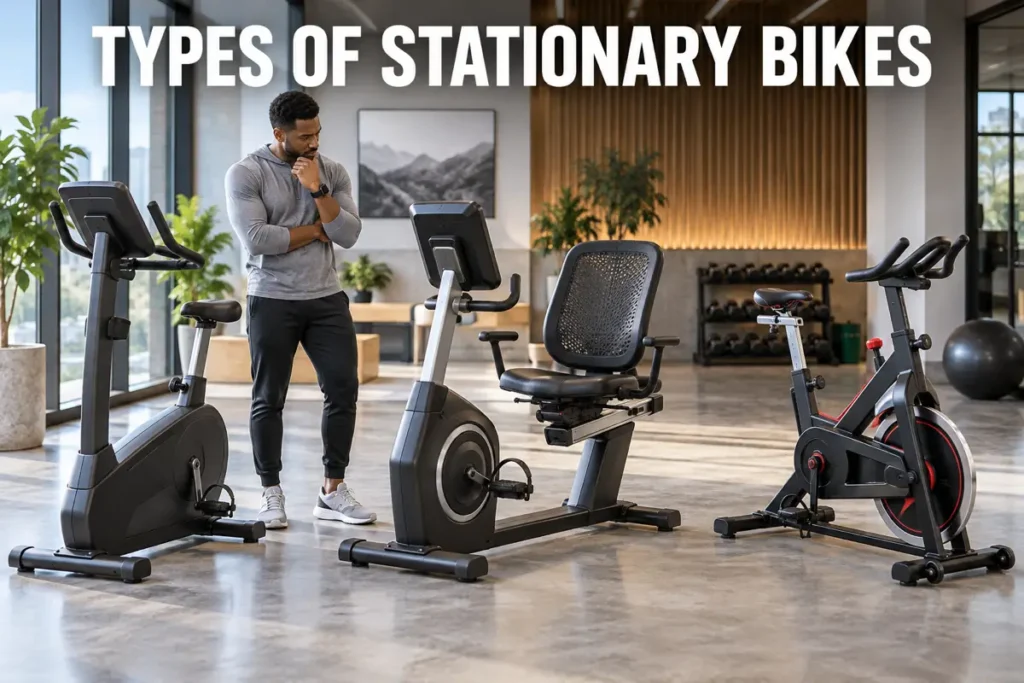
The types of stationary bikes range from gentle reclined rides to full-body machines that challenge even conditioned athletes. Choosing the wrong type means buying a bike that sits unused because it doesn't match your body, your space, or how you want to train. I've researched each category in depth - from the biomechanics of each riding position to calorie burn data across multiple peer-reviewed studies - and in this guide I'll break down exactly what each type is built for, who it suits, and how the different types compare side by side. You'll find a decision framework, study-backed intensity estimates, and answers to the questions readers ask most.

Types of Stationary Bikes - A Complete Guide to Each Design and Purpose
The four main categories are the upright bike, the recumbent bike, the spin bike (also called an indoor cycling bike), and the air bike (also called a fan bike or assault bike). These are also the different types of exercise bikes you'll encounter most often in gyms, home setups, and rehabilitation facilities. Each is built around a different riding position, resistance mechanism, and intended training intensity. Understanding these differences before you buy saves you from owning a machine that doesn't match how you actually train.
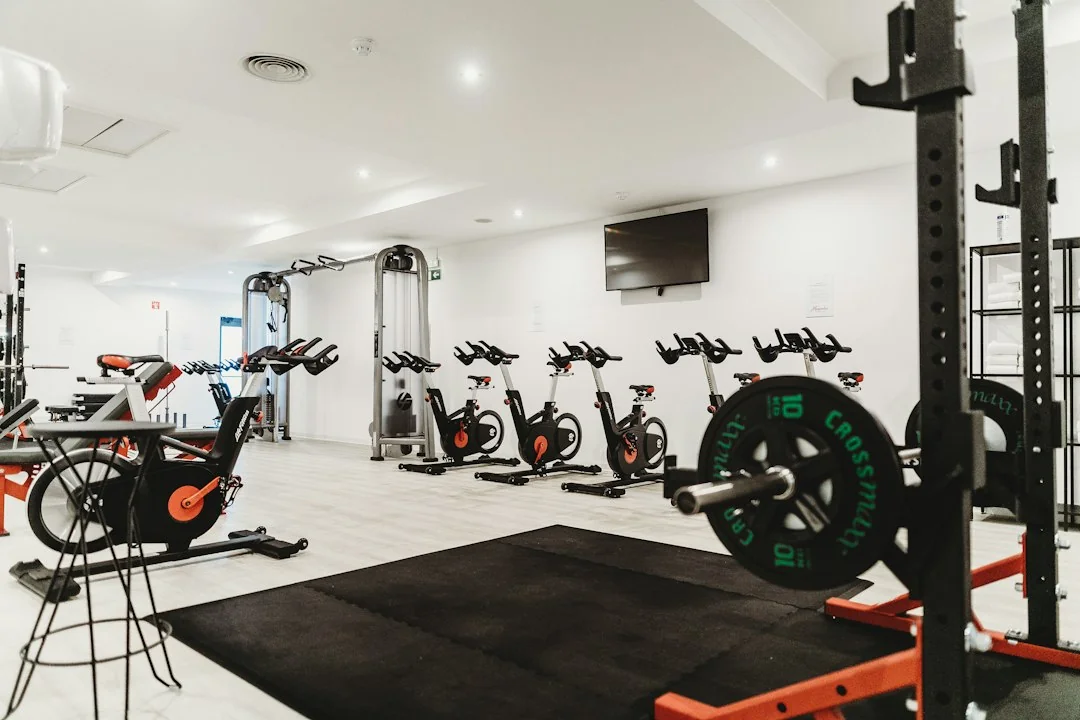
For a selection process that goes deeper than type alone - covering resistance systems, console features, and weight capacity - our guide on how to choose an exercise bike covers the decision framework in full.
Upright Bikes - The Standard for Everyday Cardio
The upright bike is the most common of all the types of stationary bikes. It positions you with your torso angled slightly forward, weight resting on the sit bones, and pedals directly beneath the hips - closely mimicking a standard road bike.
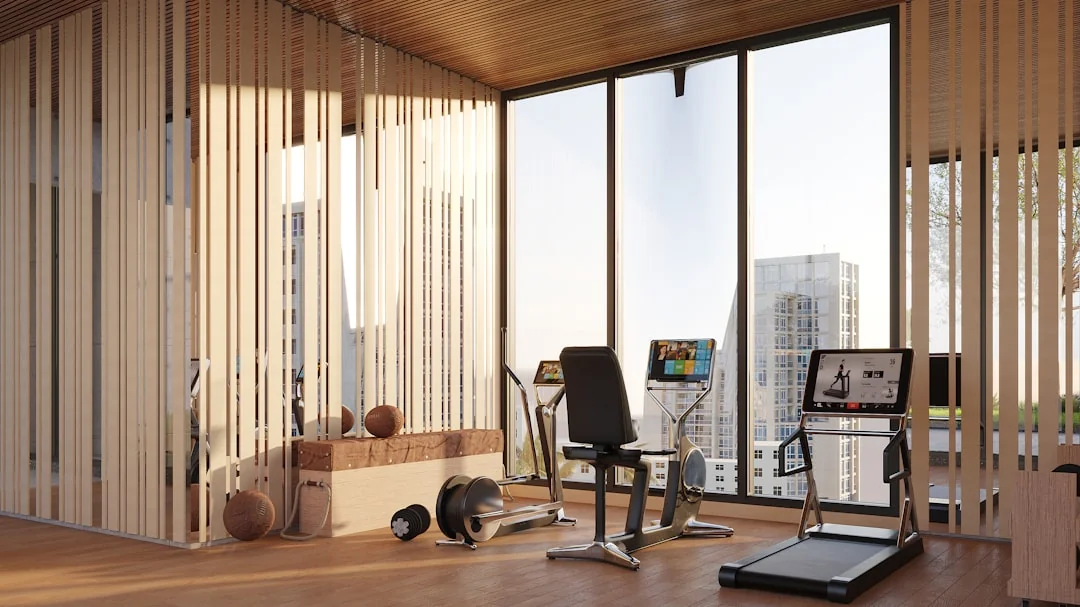
Most upright bikes use magnetic resistance, which adjusts with a dial or digital control and runs quietly at any effort level. Entry-level models use friction resistance pads; these wear out faster and can be inconsistent under heavy use. The handlebar design varies from flat bars (more relaxed posture) to drop-style bars (more aggressive lean), giving you some control over how the machine fits your body.
Who benefits most from an upright bike:
- Beginners building their first cardio base
- Riders who want a compact, accessible machine with a familiar riding feel
- People training at low to moderate intensity several times per week
- Those with limited floor space who want a standard stationary bike
The main limitation of upright bikes is seat comfort. The narrow saddle concentrates pressure on a small contact area, which becomes a problem during sessions longer than 30-40 minutes. Most riders add a padded seat cover to manage this, or upgrade to a model with a wider contoured saddle. I've found the Schwinn IC4's seat upgrade worthwhile if you're logging sessions longer than 30 minutes regularly - the stock narrow saddle is functional for short sessions but becomes the limiting factor before fitness does.
Recumbent Bikes - Full Support for Low-Impact Training
The recumbent bike seats you in a reclined position with a full backrest and a wide bucket seat. Pedals sit out in front of the body rather than beneath it, distributing your body weight across the seat and backrest rather than concentrating it on a narrow saddle.
When weighing a recumbent exercise bike vs stationary bikes of the standard upright design, the key trade-off is between joint comfort and intensity potential - the recumbent wins on joint support and stability, while the upright wins on achievable intensity ceiling and compact footprint.
This geometry has direct benefits for joint health. A biomechanical analysis by Telli et al. found that recumbent pedaling produces a more symmetrical crank trajectory and generates lower additional mechanical external power - clinically relevant for rehabilitation settings where controlled, symmetric loading is the goal (1). The reclined position also eliminates the forward trunk flexion that can aggravate lower back pain during upright cycling.
Who benefits most from a recumbent bike:
- People managing chronic lower back pain or knee osteoarthritis
- Older adults who need a stable, low-step mounting point
- Riders who want longer sessions at moderate intensity without joint fatigue
- Anyone recovering from a lower-body injury (under clinician guidance)
The step-through frame - a low entry point you swing your leg over - makes mounting straightforward for people with limited hip mobility. Recumbent bikes do require more floor space than upright models because of the extended frame, and they're not well suited for high-intensity interval training since the reclined position limits how much pedal power you can generate.
Spin Bikes - Performance-Focused Indoor Cycling
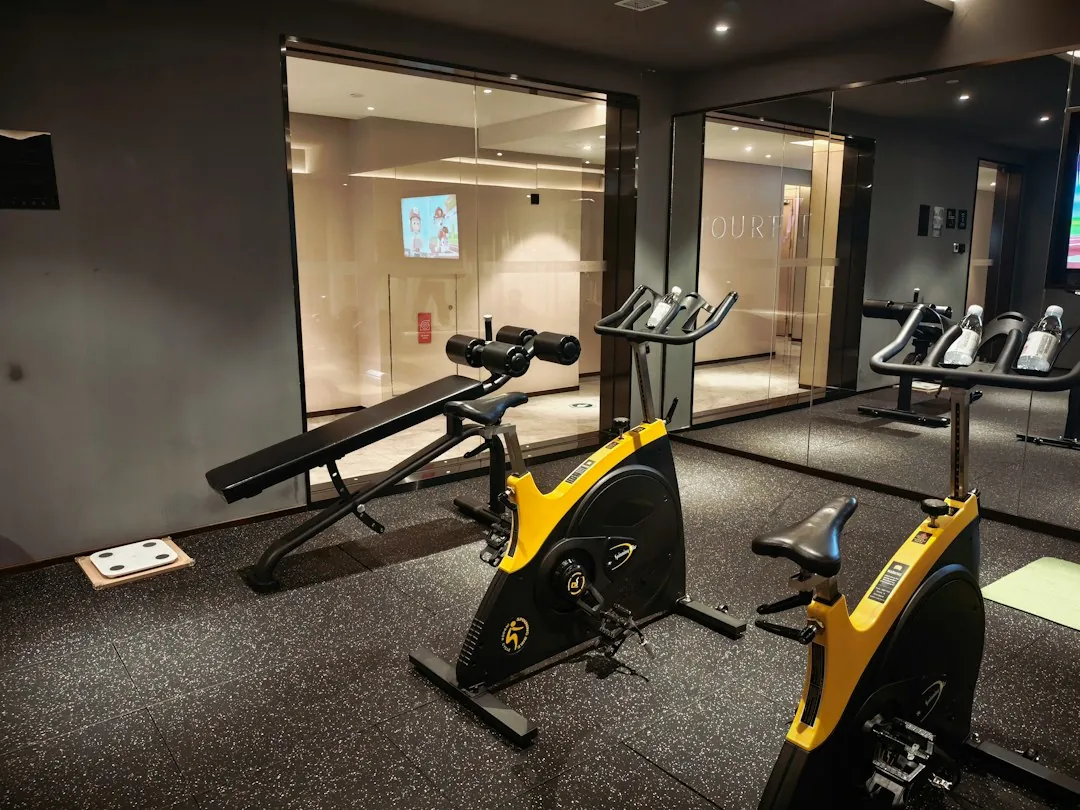
Spin bikes are designed for intensity, not comfort. They feature a heavy flywheel - typically 30 to 50 pounds - that creates smooth road-like momentum. Resistance comes from a friction pad or magnetic brake pressed against the flywheel. The riding position is aggressive: a forward lean similar to a road racing bike, with the ability to stand on the pedals for climbing and sprint intervals.
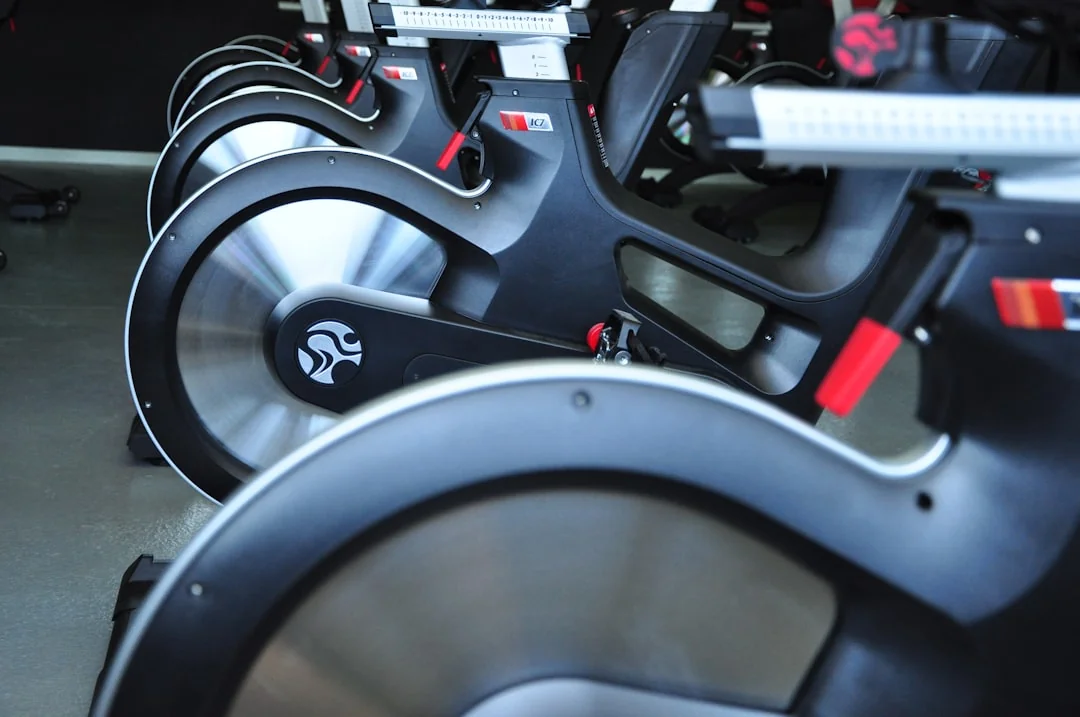
The difference between a spin bike and a standard upright exercise bike comes down to three core factors: flywheel weight, riding position, and how hard you can push through the pedals. Spin bikes are purpose-built for high-output efforts. Standard upright bikes are designed for steady-state cardio and general fitness maintenance.
Evidence for spin bike training is consistent and strong. A systematic review published in Medicina found that indoor cycling improved aerobic capacity, blood pressure, lipid profile, and body composition across 13 analyzed studies (2). A separate RCT found that 12 weeks of indoor cycling - 3 sessions weekly at 55 minutes each - significantly reduced body mass, total cholesterol, and C-reactive protein while increasing HDL cholesterol and skeletal muscle mass in women with obesity (3).
For riders who want precise heart rate data during spin bike intervals, my guide on chest strap heart rate monitors covers how they compare to wrist-based sensors for high-intensity cycling accuracy.
Who should approach spin bikes with caution:
- Beginners who haven't built a cardio foundation yet
- Riders with lower back pain (the forward-lean position can aggravate lumbar load)
- Those with hip flexor tightness (the aggressive position narrows hip flexion angle during pedaling)
Air Bikes - Self-Regulating Resistance for Maximum Output
Air bikes use a large fan wheel connected to moving handlebars. The harder you pedal and push, the more air resistance the fan generates. This self-regulating system has no mechanical ceiling: resistance rises with your effort, which is fundamentally different from how any other stationary bike type works.
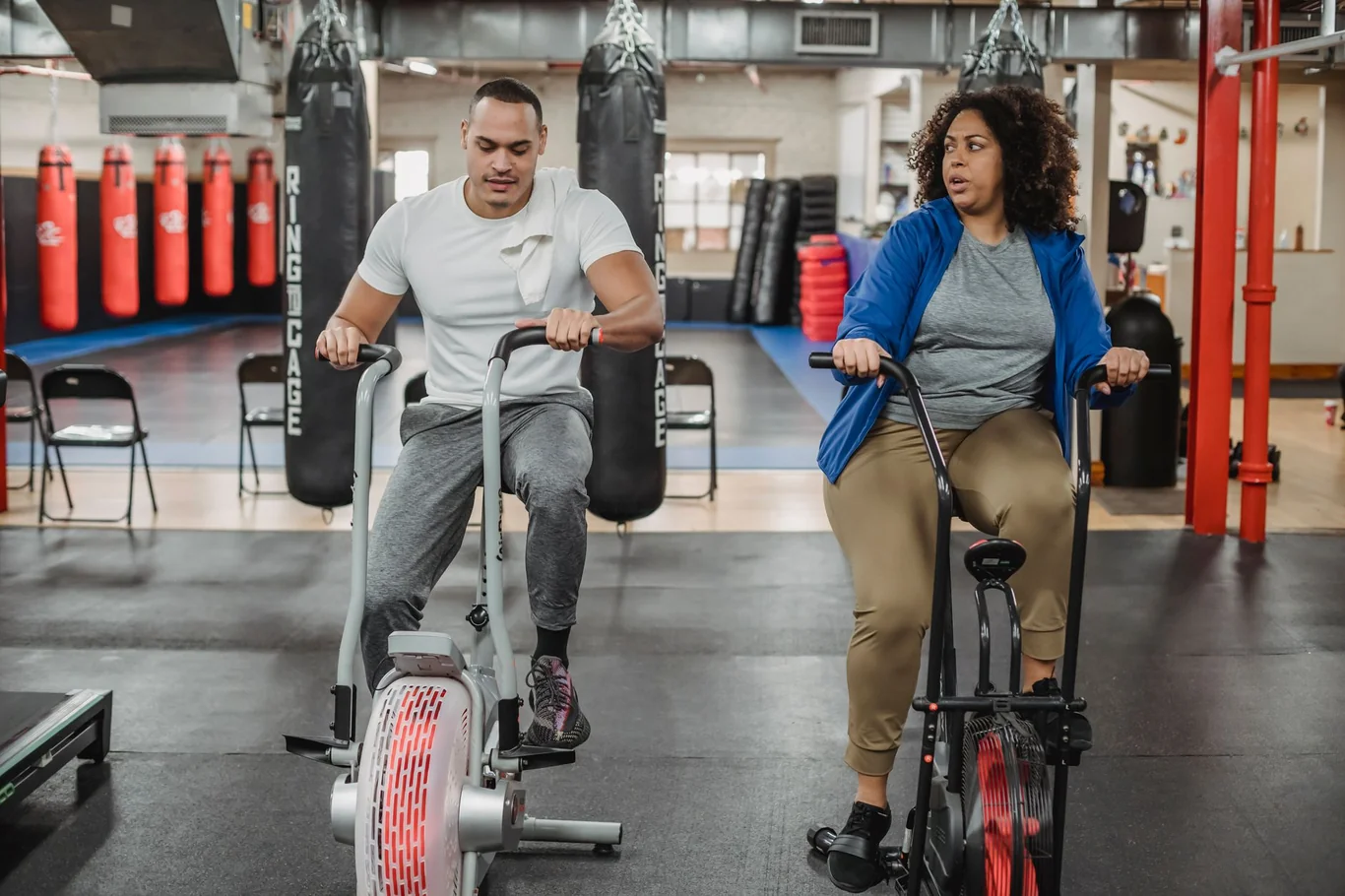
When comparing an air bike vs a standard upright, the performance gap is measurable. A comparative study found that the AssaultBike elicited significantly higher absolute VO2max, relative VO2max, peak post-exercise lactate, and maximum heart rate than a standard cycle ergometer. The researchers attributed this difference to greater whole-body skeletal muscle recruitment from the moving arm handles (4). This is the defining mechanical advantage of air bikes: you're driving power through both the lower and upper body simultaneously. In my experience testing the AssaultBike Classic during 20-minute steady efforts, average heart rate runs 12-15 bpm higher than on an upright bike at equivalent perceived exertion - reflecting the greater muscle mass recruitment the research describes.
For readers deciding between an air bike and a rowing machine as a full-body conditioning tool, my guide on the recumbent exercise bike vs rowing machine covers how the two machines compare on calorie burn, joint loading, and muscle recruitment.
The arm drive on an air bike also shares muscle recruitment patterns with rowing, where pushing and pulling generates power simultaneously. Our breakdown of what muscles a rowing machine works explains how the rowing movement pattern differs from the push-dominant air bike handle motion - useful context if you're deciding between the two for full-body training.
Who benefits most from an air bike:
- CrossFit and functional fitness athletes
- Riders focused on metabolic conditioning or fat loss at high intensity
- Experienced exercisers who want HIIT intervals that scale automatically with effort output
Air bikes are notably loud because of the fan mechanism, which matters for apartment living or shared spaces. They also take up more floor space than standard upright bikes and tend to sit at higher price points in the functional fitness category.
For CrossFit athletes pairing air bike work with other WOD movements, my guide on the best fitness tracker for CrossFit covers which devices track interval work, recovery, and mixed-modal training most effectively.
How the Four Types of Stationary Bikes Compare
The most common individual comparison is upright versus recumbent, but the table below shows how all four stack up across calorie burn, joint loading, and muscle recruitment.
Bike Type | Resistance System | Riding Position | Joint Impact | Calorie Range - 30 min, 155 lb |
Upright | Magnetic or friction | Forward lean, hip over pedal | Low | 240-300 kcal |
Recumbent | Magnetic | Reclined, back supported | Very low | 200-260 kcal |
Spin | Flywheel + friction or magnetic | Aggressive forward lean | Moderate | 350-450 kcal |
Air bike | Fan (self-regulating) | Upright with moving arm handles | Moderate | 400-600+ kcal |
For a detailed side-by-side on the two most commonly compared types, our article on recumbent exercise bikes vs. upright bikes covers seat design, resistance differences, and which populations each type serves best.
Calorie Burn by Bike Type
These are working ranges based on moderate-to-vigorous effort, not fixed values, since actual calorie burn shifts with body weight, intensity, and session length. A 2024 study comparing energy expenditure across seven cardio machines in middle-aged adults confirmed that higher-intensity machine types - like the spin bike - consistently produced greater calorie output than lower-demand options like the recumbent bike (5). A lighter rider at low intensity on an air bike can burn fewer calories than a heavier rider pushing hard on a recumbent.
For those who want to track calorie output accurately across bike types and sessions, my guide on the best calorie tracker covers which wearables give the most reliable expenditure data during stationary bike training.
Fat loss from stationary bike training is systemic, not localized. No bike type selectively reduces belly fat or targets a specific body region - our piece on exercise bikes and belly fat explains why spot reduction doesn't work this way. Calorie burn is determined far more by duration, consistency, and effort than by which machine you're sitting on.
Joint Impact and Low-Impact Suitability
All types of stationary bikes are low-impact compared to running because none involves repetitive ground-contact forces. The meaningful differences sit within the category:
- Recumbent - lowest compressive forces on the knee and lumbar spine; the safest option for riders with existing joint conditions
- Upright - low impact overall, but the narrow saddle and forward lean can aggravate back pain during longer sessions
- Spin - standing during climbs adds knee and lumbar torque; proper bike setup and technique are essential to avoiding strain
- Air - adds shoulder loading from the arm handles; not ideal for those with shoulder impingement or rotator cuff issues
Stationary Bikes vs. Bike Trainers
The stationary bike vs trainer question comes up frequently among road cyclists. A stationary bike is a self-contained machine; a bike trainer attaches your own road or mountain bike, converting it to a stationary setup. Smart trainers sync with Zwift, Rouvy, and similar platforms to simulate outdoor terrain - but unlike connected stationary bikes, they require your own bicycle and cassette. Quality stationary bikes are available at lower entry price points than quality direct-drive smart trainers, and they're plug-and-ride from the start.
Is a Stationary Bike Better Than Walking for Cardio?
At comparable durations, stationary bike riding typically burns more calories and generates a higher heart rate than walking at the same perceived effort. This makes cycling more time-efficient for cardiovascular conditioning. The specific gap depends on intensity: an easy recumbent session may produce similar output to brisk walking, while a vigorous spin or air bike interval clearly exceeds it.

Both cycling and walking avoid the joint impact of running. Neither involves ground-contact forces that stress the knee through impact loading. The difference is primarily in muscle recruitment and cardiovascular demand - cycling is a closed-chain movement driven by the quads, hamstrings, and glutes, while walking activates the posterior chain through hip extension and requires more ankle and foot stabilization.
For those who track both modalities with a wearable, my guide on the most accurate fitness watch covers which devices deliver the most reliable heart rate and calorie data across cycling and walking workouts.
Varied cardio across different movement patterns has a cumulative benefit for joint health and muscular balance. Our guide on the benefits of walking backwards on a treadmill covers how changing walking direction shifts muscle recruitment - a practical comparison point if you use both a stationary bike and a treadmill in your routine.
For most people, stationary bike training and walking work best when combined across the week rather than treated as competing options.
For those who rotate between stationary bike sessions and outdoor running, my guide on the best fitness tracker for runners covers which devices handle both activities accurately in the same weekly training block.
How to Choose Between the Different Types of Stationary Bikes
The right choice comes down to four factors: your fitness goal, your joint health, the floor space you have, and your budget. The table below covers the most common situations.

Your Situation | Recommended Type |
Building base cardio as a beginner | Upright bike |
Lower back pain or knee osteoarthritis | Recumbent bike |
Cycling-specific training or HIIT at home | Spin bike |
Full-body metabolic conditioning | Air bike |
Limited floor space, want folding option | Folding upright bike |
Older adult with limited mobility | Recumbent bike |
Off-season road cyclist | Bike trainer or spin bike |
Returning from lower-body injury | Recumbent (consult clinician first) |
Matching Your Goal to the Right Type
For cardiovascular fitness: All four types of stationary bikes deliver meaningful cardiovascular benefits when used consistently. A systematic review of stationary bike interventions in adults aged 60 and older found significant improvements in VO2max, cognition, executive function, quality of life, and mobility across 47 analyzed studies (6). I pay close attention to the acceptability data in that review - 38% overall acceptability across populations - because it reinforces that the type you'll actually use consistently matters as much as the clinical performance data. In older adult populations I've worked with, the recumbent's step-through frame and zero-strain mount are frequently the deciding factors for week-3 and week-4 adherence - far more than heart rate targets or calorie data.
For riders whose primary goal is fat loss, my exercise bike weight loss plan covers HIIT and steady-state protocols, realistic session durations, and a progressive 12-week structure across bike types.
For riders who want to monitor heart rate zones and training consistency across any bike type, my guide on the best fitness tracker covers which devices pair most reliably with stationary bike training.
For weight loss: Intensity drives calorie output more than machine type. Air bikes and spin bikes support the highest achievable intensities and are better suited for high-intensity interval protocols. Upright and recumbent bikes support longer steady-state sessions. High intensity training on an exercise bike consistently outperforms steady-state work for post-exercise calorie burn in research on exercise bike workouts for weight loss.
For seniors: The recumbent bike is the clinical recommendation for most older adults. It offers stable seated support, a step-through frame that eliminates the balance challenge of mounting, and the lowest joint loading of the four types. If you're using a wearable to track your heart rate during cycling sessions, our guide on how accurate smartwatches are for heart rate monitoring helps you interpret the data your device is giving you.
Always consult a healthcare provider before starting a cycling program for rehabilitation purposes.
Budget and Space Considerations
Upright bikes are the most space-efficient standard option. Many models fold for compact storage. They cover the widest price range and represent the most accessible entry point into stationary bike training.
For the smallest possible footprint, folding upright bikes deserve consideration - they offer the same basic ride as a standard upright but collapse for storage, making them well-suited for apartments or shared spaces where floor space is at a premium.
Recumbent bikes require more floor space because of the extended frame and seat. They tend to be mid-range in price, and quality magnetic-resistance models are available without reaching the premium tier.
Spin bikes range from budget flywheel models to connected bikes with touchscreens and live-class subscriptions at the high end. The functional difference between mid-range and premium spin bikes is significant and worth researching before buying.
My how much does a stationary bike cost guide covers what each price tier actually delivers across spin, upright, recumbent, and air bike categories, from entry-level flywheel models to premium connected smart bikes.
Air bikes are typically mid-to-premium priced and represent a long-term investment. Their mechanical simplicity - minimal electronics, a fan wheel, and basic bearings - makes them unusually durable. The trade-off is noise: the fan is loud during any meaningful intensity, which is a real practical constraint for apartment living or homes with thin walls.
For athletes using air bikes in daily training blocks, my guide on the longest smartwatch battery life covers which devices can handle high-frequency workouts without daily recharging interrupting your training routine.
The Right Type of Stationary Bike for Your Training
The types of stationary bikes serve genuinely different populations and goals. Upright bikes are the most accessible and compact all-around option. Recumbent bikes remove joint barriers for people managing lower back pain or knee discomfort. Spin bikes raise the intensity ceiling for performance training. Air bikes add full-body muscle recruitment and self-scaling resistance for well-conditioned athletes.
I'd recommend most new riders start with an upright bike - unless joint pain or mobility is a concern, in which case the recumbent is the clear choice. Experienced athletes wanting high-intensity intervals should look at spin bikes for cycling specificity or air bikes for full-body conditioning.
Pairing whichever type you choose with a wearable makes it easier to track heart rate and stay consistent over time. Our overview of what a smartwatch does for fitness tracking covers the features that directly complement stationary bike training.
FAQs
What type of stationary bike is best for seniors?
The recumbent bike is the best type of stationary bike for most seniors because its reclined seat, full back support, and step-through mounting reduce joint stress and improve stability during exercise. A systematic review of stationary bike interventions in adults aged 60 and older confirmed significant improvements in VO2max, mobility, cognition, and quality of life when stationary bike programs were followed consistently.
What is the most popular stationary bike?
The upright bike is the most widely used type of stationary bike across commercial gyms and home setups because it offers a familiar riding position, compact footprint, and the broadest range of price points. Spin bikes have grown sharply in popularity since the rise of connected indoor cycling platforms and group fitness streaming.
Is riding a stationary bike for 30 minutes as good as walking for 30 minutes?
Riding a stationary bike for 30 minutes at moderate-to-vigorous effort typically burns more calories and elevates heart rate higher than walking for the same duration, making cycling more time-efficient for cardiovascular conditioning. The specific difference depends on intensity - an easy recumbent session may match brisk walking output, while a vigorous spin or air bike interval substantially exceeds it.
What is the best exercise bicycle for home use?
The best exercise bicycle for home use depends on your goal and available space - an upright bike suits most beginners and general fitness users with limited room, a recumbent bike is the better choice for anyone managing back pain or knee discomfort, and a spin bike is ideal for those wanting high-intensity or cycling-specific training at home. Budget and floor space narrow the decision further once you've matched the type to your actual training goal.
What are the 3 different types of stationary bikes?
The three most commonly cited types of stationary bikes are the upright bike, the recumbent bike, and the spin bike. Most current fitness guides now add the air bike as a fourth category because of its distinct resistance mechanism, full-body muscle engagement, and fundamentally different intensity ceiling compared to the other three types.
This content is for informational and educational purposes only. It is not a substitute for professional medical advice, diagnosis, or treatment. Always consult with your healthcare provider before starting any new fitness program or using fitness technology for health monitoring.
References
- Telli R, Seminati E, Pavei G, Minetti AE. Recumbent vs. upright bicycles: 3D trajectory of body centre of mass, limb mechanical work, and operative range of propulsive muscles. J Sports Sci. 2017;35(5):491-499. doi:10.1080/02640414.2016.1175650.
- Chavarrias M, Carlos-Vivas J, Collado-Mateo D, Perez-Gomez J. Health benefits of indoor cycling: a systematic review. Medicina (Kaunas). 2019;55(8):452. doi:10.3390/medicina55080452.
- Ratajczak M, Skrypnik D, Krutki P, Karolkiewicz J. Effects of an indoor cycling program on cardiometabolic factors in women with obesity vs. normal body weight. Int J Environ Res Public Health. 2020;17(23):8718. doi:10.3390/ijerph17238718.
- Pearson RC, Garcia SA, Jenkins NT. Comparison of a ramp cycle ergometer and a staged Assault Fitness AssaultBike protocol for the assessment of VO2max. Int J Exerc Sci. 2023;16(4):613-619. doi:10.70252/RDUK7353.
- Prieto-Gonzalez P, Yagin FH. Energy expenditure, oxygen consumption, and heart rate while exercising on seven different indoor cardio machines at maximum and self-selected submaximal intensity. Front Sports Act Living. 2024;6:1313886. doi:10.3389/fspor.2024.1313886.
- Akter T, Moneruzzaman M, Maduray K, Kader M. Acceptability and effectiveness of stationary bike intervention on health outcomes among older adults: a systematic review of intervention studies. BMC Geriatr. 2025;25:17. doi:10.1186/s12877-025-06757-0.