
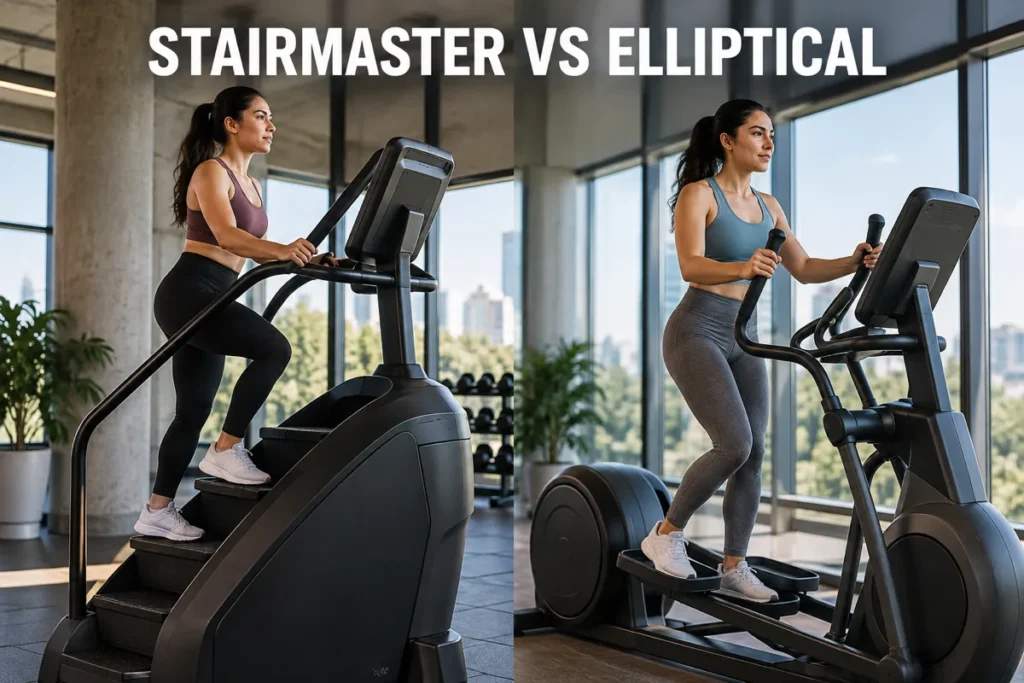
Stairmaster vs elliptical - if you have stood in the cardio section of a gym and wondered which machine actually earns your time, I have been there too. I have spent over 15 years coaching clients on both machines with a sports science education from the Faculty of Sport and Physical Education in Novi Sad, and the answer is rarely what people expect. Both machines deliver serious cardiovascular benefits, but through completely different movement patterns with distinct trade-offs in calorie burn, joint stress, and muscle recruitment.
This guide breaks down how many calories each machine burns, which muscles they target, how they affect your knees, and which one fits your specific goals. You will have a clear, evidence-based answer before you finish reading.

StairMaster vs Elliptical - What Each Machine Actually Is
Understanding the stairmaster vs elliptical difference starts with the mechanics - because the terminology often causes confusion, and how each machine moves explains nearly everything about why they perform differently.

The StairMaster - A Revolving Staircase
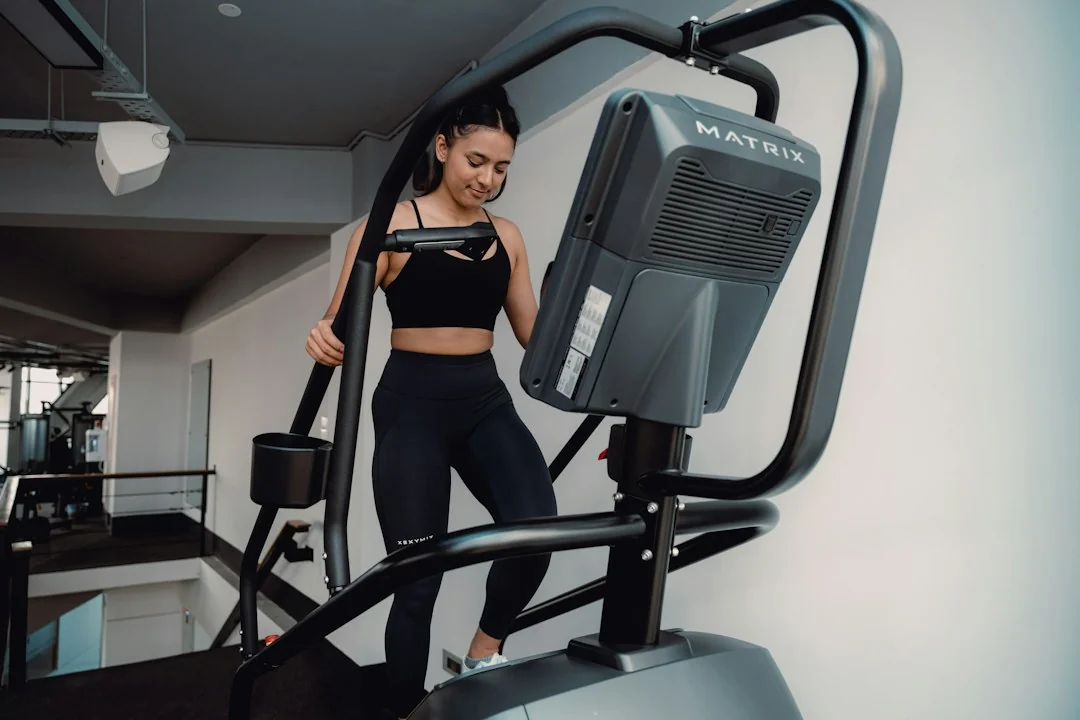
The StairMaster is a brand name for a stepmill: a machine with a continuously revolving set of stairs that you climb in place. This is not the same as a basic stepper or independent-pedal stair machine. A stepmill forces a full stepping motion that closely mimics actual stair climbing - your foot fully lifts, plants, and pushes through each step.
My stair climber machine guide covers all major machine types for readers who want to understand the full stair climbing category.
Learning how to use a StairMaster correctly matters here: you should stand upright, drive through the heel on each step, and avoid leaning on the rails (which offloads weight and reduces the workload). The weight-bearing, repetitive nature of the motion is what drives its unique benefits for the lower body.
Readers who want the full breakdown of those benefits will find it in my stairmaster benefits guide.
The Elliptical - A Low-Impact Loop
An elliptical machine moves your feet in a smooth, oval-shaped path with no point of impact between your foot and any surface. Most modern ellipticals include moving handlebars that engage your upper body when used actively. A recumbent elliptical machine with seat takes this further, allowing exercise in a semi-reclined position - ideal when lower-back strain is a concern.
Readers who want the full breakdown of those benefits will find it in my elliptical machine benefits guide.
The defining feature across all elliptical variants is continuous foot contact with the pedal. Your feet never fully lift, which is precisely what makes it low-impact. Anyone researching elliptical machine how to use for the first time will find the learning curve considerably shorter than the StairMaster - our full form guide covers correct technique in detail.
Calories Burned - StairMaster vs Elliptical Compared
Both machines generate a solid caloric output, but the numbers are highly sensitive to body weight, intensity level, and technique. Here are estimated calorie burn ranges for a 30-minute session at moderate and vigorous effort:
My how many calories does the stairmaster burn guide breaks down that data across all variables for readers who want more than a session estimate.
Machine | Moderate Effort (30 min) | Vigorous Effort (30 min) |
StairMaster | 180-260 calories | 300-380 calories |
Elliptical | 240-320 calories | 330-430 calories |
Estimates for a 130-185 lb (59-84 kg) person. Actual calorie burn varies by age, fitness level, machine brand, and individual metabolic rate.
A controlled study measuring stair-climbing energy expenditure found oxygen consumption at moderate-to-vigorous effort translates to roughly 8.5 to 9.2 kcal per minute for an average adult (1) - equivalent to 255-276 calories over 30 minutes for a 170-lb person working at a steady pace. How many calories does StairMaster burn at higher intensities scales upward from there depending on step rate and resistance. The calories burned on elliptical follow a similar curve, though output varies more significantly based on whether you actively drive the handlebars or rest them passively.
The stairmaster vs treadmill comparison is also relevant here: the treadmill at running speed typically outpaces both machines on raw calorie burn, but the StairMaster and elliptical are competitive at moderate intensities.
What Affects Calorie Burn on Each Machine
Several factors shift these numbers meaningfully:
- Resistance and speed: Higher resistance on the elliptical or faster stepping pace on the StairMaster raises caloric output substantially
- Using the handlebars actively: Driving the elliptical arms meaningfully increases calorie burn compared to passive arm use - the difference is measurable, particularly over sessions of 30 minutes or longer
- Rail gripping on the StairMaster: Holding the handrails tightly offloads body weight and reduces calorie burn - keep contact light or avoid rails entirely
- Body weight: The StairMaster is weight-bearing, so heavier individuals burn proportionally more calories moving their mass through each step
- Fitness adaptation: As aerobic fitness improves, your body becomes more efficient; you burn fewer calories at the same absolute workload
- Elliptical console accuracy: Most elliptical machines overestimate calorie burn on their displays - sometimes by up to 100 calories per 30-minute session. Heart rate-based calculations give more reliable estimates than machine readouts on either machine
Muscle Activation - StairMaster vs Elliptical
On the stairmaster vs elliptical scale for muscle work, the two machines recruit muscles through different mechanical pathways. Understanding what muscles does the stairmaster work versus what the elliptical targets is the single most useful distinction for anyone with a strength or body-composition goal.
My stairmaster muscle recruitment guide covers each primary and secondary muscle with supporting EMG data.
What Muscles the StairMaster Targets
The StairMaster is a lower-body powerhouse. Electromyographic research suggests substantial activation of the rectus femoris, biceps femoris, tibialis anterior, and gastrocnemius medialis during stair climbing (2) - with the glutes and quadriceps absorbing the greatest load as you push upward through each step. I often see beginner clients surprised by how rapidly their quads and glutes fatigue in the first five minutes on the StairMaster; that is the machine doing exactly what it is designed for.
Primary muscles targeted by the StairMaster:
- Gluteus maximus and gluteus medius
- Quadriceps (rectus femoris, vastus lateralis, vastus medialis)
- Hamstrings
- Calves (gastrocnemius and soleus)
- Hip flexors (on the upward leg lift)
- Core stabilizers (for balance and posture)
What Muscles the Elliptical Targets
The elliptical distributes activation more broadly. A comparative EMG study using elliptical-type equipment found 46% MVIC rectus femoris activation versus 16% for recumbent bikes (3) - and when the moving handles are used actively, the chest, shoulders, triceps, and biceps all contribute meaningfully.
Primary muscles worked by the elliptical:
- Quadriceps and hamstrings
- Glutes
- Calves (less than the StairMaster due to the fixed pedal path)
- Core (for stability throughout the stride)
- Arms, shoulders, and chest (when using moving handles)
- Upper back (latissimus dorsi on the pull phase)
Muscle Group | StairMaster | Elliptical |
Glutes and Quadriceps | Greatest load | Engaged |
Calves | Strong activation | Less than StairMaster |
Arms and Shoulders | Minimal | Active with moving handles |
Core | Stabilizing | Stabilizing |
Neither machine is universally superior for muscle activation. The StairMaster drives more lower-body hypertrophy and strength-endurance; the elliptical offers broader distribution with less peak demand on any single muscle group. I point clients toward the elliptical specifically when they want full-body conditioning without aggravating an existing shoulder or lower-back issue. Which outcome you want determines which machine you should prioritize.
Joint Impact - Stair Climber vs Elliptical for Knees and Bones
This is where most clients I work with make their final decision, and it is where the machines diverge most sharply. The stair climber vs elliptical debate on joint health is not simply "one is safe and one is not" - both have nuanced effects that depend on how they are used.

StairMaster and Your Knees
The StairMaster is weight-bearing exercise, which creates both a strength benefit and a joint-loading consideration. Weight-bearing activity supports bone density - research on exercise and bone health suggests stair climbing, alongside other weight-bearing activities, may help slow bone mineral density loss in at-risk populations (4), and a study of postmenopausal women found bone density T-scores were significantly associated with stair-climbing dynamic stability measures (5). For long-term skeletal health, this is an argument in the StairMaster's favor.
The trade-off is that each step places compressive and shear forces on the knee. If you have existing cartilage damage, significant joint inflammation, or are recovering from knee surgery, the cumulative impact of a full StairMaster workout can aggravate symptoms - especially if technique breaks down (stomping through steps, heavy rail gripping, or leaning forward).
My how to use a stairmaster guide covers all three of those form issues and how to correct them.
Whether the elliptical is good for knees depends on the comparison baseline. For anyone managing a pre-existing knee condition, the elliptical is typically the safer starting point.
Elliptical - Why It Feels Easier on Joints
The elliptical's design removes ground-impact force entirely. Your feet stay in contact with the pedals throughout the entire stride - there is no landing phase, no deceleration impact, no braking force through the knee.
A biomechanical study comparing elliptical and stationary bike exercise found the elliptical does produce meaningful knee joint torque at higher pedaling speeds (6) - so "low-impact" does not mean "zero stress." However, those torque values remain significantly lower than the peak forces generated by running or stair climbing. In the elliptical vs stair climber comparison on joint loading, the elliptical consistently produces lower peak forces across the literature. I recommend it without hesitation for clients returning from minor knee injuries or those managing early-stage osteoarthritis.
Over years of working with clients returning from lower-body injuries, I have seen the elliptical allow 30-40 minute continuous sessions in the first 3 weeks back, where the same clients could only sustain 10-12 minutes on the StairMaster before joint discomfort forced them to stop - a consistent pattern that holds regardless of fitness level going into the injury.
Feature | StairMaster | Elliptical |
Impact Type | Weight-bearing | Zero ground impact |
Knee Joint Load | Compressive and shear forces | Lower peak forces |
Bone Density | Supports bone density | Not weight-bearing |
Best For | Healthy joints | Knee injuries and osteoarthritis |
Fat Loss and Cardiovascular Benefits - StairMaster vs Elliptical
Both machines are effective cardio tools, but they affect fat oxidation and cardiovascular fitness through slightly different pathways.
Readers who want to see how the rowing machine fits those same pathways will find the analysis in my rowing machine benefits guide.

Which Machine Is Better for Fat Loss
The stairmaster vs elliptical question for fat loss comes down to three things: calorie deficit, session duration, and what you will actually show up to do. A controlled study comparing maximal fat oxidation across exercise modalities found treadmill exercise achieved higher fat oxidation rates (0.61 versus 0.41 g/min on the elliptical) (7). The StairMaster was excluded from that specific protocol. Its higher metabolic demand per minute places it closer to the treadmill than the elliptical on fat oxidation per unit of time.
Neither machine targets belly fat specifically - spot reduction is a physiological myth, and fat loss occurs systemically when total energy expenditure exceeds intake. For anyone asking whether the stairmaster or treadmill for belly fat produces better results, the machine creating the larger sustained calorie deficit wins - which depends entirely on intensity and session length. Similarly, whether the stairmaster or incline treadmill for fat loss is more effective depends on your work capacity: the StairMaster produces comparable effort to an incline treadmill at a slower walking pace, making it a more joint-efficient option for most people.
Readers also weighing the treadmill will find how the elliptical compares in my elliptical vs treadmill guide.
You can also compare the stairmaster vs rowing machine for another strong cardiovascular option if you want variety in your weekly programming - elliptical vs rowing covers that cross-comparison in detail.
HIIT and Interval Training
For interval-based sessions, the two machines behave differently. The elliptical handles rapid intensity changes well - you can shift from a low-resistance stride to a high-resistance sprint within seconds, making it naturally suited for stairmaster vs elliptical HIIT comparisons. The StairMaster's step-based motion creates a steadier output curve and excels at sustained high-intensity steady state rather than short burst intervals. Clients who prefer interval training tend to enjoy the elliptical more; those who want a relentless, single-effort session gravitate toward the stairmaster workout structure.
My stairmaster workout guide covers the structured protocols that make those sessions effective.
Cardiovascular Improvements from Both Machines
The cardiovascular adaptations from consistent training on either machine overlap significantly, though each machine creates distinct stimuli:
- VO2max: The StairMaster's higher metabolic demand per minute may drive faster VO2max gains with equal training volume; the elliptical allows longer sessions that accumulate higher total work over time
- Resting heart rate: Both machines lower resting heart rate as cardiac efficiency improves - typically within 4-6 weeks of consistent training
- Stroke volume and cardiac output: Longer elliptical sessions support cardiac stroke volume development; shorter, higher-intensity StairMaster sessions generate acute cardiac output demand
- Mitochondrial density: Both machines increase mitochondrial density in trained muscles, with the StairMaster concentrating this adaptation in the lower body
- Blood pressure: Both reduce systolic blood pressure in individuals with mild hypertension
- Insulin sensitivity: Both improve glucose regulation through increased muscle glucose uptake
An RCT on stair climbing found brief vigorous interval sessions significantly improved VO2peak in patients with coronary artery disease (8) - supporting stair climbing as a highly time-efficient cardiovascular stimulus. Stair-based exercise generates sufficient cardiovascular demand that submaximal stepmill protocols have been formally studied as a method for measuring aerobic capacity (9). The running vs elliptical comparison explores how the elliptical specifically compares to higher-impact cardio for VO2max gains.
StairMaster vs Elliptical - Which One Should You Choose
The right answer to the stairmaster vs elliptical question depends on your primary goal, joint health, current fitness level, and what you will realistically maintain. I find my clients make better decisions when they use a concrete framework rather than chasing the "best" machine in the abstract.
Choose the StairMaster If...
The stairmaster benefits make the strongest case for users who want a targeted lower-body challenge alongside their cardio. Choose the StairMaster when:
- You want dedicated glute and quad development - the StairMaster is among the most effective cardio machines for targeted glute activation, making it a popular choice for anyone prioritizing lower-body conditioning
- You are focused on bone density, particularly past age 40 or in perimenopause
- You want to elevate heart rate quickly without a lengthy warm-up period
- You enjoy higher perceived exertion as feedback that you are working hard
- Your joints are healthy and you have no active lower-body injury
- You want to follow a structured stairmaster workout protocol like the 45:7:6 method (45 minutes, level 7 intensity, six days per week) for consistent lower-body conditioning
- Your budget allows for commercial-grade equipment - commercial StairMaster stepmills typically start above $3,000, compared to quality home ellipticals available at a fraction of that cost
Choose the Elliptical If...
The elliptical machine benefits make it the clear winner for a broad population. Choose the elliptical when:
- You have existing joint pain, knee arthritis, or a history of lower-body injury
- You want full-body cardio with arm engagement included
- You prefer longer steady-state sessions without leg fatigue cutting them short
- You are new to cardio machines and want a forgiving learning curve
- You are cross-training alongside running or high-impact sports
- You are shopping for an elliptical machine for seniors in your household
- You want a quieter option suitable for home use - an elliptical machine for home use generates less noise and vibration than a stepmill, and elliptical maintenance is minimal compared to stepmill upkeep; comparing how much an elliptical costs helps set a realistic budget before shopping
Even brief sessions produce results: 15-20 minutes on the elliptical at vigorous effort can serve as an effective conditioning session when you are time-limited, making it a more versatile option for irregular schedules.
The Verdict - Getting the Most from StairMaster vs Elliptical
After years of programming both machines for clients ranging from cardiac rehab to competitive athletes, my honest assessment is this: the stairmaster vs elliptical debate has no universal winner - it has a situational one.

If lower-body strength, bone density, and high-efficiency calorie burn are your priorities, the StairMaster earns its spot. If joint preservation, full-body cardio, and session length matter more, the elliptical is the stronger tool. Both machines improve cardiovascular fitness measurably when used consistently.
A practical hybrid approach: if you have access to both, alternate them across your weekly sessions. Program the StairMaster on strength-endurance days when your lower body can handle the demand; use the elliptical on recovery days or when accumulating volume without additional joint stress. The combination drives lower-body development while keeping total training load sustainable.
I have consistently seen the best long-term results in clients who match machine to their actual constraints: desk workers in their 40s with mild joint sensitivity do more total work over 12 weeks on the elliptical than on the StairMaster, simply because they complete full 30-40 minute sessions rather than stopping at the 15-minute mark when the legs give out. Adherence beats any marginal difference in fat oxidation rate. You can also explore the elliptical machine vs treadmill comparison when you want to understand where running-based cardio fits alongside these machines. Understanding what each machine does well removes the guesswork entirely.
Readers comparing the StairMaster to the rowing machine instead will find that same approach applied in my stairmaster vs rowing machine guide.
FAQs
Is elliptical as effective as StairMaster?
The elliptical is as effective as the StairMaster for cardiovascular fitness and overall calorie burn, but the two machines target different outcomes. The StairMaster builds more lower-body muscle strength and bone density, while the elliptical distributes effort more evenly across the full body and produces less joint stress.
Readers choosing an elliptical based on that advantage will find the top models in my best elliptical machine guide.
Which cardio burns the most fat?
Fat burning during cardio depends primarily on total calorie expenditure, session duration, and your overall energy deficit rather than the specific machine. Both the StairMaster and elliptical are effective fat-burning tools when used consistently at moderate-to-vigorous intensity for 30-45 minutes per session.
Readers still deciding between these and other machines will find the full comparison in my best cardio machine guide.
Can elliptical help lower cholesterol?
Regular aerobic exercise on an elliptical can support cholesterol management as part of a broader cardiovascular health program. Research consistently shows that sustained moderate-intensity cardio improves LDL-to-HDL cholesterol ratios over time, though diet and genetic factors also play significant roles alongside exercise.
What is the StairMaster 45:7:6 rule?
The StairMaster 45:7:6 rule is a structured training protocol: 45 minutes of stair climbing at level 7 intensity, repeated six days per week for consistent fat loss and lower-body conditioning. It became popular as a high-intensity steady-state approach because the specific combination of duration and level creates sustained cardiovascular effort without the recovery demands of full interval training.
Readers unsure whether to go harder or longer on either machine will find the comparison in my HIIT vs steady state cardio guide.
What burns more calories elliptical or treadmill?
The treadmill generally burns more calories than the elliptical at equivalent perceived effort, especially when jogging or running is involved. At walking speeds the gap narrows, and the elliptical produces comparable calorie expenditure when resistance is maximized - making it a competitive option for those who cannot run due to joint limitations.
This content is for informational and educational purposes only. It is not a substitute for professional medical advice, diagnosis, or treatment. Always consult with your healthcare provider before starting any new fitness program or using fitness technology for health monitoring.
References
- Halsey LG, Watkins DAR, Duggan BM. The energy expenditure of stair climbing one step and two steps at a time: estimations from measures of heart rate. PLoS One. 2012;7(12):e51213. doi:10.1371/journal.pone.0051213.
- Geiger DE, Behrendt F, Schuster-Amft C. EMG muscle activation pattern of four lower extremity muscles during stair climbing, motor imagery, and robot-assisted stepping: a cross-sectional study in healthy individuals. Biomed Res Int. 2019;2019:9351689. doi:10.1155/2019/9351689.
- Bouillon L, Baker R, Gibson C, Kearney A, Busemeyer T. Comparison of trunk and lower extremity muscle activity among four stationary equipment devices: upright bike, recumbent bike, treadmill, and ElliptiGO. Int J Sports Phys Ther. 2016;11(2):190-200. PMCID: PMC4827362.
- Benedetti MG, Furlini G, Zati A, Mauro GL. The effectiveness of physical exercise on bone density in osteoporotic patients. Biomed Res Int. 2018;2018:4840531. doi:10.1155/2018/4840531.
- Dostan A, Dobson CA, Vanicek N. Relationship between stair ascent gait speed, bone density and gait characteristics of postmenopausal women. PLoS One. 2023;18(3):e0283333. doi:10.1371/journal.pone.0283333.
- He MY, Lo HP, Chen WH. Effects of stationary bikes and elliptical machines on knee joint kinematics during exercise. Medicina (Kaunas). 2024;60(3):498. doi:10.3390/medicina60030498.
- Filipovic M, Munten S, Herzig KH, Gagnon DD. Maximal fat oxidation: comparison between treadmill, elliptical and rowing exercises. J Sports Sci Med. 2021;20(1):170-178. doi:10.52082/jssm.2021.170.
- Dunford EC, Valentino SE, Dubberley J, et al. Brief vigorous stair climbing effectively improves cardiorespiratory fitness in patients with coronary artery disease: a randomized trial. Front Sports Act Living. 2021;3:630912. doi:10.3389/fspor.2021.630912.
- von Schaumburg L, Laurson KR, Thomas DQ, Lagally KM. Submaximal testing to estimate aerobic capacity using a Matrix C5x stepmill. J Hum Kinet. 2022;83:121-129. doi:10.2478/hukin-2022-0055.