
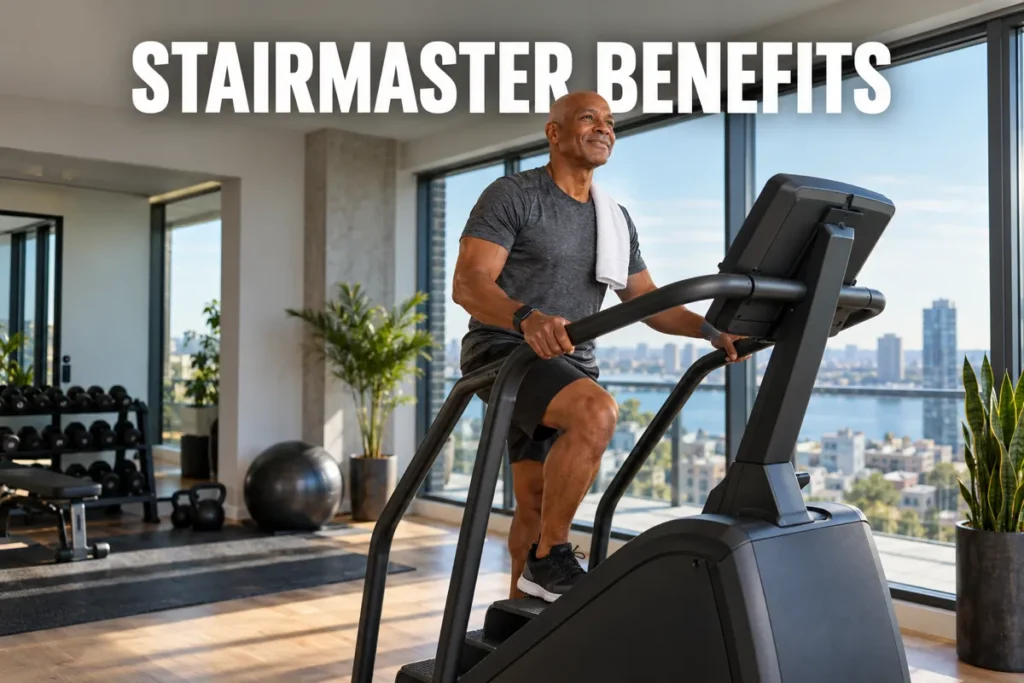
Few cardio machines deliver what the stairmaster benefits research actually shows: consistent improvements across cardiovascular health, lower body conditioning, and measurable fat loss - from a single training tool with no running impact. I've been in the fitness industry for over 15 years, coaching clients at every level, and the StairMaster stepmill consistently outperforms expectations when people use it correctly. This guide explains the science behind stair climbing, what to realistically expect from regular sessions, and how to structure training around the machine at any fitness level.

StairMaster Benefits - Why This Machine Earns Its Reputation
The StairMaster has been a commercial gym staple for decades, and its staying power comes from a straightforward physiological reality: it requires your body to propel its full weight upward continuously, recruiting multiple lower body muscle groups while sustaining significant cardiovascular demand. Unlike cycling, where the seat supports your bodyweight, stair climbing keeps your legs bearing all the load through every step.
This combination - substantial muscular engagement alongside sustained heart rate elevation - is what makes the stairmaster benefits particularly practical for those who want both cardiovascular conditioning and lower body development from a single training tool. I recommend it regularly to clients who want to avoid the repetitive impact of running but still need a stimulus that challenges the cardiovascular system seriously.
Readers who have also considered the rowing machine for that cardiovascular stimulus will find the direct comparison in my stairmaster vs rowing machine comparison.
For a direct comparison with the most common alternative, our StairMaster vs treadmill comparison breaks down which is better suited to specific goals, body types, and joint health profiles.
Cardiovascular Health - What Consistent Climbing Does to Your Heart
Climbing stairs on a regular basis produces changes that show up directly in heart health markers, from mortality risk to cholesterol and aerobic capacity. The research below breaks down exactly what a consistent practice does to the cardiovascular system.
How Stair Climbing Reduces Cardiovascular Mortality
The cardiovascular stairmaster benefits are the most thoroughly documented in the research. A 2024 meta-analysis by Paddock et al. reviewed eight studies involving over 473,000 participants and found that regular stair climbing reduced cardiovascular mortality by 35% and all-cause mortality by 30% compared to inactive controls (1).

An eight-week controlled intervention found that progressive stair climbing produced a 17.1% improvement in VO2max alongside a 7.7% reduction in LDL cholesterol in previously sedentary young women (2). In my experience, a VO2max improvement of that magnitude translates into noticeably reduced breathlessness during everyday activity - something clients typically describe feeling within four to six weeks of consistent training.
Readers looking to add rowing as a complementary full-body machine will find specific recommendations in my best rowing machine guide.
The benefits of stair climber exercise extend to clinical populations. A randomized trial found that 12 weeks of vigorous stair climbing produced approximately 3.5 mL/kg/min improvement in peak oxygen uptake in coronary artery disease patients, comparable to traditional cardiac rehabilitation outcomes (3). It illustrates the cardiovascular potency of stair climbing stimulus even in compromised populations.
Key Aerobic and Metabolic Adaptations
Key cardiovascular adaptations research has consistently documented from regular stair climbing include:
- Improved VO2max - aerobic capacity measured as oxygen uptake per kilogram of body mass
- Reduced resting heart rate over progressive training weeks
- Lower LDL cholesterol and triglyceride levels
- Reduced cardiovascular mortality risk at a population level
- Faster heart rate recovery after exercise, a marker of cardiac efficiency
The table below summarizes the primary research referenced throughout this article:
[TABLE: summary of primary research]
Lower Body Strength - The Muscles Stair Climbing Targets
Electromyographic research has confirmed which muscles bear the load during stair climbing. A cross-sectional study measuring muscle activation patterns found consistent EMG activity across all tested lower body muscles - rectus femoris, biceps femoris, tibialis anterior, and gastrocnemius - during stair climbing, validating it as a comprehensive lower body conditioning tool (4). The topic of what muscles does the stairmaster work - also commonly searched as stairmaster muscles worked - covers each muscle's role in full anatomical detail.
Readers interested in how exercise bike muscle activation compares will find a detailed breakdown in my exercise bike muscles guide.
The primary muscles activated during a StairMaster session include:
- Gluteus maximus and medius - heavily loaded during the push-off phase of each step
- Quadriceps (rectus femoris, vastus group) - responsible for knee extension throughout each step
- Hamstrings - provide posterior chain stability and assist hip extension
- Gastrocnemius and soleus (calves) - engaged in ankle plantarflexion with each push-off
- Hip flexors - active during the leg-lift phase between steps
- Core stabilizers (transverse abdominis, erector spinae) - contract isometrically to maintain upright posture
Core Stability - Why Stair Climbing Trains More Than Your Legs
Core engagement during stair climbing is often overlooked because it happens isometrically - your core remains still while working continuously to keep your torso upright against gravity and lateral sway. Clients who break the habit of leaning into the handrails consistently report more pronounced core fatigue alongside lower body tiredness. Over weeks of training, this sustained isometric demand produces meaningful improvements in trunk stability that transfer directly to other exercises and everyday movement patterns.
StairMaster Benefits for Glutes - What Climbing Actually Does
Whether the StairMaster truly tones or builds the glute muscles is a question worth answering directly, since it matters for setting realistic expectations. Consistent StairMaster use produces improved glute tone and definition, primarily through fat loss around the hip and thigh region combined with endurance-based muscle conditioning. It does not build significant glute mass on its own - that requires progressive resistance loading - but it does create visibly leaner, more defined glutes over weeks of consistent training.
The StairMaster is effective for glutes - for endurance conditioning and visible toning, which are exactly what consistent stepping produces. The stairmaster before and after changes people document online, typically after four to eight weeks, reflect those two mechanisms: reduced subcutaneous fat in the lower body and improved muscular endurance. For a different lower body cardio stimulus, the elliptical machine benefits include hip flexor and glute activation patterns through a different arc that complements stair climbing well.
How the StairMaster Activates the Glutes
Glute activation is highest during the push-off phase, when the working leg presses down through the heel to lift the body onto the next step. This mirrors the mechanics of a step-up exercise performed continuously. I've observed with clients that slowing the pace and pressing deliberately through the heel rather than the ball of the foot increases gluteal demand noticeably.
The most common form error that reduces glute activation is leaning into the handrails. Keeping an upright torso and using the handrails only for light balance support transfers the effort back to the hip extensors where it belongs. My clients who break this habit consistently report increased lower body fatigue - a reliable sign that the right muscles are now doing the work.
Readers who want to verify their technique is activating those muscles correctly will find a complete walkthrough in my stairmaster form and technique guide.
The precise muscles doing that work, and how each contributes to the loading profile, are covered in my stairmaster muscle activation guide.
Managing Expectations - Toning vs. Building Muscle Mass
The stairmaster glutes before and after results seen in popular fitness content are genuine, but they reflect the combined effect of fat loss and muscular endurance conditioning, not hypertrophy. Building substantial glute mass requires resistance training that progressively overloads the muscle beyond bodyweight. Pairing two to three StairMaster sessions per week with resistance work - squats, hip thrusts, Romanian deadlifts - produces the best combined outcome: fat reduction plus genuine muscle development for those whose goal is both.
Readers who also use rowing and want to know whether it builds comparable muscle will find the evidence in my rowing machine muscle building guide.
Fat Loss and Calorie Burn - What the Numbers Actually Mean
The stairmaster benefits for fat loss are well-supported, but the numbers depend entirely on body weight, stepping pace, and session duration. I make this point consistently with clients because unrealistic expectations are the primary reason people abandon programs that would otherwise work.

Research on Fat Loss and Metabolic Outcomes
A controlled trial assigned 50 sedentary women to eight weeks of home-based stair climbing. The intervention group saw average weight reduction of 0.99 kg, a 1.63 mL/min/kg improvement in VO2max, and measurably lower LDL cholesterol, triglycerides, and fasting blood glucose compared to controls (5). A separate pilot randomized trial found that four weeks of brief vigorous stair climbing produced a 10% improvement in VO2peak along with reductions in body weight, BMI, and waist circumference (6).
Beyond in-session calorie burn, vigorous stair climbing triggers EPOC - excess post-exercise oxygen consumption - meaning metabolism remains elevated for up to two hours after the session ends. This afterburn effect adds meaningfully to the total calorie expenditure of each training day, compounding the fat loss impact of consistent sessions.
For detailed calorie data by body weight and duration, our guide on how many calories the StairMaster burns covers MET-based calculations in full.
Estimating Calories Burned by Body Weight and Intensity
Calorie burn estimates below are based on published MET values for stepping exercise (MET 6.5-9.0 depending on intensity). These are approximate ranges - individual metabolic rate, stepping mechanics, resistance level, and fitness level all affect the actual figure.
[TABLE - calorie estimates]
These are estimates only. Actual calorie expenditure varies by individual metabolic rate, stepping mechanics, resistance level, and current fitness.
A worked example: a 155-pound person climbing at moderate intensity for 30 minutes burns approximately 246-281 calories. Over five sessions per week at that output, the weekly StairMaster contribution to a calorie deficit ranges from roughly 1,230-1,405 calories - a meaningful component of a fat loss program when diet is managed alongside training.
Readers comparing the StairMaster and elliptical specifically for fat loss will find the full breakdown in my elliptical for weight loss guide.
Mental Health and Mood - A Less Discussed StairMaster Benefit
The stairmaster benefits extend beyond the cardiovascular system. Regular aerobic exercise at moderate to vigorous intensity - the zone most StairMaster sessions occupy - consistently produces measurable improvements in mood, anxiety reduction, and stress regulation through elevated endorphin release and neurochemical adaptation. I've observed this directly with clients training primarily for physical results: improved sleep, reduced baseline stress, and greater mental clarity are frequently reported within two to three weeks of consistent training. These psychological adaptations are underreported relative to the physical benefits, but they are a meaningful part of the full stairmaster benefits profile.
How Long You Should Use the StairMaster for Results
Session duration is one of the most misunderstood aspects of stairmaster benefits. Shorter sessions do produce cardiovascular and metabolic stimulus - the threshold for meaningful adaptation is lower than most people assume. Research demonstrating VO2peak improvements from four-week protocols using brief intense intervals confirms that intensity can partially compensate for short duration.
That said, fat loss outcomes improve substantially with longer sessions and higher weekly frequency. The difference in cumulative calorie expenditure between 15 minutes three times per week and 30 minutes five times per week is large enough to significantly change body composition outcomes over eight to twelve weeks.
Session Length by Fitness Level
The appropriate starting point depends on current conditioning:
Beginners (weeks 1-4): 10-15 minutes at a pace that allows full sentences in conversation - approximately 55-65% of maximum heart rate. Four sessions per week at this level builds aerobic base and establishes the movement pattern without overloading tendons during the early adaptation period.
Intermediate (weeks 5-12): Progress toward 20-30 minutes at moderate intensity, incorporating two to three bouts of increased pace during each session. This range covers the session duration used in most studies above that showed measurable body composition improvements.
Advanced (ongoing): 30-45 minutes at moderate to vigorous intensity. At this stage, mixing steady-state sessions with interval protocols prevents adaptation plateaus.
Readers looking for a complete set of structured StairMaster protocols will find progressive plans and interval formats in my stairmaster workout guide.
HIIT approach: 30-second high-effort intervals alternating with 60-second recovery pace, repeated for 20 minutes, provides time-efficient cardiovascular adaptation comparable to longer steady-state sessions.
Readers deciding between HIIT and steady-state programming for the StairMaster will find the comparison in my HIIT vs steady state cardio guide.
Fitness Level | Session Duration | Intensity |
Beginner (Weeks 1-4) | 10-15 minutes | 55-65% max heart rate |
Intermediate (Weeks 5-12) | 20-30 minutes | Moderate with pace intervals |
Advanced | 30-45 minutes | Moderate to vigorous |
HIIT | 20 minutes | 30-second high / 60-second recovery |
Structuring Your Weekly Training Around the StairMaster
The StairMaster delivers its best results as part of a complete training week rather than as a standalone tool. In my coaching practice, I incorporate a stairmaster workout two to three times per week alongside resistance training, not as a replacement for it. For technique and form guidance, the topic of how to use a stairmaster provides step-by-step instruction that protects joints and maximizes muscle activation. A structured treadmill workout uses similar interval programming principles, so if you cross-train between machines both can share the same periodization framework.
Readers comparing the elliptical and treadmill as cross-training options will find the full breakdown in my elliptical vs treadmill guide.
Machine Types - Stepmill, Mini-Stepper, and What Each Actually Delivers
Understanding which stairmaster machine delivers which benefits prevents a common and costly mistake - buying the wrong piece of equipment. The StairMaster brand name refers specifically to the revolving staircase stepmill, which is the commercial gym version studied in all the research above. Two other machines are regularly confused with it.
Readers wanting a full breakdown of the stair climber machine category will find it in my stair climber machine guide.

[TABLE comparing machine types]
The mini-stepper - the most common stairmaster for home option due to its compact footprint and lower price range - provides lighter cardiovascular work than a full stepmill because the movement range and bodyweight demand are both reduced. A used stairmaster stepmill from gym liquidation suppliers can offer significant cost savings, and any unit purchased secondhand should be vetted for service history before purchase.
What to Consider Before Buying a Stair Climber
Before purchasing any stair climbing machine for home use, weigh these factors:
- Available floor space - commercial stepmills require a substantial footprint; confirm measurements before buying
- Noise tolerance - stepmills are significantly louder than mini-steppers during operation
- Budget range - commercial stepmills cost considerably more than compact home versions; the gap is large
- Primary fitness goal - heavy cardiovascular conditioning requires a stepmill; light daily activity accumulation can be served by a mini-stepper
- Access to servicing - commercial stepmill maintenance and parts require specialized support not available everywhere
Joint Health and Bone Density - The Low-Impact Case for Stair Climbing
Clinical research backs up the idea that stair climbing is gentle on the joints while still loading bone in a meaningful way. This section covers what the studies show about knee strain, osteoarthritis outcomes, and bone density gains.
Research on Stair Climbing and Joint Health
The StairMaster is frequently cited as a joint-friendly cardio option, and the clinical research provides measured support for this. A 2024 randomized controlled trial found that 12 weeks of stair-climbing combined with electrotherapy significantly improved quadriceps and hamstring strength, dynamic postural stability, and pain scores in patients with mild to moderate knee osteoarthritis (7). This is general fitness guidance, not medical advice - anyone managing an active joint condition should consult a healthcare provider before beginning a stair climbing program.
The key mechanical distinction is ascending versus descending stairs. Descending places substantially higher compressive and shear forces on the knee joint than ascending, and the StairMaster eliminates the descent entirely. I find this particularly relevant for clients managing mild patellofemoral pain who cannot tolerate running impact but still need meaningful cardiovascular training intensity.
Readers who need a lower-impact alternative will find reviewed options and selection criteria in my best elliptical machine guide.
For clients weighing the stairmaster vs rowing machine decision, rowing adds significant upper body involvement and distributes load differently across the spine and hips, making it a useful complement to StairMaster training. Full details on rowing machine benefits are worth reviewing if you are building a mixed-cardio week without running impact.
StairMaster and Bone Density
Weight-bearing exercise is a primary driver of bone mineral density maintenance - particularly important for women over 40 and anyone with elevated osteoporosis risk. Stair climbing, as a weight-bearing activity that loads the lower body vertically with each step, contributes to the cumulative mechanical stimulus bones need to maintain density, an advantage cycling and swimming do not share. Combined with its low-impact profile, this positions the StairMaster as a strong option for clients who need weight-bearing cardio without running loads.
Readers weighing that advantage against the elliptical will find the direct comparison in my stairmaster vs elliptical guide.
Stair Climber Benefits - Who Gets the Most from This Machine
Understanding which stair climber benefits align with your specific profile helps avoid investing in a training approach that doesn't match your goals. In my coaching experience, certain populations respond disproportionately well to consistent StairMaster training.

Clients who tend to benefit most:
- Those seeking lower body definition without dedicated resistance training - continuous stepping produces visible toning, especially when combined with appropriate calorie management
- People with sensitivity to running impact - the ascending-only mechanics eliminate heel-strike forces that make running uncomfortable for many
- Cardiovascular fitness beginners - adjustable pace makes entry accessible with clear built-in progression as intensity increases
- Anyone who has plateaued on flat-surface cardio - the vertical demand raises metabolic cost compared to walking at matched perceived effort
- Athletes building aerobic base for cycling, field sports, or endurance events - cardiovascular adaptations from stair climbing transfer well across modalities
The stairmaster vs elliptical choice comes down primarily to joint loading profile and upper body involvement preference. The elliptical engages the arms and eliminates vertical body displacement, producing a different muscle recruitment pattern even when calorie burn at matched intensity is similar. For those managing lower back or hip conditions, walking backwards on a treadmill is an alternative low-impact approach worth considering.
Limitations of the StairMaster
The StairMaster is a specialized tool, and understanding its limitations before committing to it as a primary cardio method saves time and money. It provides no upper body cardiovascular training, which means those who need full-body conditioning will need a second mode. The repetitive stepping pattern means plateauing is possible without deliberate progression in resistance or duration. Machines require significant floor space and carry a high purchase price for home use. Knee pain that worsens during or after sessions is a signal to stop and assess - not all knee conditions respond well to stair climbing, and individual response varies.
Building a StairMaster Habit That Actually Sticks
Long term results on this machine depend less on effort level than on how consistently you show up and whether you let the handrails take over. I walk through the habits that protect progress and keep the stimulus working.
What Consistent StairMaster Training Requires
The stairmaster benefits you accumulate over months come down primarily to three things: consistency, posture, and progressive overload. I've seen clients spend an entire year on the StairMaster without significant change because they held the handrails throughout every session, which offloads the work to the arms and significantly undercuts lower body and cardiovascular demand.
Habits that protect and compound your results:
- Keep your core braced and chest tall throughout each session; avoid forward lean into the handrails
- Use handrails for balance only, not weight support - the moment you bear load through your arms, glute and quad activation drops meaningfully
- Vary cadence week to week rather than training at the same pace each session; the body adapts quickly to fixed stimuli
- Pair two to three StairMaster sessions per week with progressive resistance training for optimal lower body development
- Track progress through concrete performance markers: your resting heart rate at a fixed stepping pace, session duration before fatigue onset, or perceived exertion at a fixed speed after four weeks of training
The treadmill benefits and stairmaster benefits are most powerful when used together in a mixed-cardio week. Both machines train the cardiovascular system with different muscular demands, which prevents adaptation and sustains long-term progress.
FAQs
Does the StairMaster burn belly fat?
The StairMaster burns calories during every session, which contributes to the overall calorie deficit needed for fat loss, and that reduction happens systemically across the body - including the belly region - over time. Spot reduction of fat in a specific area is not physiologically possible, so the StairMaster supports total-body fat loss by creating caloric expenditure, with genetics and overall energy balance determining where the body loses fat first.
Is 20 minutes of StairMaster enough?
Twenty minutes on the StairMaster is enough to produce meaningful cardiovascular benefit, particularly when intensity changes are incorporated during the session, as research has shown measurable VO2peak improvements from brief vigorous stair climbing protocols over just four weeks. For fat loss specifically, 20 minutes is a productive starting point, but extending sessions to 30 minutes or increasing weekly frequency will accelerate calorie expenditure and body composition changes.
How long should you do the StairMaster for?
How long you should use the StairMaster depends on your current fitness level and primary goal, with beginners starting at 10-15 minutes and building progressively to 20-30 minutes over four to eight weeks of consistent training. Advanced users pursuing cardiovascular conditioning or fat loss can train productively for 30-45 minutes at moderate intensity or 20-25 minutes using structured intervals, both of which deliver sufficient stimulus for continued physiological adaptation.
Is 30 minutes on StairMaster enough?
Thirty minutes on the StairMaster at moderate to vigorous intensity constitutes a complete cardiovascular session that provides the calorie burn and heart rate stimulus needed to support both fitness adaptation and fat loss when nutrition is managed appropriately. For most people working toward improved fitness and body composition, 30-minute sessions repeated two to three times per week alongside a resistance training program represent a highly effective and sustainable training volume.
Readers who also use a treadmill at home will find specific recommendations and buying criteria in my best treadmill for home guide.
Is stairmaster good for weight loss?
The StairMaster is effective for weight loss because it burns a substantial number of calories per session - approximately 246-281 calories in 30 minutes for a 155-pound person at moderate intensity - while also conditioning the lower body muscles that help sustain an elevated metabolic rate between sessions. The most effective approach combines regular StairMaster sessions with a structured calorie deficit and two to three resistance training sessions per week for the best combined fat loss and body composition outcome.
Readers who use rowing or running alongside the StairMaster will find a direct comparison of those formats in my rowing vs running guide.
Medical Disclaimer: This content is for informational and educational purposes only. It is not a substitute for professional medical advice, diagnosis, or treatment. Always consult with your healthcare provider before starting any new fitness program.
References:
- Paddock S, Veerni R, Bhalraam U, Meng J, Dawson-Plincke E, Vassiliou V, Tsampasian V. Evaluating the cardiovascular benefits of stair climbing: a systematic review and meta-analysis. Eur J Prev Cardiol. 2024;31(Supplement_1):zwae175.405. doi:10.1093/eurjpc/zwae175.405.
- Boreham C, Kennedy R, Murphy M, Tully M, Wallace W, Young I. Training effects of short bouts of stair climbing on cardiorespiratory fitness, blood lipids, and homocysteine in sedentary young women. Br J Sports Med. 2005;39(9):590-593. doi:10.1136/bjsm.2002.001131.
- Dunford EC, Valentino SE, Dubberley J, Oikawa SY, McGlory C, Lonn E, Jung ME, Gibala MJ, Phillips SM, MacDonald MJ. Brief vigorous stair climbing effectively improves cardiorespiratory fitness in patients with coronary artery disease: a randomized trial. Front Sports Act Living. 2021;3:630912. doi:10.3389/fspor.2021.630912.
- Geiger DE, Behrendt F, Schuster-Amft C. EMG muscle activation pattern of four lower extremity muscles during stair climbing, motor imagery, and robot-assisted stepping: a cross-sectional study in healthy individuals. Biomed Res Int. 2019;2019:9351689.
- Michael E, White MJ, Eves FF. Home-based stair climbing as an intervention for disease risk in adult females; a controlled study. Int J Environ Res Public Health. 2021;18(2):603. doi:10.3390/ijerph18020603.
- Yun JE, Wen X, Han M, Cho S, Kuk JL, Lee S. Effect of short bouts of vigorous stair climbing on cardiorespiratory fitness in women with overweight and obesity: a pilot feasibility study. J Obes Metab Syndr. 2023;32(4):346-352. doi:10.7570/jomes23024.
- Lee JH, Lee GB, Chung WY, Wang JW, Jang KM. Stair-climbing training with interferential electrotherapy improves knee muscle strength, dynamic postural stability, pain score, and physical activity in patients with knee osteoarthritis. Diagnostics. 2024;14(18):2060. doi:10.3390/diagnostics14182060.