
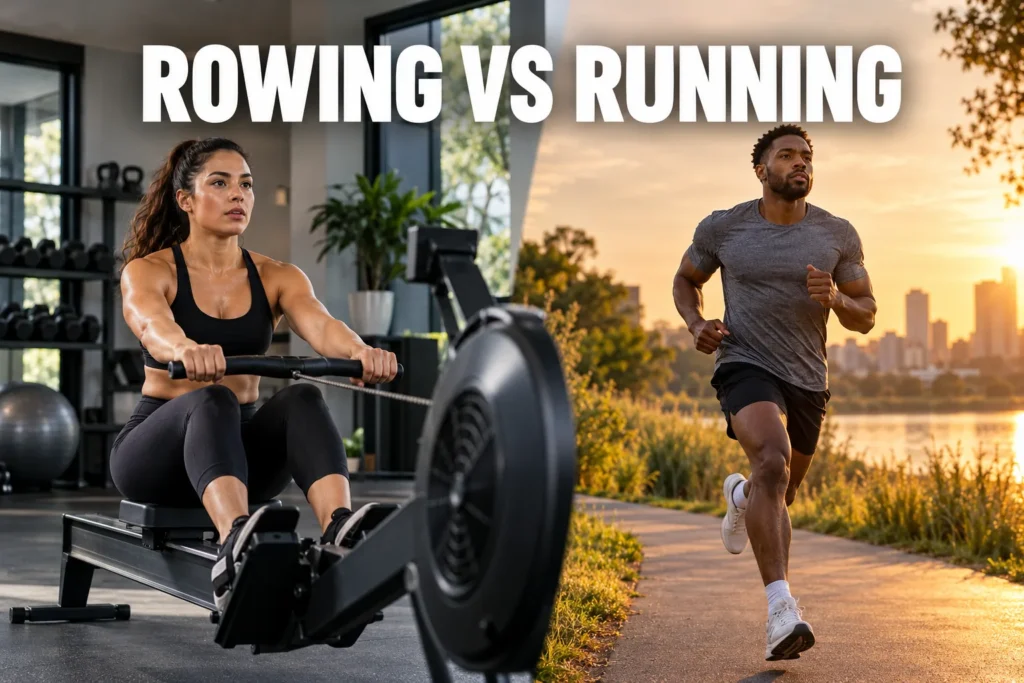
Rowing vs running comes down to what you want from your cardio, because each wins in a different area. Running produces a higher calorie burn per minute at moderate intensity. A rowing machine recruits the majority of your major muscle groups in every stroke - something running cannot replicate. I coach runners who cross-train on the rower, I run and row in my own training, and for this guide I checked that experience against five peer-reviewed studies on calorie burn, joint impact, muscle activation, cardiovascular adaptations, and fat loss. Below you get the research-backed numbers, where I push back on common claims, and how I would combine the two.

Rowing vs Running: Key Differences at a Glance
Choosing between rowing and running comes down to your specific goals, joint health, and available equipment. Both workouts deliver meaningful cardiovascular benefits, but they work through different mechanisms. Running is a weight-bearing, high-impact lower-body activity. An ergo rowing machine is a seated, low-impact pull movement that simultaneously trains your upper body, core, and legs.
Both activities build aerobic capacity and support fat loss when combined with consistent nutrition. The rowing vs running decision rarely has an objective winner, so I frame it around which option matches your goals and physical situation. When a client asks me which one to pick, my first question is always about their knees and their schedule, not about calories.
Calorie Burn: Does Running Burn More Than Rowing?
Calorie burn is where running holds its clearest advantage in the rowing vs running comparison. Running consistently produces higher energy expenditure per minute at the same perceived effort, though the gap is smaller than most people assume.

How Intensity and Body Weight Shift the Numbers
A 2024 study in Frontiers in Sports and Active Living measured energy expenditure across seven indoor cardio machines in 30 recreationally active men (1). At the same perceived exertion level (RPE 17), treadmill running produced 15.18 kcal per minute compared to 11.45 kcal per minute on the rowing ergometer - roughly a 33% gap. The researchers also found that rowing produced lower heart rate and oxygen consumption than weight-bearing machines at the same effort level, partly because the seated position and whole-body muscle involvement distribute cardiovascular demand differently.
The table below shows estimated calorie ranges by body weight for a 30-minute session at moderate intensity, based on standardized MET values. These are ranges, not fixed values - effort level, stroke rate, and running pace shift these numbers considerably.
Body Weight | Rowing (30 min, moderate) | Running (30 min, moderate) |
55 kg / 120 lb | 200-260 kcal | 270-340 kcal |
70 kg / 155 lb | 250-330 kcal | 335-430 kcal |
85 kg / 185 lb | 305-400 kcal | 405-520 kcal |
Having used both machines for years, I find the calorie gap matters less than most people expect, because the effort ceiling on a rowing machine is much higher than beginners realize. Higher-intensity rowing, such as a structured HIIT rowing workout with hard interval efforts, narrows the gap significantly. At maximum effort, trained rowers can reach energy expenditure levels competitive with sprint running. When I push a hard 20-minute rowing interval session, my heart rate sits within a few beats of what I see on a tempo run of the same length.
Rowing vs Running for Fat Loss and Belly Fat
Fat oxidation and total calorie burn are related but separate questions. A small 2021 study in the Journal of Sports Science and Medicine (n=9) compared maximal fat oxidation across treadmill, elliptical, and rowing exercise in healthy fasted males (2). Treadmill fat oxidation reached 0.61 g per minute at peak output; rowing reached 0.40 g per minute. At lower training intensities, the difference between modalities narrows considerably.
No cardio machine targets belly fat directly. Fat loss comes from a sustained calorie deficit over time, and where your body mobilizes stored fat first is determined by genetics and hormonal factors rather than machine selection. Documented rowing machine before and after results show meaningful fat mass reduction, and those changes come from consistent training and dietary consistency. What I tell clients chasing belly fat is simple: pick the machine you will use four times a week, because both rowing and running reduce overall body fat when paired with appropriate nutrition, and both work through the same pathway: a total energy deficit.
Joint Impact: How Each Workout Loads Your Body
Joint impact is often the deciding factor for people comparing rowing vs running, and the difference between the two is substantial.
Why Rowing Is a Low-Impact Option
Every running stride loads a single leg with ground reaction forces of up to three times your body weight at moderate speeds. Over a 30-minute run at a comfortable pace, that accumulates into thousands of high-force impacts on your knees, hips, ankles, and lower back. Rowing eliminates this impact entirely. Your body weight is supported by the seat throughout the full stroke cycle, and both legs drive simultaneously rather than bearing load one at a time.
A 12-week randomized controlled trial found that computer-aided rowing exercise significantly improved lower-limb muscle strength and functional capacity in older adults with mild knee osteoarthritis (3). Hip flexor strength improved by 4.01 kg on average and knee extensor strength improved by 1.80 kg in the rowing group compared to conventional exercise. I find this evidence particularly relevant for recreational athletes who assume rowing is only for elite competitors, because the same joint loading profile that suits osteoarthritis patients is what makes rowing sustainable for high-frequency training. The one joint area to watch is the lower back: rounding at the catch is the usual trigger for rowing-related back pain, so I coach a neutral spine before adding volume.
A 52-year-old recreational runner I coached had to cut his mileage because of knee pain after about 25 km a week. We replaced two of his four runs with 30-minute rows for eight weeks, and he kept his aerobic fitness while his knee settled enough to return to three runs a week.
Running and Bone Density
Running has one clear physiological advantage over rowing: bone density stimulus. Mechanical impact loading triggers adaptive bone remodeling - a response that rowing cannot replicate because the forces involved are minimal. For people with osteoporosis risk or those in the bone-building years of young adulthood, some degree of impact training provides a stimulus that seated rowing does not. If bone health is a priority, I recommend keeping some running or other impact activity in your weekly routine, even at low mileage. I am against moving a young athlete entirely onto the rower for this reason.
Muscles Worked in Rowing vs Running
This is where rowing vs running diverges most sharply. Running is a lower-body dominant activity that primarily trains the legs and engages the core as a stabilizer. Rowing is a compound full-body movement that demands meaningful output from legs, back, core, and arms in every stroke.

The Full-Body Demand of Rowing
A complete rowing stroke spans four phases: catch, drive, finish, and recovery. Each phase recruits a different set of the muscles a rowing machine works:
- Legs (drive phase): Quadriceps, hamstrings, glutes, and calves generate roughly 60-70% of total propulsive power per stroke
- Back and trunk (finish phase): Latissimus dorsi, trapezius, rhomboids, erector spinae, obliques, and abdominals stabilize and extend the trunk against the load
- Arms (pull phase): Biceps, forearms, deltoids, and rear deltoids complete the stroke at the finish position
Rowing is widely cited as engaging the vast majority of your major muscle groups per stroke - a level of full-body engagement that running cannot replicate. This explains why rowing machine benefits extend beyond cardiovascular fitness to include improved posture, back strength, and upper body endurance. Rowing does build muscle to a meaningful degree for beginners and recreational athletes, but it is primarily a cardiovascular activity, so I treat it as a complement to progressive resistance training rather than a replacement.
Running’s Lower-Body Focus
Running is highly effective at developing the lower body but leaves the upper body largely untrained. The primary muscles involved include:
- Quadriceps and hamstrings for impact absorption and forward propulsion
- Glutes for hip extension and push-off power
- Calves and the Achilles tendon for elastic energy storage and release
- Core muscles (transverse abdominis, obliques) maintaining upright posture
The arms and shoulders in running serve only as counterbalance - they generate no meaningful propulsive force and receive no significant training stimulus. For athletes who want upper body and core development alongside their cardio work, rowing is the more complete single-machine solution.
Cardiovascular Benefits: Rowing vs Running Cardio
Both rowing and running push the cardiovascular system hard, but they get there through different mechanisms. The following looks at VO2max gains, heart rate response, and the psychological benefits each modality delivers.
VO2max Development and Aerobic Capacity
Both rowing and running are powerful tools for building cardiovascular capacity. The key performance marker is VO2max - the maximum volume of oxygen your body can process per kilogram of body weight per minute. Higher VO2max correlates directly with endurance performance and long-term cardiovascular health.
An 8-week training study in young well-trained rowers found that combining high-intensity intervals with moderate continuous rowing improved relative VO2max by 3.7 mL per kg per minute - from 58.4 to 62.1 mL/kg/min (p=0.023) - and improved 2000m time trial performance by 5.3 seconds (4). Structured rowing builds substantial aerobic capacity when intensity is programmed appropriately. For rowing vs running cardio development, research shows both modalities deliver comparable VO2max adaptations when effort is matched - the difference is in the sport-specific muscle groups each trains.
Heart Rate and Metabolic Adaptations
One important physiological nuance: rowing produces lower heart rate than treadmill running at the same relative exercise intensity. The seated position aids venous blood return to the heart, and the involvement of more total muscle mass spreads cardiovascular demand differently than single-plane running does. If you train by heart rate, these differences matter: I set separate zones for each machine rather than assuming your normal running heart rate carries over to the rower.
A 2015 indoor rowing study documented significant reductions in fat mass over six weeks (5). These findings support rowing as a tool for improving metabolic health markers alongside cardiovascular fitness.
Mental Benefits and Long Term Adherence
In the rowing vs running comparison, both modalities produce meaningful psychological benefits. Sustained aerobic exercise consistently reduces cortisol and increases endorphin output - the same biological response that produces a runner's high applies to rowing at comparable intensities. Rowing's rhythmic, bilateral movement pattern can be meditative in a way that indoor treadmill running often is not, which matters for long-term adherence more than many training variables do. I see this most with clients who find treadmill sessions monotonous: the stroke rhythm gives them something to focus on, and they keep showing up.
Does Rowing Help with Running?
Yes, rowing helps with running, because it builds the posterior chain muscles (glutes, hamstrings, lats, lower back) and core endurance that running directly depends on for efficiency and injury resistance. For runners seeking low-impact cross-training, this is one of the most compelling arguments for adding a rowing workout to a weekly schedule. In my years conditioning professional tennis players, Carlos Alcaraz among them, the aerobic work that spared the legs from extra pounding was the work that let me keep on-court volume high, and rowing fills that role well.
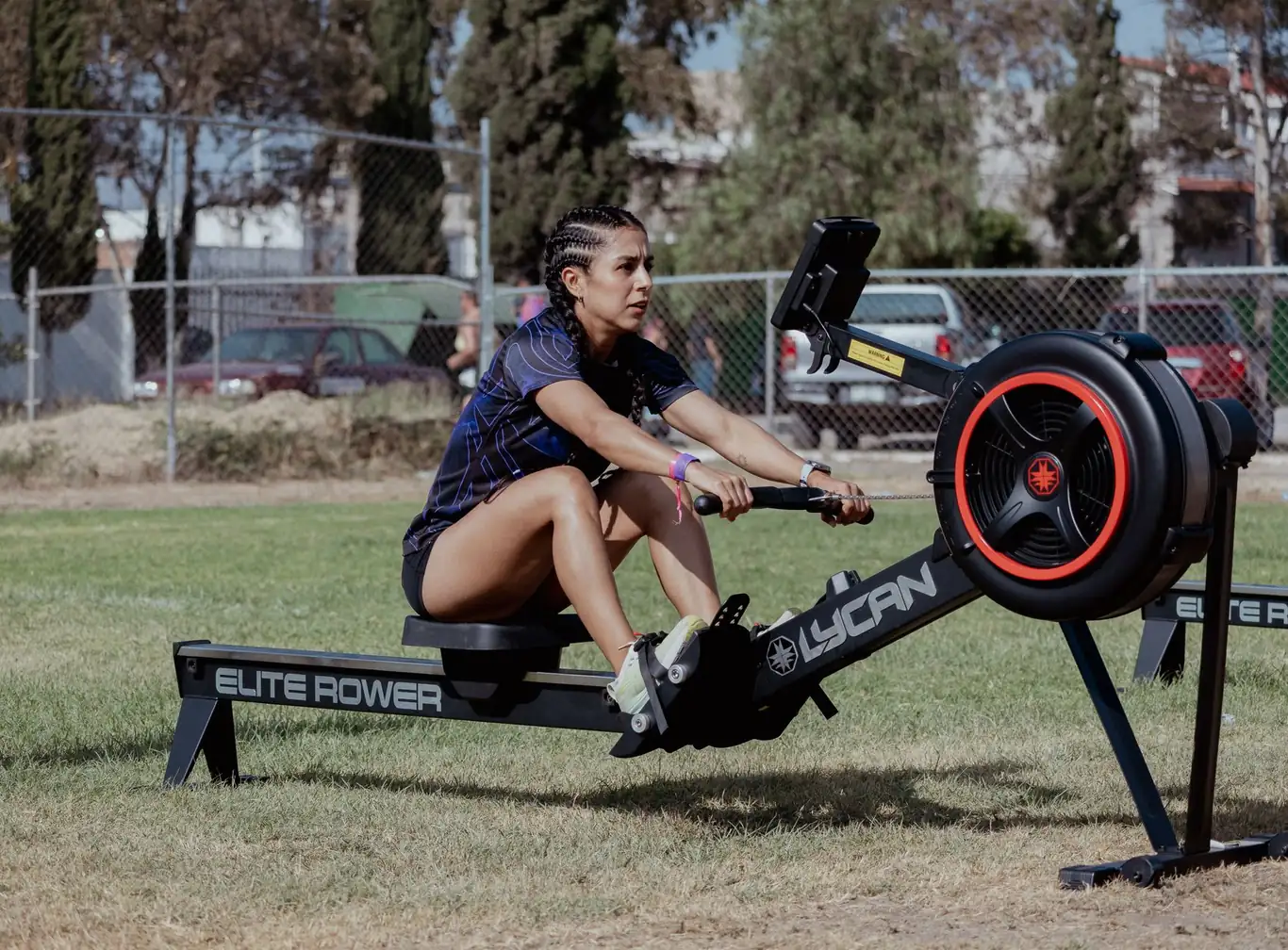
Here is what structured rowing adds to a running program:
- Core and trunk endurance - rowing trains spinal extensors and abdominals under sustained load, improving posture in the late miles of a long run when form breaks down
- Glute and hamstring strength - the rowing drive mirrors the push-off mechanics of running, building power that transfers to stride efficiency
- Aerobic capacity without joint stress - rowing sessions develop VO2max and cardiovascular endurance on recovery days when your joints need a break from impact
- Upper back activation - stronger lats and rhomboids reduce forward shoulder rounding, a common fatigue pattern in distance runners
500m rowing times depend heavily on drag factor settings and the rower's body weight, so treat any rowing-to-running distance conversion as a starting point rather than a fixed rule. Both the research and what I see with the runners I coach confirm that rowing helps with running, provided the stroke is learned properly before the intensity goes up.
Rower vs Treadmill: Which Is Better for Home Use?
The rower vs treadmill decision for home comes down to four practical factors: space, noise, budget, and fitness goals.

Treadmill Advantages for Home Athletes
Treadmill advantages for home use:
- Intuitive immediately - no technique learning required before getting an effective workout
- Best option for runners who want to replicate outdoor training mechanics
- Provides bone density stimulus not replicated by seated rowing
- Available across a wide range of budgets and form factors
Rowing Machine Advantages for Home Athletes
Rowing machine advantages for home use:
- Smaller active floor footprint when stored vertically or folded
- Trains more total muscle groups per session than any treadmill
- Quieter operation - water resistance and magnetic rowing machine options produce significantly less noise than treadmills
- Lower long-term joint stress for consistent use
Feature | Rowing Machine | Treadmill |
Joint Impact | Low (seated, no ground force) | High (up to 3x body weight per stride) |
Muscle Groups | Full body: legs, back, core, arms | Lower body dominant |
Noise Level | Quieter | Louder |
Bone Density Stimulus | Minimal | Yes (impact loading) |
Storage Footprint | Compact (vertical or folded) | Larger floor footprint |
Technique Required | Yes (learning curve) | No (intuitive immediately) |
Making the Final Equipment Decision
The Concept 2 rowing machine (the RowErg) is the benchmark for both home and competitive use, and the Concept2 RowErg with PM5 is the model I trust most for matching split data to published research. The treadmill vs rowing machine comparison does not have a universal winner. If you have joint issues or want upper body and core training alongside cardio, rowing machine benefits outweigh a treadmill's per-minute calorie advantage. If maximum calorie output per session is the primary goal and your joints tolerate running well, a treadmill may be more efficient. When I help clients narrow down the best rowing machine for home use, floor space is usually the first filter, and a compact rowing machine that stores upright takes far less room than a treadmill built for running.
How to Choose Between Rowing and Running
There is no universally better option in rowing vs running. Your best choice depends on your injury history, training goals, available equipment, and what you will actually do consistently over time.
Choose Rowing If You...
- Have existing joint pain in your knees, hips, or ankles that limits running volume
- Want a single cardio machine that develops your upper body, core, and legs simultaneously
- Are a runner looking for a low-impact option on recovery days
- Prefer seated exercise for long-term training sustainability
- Want to build back and postural strength alongside cardiovascular fitness
Choose Running If You...
- Want the highest calorie burn per minute with minimal equipment investment
- Are prioritizing bone density maintenance or long-term skeletal health
- Enjoy outdoor training or are preparing for running events (5K, half marathon, marathon)
- Are already proficient at running and want to maximize sport-specific performance
- Value simplicity - running requires only shoes and safe ground
The most productive approach for most people is combining both. A weekly schedule that includes three to four runs plus one or two rowing workouts builds aerobic capacity, covers the calorie burn goal, protects joint health long-term, and develops a more complete physical foundation than either modality alone. Adding a rower does not require a big spend either, since the budget rowing machines I rate cover the basics a runner needs for cross-training. You can compare current air, magnetic, and water models in the rowing machines shop.
The Cardio That Fits Your Life Is the Best Cardio
Rowing vs running ultimately comes down to what you will do with enough consistency to produce results. Running delivers a higher calorie burn per minute and a bone-loading stimulus that rowing cannot replicate. Rowing recruits the majority of your muscle groups in every stroke, eliminates joint impact, and trains muscles that running leaves completely untouched.

For joint-compromised individuals or those rebuilding fitness after injury, a rowing machine provides a way to sustain high training volume without the cumulative wear of thousands of running strides per session. For runners chasing performance gains, I favor rowing as cross-training ahead of cycling or elliptical work, precisely because of the posterior chain and core development it delivers without adding running mileage.
Based on those five studies and my work with runners, I would structure a combined week as three to four runs for calorie burn and skeletal stimulus, plus two rowing sessions for full-body muscular conditioning and joint-friendly volume. Running builds impact-resilient bones and sport-specific aerobic endurance. Rowing builds full-body muscular fitness and sustainable high-volume cardio. If you are new to rowing, learn proper rowing form before chasing intensity, because technique drives both results and injury risk in rowing far more than it does in running.
FAQs
What is 10 minutes of rowing equivalent to?
Ten minutes of moderate-effort rowing produces a cardiovascular stimulus broadly comparable to 10 minutes of moderate-paced running, though running generates roughly 33% higher calorie expenditure at the same perceived effort level. The most accurate way to equate the two is by heart rate zone rather than time or distance, since body weight, rowing stroke rate, and running speed all shift individual calorie output substantially.
Is 20 minutes a day on a rowing machine enough?
Twenty minutes of daily rowing is sufficient to build and maintain meaningful cardiovascular fitness, particularly when intensity varies throughout the week. Research suggests that structured rowing produces significant VO2max improvements and muscular strength gains at moderate training volumes, and 20 consistent minutes per day exceeds the minimum effective dose for cardiovascular health benefits.
Is running or rowing better for losing weight?
Running burns slightly more calories per minute at the same perceived effort, giving it a modest advantage in total energy expenditure per session. Weight loss depends primarily on a sustained calorie deficit over time, however, and the better cardio for fat loss is whichever one you will perform consistently - many people sustain rowing more easily over months and years due to the lower joint stress and broader muscle engagement.
How much rowing is equivalent to running?
A widely used conversion from CrossFit programming equates 500m of rowing to approximately 400m of running in cardiovascular effort, a 1.25:1 distance ratio. For pace context, a 10-minute per mile running pace corresponds roughly to a 2:30 per 500m rowing split, though this varies considerably based on fitness level, rowing technique, and machine resistance settings.
What muscles does the rowing machine work the most?
The rowing machine works the legs most intensively - quadriceps, hamstrings, and glutes generate roughly 60-70% of total propulsive force in each stroke. The back muscles (latissimus dorsi, rhomboids, trapezius) and core (abdominals, obliques, erector spinae) handle trunk position and the finish pull, followed by the biceps and forearms completing the arm draw. This sequential recruitment across the full body is what distinguishes rowing from primarily lower-body cardio like running or cycling.
This content is for informational and educational purposes only. It is not a substitute for professional medical advice, diagnosis, or treatment. Always consult your healthcare provider before starting any new fitness program.
We are always looking for expert inputs to make our content even better and more useful.
References
- Prieto-Gonzalez P, Yagin FH. Energy expenditure, oxygen consumption, and heart rate while exercising on seven different indoor cardio machines at maximum and self-selected submaximal intensity. Front Sports Act Living. 2024;6:1313886. doi:10.3389/fspor.2024.1313886.
- Filipovic M, Munten S, Herzig KH, Gagnon DD. Maximal Fat Oxidation: Comparison between Treadmill, Elliptical and Rowing Exercises. J Sports Sci Med. 2021;20(1):170-178. doi:10.52082/jssm.2021.170.
- Lin PL, Yu LF, Kuo SF, Wang XM, Lu LH, Lin CH. Effects of computer-aided rowing exercise systems on improving muscle strength and function in older adults with mild knee osteoarthritis: a randomized controlled clinical trial. BMC Geriatrics. 2022;22:809. doi:10.1186/s12877-022-03498-2.
- Kirchenberger T, Ketelhut S, Ketelhut RG. Effects of Moderate- versus Mixed-Intensity Training on VO2peak in Young Well-Trained Rowers. Sports (Basel). 2021;9(7):92. doi:10.3390/sports9070092.
- Shin KY, Choi EH, Lim JY, Cho AR, Lim YH. Effects of Indoor Rowing Exercise on the Body Composition and the Scoliosis of Visually Impaired People: A Preliminary Study. Ann Rehabil Med. 2015;39(4):592-598. doi:10.5535/arm.2015.39.4.592.