
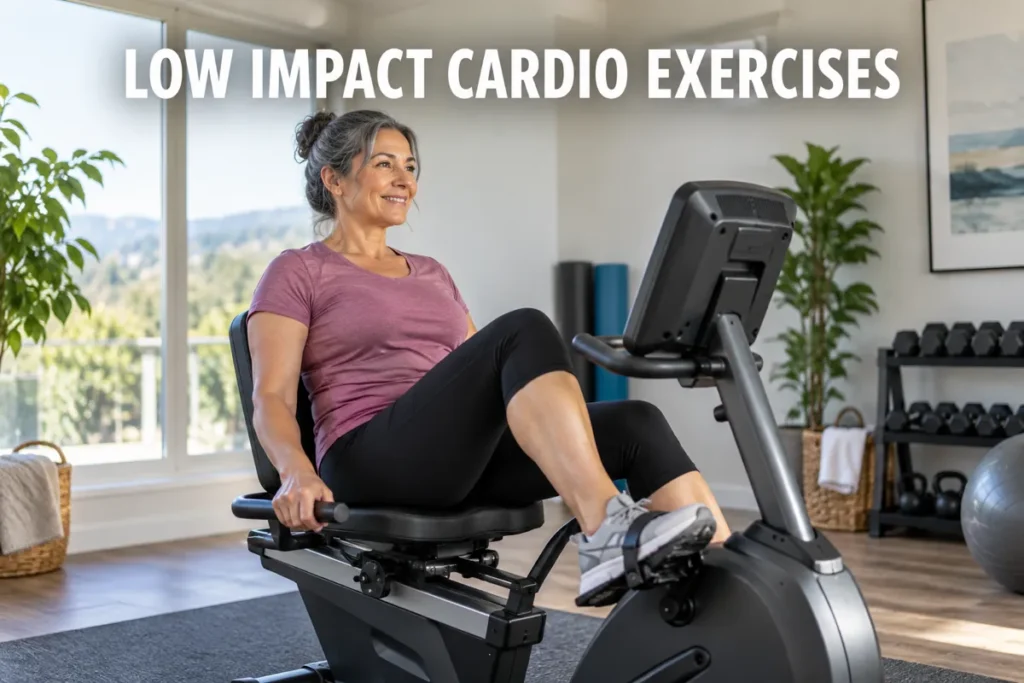
Low impact cardio exercises deliver the same cardiovascular challenge as harder training while keeping stress on your knees, hips, and ankles within safe limits. As an ISSA Elite Trainer and MPhEd graduate, I've built low impact programs for tennis athletes recovering from overuse injuries, older clients starting from scratch, and recreational exercisers who needed something sustainable long-term. Low impact cardio consistently delivers when the goal is durable fitness progress rather than a one-month sprint.
This guide covers 15 proven options across home and gym settings, with dedicated sections on bad knees, seniors, and weight loss. You will walk away knowing exactly which option fits your situation and how to structure consistent sessions around it.

Benefits of Low Impact Cardio
One distinction worth making early: low impact and low intensity are not the same thing. Low impact means reduced ground reaction force - not reduced effort. You can train at full cardiovascular effort on an elliptical and that session is still low impact. The defining feature is force management, not pace.
The case for low impact cardio exercises goes beyond joint protection. Regular sessions improve cardiovascular efficiency, lower resting heart rate, and support long-term blood pressure management - outcomes that hold for both younger athletes recovering from injury and older adults building their first consistent routine. Because these exercises eliminate the injury-producing forces of running and jumping, adherence rates run significantly higher than high-impact programs: people who are not dealing with pain keep showing up week after week, and that consistency is what compounds into real results.
Low Impact Cardio Exercises - 15 Options That Keep Your Joints Safe
The 15 low impact cardio exercises below cover machines at the gym, equipment-free moves at home, and aquatic formats. What they share: each one either keeps at least one foot in continuous contact with the surface, or removes ground contact entirely (as swimming and pool walking do), which eliminates the impact forces that running and jumping create. These options fall into three groups - machine-based cardio, home and bodyweight cardio, and aquatic cardio - each with its own strengths and best-fit populations, covered in the sections below.
Low Impact Cardio Machines - The Most Efficient Options
Below is the full list of cardio exercises at gym that offer the highest calorie output while keeping joint stress within safe limits. Machine-based low impact cardio exercises consistently produce the highest calorie output per session while providing the most joint protection. The reason: machines guide your movement path, reduce balance demands, and eliminate the ground reaction forces that free movement creates. I recommend machine-based options first for anyone with active joint pain because the movement pattern is controlled and the progression path is clear, and I compare the best machines for bad knees separately.
Elliptical Machine
The elliptical remains the most widely recommended low impact machine because the pedal path mimics running mechanics while keeping both feet on the pedals at all times. Research indicates that this type of low-impact, reduced-force movement carries no increased risk of developing knee or hip osteoarthritis over time (1). Most users burn 270-400 calories in 30 minutes at moderate resistance. After 8 weeks using the elliptical as the primary training tool with a tennis athlete recovering from an Achilles strain, her end-of-session heart rate at level 10 averaged within 4 bpm of her pre-injury treadmill benchmarks - and her return-to-running timeline compressed to 11 weeks instead of the typical 16-20. My breakdown of whether the elliptical works for cardio covers the heart benefits and calorie burn in more detail.
I give the elliptical more weight than almost any other machine when recommending low impact cardio exercises for clients coming off lower-body injuries. The learning curve is minimal, the cardiovascular return is immediate, and nearly every commercial gym carries one. For a detailed breakdown of outcomes, our elliptical machine benefits guide covers what to expect after consistent use.
Stationary Bike
The stationary bike is the strongest choice for people with knee pain specifically. Pedaling keeps the knee in a controlled, circular range of motion that reduces compression compared to walking or running. This makes it the machine I prioritize for clients with patellofemoral syndrome or post-surgical knee rehab. Our stationary bike vs elliptical comparison is worth reading if you are weighing both options - the bike wins on knee-joint specificity while the elliptical wins on full-body engagement.
Rowing Machine
The rowing machine is one of the most underused low impact cardio exercises available. It drives 210-300 calories in 30 minutes while training legs, core, and upper body in a single continuous sequence. The key detail: technique matters more here than on any other machine. Poor form shifts load from large muscle groups to the lower back. Learn the drive sequence (legs first, then core lean, then arms) before increasing resistance. Our rowing machine benefits guide covers the setup and mechanics in detail.
Recumbent Bike
The recumbent bike reclines the seat position, which removes vertical compression from the hip joint and reduces lower back load compared to upright cycling. This makes it the safest machine option for people combining knee issues with hip or back problems. Resistance adjustments in small increments let absolute beginners start at very low intensities and progress steadily. Our guide to the recumbent vs upright bike explains which profile suits which training goal and population.
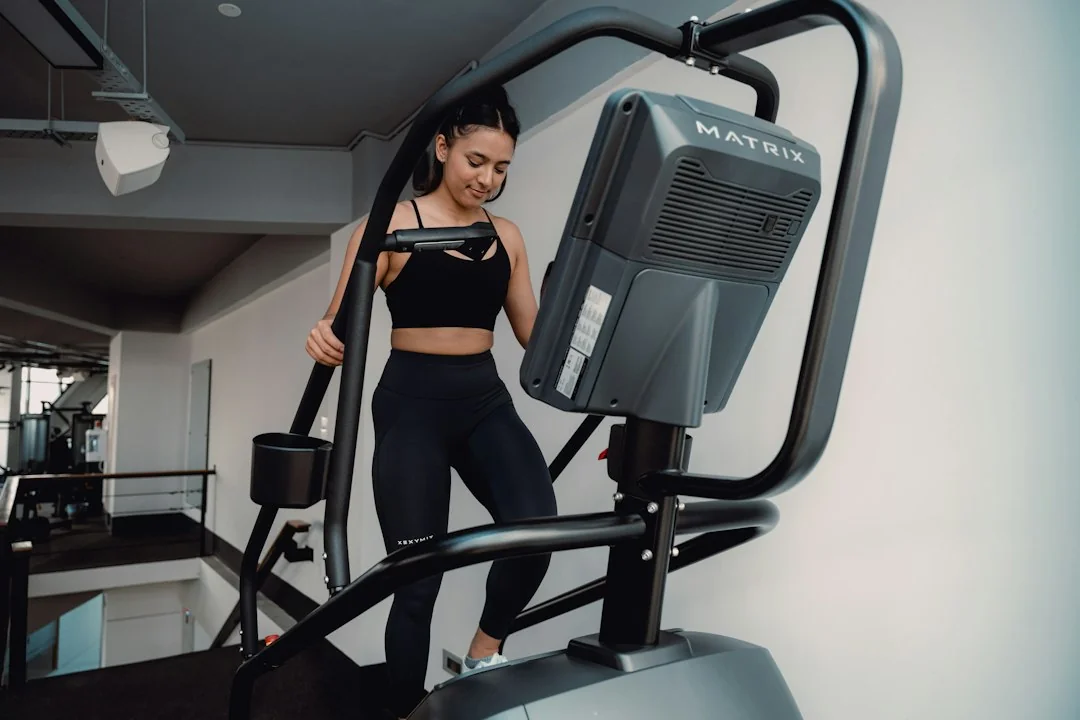
Stair Climber
The stair climber sits at the edge of the low impact category. It produces real results for glute and leg conditioning while keeping ground forces lower than running, but the stepping motion involves more knee flexion under load than cycling or walking. I include it as an advanced progression option - well-suited for people who have built a base with the machines above and want more challenge without returning to running. Keep the pace controlled and avoid holding the handrails for postural support.
Machine | Joint Focus | Best For |
Elliptical | Knees and ankles | Lower-body injury recovery |
Stationary Bike | Knees | Knee pain and post-surgical rehab |
Rowing Machine | Full body; back with poor form | Full-body conditioning |
Recumbent Bike | Knees, hips, and lower back | Combined joint conditions |
Stair Climber | Knees (high flexion) | Advanced progression |
Low Impact Cardio Exercises at Home - No Equipment Needed
The best cardio exercises at home no equipment required can produce real cardiovascular adaptations when performed at the right intensity and duration. Low impact cardio exercises at home without any equipment cover every fitness level - from a beginner starting with a 10-minute walk to an experienced athlete using shadow boxing rounds as a recovery session. Research supports this directly: low-intensity exercise programs improve balance, lower limb strength, flexibility, and depression scores in older adults with significantly better compliance and lower injury rates than higher-intensity programs (2). These findings apply to home-based cardio exercises at home no equipment formats as effectively as gym programs. If you are new to this, my beginner cardio plan lays out the first eight weeks.
Brisk Walking
25-30 minutes at a pace where breathing changes but conversation remains possible. Walk outdoors, in a hallway, or use a treadmill. This is the single most accessible option for any fitness level.
Dancing
Any style counts. Controlled research shows low-impact dance achieves aerobic threshold levels (approximately 50% heart rate reserve) that support real cardiovascular conditioning (3). Put on music you enjoy and move continuously for 20-30 minutes.
Shadow Boxing
Punch combinations while stepping side to side. This keeps heart rate elevated without any jumping and adds upper body conditioning alongside the cardiovascular work. Aim for 2-minute rounds with 30-second rests.
Marching in Place
Lift each knee to hip height alternately while swinging the opposite arm. This is an effective option for people with severe joint restrictions who cannot walk comfortably for extended periods. Start with 10 minutes, add 2-3 minutes per session until you reach 20-25 minutes, and focus on keeping knee lifts controlled and consistent rather than fast.
Yoga Flow
A 20-30 minute vinyasa or flow sequence maintains an elevated heart rate while adding mobility work. I specifically recommend yoga flow as a recovery workout rather than a primary cardio day, paired with higher-output sessions on other days.
Pilates
A 20-30 minute mat Pilates session maintains cardiovascular effort through low-load continuous movement while developing core strength and hip stability. Pilates is particularly useful for people whose knee or back limitations make standing options uncomfortable - it removes standing load entirely while still elevating the heart rate. I recommend it as a complementary session alongside one or two higher-output low impact days per week.
Tai Chi
Tai chi uses slow, controlled movement sequences that elevate heart rate moderately while training the coordination patterns that protect balance and reduce fall risk. A 30-minute tai chi session fits the low impact definition completely - no jumping, no running, and no ground impact of any kind. I recommend it most often as a third weekly session for older clients alongside cycling and walking days, and as a zero-equipment option anyone can do at home.
The full list of cardio exercises at home above works equally well for people who have never trained before and for gym regulars adding a recovery day. For people who want to equip a home space to support these sessions, our home gym equipment exercises guide covers affordable options that complement bodyweight low impact cardio.
Low Impact Cardio for Bad Knees
The single best category of cardio exercises for bad knees is aquatic exercise. In waist-deep water, buoyancy reduces effective body weight loading by approximately 40-50%, with neck-deep immersion extending that reduction to as much as 90% (4). This makes it possible to raise heart rate without any compressive stress on the knee joint.

Swimming
Swimming removes ground reaction forces entirely. A review of aquatic training research found zero injury rate for aquatic formats versus a 50% injury rate for land-based high-intensity training, alongside comparable improvements in aerobic capacity, resting heart rate, and blood pressure (5). Front crawl and backstroke are reliably safe for most knee conditions. If you have patellofemoral syndrome, consult a physiotherapist before using breaststroke kick, which places more rotational stress on the knee than the other strokes.
Water Aerobics
Water aerobics applies the aquatic buoyancy principle to structured class formats. Jogging in place, leg swings, and knee lifts all become joint-safe in water. I recommend water aerobics specifically to anyone whose low impact cardio for bad knees options on land have become uncomfortable - the effort level is adjustable, the format is group-based, and compliance runs high.
Pool Walking
Pool walking - moving forward, backward, or sideways in waist-deep water - delivers effective low impact cardio for bad knees without any swimming technique required. The water resistance adds cardiovascular load while the buoyancy removes joint compression. It is the most accessible aquatic option for people who are not comfortable with full swimming, and requires nothing beyond access to a pool. I introduced pool walking as a 20-minute protocol for a client 11 weeks post-ACL reconstruction - a point where walking on land still produced knee discomfort she rated at 4 out of 10 - and she completed the full session with zero pain reported, a result that took until week 16 to replicate on the treadmill.
Exercise | Technique Required | Format | Best Use |
Swimming | Stroke technique needed | Individual | Maximum joint offloading |
Water Aerobics | None | Group class | Adjustable effort; high compliance |
Pool Walking | None | Individual | Most accessible; no swim skill needed |
Machine Options for Knee Pain
For home-based knee rehab, the stationary bike with a low resistance setting is the most accessible daily option. Physiotherapists frequently recommend cycling as the first cardiovascular activity after knee surgery because the range of motion is controlled and can be adjusted precisely. Our exercise bike and knee pain guide covers seat height adjustments and resistance protocols for knee-safe training.
The elliptical is the best gym machine for bad knees among weight-bearing options. Our running vs elliptical comparison shows why the elliptical consistently scores higher on joint comfort ratings based on user data and research outcomes.
Low Impact Cardio Exercises for Seniors
For older adults, the goals shift away from pure calorie burn toward protecting bone density, blood pressure, and balance. Here are the exercise options that rank highest for safety and ease of getting started, and my guide to equipment for seniors covers the safe machines in more detail.
Cardiovascular and Balance Benefits for Seniors
Low impact cardio exercises for seniors serve three specific goals alongside general fitness: maintaining bone density, improving cardiovascular markers like blood pressure, and preserving the balance that reduces fall risk over time. These outcomes matter more as the primary targets than raw calorie burn.
A randomized controlled trial of low-to-moderate intensity aerobic cycling in older adults with hypertension found significant reductions in systolic blood pressure (2.91 mmHg) and diastolic blood pressure (1.33 mmHg) after just eight weeks of three sessions per week (6). Consistent low impact cardio exercises for seniors can serve as a non-pharmacological tool for managing blood pressure - alongside ongoing clinical guidance. If you prefer cycling, I list the low-impact bikes for seniors that I would pick.
Best Exercises and How to Get Started
In my experience working with older clients, consistency matters far more than starting intensity. Fifteen to twenty minutes at a perceived effort of 4-5 out of 10, three times per week, builds the base. The following options rank highest for safety and accessibility in this population:
- Recumbent bike - lowest balance demand, most comfortable seated position, easiest to start
- Walking - free, social, adjustable intensity, proven long-term adherence
- Water aerobics - joint-safe, group-based format, widely available at community pools
- Tai chi - specifically improves balance and reduces fall risk through coordinated low-intensity movement
- Elliptical - suitable for seniors with good standing balance who want higher calorie output per session
Low Impact Cardio Exercises for Weight Loss
Weight loss through gentler cardio comes down to the same calorie deficit mechanism as any other training style, just with better long term adherence. I cover which options burn the most and how to structure a fat loss week. My breakdown of cardio and weights for weight loss covers what the research shows.
Why Low Impact Cardio Supports Weight Loss
Low impact cardio exercises for weight loss work through the same mechanism as any cardio program: consistent calorie expenditure that creates a deficit over time. The meaningful advantage over high-impact options is long-term adherence - people who are not dealing with pain and injury keep showing up for sessions week after week. For a low-impact treadmill option, I explain the 12-3-30 incline workout and the results to expect in its own guide.
A 2024 systematic review and meta-analysis of 116 randomized trials found aerobic exercise totaling 150 minutes or more per week produces weight loss of 2.79 kg, along with waist circumference and body fat reductions in adults with overweight or obesity - with higher weekly volumes associated with progressively greater reductions (7). The majority of trials in that review used moderate-intensity aerobic formats consistent with the low impact cardio exercises covered in this guide.
Best Options and Programming for Fat Loss
I weigh the elliptical and rowing machine most heavily for weight loss efficiency because they deliver the highest calorie output at moderate effort. For the best cardio exercises for weight loss at home, walking covers the broadest population because the barrier to entry is zero. Our elliptical for weight loss guide covers session structures designed specifically around fat loss goals. Our exercise bike workouts for weight loss covers cycling-specific programming for the same objective.
Low impact exercises for weight loss at home work best when paired with a modest caloric deficit. Three to five sessions of 30-40 minutes per week at moderate intensity is the minimum effective dose based on the current evidence. Cardio exercises for weight loss at home that require no equipment - walking, dancing, shadow boxing - are the most practical starting point for beginners because the barrier to the first session is zero. These low impact exercises for weight loss at home do not require a gym membership: the calorie expenditure from consistent sessions at moderate intensity compounds meaningfully over weeks.
How to Build a Weekly Low Impact Cardio Routine
When putting a week together, I balance how often to do cardio, how long each session lasts, and how hard to work across machine-based and recovery-focused days. I lay out a sample schedule along with the signs that tell you whether to progress or pull back.
A Sample Weekly Low Impact Cardio Schedule
A practical weekly low impact cardio routine fits three to five sessions per week, 20-45 minutes each, at an effort level where you can hold a short conversation but feel your breathing change. Here is a starting framework built around a mix of machine-based, bodyweight, and recovery-focused sessions:
- Monday - 30-minute stationary bike at moderate resistance (target: 65% max heart rate)
- Wednesday - 25-minute elliptical machine session plus 5-minute cool-down walk
- Friday - 30-minute swimming or water aerobics session
- Saturday (optional) - 30-minute brisk outdoor walk
- Sunday - 20-minute tai chi or yoga flow session
Progress by adding 5 minutes to one session per week. After four weeks, I recommend increasing resistance or speed on the machine sessions while keeping the same duration, with more ways to improve cardio covered separately.
Tracking Progress and Adjusting Training Load
Signs your fitness is progressing well:
- Resting heart rate drops 3-5 beats per minute over 4 weeks
- The same effort level feels noticeably easier than it did at the start
- You recover to normal breathing within 10 minutes after each session
Signs you need to reduce the training load:
- Joint pain that persists into the following day
- Fatigue that does not improve after normal sleep
- Elevated resting heart rate compared to your recent baseline
The list of cardio exercises at gym in the machines section above covers the highest-efficiency options for people who prefer structured sessions with equipment. The home section's list of cardio exercises at home covers the same progression logic using bodyweight movement at zero cost. Use either list as your starting point and build from there.
The Best Starting Point for Low Impact Cardio
After building programs for clients from professional tennis players conditioning at elite academies to recreational exercisers over 60 building their first consistent routine, my position is consistent: the best low impact cardio exercise is the one you will actually repeat week after week without injury or burnout.
Among the top cardio machines, I put the elliptical and rowing machine first for calorie efficiency for gym users. Swimming is unmatched for people with severe joint conditions or active knee pain. Walking is the most sustainable option for the broadest population because the barrier to entry is zero and the format fits almost any schedule. Start with what feels accessible, build the habit over four to six weeks, and add variety once the routine is solid. In my years of building low impact programs, I have seen a 30-minute walk 4 days per week sustain beyond the 12-month mark more consistently than any machine-based format I have prescribed - not because it produced faster results, but because clients never had a scheduling or equipment reason to skip it.
For people comparing cardio equipment for a home gym, our elliptical vs treadmill comparison covers the key trade-offs. Our treadmill weight loss guide covers how to program treadmill sessions specifically for fat loss goals.
FAQs
What is a low cardio workout?
A low cardio workout is a cardiovascular training session that uses low-impact movements - those that keep at least one foot on the ground at all times or remove ground contact entirely (as in swimming) - to raise heart rate and improve cardiovascular fitness without the compressive joint forces of running or jumping. These sessions are suitable for people with joint conditions, beginners, and anyone in active recovery phases between harder training days.
What is the 3-3-3 rule for working out?
The 3-3-3 rule for working out is a training framework that structures your week around three cardiovascular sessions, three strength training sessions, and three recovery or flexibility sessions. Applied to low impact cardio, this means three sessions of elliptical, cycling, or swimming per week paired with three resistance training days and three active recovery sessions - a structure that covers all major fitness components without overloading any single system.
What are some of the best cardio exercises I can do at home?
The best cardio exercises you can do at home include brisk walking, dancing, shadow boxing, marching in place, yoga flow, Pilates, and tai chi - all require no equipment. If you own a stationary bike or rowing machine, those lead on calorie efficiency for home-based training. For a complete no-equipment session, alternate 10 minutes of dancing, 10 minutes of shadow boxing, and 10 minutes of marching in place at moderate effort - that sequence maintains aerobic intensity for the full 30 minutes without any gear.
Can you provide a 30-minute low-impact cardio workout?
A 30-minute low impact cardio workout that works at home looks like this: five minutes of marching in place to warm up, ten minutes of brisk walking or moderate-pace cycling if available, ten minutes of shadow boxing or low-impact dancing, and five minutes of slow tai chi movements to cool down. Keep your perceived exertion at 5-6 out of 10 throughout - that keeps you in the aerobic zone while maintaining the joint-safe, low impact character of the session.
This content is for informational and educational purposes only. It is not a substitute for professional medical advice, diagnosis, or treatment. Always consult your healthcare provider before starting any new fitness program.
References
- Hunter DJ, Eckstein F. Exercise and Osteoarthritis. Journal of Anatomy. 2009;214(2):197-207. doi:10.1111/j.1469-7580.2008.01013.x.
- Tse ACY, Wong TWL, Lee PH. Effect of Low-intensity Exercise on Physical and Cognitive Health in Older Adults: a Systematic Review. Sports Medicine - Open. 2015;1:37. doi:10.1186/s40798-015-0034-8.
- Kokubo T, Tajima A, Miyazawa A, Maruyama Y. Validity of the Low-Impact Dance for exercise-based cardiac rehabilitation program. Physical Therapy Research. 2018;21(1):9-15. doi:10.1298/ptr.E9929.
- Becker BE. Aquatic therapy: scientific foundations and clinical rehabilitation applications. PM&R. 2009;1(9):859-72. doi:10.1016/j.pmrj.2009.05.020.
- Nagle EF, Sanders ME, Franklin BA. Aquatic High Intensity Interval Training for Cardiometabolic Health: Benefits and Training Design. American Journal of Lifestyle Medicine. 2016;11(1):64-76. doi:10.1177/1559827615583640.
- Alzahrani AA, Alqahtani AS, Vennu V, Bindawas SM. Feasibility and Efficacy of Low-to-Moderate Intensity Aerobic Exercise Training in Reducing Resting Blood Pressure in Sedentary Older Saudis with Hypertension Living in Social Home Care: A Pilot Randomized Controlled Trial. Medicina (Kaunas). 2023;59(6):1171. doi:10.3390/medicina59061171.
- Jayedi A, Soltani S, Emadi A, Zargar MS, Najafi A. Aerobic Exercise and Weight Loss in Adults: A Systematic Review and Dose-Response Meta-Analysis. JAMA Network Open. 2024;7(12):e2452185. doi:10.1001/jamanetworkopen.2024.52185.