

On the studies cited here, neither machine is shown to burn more calories or to be easier on the knees. The one study cited here that compared them ran both at 55, 65 and 75% of treadmill VO2max, where oxygen use did not differ, and the maker's calorie and knee claims for the Arc Trainer name no study. Choose by which machine your gym has and which one feels comfortable in a short trial.
Arc Trainer vs elliptical comes down to a maker's product name against a machine type: the Arc Trainer is Cybex's cross-trainer, and an elliptical is any machine whose pedals move the feet along an oval. Life Fitness, which sells it, says the Arc Trainer follows an Arc pattern, and its joint and calorie claims name no study. This guide separates those claims from what studies measured, and it gives calorie estimates by one stated method.
Arc Trainer vs Elliptical - The Key Difference Explained
The key difference between an Arc Trainer and an elliptical is the path the feet follow. An elliptical moves each foot along an oval. Life Fitness, which sells the Cybex Arc Trainer, calls it a non-impact cross-trainer that follows an Arc pattern engaging muscles the way running does (1). That is the maker's description, and it names no study. The sections below check each claimed effect of the arc one at a time.
You can compare our elliptical picks directly if the elliptical side of this comparison fits your goals.
What is an elliptical machine?
An elliptical machine moves each foot along an oval path, and both feet stay on the pedals through the whole stride. Most ellipticals add moving handles for the arms. Makers then add settings on top of that path, such as resistance levels and a ramp or incline, and those settings differ by model.
What is the Cybex Arc Trainer?
Arc Trainer is Cybex's name for its cross-trainer, which Life Fitness sells. Life Fitness currently lists a Lower Body Arc Trainer and a Total Body Arc Trainer, each with 21 incline levels and 100 resistance levels, plus an HD SPARC (1). The maker describes the motion as an Arc pattern. On the older 625A and 625AT models, the incline setting changes the arc: setting 0 equals an arc of 12 degrees and setting 20 equals an arc of 34.5 degrees (2).
| Factor | Elliptical | Arc Trainer |
|---|---|---|
| Foot path | Oval | Arc (the maker's term); on the 625AT, 12 to 34.5 degrees by incline setting |
| Muscle activity measured | Higher than in walking: rectus femoris, gluteus maximus, vastus lateralis | No study cited |
| Oxygen use and heart rate at 55, 65 and 75% of treadmill VO2max (18 adults) | Same oxygen use as on the Arc Trainer; heart rate higher | Oxygen use matches the elliptical's; heart rate is lower |
| Knee force measured | About 2.2 times body weight in three people with knee replacements | No study cited |
| Maker | Many makers | Cybex, sold by Life Fitness |
| Adjustments (maker figures) | Vary by model; Precor EFX635: 20 resistance levels, incline 10 to 35 degrees | 21 incline levels and 100 resistance levels |
| Knee, hip or back pain, or joint surgery | Ask your doctor or physical therapist | The same advice applies |
| Maximum user weight | Set by each model; Precor EFX635: 350 lb | 400 lb on the 625AT |
No study cited here ranks one machine above the other overall, so the choice rests on what each machine can be shown to do and on what you can try at your gym.
Arc Trainer is Cybex's product name, and the name does not describe a type of machine. Other makers sell ellipticals and cross-trainers under their own names. Precor, for example, sells the EFX635 with incline angles of 10 to 35 degrees (3).
The guide to the best treadmill for home covers treadmill options for the same decision.
How the Motion Mechanics Differ Between Arc Trainer and Elliptical
The arc trainer machine vs elliptical difference begins with the foot path and the settings each machine offers. No study cited here measured the Arc Trainer's foot path, so that path is described as the maker describes it.
The complete guide to the elliptical machine covers how a standard elliptical works.
Elliptical motion - the smooth oval path
On an elliptical the foot path is an oval set by the machine's design, and the feet stay on the pedals through the whole stride. Makers add adjustments on top of that path, and stride length differs by model, so check the figure for a model before choosing it.
Arc Trainer motion - the arc
Life Fitness describes the Arc Trainer as following an Arc pattern (1). On the 625A and 625AT, stride length is a fixed 24 inches, and the incline setting changes the arc from 12 degrees at setting 0 to 34.5 degrees at setting 20 (2). Current models may differ, so check the stride length for the model you plan to use.
Adjustability - where the machines diverge
Life Fitness lists 21 incline levels and 100 resistance levels for the Lower Body and Total Body Arc Trainers (1). The Precor EFX635 lists 20 resistance levels and incline angles of 10 to 35 degrees (3). Levels are each maker's own scale, so a level on one machine does not convert to a level or an angle on another.
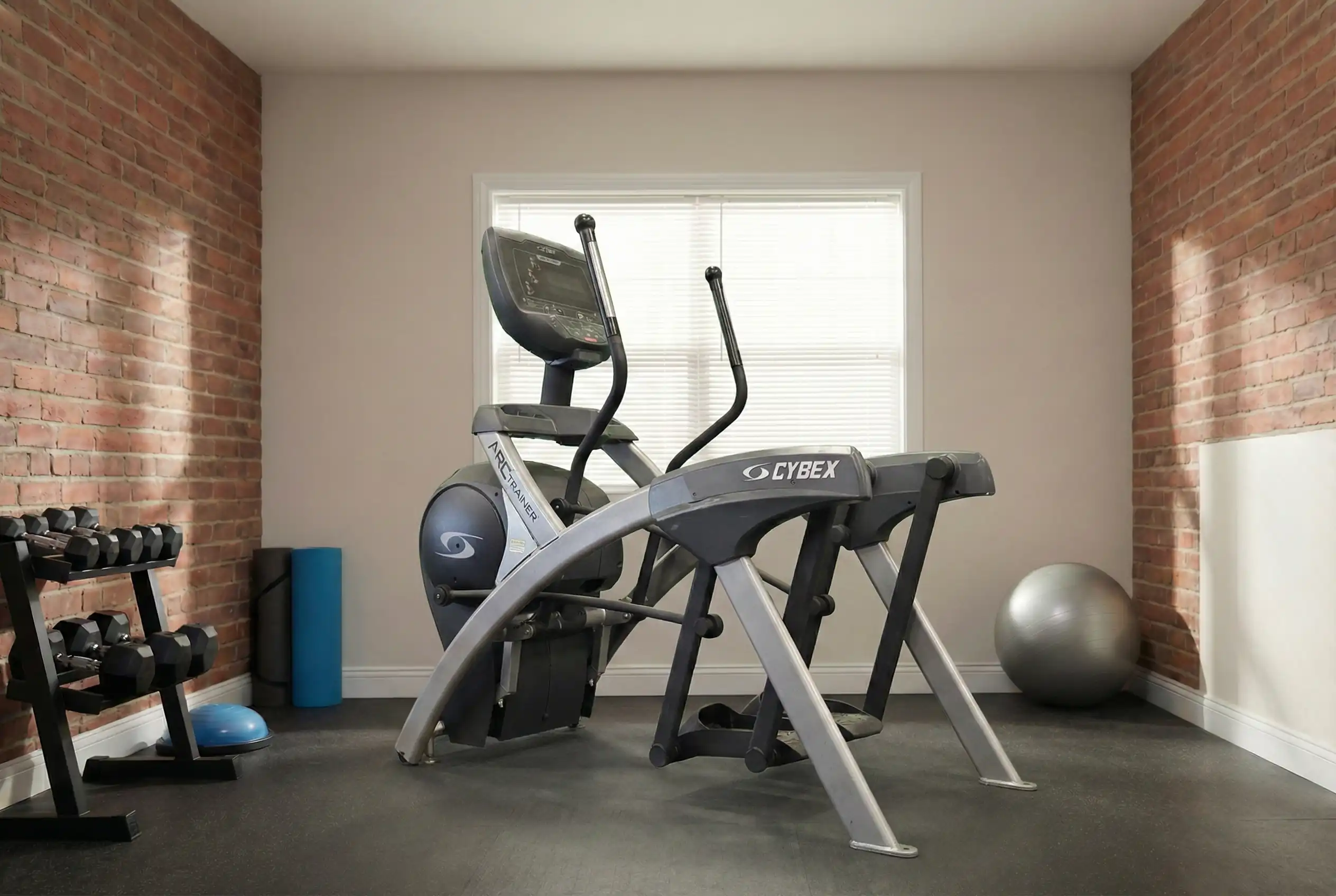
The link below goes to the Cybex 750AT Total Body Arc Trainer on Amazon. The Life Fitness catalog lists Lower Body and Total Body models and no 750AT, so confirm the model, condition, seller and warranty before buying.
The review of the best incline treadmills covers incline on a different type of machine.
Arc Trainer vs Elliptical Calorie Burn - What the Research Shows
Life Fitness says that "research has shown that the Arc is capable of burning 9-16% more calories than competitive machines" and names no study (1). That is a maker's claim, and this guide treats it as one. The one comparison of the two machines cited here measured oxygen use in 18 adults, 10 men and 8 women with an average age of about 25, on an elliptical and an Arc Trainer at 55, 65 and 75% of treadmill VO2max. Oxygen use did not differ between the two machines, while heart rate was higher on the elliptical (4). That study measured oxygen use, not calories, and it set the work on both machines as a share of treadmill VO2max, so it does not test the maker's figure.
Calorie estimates on this site use one method: kilocalories equal MET value times body weight in kilograms times hours, with values from the 2024 Adult Compendium of Physical Activities (5). The Compendium has two elliptical entries: code 02048, elliptical trainer, moderate effort, 5.0 METs, and code 02049, elliptical trainer, vigorous effort, 9.0 METs. For a 70 kg (155 lb) person over 30 minutes, that is an estimate of about 180 kcal at moderate effort and about 320 kcal at vigorous effort, rounded to the nearest 10. The Compendium has no code for an Arc Trainer, so no Arc Trainer figure on this basis exists.
Console numbers are a second basis, the machine's own estimate. In 34 adults on one Precor EFX 883 with no body weight entered, the console read higher than the lab measurement over 30 minutes of moderate exercise (6). Measured laboratory values are a third basis. The three are not interchangeable, so a console number does not belong beside a Compendium estimate. No check of an Arc Trainer's console is cited here.
What sets calorie burn on either machine, as far as the studies cited here show:
- Effort: at the same share of each machine's own peak workload, oxygen use did not differ between a treadmill, an elliptical and a stepper in 18 trained runners (7).
- Body weight: the Compendium formula multiplies the MET value by body weight, so the estimate rises with weight.
- Session length: the same formula multiplies by hours.
- Moving handles: in a study of 26 adults, the arm poles raised oxygen use compared with legs only at the same settings, while heart rate was not higher (8).
- Settings: a resistance or incline level is a maker's scale, so the same number on two machines is not the same workload.
- Individual differences: in the same 26 adults, oxygen use at the same settings varied widely from person to person (8).
On Arc Trainer vs elliptical weight loss, no trial has tested elliptical training alone for weight loss in healthy adults, and no weight-loss trial of the Arc Trainer is cited here. The treadmill weight loss guide covers calorie use on a different machine.
Muscle Activation
Muscle activity has been measured on ellipticals. No study cited here measured it on an Arc Trainer. This section sets out the elliptical results with their populations, then what the maker claims for the Arc Trainer.
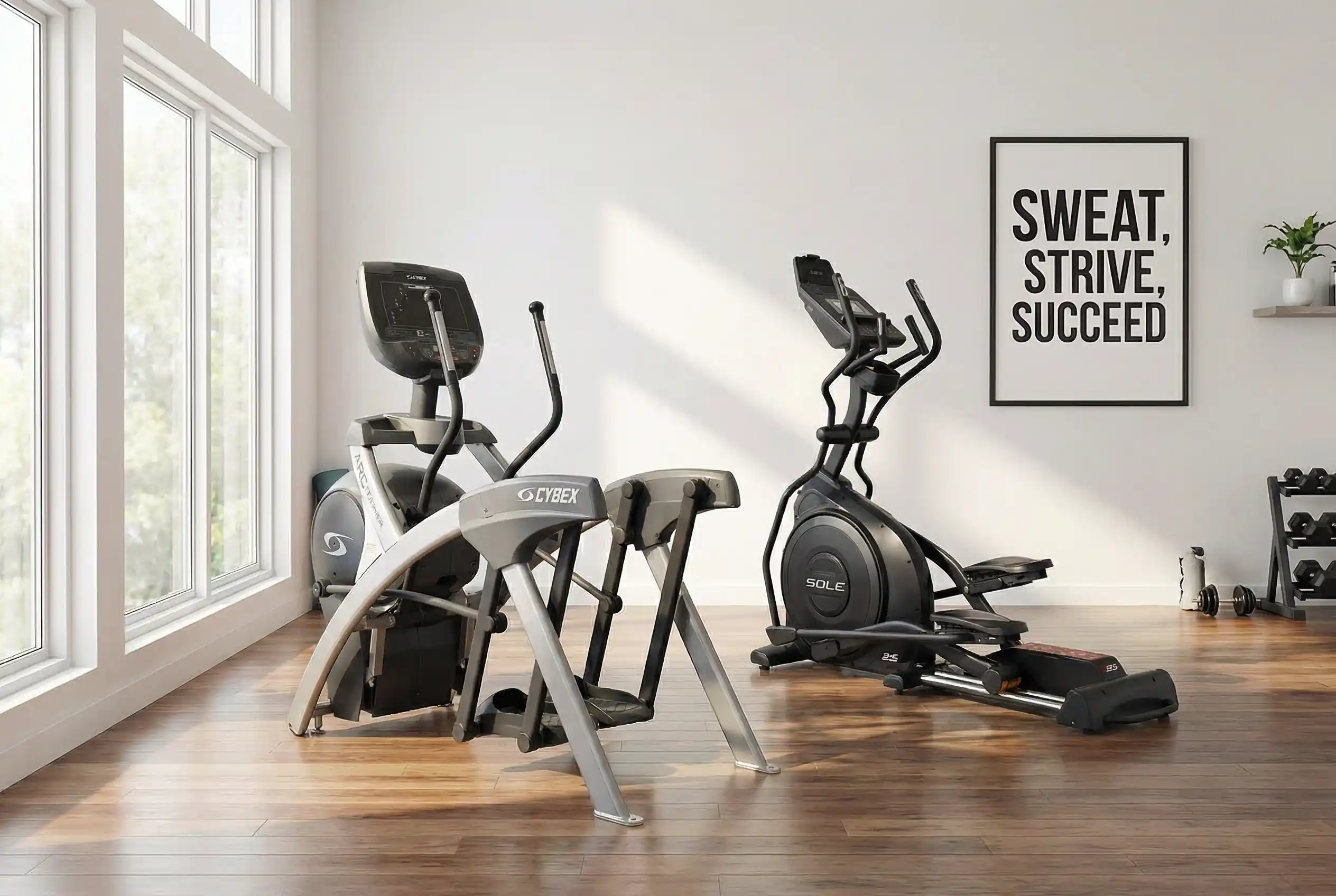
Elliptical training
In 10 healthy young adults, one front-thigh muscle, the rectus femoris, was more active on an elliptical than in walking, treadmill walking or stationary cycling. Only two muscles were measured (9). In 20 adults across four elliptical models, the gluteus maximus and the vastus lateralis (an outer front-thigh muscle) were more active than in walking, the medial hamstring, calf muscles and tibialis anterior were less active, and the gluteus medius and lateral hamstring were about unchanged (10). In 40 healthy young men, gluteal activation was consistently higher on an elliptical than in walking, and the lower back bent forward and rotated more (11).
Against running the picture differs. In 17 well-trained runners at matched intensity, most leg muscles worked less on an elliptical than in treadmill running, by up to 60% for some muscles, and the quadriceps did not differ (12). That is muscle activity, not joint impact.
These studies tested healthy adults, so they say nothing about recovery from an injury or an operation. Anyone rehabilitating a joint should ask a doctor or physical therapist which machine, if any, fits the stage of recovery.
Arc Trainer muscle activity
Life Fitness claims the Arc Trainer "reduces knee stress while increasing glute and hamstring engagement" (1). It names no study, and no muscle-activity study of the Arc Trainer is cited here. Cybex states that on the 625A and 625AT the incline setting changes the intensity of muscle activity and not which muscles are used (2).
Muscle activation comparison
| Muscle Group | Elliptical | Arc Trainer |
|---|---|---|
| Rectus femoris (front thigh) | More active than in walking in 10 adults | No study cited |
| Hamstrings | Medial hamstring less active than in walking in 20 adults | No study cited |
| Gluteus maximus | More active than in walking in 20 adults and in 40 men | No study cited |
| Hip flexors and knee extensors | Larger joint moments than in walking in 15 men | No study cited |
| Calf and shin | Less active than in walking in 20 adults | No study cited |
| Arms (moving handles) | Arm poles raised oxygen use in a study of 26 adults | No study cited; Life Fitness lists a Lower Body and a Total Body model |
| Lower back | Bent forward and rotated more than in walking in 40 men | No study cited |
An Arc Trainer cell without a result means that the studies on this page did not measure it. It does not mean the muscle works less.
The overview of treadmill benefits covers what a treadmill offers instead.
Joint Impact - Arc Trainer vs Elliptical
Life Fitness calls the Arc Trainer non-impact and "scientifically tested to be gentler on your joints than walking", and it names no test or study (1). What studies measured is narrower, and it exists only for ellipticals.
Elliptical joint mechanics
In 15 men, the vertical force on the pedal and the rate at which load built up were smaller on an elliptical than the ground force in walking, but the knee-straightening and hip-bending moments were larger (13). In three people with an instrumented knee replacement, aged 67 to 83, peak knee force on an elliptical was 2.24 times body weight: not lower than treadmill walking (2.05), below jogging, which was consistently greater than 4 times body weight, and about twice a stationary bike (1.03) (14). The post on whether the elliptical is good for knees covers the research on joint load in more detail.
In 12 healthy young men, calculated knee joint torque was higher on an elliptical than on a stationary bike, and faster pedalling raised the peak torque on both (15).
Arc Trainer knee loading
No study cited here measured joint loading on an Arc Trainer, so the knee-stress claim above stays a maker's claim. The one direct comparison asked 18 young adults to rate physical discomfort: knee and lower-back ratings did not differ between the Arc Trainer and the elliptical, and hip ratings did. Those are self-rated scores, not joint loads (4).
Who each machine suits
No study cited here sorts users by knee condition, so neither machine can be called safer for a given diagnosis. For pain in the knee, hip or back, or after a joint operation, check with your doctor or physical therapist before choosing a machine. No machine is a treatment.
- If you feel pain, stop right away (16).
- Go to the hospital right away or call 911 or the local emergency number if you have chest pain during or after exercise (16).
The article on the benefits of walking backwards on a treadmill covers a separate technique.
Arc Trainer vs Elliptical for Runners - Cross-Training
The Arc Trainer vs elliptical for runners question has only elliptical evidence behind it. The runner studies cited here tested a treadmill, an elliptical and a stepper, and none tested an Arc Trainer.
Elliptical cross-training - the evidence base
In 18 trained runners working at 60, 70 and 80% of each machine's own peak workload, oxygen use and heart rate did not differ between a treadmill, an elliptical and a stepper (7).
Arc Trainer running mechanics
The maker's claim that the Arc pattern engages muscles the way running does has no study behind it in this guide. In 18 young adults, maximal oxygen uptake was higher on the treadmill than on the elliptical and similar on the treadmill and the Arc Trainer (4).
In my view, a runner choosing between the two should pick by what the gym has and which one feels right in a short trial, because no comparison cited here ranks them for runners.
For a different machine, the guide to a treadmill workout covers session structure.
Planet Fitness Arc Trainer vs Elliptical - What to Use at the Gym?
The Planet Fitness Arc Trainer vs elliptical choice depends on what a given club stocks. Equipment lists differ by gym, and Arc Trainer is Cybex's product name, so ask the club which machines it has before planning a workout around one.
For beginners and general fitness maintenance
No study cited here compares beginners on the two machines. In my view, a beginner should use whichever machine is free and feels stable. Warm up by exercising slowly for the first few minutes, then pick up the pace, and cool down by ending at a slower pace for the last 5 to 10 minutes (16).
For a home elliptical, the shop lists the pooboo elliptical, a magnetic-resistance model listed with 16 levels.
The post on how effective the elliptical is for cardio covers the cardio research on ellipticals.
For intermediate and advanced users
On paper, variety is the Arc Trainer's selling point: Life Fitness lists 21 incline levels and 100 resistance levels (1). No study cited here tests whether that variety helps a given user.
The review of the best folding treadmills covers space-saving machines.
Arc Trainer vs Elliptical vs Treadmill - How Do All Three Compare?
The Arc Trainer vs elliptical vs treadmill comparison is clearest where one study put the three side by side. In 18 adults, maximal oxygen uptake was higher on the treadmill than on the elliptical and similar on the treadmill and the Arc Trainer (4).
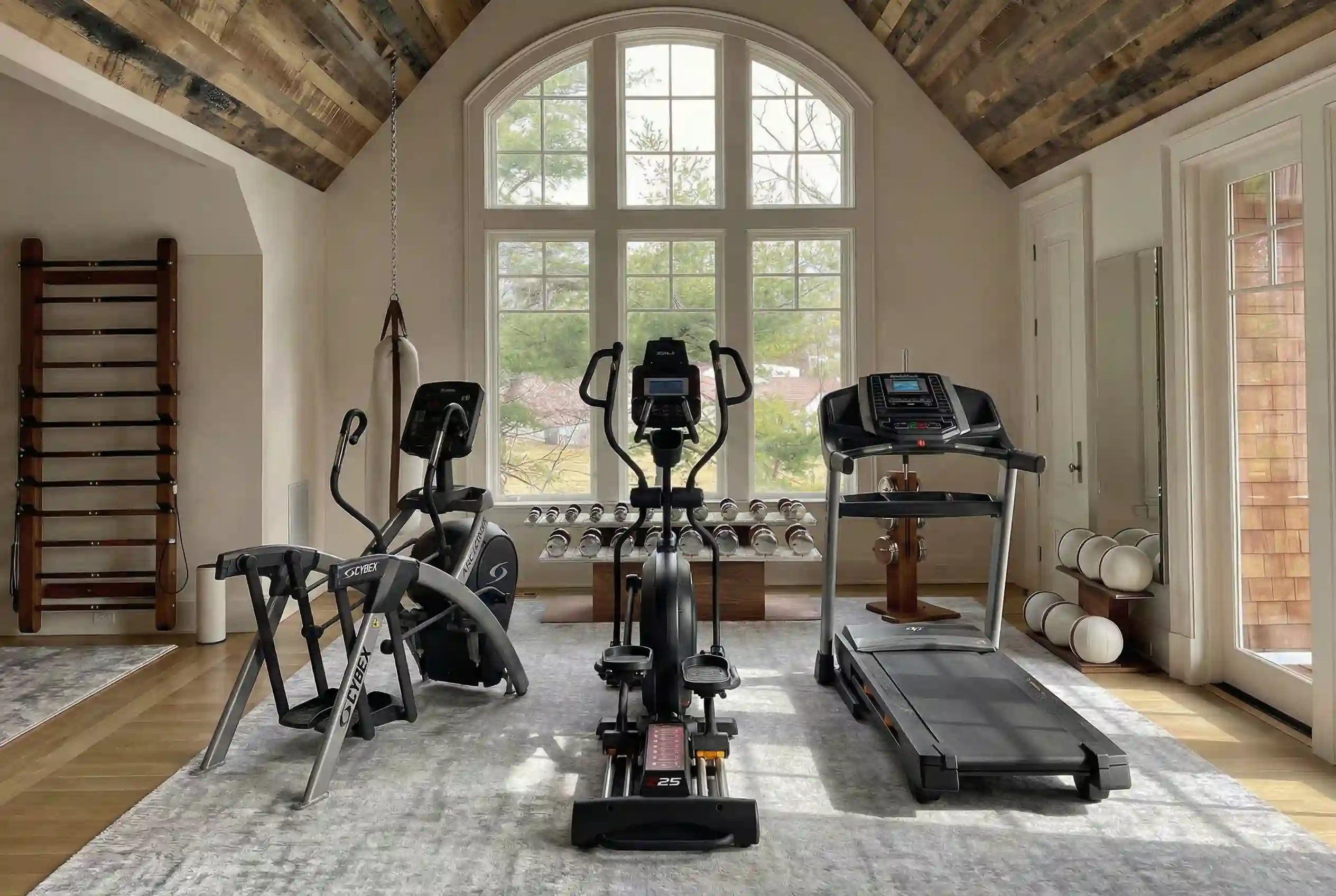
Impact level
Impact depends on where it is measured. Under the foot, peak heel pressure in 20 adults was 94 kPa on an elliptical against 215 in walking and 188 in running (17). At the knee, force on an elliptical was not lower than in treadmill walking in three people with knee replacements (14). The Arc Trainer was measured in neither study.
Calorie burn
At the Compendium's efforts for a 70 kg person over 30 minutes, an elliptical at vigorous effort comes to about 320 kcal and running at 6 to 6.3 mph to about 330 kcal (5). Those are estimates for set efforts, not a measured comparison, and the Arc Trainer has no code.
Muscle specificity
In 17 well-trained runners, most leg muscles were less active on an elliptical than in treadmill running, and the quadriceps did not differ (12). Muscle activity on an Arc Trainer was not measured, so no cell in the table ranks it.
| Factor | Treadmill | Elliptical | Arc Trainer |
|---|---|---|---|
| Knee force, three knee-replacement patients (times body weight) | Walking about 2.1; jogging over 4 | About 2.2 | Not measured |
| Leg muscle activity against treadmill running (17 runners) | Reference | Most muscles lower; quadriceps no different | Not measured |
| Compendium estimate in kcal, 70 kg, 30 minutes, rounded to 10 | About 330 (running at 6 to 6.3 mph) | About 320 (vigorous effort) | No code |
| Oxygen use at the same share of peak workload (18 runners) | Same | Same | Not tested in that study |
| Maximal oxygen uptake (18 adults) | Reference | Lower than the treadmill | Similar to the treadmill |
| Heart rate at the same oxygen use (18 adults) | Not compared | Higher than on the Arc Trainer | Lower than on the elliptical |
| Maker | Many makers | Many makers | Cybex, sold by Life Fitness |
| Knee, hip or back pain | Ask your doctor or physical therapist | The same advice applies | Likewise |
The guide to the best under-desk treadmills covers compact options.
Total Body Arc Trainer vs Elliptical - Upper Body Engagement
Life Fitness lists a Lower Body Arc Trainer with fixed handles and a Total Body Arc Trainer with moving arms (1). On an elliptical, the arm poles raised oxygen use at the same settings in a study of 26 adults, and heart rate was not higher (8). No study cited here measured arm use on an Arc Trainer.
Upkeep on the 625A and 625AT is a service-technician job. The minimum schedule has the belts examined after the first 500 miles and every 5,000 miles, and an elevation-assembly check with lubrication of the elevation bushings every 20,000 miles, all by qualified personnel (2). For a different machine, the guide to treadmill maintenance covers upkeep.
How to Properly Use the Arc Trainer
Use the machine the way its maker instructs. On the 625A and 625AT, plates that are still moving while you mount or dismount can trip you (2). The steps below follow that model's mount and dismount procedure.
Starting position and form
- Confirm the unit is off or in dormant mode and the foot plates have completely stopped.
- Grasp the handrail and step carefully onto the foot plates. The handrails are for support and balance.
- To get off, wait until the foot plates come to a complete stop, hold the handrails and step carefully off the back of the unit. In an emergency, stop striding, wait for the plates to stop and keep holding the handrails.
Arc setting selection
On the 625A and 625AT, the incline setting runs from 0 to 20 and the resistance setting from 0 to 100 (2). The current models list 21 incline levels and 100 resistance levels (1):
- Incline setting 0 equals an arc of 12 degrees.
- Incline setting 20 equals an arc of 34.5 degrees.
- Cybex states that the incline setting changes the intensity of muscle activity and not which muscles are used.
No source cited here says which setting suits a beginner. In my view, start at a low incline and light resistance, and change one setting at a time.
Resistance, stride length, and intensity
The stride length on the 625A and 625AT is fixed at 24 inches, so it cannot be adjusted on that model (2). The handrails are for support and balance.
Recommended workout structure
No source cited here gives a tested Arc Trainer workout. The following is the author's judgement for a first session on any elliptical-type machine, not a protocol tested on the Arc Trainer:
- Warm up for 5 minutes at light resistance, starting slowly and picking up the pace.
- Work for 15 to 20 minutes at a steady effort you can hold while talking.
- Cool down for the last 5 to 10 minutes at a slower pace (16).
- If you feel pain, stop right away.
The guide to treadmill assembly covers a different machine.
Which Machine Is Right for You?
The elliptical machine vs Arc Trainer decision cannot be settled by a ranking. Only one study cited here compared them, and oxygen use did not differ at the intensities it set (4). The lists below follow what can be shown.
Choose the elliptical if:
- You want the machine with the most outside evidence: the muscle, joint and oxygen-use studies cited here tested ellipticals.
- You are choosing a home machine: ellipticals come from many makers, each with its own stated weight limit, resistance levels and warranty to compare.
- You want a calorie estimate on this site's method: the Compendium has elliptical codes and none for the Arc Trainer.
- A doctor or physical therapist has approved an elliptical for your condition.
For a home elliptical, the SOLE E25 Elliptical is one model listed on Amazon. Check its current weight limit, stride length and warranty on the maker's page, because figures differ by model and year.
Choose the Arc Trainer if:
- You want to try the maker's claimed glute and hamstring emphasis; no study cited here confirms it.
- You want a wide range of settings: Life Fitness lists 21 incline levels and 100 resistance levels (1).
- You find the elliptical uncomfortable at the hip: hip discomfort ratings differed between the two machines in 18 adults, and knee and lower-back ratings did not (4).
- Your gym stocks Arc Trainers; ask the club, since equipment lists differ by gym.
Either machine works well for:
- Steady cardio at a chosen effort: at matched intensity, oxygen use did not differ between the two machines in 18 adults (4).
- A gym visit where you can try both machines for one session each and start easy.
Decision summary, based on what the sources cited here show:
| Your Profile | Best Choice | Primary Reason |
|---|---|---|
| Your gym has both | Try each for one session | Oxygen use did not differ at matched intensity in 18 adults; heart rate and hip discomfort ratings did |
| Knee, hip or back pain, or joint surgery | Ask a doctor or physical therapist first | Knee force on an elliptical was not lower than in treadmill walking in three knee-replacement patients; no Arc Trainer joint study is cited |
| You want evidence behind the machine | Elliptical | The muscle, joint and oxygen-use studies cited here tested ellipticals |
| You want the maker's claimed glute and hamstring work | Arc Trainer, as an untested claim | The maker names no study for it |
| Runner choosing cross-training | Either, chosen by access | The runner studies cited here tested ellipticals, not Arc Trainers |
| Home gym | A model whose limits you have checked | Weight limit, stride length and settings differ by model |
| General cardio | Either | Oxygen use matched at the same intensity in 18 adults |
The guide on how to disassemble a treadmill covers moving a treadmill.
The Bottom Line on Arc Trainer vs Elliptical
Both machines give cardio work at an effort you choose. The elliptical has the larger body of published studies, and the Cybex Arc Trainer has maker claims with no study named. The one direct comparison found matching oxygen use at matched intensity (4).
The post on what an elliptical does well covers elliptical benefits in more detail.
The benefits of Arc Trainer vs elliptical training come down to separating claims from measurements.
- Measured on ellipticals: oxygen use, muscle activity, pedal and foot loads, and knee force in three people with knee replacements.
- Claimed for the Arc Trainer but not shown by any study cited here: its joint, muscle and calorie effects.
Alternating the two machines is a matter of preference. No study cited here tested a weekly plan that combines them.
The guide to choosing an elliptical covers what to compare in an elliptical model.
The article on what fitness trackers measure covers what wearables measure.
Frequently Asked Questions
How is the Arc Trainer different from an elliptical?
An Arc Trainer is Cybex's cross-trainer, which the maker says follows an arc pattern rather than the oval path of an elliptical. On the older 625A and 625AT models, the incline setting changes the arc from 12 to 34.5 degrees.
What burns more calories, an elliptical or Arc Trainer?
No study cited here shows that either machine burns more: the one direct comparison found no difference in oxygen use at matched intensity in 18 adults. The maker claims 9 to 16% more calories than competitive machines and names no study.
Is an Arc Trainer hard on your knees?
No study cited here measured knee loading on an Arc Trainer, and the statement that it reduces knee stress is the maker's claim. If you have knee pain, check with your doctor or physical therapist before choosing a machine.
Which is better for losing belly fat, walking or elliptical?
No trial has tested elliptical training alone for weight loss in healthy adults, so neither can be shown to be better for belly fat. At the Compendium's efforts, 30 minutes at 70 kg comes to about 170 kcal for brisk walking at 3.5 to 3.9 mph and about 180 kcal for moderate-effort elliptical.
Is Cybex Arc Trainer a good workout?
The maker describes the Arc Trainer as a non-impact cross-trainer, and no study cited here tests that description. In 18 adults, oxygen use on it matched an elliptical's at 55, 65 and 75% of treadmill VO2max.
Is an Arc Trainer harder than an elliptical?
At the same oxygen use in 18 adults, heart rate was higher on the elliptical than on the Arc Trainer. No study cited here compares how hard the two machines feel at the same settings, and levels are each maker's own scale.
How to properly use Arc Trainer?
On the 625A and 625AT, confirm the foot plates have stopped, grasp the handrail, step carefully onto the plates and use the handrails for support and balance. Wait for the plates to stop before stepping off the back.
 Tech Fitness Lab
Author
Vanja Vukas
I founded Tech Fitness Lab and hold a master's degree from the Faculty of Sport and Physical Education in Novi Sad. I have competed in sport and coached clients, and my writing has appeared on Fitness Volt and BOXROX. I research products from their manuals, spec sheets and warranty terms, and I flag thin evidence.
References:
- Life Fitness. Arc Trainers. Life Fitness US catalog page. Accessed November 21, 2026.
- Cybex International. Cybex Arc Trainer 625A/625AT Owner’s Manual. Part 5625-4, Rev A.
- Precor. EFX635 elliptical. Precor US product page. Accessed November 21, 2026.
- Turner MJ, Williams AB, Williford AL, Cordova ML. A comparison of physiologic and physical discomfort responses between exercise modalities. J Strength Cond Res. 2010;24(3):796-803. doi:10.1519/JSC.0b013e3181cc2472
- Herrmann SD, et al. 2024 Adult Compendium of Physical Activities. J Sport Health Sci. 2024;13(1):6-12. doi:10.1016/j.jshs.2023.10.010
- Glave AP, Didier JJ, Oden GL, Wagner MC. Caloric expenditure estimation differences between an elliptical machine and indirect calorimetry. Exerc Med. 2018;2:8. doi:10.26644/em.2018.008
- Bosch AN, Flanagan KC, Eken MM, Withers A, Burger J, Lamberts RP. Physiological and metabolic responses to exercise on treadmill, elliptical trainer, and stepper: practical implications for training. Int J Sport Nutr Exerc Metab. 2021;31(2):135-142. doi:10.1123/ijsnem.2020-0155
- Mier CM, Feito Y. Metabolic cost of stride rate, resistance, and combined use of arms and legs on the elliptical trainer. Res Q Exerc Sport. 2006;77(4):507-513. doi:10.1080/02701367.2006.10599385
- Prosser LA, Stanley CJ, Norman TL, Park HS, Damiano DL. Comparison of elliptical training, stationary cycling, treadmill walking and overground walking. Electromyographic patterns. Gait Posture. 2011;33(2):244-250. doi:10.1016/j.gaitpost.2010.11.013
- Burnfield JM, Shu Y, Buster T, Taylor A. Similarity of joint kinematics and muscle demands between elliptical training and walking: implications for practice. Phys Ther. 2010;90(2):289-305. doi:10.2522/ptj.20090033
- Moreside JM, McGill SM. How do elliptical machines differ from walking: a study of torso motion and muscle activity. Clin Biomech (Bristol). 2012;27(7):738-743. doi:10.1016/j.clinbiomech.2012.03.009
- Eken MM, Withers A, Flanagan K, Burger J, Bosch A, Lamberts RP. Muscular activation patterns during exercise on the treadmill, stepper, and elliptical trainer. J Strength Cond Res. 2022;36(7):1847-1852. doi:10.1519/JSC.0000000000003743
- Lu TW, Chien HL, Chen HL. Joint loading in the lower extremities during elliptical exercise. Med Sci Sports Exerc. 2007;39(9):1651-1658. doi:10.1249/mss.0b013e3180dc9970
- D’Lima DD, Steklov N, Patil S, Colwell CW. The Mark Coventry Award: in vivo knee forces during recreation and exercise after knee arthroplasty. Clin Orthop Relat Res. 2008;466(11):2605-2611. doi:10.1007/s11999-008-0345-x
- He MY, Lo HP, Chen WH. Effects of stationary bikes and elliptical machines on knee joint kinematics during exercise. Medicina (Kaunas). 2024;60(3):498. doi:10.3390/medicina60030498
- How to avoid exercise injuries. MedlinePlus Medical Encyclopedia. Review date July 15, 2026.
- Burnfield JM, Jorde AG, Augustin TR, Augustin TA, Bashford GR. Variations in plantar pressure variables across five cardiovascular exercises. Med Sci Sports Exerc. 2007;39(11):2012-2020. doi:10.1249/mss.0b013e318148bdfa