
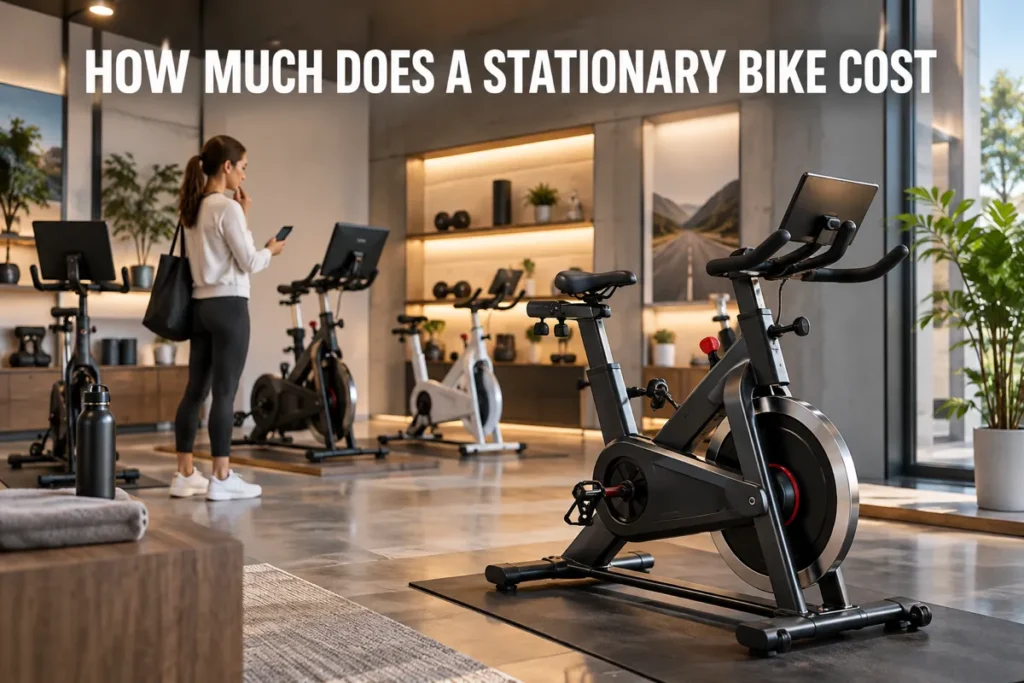
The cost of a stationary bike depends on the bike type, the resistance system, the frame and its rated user weight, the screen and connectivity, the adjustments and the warranty, plus what you keep paying for after delivery. This page lists no figures because prices change; the current price sits on the maker's or retailer's page, and this guide shows what each driver buys.
How much does a stationary bike cost? The honest answer is a set of choices rather than one number, and this page names no figures on purpose: prices change, and the current price sits on the maker's or retailer's page. This guide shows instead what each part of that price pays for and what comes after delivery: assembly, a membership, shoes and parts. I compared those drivers across current maker lineups and manuals so you can read any stationary bike price and see what it buys.
How Much Does a Stationary Bike Cost and What Your Money Gets You
The cost of a stationary bike follows from a short list of hardware choices. Each row below is one driver, what changes along it, a current example and what to check before you compare listings (1, 2, 3). An exercise bike price comparison only works between bikes that match on these rows; otherwise you are comparing different machines.
| Cost driver | What changes | Example | What to check |
|---|---|---|---|
| Bike type | Frame layout, seat and drive: a recumbent adds a backrest seat, an air bike adds a fan | Schwinn sells uprights, recumbents, indoor cycles and air bikes as separate lines | Choose the type for your body and training first, then compare within it |
| Resistance system | A felt pad on the flywheel (friction), magnets near a conductive flywheel (magnetic) or a fan (air) | Schwinn IC3: friction felt pad; Schwinn IC4: magnetic eddy current brake; AirDyne AD6: air | How the level is set (knob or console) and whether that needs a wall outlet |
| Frame and user limit | The maximum user weight the maker rates the bike for | Peloton bikes: 297 lb; Sunny SF-RB4850SMART: 300 lb; Schwinn 190 and 290: 330 lb | Your weight against the rated limit, and the frame material if the maker states it |
| Screen and connectivity | From a segmented LCD to a touchscreen that streams classes | Schwinn 130: 5.5 in segmented LCD; Peloton Cross Training Bike: 21.5 in swivel touchscreen | What the screen needs a membership for, and which apps the bike connects to |
| Warranty | How long the frame, parts, electronics and labor are covered | Schwinn 130, 190, 230 and 290: frame 10 years, parts 2, electronics 1, labor 90 days | Each part's term, who does the repair, and what an added plan covers |
Friction, Magnetic and Air Resistance
The resistance system is the first hardware driver to read on a spec sheet. On a friction bike a pad presses on the flywheel: the Schwinn IC3 uses a felt pad on a 40 lb perimeter-weighted flywheel with infinite levels (1). On a magnetic bike, magnets sit near a flywheel made of a conductive material such as aluminum and never touch it, and moving the magnets closer raises the resistance (4).
Magnetic and air bikes set the level in different ways:
- A knob with a battery console. The Sunny SF-RB424006 recumbent uses a tension control knob with levels 1 to 16, and its console runs on 2 AA batteries (5).
- Console buttons on mains power. The Sunny SF-RB4850SMART plugs in through an adapter; unplugged, it can still be pedaled, but the console does not work and the resistance level cannot be changed (3).
- A knob that still needs power. Echelon's Connect bikes are adjusted with a knob on the frame, yet the tension cannot be adjusted unless the bike is plugged in; the app is not needed to change it (6).
- Mechanical or digital adjustment. Peloton describes the Cross Training Bike's resistance as magnetic with mechanical adjustment and the Cross Training Bike+ as magnetic with digital adjustment (2); Auto-Resistance, which follows the instructor's cues, is only on the Cross Training Bike+ and Original Bike+ (7).
- Air. The Schwinn AirDyne AD6 lists infinite levels of air resistance from a fan on a single-stage belt drive, and its console runs on 2 AA batteries (1).
What this means for the cost: a bike whose level is set from the console, or one that needs the wall to change tension, has to stand near an outlet, and its level cannot change without power. A knob bike with a battery console, such as the SF-RB424006, needs no outlet (5). In my view, the way the level is set matters more in daily use than the number of levels, because each maker uses its own scale and levels do not compare across brands. On any magnetic bike, the same level feels harder at a faster cadence, because the magnetic force rises with flywheel speed (4).
Frame, Drive and Fit Adjustments
Frame and rated user weight are the next drivers. The Sunny SF-RB4850SMART and SF-RB424006 are each rated to 300 lb (3, 5), the Peloton bikes to 297 lb on a welded steel frame (2), and Schwinn rates its 130 and 230 to 300 lb and its 190, 290 and IC4 to 330 lb (1). A limit is the maker's rating for that model, not a promise about other bikes of the same type, so read it for the exact model you are pricing.
The drive and the adjustments are the quieter cost drivers. Peloton's bikes use a Poly V belt drive and Delta-compatible aluminum pedals (2), and Echelon's Connect bikes are belt driven (6). Adjustments differ by model within one maker: the Schwinn IC4 has a race-style seat with fore and aft adjustment and fore and aft handlebars, the 130 and 190 uprights have tilt-adjustable handlebars, and the 230 and 290 recumbents have static ones (1). Peloton fits its Cross Training bikes to riders from 4'11" to 6'5" (2). In my view, the fit range comes before any other spec, because a bike that does not fit is the wrong purchase at any price.
Screens, Connectivity and Warranty Terms
Screens and connectivity decide whether the bike needs a membership at all. A segmented LCD shows the workout numbers: the Schwinn 130 and 230 have a 5.5 in segmented LCD and the 190 and 290 a 7 in LCD (1). A touchscreen streams classes; on the Peloton Cross Training Bike (21.5 in) and Cross Training Bike+ (23.8 in) it swivels (2). That screen ties the bike to a membership: a Peloton bike's touchscreen needs the All-Access Membership for classes (7), while Schwinn's LCD bikes connect by Bluetooth to apps that each need their own subscription (1).
Warranty terms are part of what the price buys, and they differ even within one maker's lineup. Schwinn covers the 130, 190, 230 and 290 for 10 years on the frame, 2 years on parts, 1 year on electronics and 90 days on labor; the IC4 for 10 years on the frame, 3 years on mechanical and electrical parts and 1 year on labor; and the friction IC3 for 5 years on the frame, 2 years on mechanical and electrical parts and 1 year on labor (1). Peloton's Limited Warranty covers the frame for 5 years and the touchscreen and most original components for up to 12 months, and a technician comes to the home for repairs in that period (8). Echelon ties a warranty guarantee to its Premier membership, so check the term before you buy (9). Riders deciding between those two connected brands can read the Echelon vs Peloton comparison.
Stationary Bike Cost by Type for Upright, Recumbent, Spin, and Air Bikes
Bike type sets which of those drivers apply. The table compares one current example per type with the resistance and power source each maker lists; it is not a full lineup, and a dash means the maker does not state that item (1, 3, 10). The guide to types of stationary bikes explains each design in more detail.
| Bike Type | Example | Resistance | Power source | Best For |
|---|---|---|---|---|
| Upright | Schwinn 130 | 16 magnetic levels | Wall outlet | Seated cardio at home |
| Recumbent | Sunny SF-RB4850SMART | 16 levels per program, set from the console | Adapter; no level change unplugged | Riders who want a backrest |
| Spin/Indoor Cycling | Schwinn IC4 | 100 levels of micro-adjustment | Wall adapter | Standing climbs and intervals |
| Air/Fan Bike | Schwinn AirDyne AD6 | Infinite air levels | 2 AA batteries, not included | Hard intervals |
| Folding | pooboo X428 | 8 magnetic levels | - | Small apartments, storage |
How Much Does a Recumbent Bike Cost
If you are weighing a recumbent against an upright, the recumbent's own cost drivers are its seat and backrest, on top of the same resistance and console choices as any bike. Schwinn's two current recumbents show how the drivers stack within one maker: the 230 has 16 magnetic resistance levels, a 5.5 in segmented LCD, a 300 lb rated limit and partial FTMS Bluetooth, while the 290 has 25 levels, a 7 in LCD, a USB charging port, a 330 lb limit and full FTMS (1). Both carry the same warranty terms, so the difference between them sits in the console, the levels, the rated limit and the app connection. Comparing a few recumbent bike models side by side on those same rows shows where a price difference comes from.
For older riders and anyone with joint pain, the step-over height and the backrest are the features I weigh first: the step-over decides how easily you get on and off, and the backrest supports your back. The Schwinn 230 recumbent bike is one current example, with 16 magnetic levels and a 300 lb rated limit (1). Medical needs change the choice more than the price does, so check with your doctor or physical therapist before you start; Sunny rates the SF-RB4850SMART and SF-RB424006 as not suitable for therapeutic use (3, 5).
Spin Bikes and Air Bikes
Indoor cycling bikes show the resistance driver most clearly, because one maker sells both systems. The Schwinn IC3 uses a felt friction pad on a 40 lb flywheel, runs its console on 2 AA batteries and has no app connectivity; the IC4 uses a magnetic eddy current brake with 100 levels, plugs into a wall adapter, includes a Bluetooth heart-rate monitor and works with apps such as JRNY, Peloton and Zwift, each with a separate subscription (1). The guide to spin bike vs exercise bike explains how the riding position differs.
Air bikes trade the magnetic flywheel for a fan. The Schwinn AirDyne AD6 and AD7 both list infinite levels of air resistance; the AD6 runs on 2 AA batteries and the AD7 on 2 D batteries with an AC adapter option, and they are rated to 300 lb and 350 lb (1). Schwinn lists no app connection for either, so there is no subscription to count.
Stationary Bike Trainers and Stand Workouts
A bicycle trainer is a stand that turns a bike you already own into a stationary setup, so the purchase is the stand rather than a second machine. Its cost drivers mirror a stationary bike's: how resistance is created, whether it connects to apps, and what those apps charge. If you already ride a road bike often, I'd look at a trainer before a dedicated machine; if you do not own a bike, the trainer route adds the cost of one.
Exercise Bike Brands, What You Pay, and Why It Matters
Among the brands of stationary bikes, the biggest difference in what you keep paying is whether the bike's screen depends on a membership. In my view, the brands are best sorted by that rather than by price, because the hardware is paid for once, while the membership is the part that keeps running.
The main brands fall into two groups:
Bikes built around a class membership:
- Peloton: the bike's touchscreen needs the All-Access Membership for classes, saved history and progress tracking, and one membership covers up to 20 profiles in a household (7).
- Echelon: the Premier membership includes on- and off-equipment classes for up to 5 members, while FitPass covers off-equipment workouts only (9).
- NordicTrack: touchscreen machines use iFIT Pro, and iFIT states that a paid membership is required with the equipment purchase (11).
Bikes that work fully without a subscription:
- Schwinn: Schwinn states that its products deliver a full workout with zero subscriptions required; apps such as JRNY and Zwift are optional and need their own subscriptions (1, 12).
- Sunny Health & Fitness: the SF-RB424006 and SF-RB4850SMART run on their own consoles, and the SF-RB4850SMART pairs with a free SunnyFit account (3, 5).
- Air bikes: Schwinn lists no app connection for its AirDyne AD6 and AD7 (1).
Three checks for any brand:
- Find the membership name and what it unlocks before the hardware specs.
- Read the warranty by part: frame, parts, electronics and labor.
- Check the rated user weight and the rider height range for that exact model.
Where to Buy a Stationary Bike
I compare places to buy by the terms around the bike: financing, home trials and returns. Peloton, for example, offers financing through Affirm, with rates that depend on eligibility and a down payment that may be required, and a 30-day home trial for first-time purchasers only: one trial per household, in the 48 contiguous states, with return fees that may apply (8). Read those terms on the maker's page on the day you order, because they change.
Refurbished bikes from the maker are a separate route. Peloton's refurbished bikes are Original Series bikes that go through Peloton's own certification process. The Original Series Bike+ is offered refurbished or as a rental, and the refurbished Original Series Bike can be out of stock (2, 8). A refurbished Peloton is the older generation, so compare it with the current model on the same cost drivers before you decide.
A used or refurbished Peloton needs a recall check before anyone rides it. The CPSC recalled about 2.2 million Original Series Bikes, model PL01, in May 2023 (recall 23-201), and about 833,000 Original Series Bike+ units, model PL02 with serial numbers beginning with T, in November 2025 (recall 26-067), because the seat post assembly can break during use (13, 14). On a PL02 the serial number sits inside the front fork, behind the front fork, or behind the flywheel. If a recalled bike has not had its repair, stop using it and contact Peloton for the free repair, a new seat post that owners install themselves (13, 14).
- STEP 1Read the model number Every PL01 bike is under recall, and so is a PL02 with a serial starting with T.
- STEP 2Find a PL02 serial Look inside or behind the front fork, or behind the flywheel.
- STEP 3Ask about the seat post A recalled bike is not ridden until Peloton's free seat post is fitted.
- STEP 4Plan the membership Classes on the screen need your own All-Access Membership.
If you are choosing between a bike and a treadmill for home cardio, the guide to treadmill prices covers what drives the cost on that side.
Hidden Costs That Affect Total Ownership Cost
The price tag is not always the whole cost. What comes after it can be read in advance from the maker's terms: delivery and assembly, a membership, the shoes or parts the bike needs, power, and upkeep. None of these is shown here as a figure; each is a line to check before you buy.
Delivery and Assembly
Delivery terms decide how much of the work lands on you. Peloton offers two routes for its bikes: with self-assembly, packages are left outside the home's primary entrance or garage, or at an apartment building's front desk or lobby, and you move them in and assemble the bike with the provided tools; with expert assembly, the bike is unpacked, inspected and assembled in the room of your choice, including connecting it to Wi-Fi and removing the packaging (8). The heaviest package of the Cross Training Bike weighs 146 lb, and Peloton says not to lift or move packages alone (8).
Plan the spot before delivery as well. A console-controlled or plug-in bike has to sit near an outlet: Schwinn's 130 and 190 uprights and 230 and 290 recumbents plug into a standard 110V to 120V outlet (1), and Peloton asks for 24 inches of clear space on all four sides of its bikes (2). The guide on how magnetic resistance works explains why some magnetic bikes need power to change the level.
Measure the spot before you order: the outlet, the clear space around the bike and the route through your doors. Choose the model that fits that spot, not the one that fits a spare room you rarely use.
Subscription Costs
A membership is the main ongoing cost of a connected bike, and what matters is what it unlocks and what the bike still does without it. The table compares the main platforms; terms change, so check current terms before you buy (6, 7, 9, 11, 12).
| Service | What it unlocks | Without it | Notes |
|---|---|---|---|
| Peloton All-Access | All classes, workouts and connected features on a Peloton bike; up to 20 profiles | Ride on your own with live stats; no saved history, classes or progress tracking | Can be paused for up to 3 months |
| Echelon Premier | On- and off-equipment classes, live and on demand; up to 5 members | Most content needs a membership plan; without the app, ride stats are not shown or stored | FitPass excludes equipment classes |
| iFIT (NordicTrack) | iFIT Pro for built-in touchscreens, up to 5 users; iFIT Train for screenless Bluetooth equipment, 1 user | - | Paid membership required with the equipment purchase; free account and wi-fi needed to operate |
| JRNY (Schwinn) | JRNY All-Access up to 6 profiles; JRNY App up to 3 | Schwinn bikes give a full workout with no subscription | Renews automatically after the free trial until canceled |
| No membership | The bike's own console programs | Nothing changes | Schwinn IC3 has no app connection; none is listed for the AirDyne AD6 and AD7 |
A dash means iFIT does not state what its machines do without a paid membership. In my view, count the membership as part of the bike: it runs whether you ride or not, though Peloton lets you pause it for up to 3 months (7). One Peloton membership covers one machine of each type per household, so a second Peloton bike needs a second membership (8). If you only want the classes, the guide to the Peloton app without any equipment explains what the app gives on its own.
Judging a connected bike by its price tag alone. Count the membership for as long as you will keep it, and read what the bike still does if you stop paying.
Accessories and Maintenance
The accessories that count are the ones the bike needs or the maker leaves out:
- Cycling shoes with cleats: Peloton requires cycling shoes with Delta-compatible cleats for its bikes, whose pedals are Delta-compatible aluminum pedals (2, 8). The Schwinn IC3 and IC4 have pedals with toe cages and SPD clips (1).
- A heart-rate monitor: the IC4 includes a Bluetooth heart-rate monitor, the Schwinn 130, 190, 230 and 290 work with one that is not included, and the Sunny SF-RB424006 does not include one (1, 5).
- Heart-rate training: with a monitor, zone-based training works on any bike whose console or app reads it.
- Batteries: the SF-RB424006 console runs on 2 AA batteries, both replaced at the same time, and the AD6 needs 2 AA batteries that are not included (1, 5).
- A floor mat: no maker named here lists one as required; I'd still put a mat under any bike on a wood floor to catch sweat.
On the SF-RB424006, check all assembly bolts and pedals for tightness every week, clean the bike with a damp cloth and wipe sweat off after each use (5); Sunny replacement parts are ordered by the model number and the part number from the parts list (3). The guide to maintenance for a magnetic-resistance bike covers the routine in detail.
Extended cover is a separate purchase. Peloton offers a Peloton Protection Plan for 48 months of total coverage, with accidental damage coverage and surge protection (8); set what it adds against the standard warranty before you add it.
What a Stationary Bike Gives You for Health and Long-Term Use
A stationary bike earns back its cost only through use, so the useful test is how often you will ride, not the price. No bike is worth it in general. A bike in use most days spreads its cost over many sessions, and one left idle most weeks does not.
What the riding gives you is easier to count in minutes than in money. US guidelines say adults need at least 150 to 300 minutes of moderate-intensity aerobic activity each week, plus muscle-strengthening activity on at least 2 days (15). The American Heart Association sets at least 150 minutes of moderate activity or 75 minutes of vigorous activity a week, or a combination, preferably spread through the week (16). A bike at home is one way to reach those minutes in any weather.
If you plan a stationary bike workout for weight loss, estimate the energy cost with the 2024 Adult Compendium of Physical Activities: at 70 kg (155 lb), 30 minutes of general stationary cycling (6.8 METs) comes to about 240 kcal, a spin-bike class (9.0 METs) to about 320 kcal, and brisk walking at 3.5 to 3.9 mph (4.8 METs) to about 170 kcal (17). These are estimates from kcal = METs x body weight in kg x hours, rounded to the nearest 10, and a console's calorie reading is an estimate too.
No ride burns fat from one chosen area. In a trial of 24 healthy sedentary adults aged 18 to 40 whose calorie intake was held steady, six weeks of abdominal exercises five days a week did not reduce body fat, belly fat or waist size compared with a control group (18). Treat the bike as a way to add regular minutes, not as a way to target one part of the body.
Choosing the Right Stationary Bike for Your Space and Goals
Once you know which cost drivers matter to you, the right model follows from five questions. The guide on how to choose an exercise bike goes through fit and setup step by step.
- Frequency: if you will ride most days, weigh the frame, the rated limit and the warranty terms first; if you will ride now and then, a simpler console and no membership keep the ongoing cost down.
- Training style: steady riding works on an upright or a recumbent; standing climbs and intervals suit an indoor cycling bike; instructor-led classes mean a touchscreen bike and its membership, counted for as long as you will keep it.
- Body needs: with joint, back or balance concerns, check with your doctor or physical therapist first; in my view a well-supported recumbent bike with a backrest is the type to compare first. Otherwise any type works if it fits your height and weight.
- Space: Folding exercise bikes suit small apartments where storage matters; the pooboo X428, for example, folds and is rated to 300 lb (10). A powered bike also needs a spot near an outlet.
- Subscription preference: self-directed riders can pick a bike that runs on its own console; riders who want live classes should count the membership alongside the hardware.
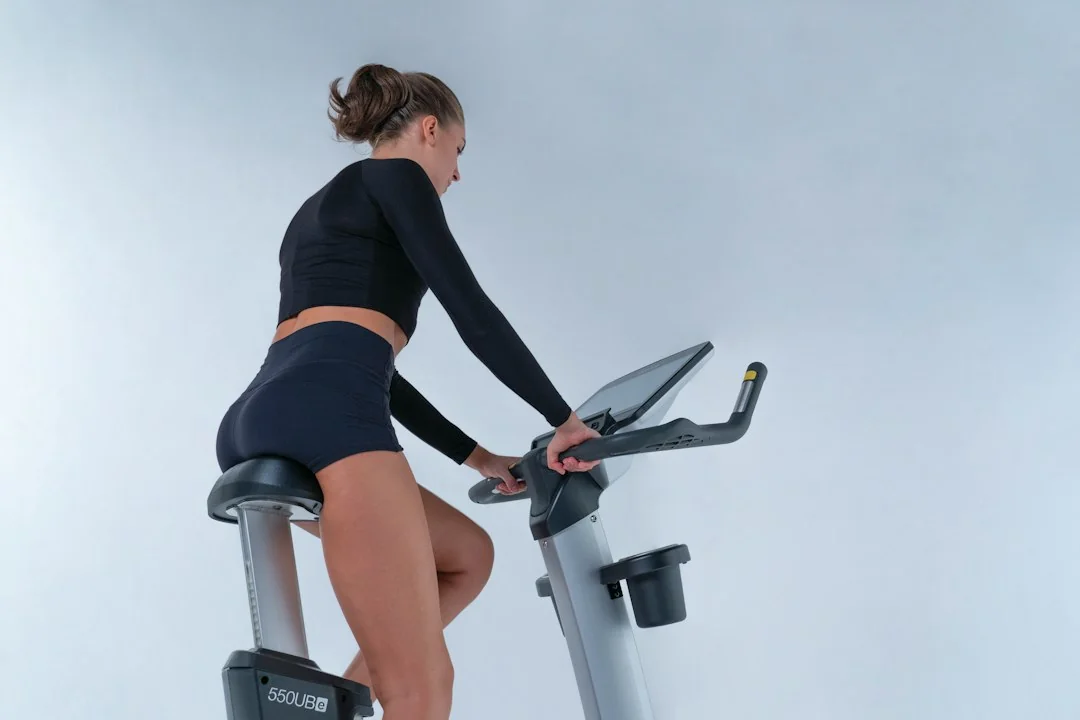
When choosing the best stationary bike for seniors with bad knees, I'd weigh the step-over height, the backrest and the rated limit first, and the screen last. For daily riders of any age, I'd put the money into the frame, the rated limit and the warranty terms before the screen, because those are the parts you rely on every ride.
Making the Most of Your Stationary Bike Purchase
So how much does a stationary bike cost once everything is counted? It is the bike, plus delivery and assembly, plus any membership for as long as you keep it, plus the shoes or parts the bike needs. Read those four lines for any model and the price tag makes sense. The roundup of the best exercise bikes for a home gym applies the same drivers model by model.
A bike pays off only when it is ridden, and three habits help:
- Place the bike somewhere you pass it naturally each day, not in a spare room you avoid
- Set the saddle height and handlebar position before the first ride, using the setup steps for your model.
- Start with shorter rides at a moderate effort and increase the amount and intensity gradually (16).
Frequently Asked Questions
Is 30 minutes of stationary bike the same as 30 minutes of walking?
At the same 30 minutes and a body weight of 155 lb, general stationary cycling is estimated at about 240 kcal and brisk walking at 3.5 to 3.9 mph at about 170 kcal. Both count toward the weekly activity that US guidelines set, so the better choice is the one you will repeat.
Can you lose belly fat by riding a stationary bike?
No exercise burns fat from one chosen area: in a trial of 24 adults, six weeks of ab exercises did not reduce belly fat. A bike adds regular activity, so ride for the weekly minutes rather than for one part of the body.
Is 20 minutes a day on a stationary bike enough?
Twenty minutes every day adds up to 140 minutes a week, just under the 150 minutes of moderate activity that US guidelines set as the minimum for adults. At a vigorous effort, the American Heart Association counts 75 minutes a week, so 20 hard minutes on four or more days covers it.
When is a stationary bike worth getting?
It is worth getting one if you will ride it regularly, because its cost is spread over every ride and its value comes from the minutes you put in. Check the full cost first: the bike, delivery and assembly, any membership for as long as you keep it, and the shoes or parts it needs.
How long to ride stationary bike for weight loss?
Build toward the weekly 150 to 300 minutes of moderate activity, increasing the length and effort of rides gradually. For scale, 30 minutes of general riding is estimated at about 240 kcal for a 155 lb rider, so pair the riding with your eating habits.
 Tech Fitness Lab
Author
Vanja Vukas
I founded Tech Fitness Lab and hold a master's degree from the Faculty of Sport and Physical Education in Novi Sad. I have competed in sport and coached clients, and my writing has appeared on Fitness Volt and BOXROX. I research products from their manuals, spec sheets and warranty terms, and I flag thin evidence.
This content is for informational and educational purposes only and is not a substitute for professional medical advice. Always consult your healthcare provider before starting a new fitness program, especially if you have joint conditions or cardiovascular concerns. We are always looking for expert inputs to make our content even better and more useful.
References
- Schwinn Fitness. Compare bikes. Johnson Health Tech. Accessed November 20, 2026.
- Peloton Interactive, Inc. Compare Peloton bikes: specifications. Peloton. Accessed November 20, 2026.
- Sunny Health & Fitness. Smart Programmable Recumbent Bike SF-RB4850 SMART: user manual. Version 3.1. Sunny Health & Fitness; 2023. Accessed November 20, 2026.
- Octane Fitness. How do commercial magnetic resistance bikes work? Octane Fitness. Accessed November 20, 2026.
- Sunny Health & Fitness. Corezy 16-Level Smart Magnetic Resistance Recumbent Bike With Workout Bands, SF-RB424006: user manual. EN V1.3. Sunny Health & Fitness; 2026. Accessed November 20, 2026.
- Echelon Fitness. App FAQs. Echelon Fit US. Accessed November 20, 2026.
- Peloton Interactive, Inc. Peloton membership. Peloton. Accessed November 20, 2026.
- Peloton Interactive, Inc. Peloton Cross Training Bike. Peloton. Accessed November 20, 2026.
- Echelon Fitness. Membership plans. Echelon Fit US. Accessed November 20, 2026.
- pooboo. X428 Folding Exercise Bike Indoor. Product listing in the maker's store feed. Accessed November 20, 2026.
- iFIT Inc. iFIT membership options. iFIT. Accessed November 20, 2026.
- Schwinn Fitness. Connected apps. Johnson Health Tech. Accessed November 20, 2026.
- US Consumer Product Safety Commission. Peloton recalls two million exercise bikes due to fall and injury hazards. Recall 23-201. May 11, 2023. Accessed November 20, 2026.
- US Consumer Product Safety Commission. Peloton recalls Original Series Bike+ exercise bikes due to fall and injury hazards. Recall 26-067. November 6, 2025. Accessed November 20, 2026.
- Office of Disease Prevention and Health Promotion. Top 10 things to know about the second edition of the Physical Activity Guidelines for Americans. US Department of Health and Human Services. Accessed November 20, 2026.
- American Heart Association. American Heart Association recommendations for physical activity in adults and kids. Last reviewed January 19, 2024. Accessed November 20, 2026.
- Herrmann SD, Willis EA, Ainsworth BE, et al. 2024 Adult Compendium of Physical Activities: a third update of the energy costs of human activities. J Sport Health Sci. 2024;13(1):6-12. doi:10.1016/j.jshs.2023.10.010
- Vispute SS, Smith JD, LeCheminant JD, Hurley KS. The effect of abdominal exercise on abdominal fat. J Strength Cond Res. 2011;25(9):2559-2564. doi:10.1519/JSC.0b013e3181fb4a46