
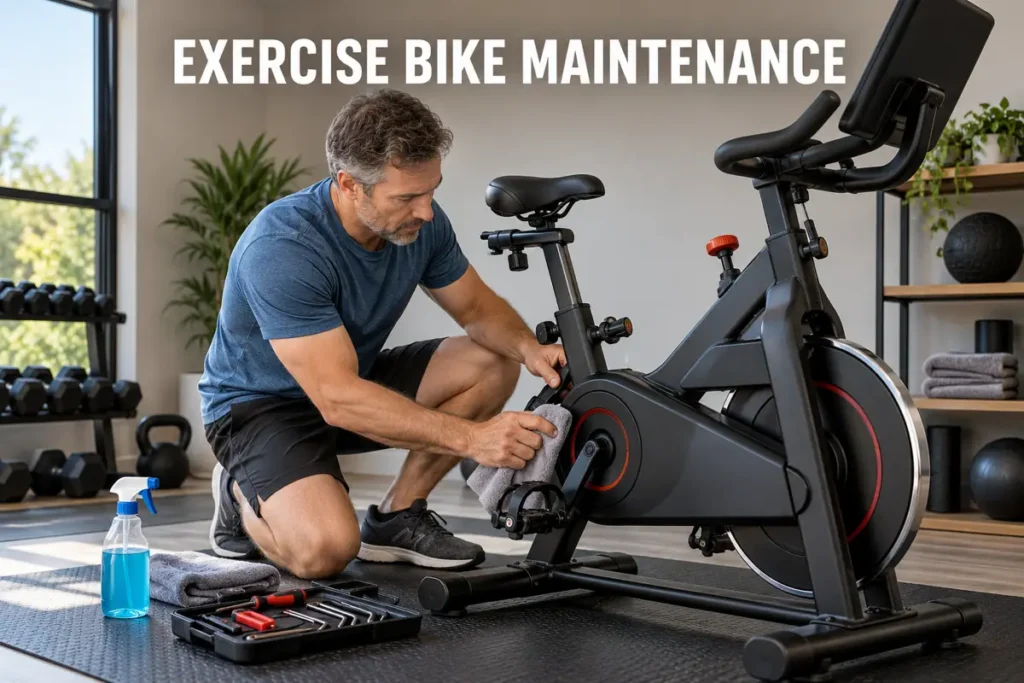
Exercise bike maintenance is the routine that separates a machine running smoothly after five years from one that starts squeaking within months and ends up gathering dust in a corner. I am Vanja Vukas, founder of TechFitnessLab and an MPhEd with over 15 years working in fitness, and I have watched riders replace perfectly functional bikes because they skipped cleaning and lubrication steps that take under five minutes. This guide covers what a complete maintenance schedule looks like, which lubricant works for which drive type, how to diagnose and fix the most common noise and resistance problems, and what extra steps Peloton and spin bike owners need to add. Follow this system and your bike will run quieter, feel more responsive, and last significantly longer than the average home machine. Consistent maintenance is the single most cost-effective investment a home rider can make.

Exercise Bike Maintenance - What a Complete Routine Looks Like
A structured exercise bike maintenance routine addresses two distinct failure modes. The first is corrosion - sweat is mildly acidic, and every ride without a wipe-down deposits salt and moisture on bolts, frame welds, and exposed metal near the bottom bracket. The second is mechanical wear - drive components under friction generate heat and strip protective coatings unless they receive periodic lubrication. Both are predictable, and both are preventable with minimal effort and inexpensive supplies. Before building out your maintenance habits, a complete exercise bike buying guide can clarify how your specific drive system affects the intervals and products you need.
The Daily and Weekly Habits That Prevent Long-Term Damage
Daily maintenance takes under two minutes. After every ride, wipe down the frame, handlebars, and seat with a damp microfiber cloth to remove sweat before it dries into a mineral crust on metal surfaces. Never spray cleaning solution directly onto the console or display - apply it to the cloth first, then wipe. Understanding what muscles an exercise bike works also helps identify the high-sweat-contact areas where daily cleaning attention matters most.
Weekly checks build directly on the daily habit:
- Inspect and finger-tighten all visible bolts: handlebar stem, seat post clamp, and pedal bolts
- Wipe down pedals and crank arm covers, where grit accumulates fastest with daily use
- Test the resistance knob or lever through its full range for smooth, even adjustment
- Complete a short 5-minute test ride while listening for new squeaks, clicks, or grinding
- Inspect the base and welds for unusual flex or visible cracking under the frame
The Monthly and Annual Checks That Extend Lifespan
Monthly checks go deeper. This is when you inspect and lubricate drive components, verify belt or chain tension, and run the resistance system through its complete range from lowest to highest setting. For belt tension specifically: grip the belt at the midpoint between the two pulleys and deflect it sideways - correct tension allows about 0.5 to 1 cm of lateral movement under moderate thumb pressure. More than 1 cm indicates the belt is loose and slipping under load; less than 0.5 cm indicates it is over-tensioned and will wear the pulleys prematurely. An exercise bike maintenance checklist that covers all three - cleaning, lubrication, and mechanical inspection - done monthly prevents the compounding failures that develop slowly and become expensive.
Annual service is the most thorough pass of the year:
- Remove and inspect the drive belt for cracking, fraying, or glazing (a shiny, heat-hardened surface)
- Spin the flywheel by hand and feel for roughness, side-play, or wobble that was not present before
- Inspect power and data cables on connected bikes for kinking or fraying near the connectors
- Remove the seat post and handlebar post from their tubes, clean the contact surface, and reapply silicone-based grease to prevent seizing
- Review the manufacturer's service manual for any model-specific intervals for your bike
Task | Daily | Weekly | Monthly | Yearly |
Wipe down frame, handlebars, and seat | Yes | Yes | Yes | Yes |
Tighten all visible bolts | - | Yes | Yes | Yes |
Lubricate chain or belt drive components | - | - | Yes | Yes |
Test full resistance range | - | Yes | Yes | Yes |
Inspect drive belt for wear or glazing | - | - | Yes | Yes |
Spin flywheel and check for roughness | - | - | - | Yes |
Lubricate seat post and handlebar post | - | - | - | Yes |
Inspect cables on connected bikes | - | - | - | Yes |
How to Clean Your Exercise Bike Without Damaging It
Cleaning is the foundation of stationary bike maintenance, and the most common mistakes involve reaching for the wrong product. Several standard household cleaners damage finishes, corrode metal, or degrade electronic components - which is exactly what you are trying to protect. The right approach costs nothing extra and consistently protects the parts most expensive to replace. People curious about how exercise bikes affect belly fat often discover that equipment condition directly influences their ability to train at the intensities that drive results.
What to Use and What to Avoid on the Frame and Console
For the frame and plastic shrouds, mild dish soap diluted in water is the safest universal cleaner. A few drops in a spray bottle handles sweat residue and grime without stripping paint or corroding metal alloys. For the console and touchscreen, use a dry or very lightly dampened microfiber cloth only - no liquid cleaner sprayed anywhere near electronics.
Avoid these products on exercise bikes:
- Bleach-based cleaners - corrode aluminum components and strip protective paint coatings
- Ammonia-based glass cleaners - damage polycarbonate shrouds and degrade plastic consoles
- Abrasive scrubbing pads - scratch frame surfaces and remove the protective coating that slows oxidation
- WD-40 on painted or plastic surfaces - leaves a dust-trapping residue and can degrade rubber seals over time
For foam or rubber handlebar grips, a small amount of isopropyl alcohol on a microfiber cloth removes embedded grime without compressing or degrading the foam. In my experience, grip condition is one of the most overlooked aspects of routine care - riders replace entire bikes over comfort issues that a simple grip replacement would have solved. Inspect grip condition at each cleaning session and replace if foam has hardened significantly or rubber has cracked through.
Handling Sweat Buildup on High-Use Areas
The seat post-frame junction and the area directly below the handlebars accumulate the most sweat. Both are locations where moisture wicks down from above and pools in a hidden contact zone that rarely gets cleaned until visible damage appears. I recommend placing an absorbent rubber mat beneath the bike on every ride to catch floor-level drips and reduce the moisture environment around the base.
If you train at high intensity several days per week, positioning a fan to direct airflow across the bike during use is the single most effective long-term corrosion prevention strategy I have found. It keeps metal parts drier during the ride and dramatically slows the moisture penetration that eventually reaches bolt threads and bearing surfaces. This habit has extended service life for more of my clients' bikes than any lubricant or post-ride cleaning product.
Storage and Environmental Conditions
Where you store the bike between sessions matters nearly as much as how you clean it after them. Direct sunlight degrades plastic shrouds and fades console displays faster than mechanical use - position the bike away from windows or use a cover when the room receives strong afternoon sun. Humidity above 60% accelerates frame corrosion at weld points and bolt heads; a dehumidifier in a basement gym is a worthwhile investment. Temperature swings above 35 degrees Celsius soften belt compounds over time. If the bike sits in an unheated garage in winter, allow it to return to room temperature before riding - cold drive belts are brittle and more prone to cracking under load.
Exercise Bike Lubrication - Choosing the Right Product
The exercise bike lubricant question generates more conflicting guidance than almost any other maintenance topic, largely because advice written for chain-drive bikes gets applied incorrectly to belt-drive machines and vice versa. Choosing the right lubricant for your exercise bike depends entirely on the drive type. Understanding how a magnetic resistance exercise bike works clarifies which components in belt-drive systems actually need lubrication and which should never be touched with oil.
Belt vs. Chain Drives - Different Needs, Different Lubricants
Belt-drive bikes - the majority of modern magnetic resistance models - use a reinforced rubber or polyurethane belt. The belt itself does not need lubrication. Applying chain lube to a belt drive can cause the belt to swell, skip on the pulleys, or degrade prematurely. What belt-drive bikes do need is periodic lubrication of the flywheel axle bearings via the manufacturer's designated service port, using a silicone-based lubricant or white lithium grease in the small quantity specified in the manual. My guide to the magnetic exercise bike explains what this resistance type is and what to expect from it.
Chain-drive bikes - found on many older upright models and most friction-brake spin bikes - require a dry bicycle chain lubricant applied directly to the chain links. Apply it while turning the pedals slowly by hand, targeting the inner link surfaces. Wipe off all excess lubricant immediately - excess product attracts fine dust and grit that acts as an abrasive and accelerates chain wear faster than running a dry chain.
Where to Apply Lubricant and How Often
The seat post and handlebar post are the two most overlooked lubrication points in exercise bike maintenance. Both are metal-on-metal contacts inside tubes that gradually seize when sweat wicks down and the protective film wears away. In my own testing, I have seen seat posts seize completely in aluminum frames within 14 months when the post was never removed or greased - a repair that costs more in time and parts than a complete annual service program would have prevented. When you adjust seat height and feel resistance that was not there before, the post is beginning to bind. Removing both posts annually, cleaning the contact surface, and applying white lithium grease or silicone grease before reinserting prevents permanent seizing.
A clear note on WD-40: this is the most common lubricant question I receive from riders, and the answer is consistent - WD-40 is not appropriate for exercise bike maintenance. It is a water-displacement compound and light solvent that evaporates within days and leaves surfaces unprotected. Using it on chain links or bearings provides temporary loosening action followed by rapid metal-on-metal wear. The correct exercise bike lubricant depends on the drive type, not on what is available nearby.
Lubrication frequency by component:
- Chain-drive bikes: dry bicycle chain lube every 4-6 weeks with regular use, or every 2-3 weeks with intensive daily training
- Belt-drive flywheel bearings: follow the manufacturer interval, typically every 6-12 months, via the service port
- Seat post and handlebar post: every 6-12 months, or at the first sign of stiff height adjustment
- Resistance pivot points on friction-brake bikes: every 3 months, or when resistance adjustment feels notchy
Always unplug the bike from the wall before applying any lubricant to drive components or internal access points.
Resistance System Maintenance
The resistance mechanism determines the quality of every session, and it is the component most likely to produce intermittent failures that riders misidentify as hardware defects. In my experience, the majority of resistance problems I see with clients' equipment are maintenance-related - not mechanical failures requiring parts. Addressing resistance issues early keeps the system responsive and prevents the gradual calibration drift that makes training feel inconsistent. Regular cycling produces measurable cardiovascular adaptations, including blood pressure reduction, improved HDL cholesterol levels, and enhanced insulin sensitivity (1), with systematic reviews of indoor cycling confirming consistent health benefits across diverse populations (2). I go through the benefits and limitations in my guide on whether exercise bikes are good.
Magnetic resistance systems use magnets positioned near the flywheel without physical contact. These systems are largely self-maintaining. On cable-actuated models, the resistance cable should move freely through its full travel with no kinking at the handlebars or mid-run. Digital-control models benefit from keeping the sensing mechanism clear of dust buildup. The recumbent vs. upright exercise bike comparison covers how frame design affects access to these components during service.
Friction resistance systems contact the flywheel directly and need more active maintenance:
- Inspect the brake pad every 3 months - a pad worn to less than 2mm risks metal-on-metal flywheel contact
- Replace pads before they reach the backing plate, which can score the flywheel surface
- Apply a single drop of multi-purpose oil to the outer edge of the flywheel if squealing persists after pad inspection
- Check the resistance knob threads monthly and apply white lithium grease if adjustment feels gritty
Troubleshooting Common Exercise Bike Problems
Most exercise bike problems follow recognizable patterns. Working through a systematic diagnostic approach before ordering parts or calling a technician resolves the majority of issues in under 30 minutes. Systematic exercise bike maintenance prevents most of the problems in this table from developing at all. The table below covers the problems I encounter most often when reviewing equipment with clients. My general rule is: if the issue appears in this table, exhaust the listed fixes before spending money on parts.
Symptom | Likely Cause | Fix |
Squeaking from drive area | Worn brake pads (friction bikes); dry chain (chain-drive bikes) | Inspect and replace brake pads; lubricate chain |
Grinding from pedal area | Loose crank arms; worn pedal bearings | Tighten crank arm bolts to spec; replace pedals |
Clicking on each pedal stroke | Loose or cross-threaded pedal | Re-thread pedal (left pedal is reverse-threaded); replace if bearing is worn |
Resistance does not adjust | Frayed resistance cable; magnetic brake misalignment | Inspect and replace cable; check magnetic brake position |
Seat drops during use | Worn seat post clamp or under-torqued bolt | Replace clamp or re-torque to manufacturer specification |
Handlebar wobble | Loose stem clamp bolt | Tighten stem clamp to manufacturer specification |
Console does not power on | Dead batteries; loose connector | Replace batteries; re-seat cable connectors at back of console |
Burning smell during use | Belt slipping on drive pulleys | Reduce resistance immediately; inspect belt tension and pulley alignment |
Clattering noise during pedaling | Loose accessory - water bottle holder, phone mount | Identify and secure all loose-fitting accessories |
Flywheel wobble visible during spin | Loose flywheel bolt or bent axle | Tighten flywheel bolt; contact manufacturer if axle deflection persists |
Riders dealing with knee discomfort during cycling should also check seat height, saddle fore-aft position, and pedal alignment before assuming resistance or drive issues are the cause - mechanical misalignment often produces joint pain symptoms that look like equipment problems.
Maintenance for Specific Bike Types
I adjust exercise bike maintenance routines between stationary bike types because their requirements vary enough that a single protocol does not transfer unchanged across categories. The two categories that benefit most from dedicated guidance are connected smart bikes and high-intensity friction-brake spin models.
Peloton Maintenance - Additional Steps for Connected Bikes
Peloton maintenance follows the complete exercise bike maintenance checklist above without exception. On top of the standard schedule, Peloton owners add a set of digital and hardware-specific tasks that generic guides do not cover:
- Check touchscreen mounting bolts every 3 months - vibration from high-intensity sessions loosens them gradually
- Clean the display with a dry microfiber cloth only - any moisture risks the screen
- Keep the bike away from direct sunlight and heat vents; prolonged exposure degrades the tablet display faster than mechanical use
- Install software updates within two weeks of release to maintain resistance sensor calibration accuracy
- Inspect Look Delta pedal threads and shoe cleat contacts monthly if you ride with clip-in cycling shoes
Spin Bike Maintenance Differences
High-resistance, high-cadence efforts in spin-style sessions put significantly more stress on brake pads, flywheel axle bearings, and resistance knob threading than moderate-intensity upright riding. Spin bike maintenance intervals should run at roughly double the standard frequency: lubricate chains every 2-3 weeks with frequent use, inspect brake pads monthly, and check resistance knob threads monthly for early stripping.
Sunny exercise bike brake pads - and those on similar friction-brake models - commonly wear to the squeal threshold within 12-18 months of regular training. This is normal wear progression rather than a defect. Proactive pad replacement before squealing becomes consistent is the most cost-effective spin bike maintenance approach for this class of equipment. The distinction between the spin bike vs exercise bike form factor also matters for maintenance planning: spin bikes run at higher flywheel speeds, which shortens brake pad lifespan and increases the frequency of flywheel axle bearing service. I cover the differences between spin bikes and exercise bikes in more detail, with workouts for each.
A Well-Maintained Bike Is Where Real Results Happen
Exercise bike maintenance is what keeps the result-producing work accessible over time. A systematic review covering 724 participants found stationary cycling significantly reduced pain in knee osteoarthritis versus no-exercise controls (3), and preliminary research suggests one supervised 12-week cycling program found approximately 20% improvement in estimated VO2max among sedentary older adults (4), though larger controlled trials are needed to confirm the effect size. The health benefits of cycling are well established - and they depend entirely on having a functional bike to ride. Research also confirms real before and after changes from consistent riding, which reinforces why keeping the equipment running matters.
I started tracking exercise bike maintenance systematically with clients after watching a solid, quiet machine deteriorate into a noisy, resistance-skipping frustration within eight months - entirely from skipped monthly chain lubrication that takes under three minutes to complete. The framework is simple: daily wipe-down, weekly bolt check, monthly lubrication and resistance test, annual deep inspection. That sequence catches problems before they compound. If you are building toward specific outcomes on a well-maintained machine, exercise bike workouts for weight loss pair directly with this maintenance foundation to ensure your equipment matches your training intensity. Riders just starting out will find that exercise bike workouts for beginners provide the structured starting point that pairs with this maintenance framework.
FAQs
How to lubricate a stationary bike?
To lubricate a stationary bike correctly, first identify your drive type: chain-drive bikes need a dry bicycle chain lubricant applied lightly to each link while the pedals turn slowly, while belt-drive bikes need a silicone-based lubricant applied to flywheel axle bearings via the manufacturer's service port. Lubrication is a core part of stationary bike maintenance - always unplug the bike before lubricating internal components, wipe off any excess product immediately to prevent dust accumulation, and follow the specific interval in your manufacturer's manual for the correct access point and lubricant type.
Is 30 minutes of stationary bike the same as 30 minutes of walking?
Thirty minutes on a stationary bike is not equivalent to 30 minutes of walking because calorie expenditure and cardiovascular load depend on resistance setting, cadence, and effort level rather than time alone. Research suggests stationary cycling produces significant cardiovascular fitness gains over consistent training programs (5) - one 12-week supervised program found approximately 20% VO2max improvement in sedentary older adults who adhered to target intensity (Novak et al., 2026) - but the actual output of any given session depends on intensity rather than simply matching a walking duration.
Can you use WD-40 on a stationary bike?
WD-40 is not suitable for exercise bike maintenance because it is a water-displacement solvent that evaporates within days rather than a film-forming lubricant that stays on metal surfaces under load. Applying it to chain links, bearings, or axle contact points provides temporary loosening action but leaves those surfaces unprotected within a week, accelerating metal-on-metal wear that the correct lubricant would have prevented.
What is the best lubricant for a stationary bike?
The best lubricant for your exercise bike depends on the drive system: a dry bicycle chain lube for chain-drive bikes, and white lithium grease or a silicone-based lubricant for belt-drive axle bearings and metal-on-metal contact points like the seat post and handlebar post. Choosing the right exercise bike lubricant starts with identifying your drive type - avoid petroleum-based automotive oils, cooking oils, and WD-40 - each of these either attracts abrasive grit, evaporates before providing lasting protection, or swells rubber belt components over time.
How to lubricate exercise bike?
To lubricate your exercise bike, unplug it first, then address each component with the appropriate product: apply dry chain lube to each link of a chain-drive system while turning the pedals by hand and wipe off all excess, remove the seat post and handlebar post annually to apply silicone grease to the full contact surface before reinserting, and follow the manufacturer's service protocol for belt-drive flywheel bearings using the designated access point. Run the drive system slowly by hand after any lubrication to distribute the product evenly before your next session. For workout plans to pair with a well-maintained machine, see the exercise bike workouts for beginners guide.
This content is for informational and educational purposes only. It is not a substitute for professional medical advice, diagnosis, or treatment. Always consult with your healthcare provider before starting any new fitness program or using fitness technology for health monitoring.
References
- Nystoriak MA, Bhatnagar A. Cardiovascular effects and benefits of exercise. Front Cardiovasc Med. 2018;5:135. doi:10.3389/fcvm.2018.00135.
- Chavarrias M, Villafaina S, Lavin-Perez AM, et al. Health benefits of indoor cycling: a systematic review. Int J Environ Res Public Health. 2019;16(18):3209. doi:10.3390/ijerph16183209.
- Luan L, Bousie J, Pranata A, Adams R, Han J. Stationary cycling exercise for knee osteoarthritis: a systematic review and meta-analysis. Clin Rehabil. 2021;35(4):522-533. doi:10.1177/0269215520971795.
- Novak TS, Quan C, McGregor K, et al. Adherence to heart rate-based intensity parameters predicts cardiovascular response to 12-weeks of aerobic cycling training in sedentary older adults. Prev Med Rep. 2026;62:103388. doi:10.1016/j.pmedr.2026.103388.
- Warburton DE, Nicol CW, Bredin SS. Health benefits of physical activity: the evidence. CMAJ. 2006;174(6):801-809. doi:10.1503/cmaj.051351.