
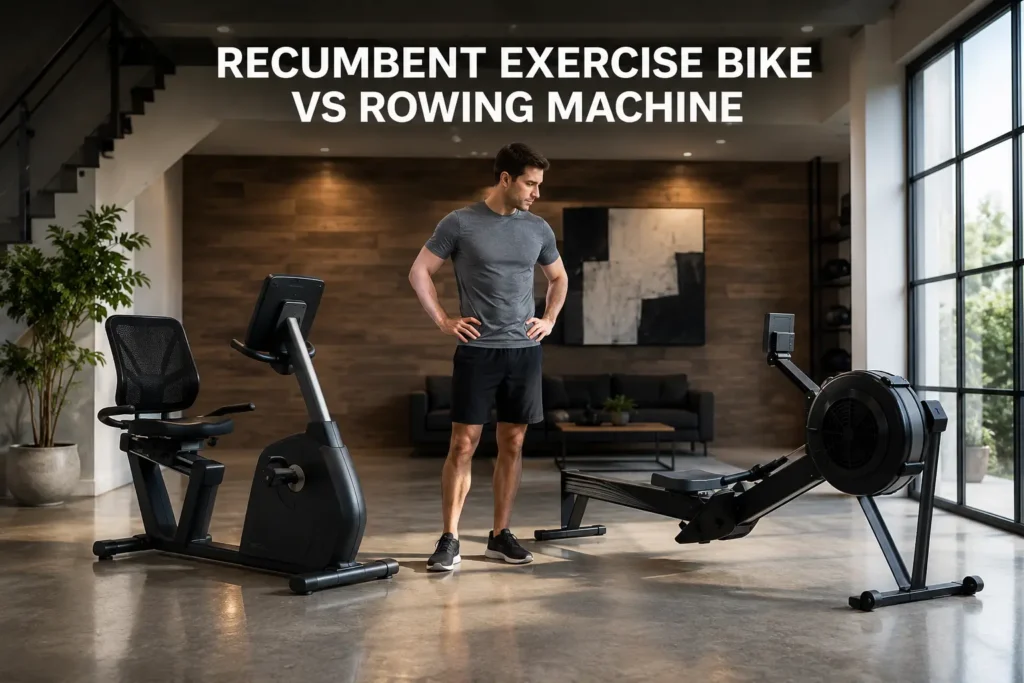
The recumbent exercise bike vs rowing machine debate comes down to more than calorie counts. Both machines deliver real cardiovascular benefits through completely different movement patterns, and the right choice depends heavily on your physical condition, goals, and which machine you will actually use. A recumbent bike pedals your lower body from a reclined, supported seat. A rowing machine drives coordinated full-body pulls through your legs, core, and upper body in sequence. This guide covers muscle activation, calorie burn, joint impact, and which populations benefit most from each machine.
Our rowing machine lineup covers current models across resistance types if rowing turns out to be the better fit for you.

Recumbent Exercise Bike vs Rowing Machine - A Side-by-Side Overview
The recumbent exercise bike vs rowing machine comparison starts with understanding what each machine asks your body to do. A recumbent bike positions you in a reclined seat with built-in lumbar support, driving forward pedal strokes primarily through your quads, hamstrings, and glutes. A rowing machine places you on a sliding seat, pulling a handle attached to a resistance flywheel through a four-phase stroke: legs push first, torso leans back, arms draw the handle to your lower chest, then you reverse the sequence back to the catch position.
You can browse current recumbent bikes for sale in our shop while you weigh the two formats.
These mechanics determine everything downstream - which muscles get trained, how many calories you burn per session, and which populations thrive on each option. TechFitnessLab's research into both machines revealed clear population-fit patterns that hold up across fitness levels and clinical conditions.
Feature | Recumbent Exercise Bike | Rowing Machine |
Primary muscles | Quads, hamstrings, glutes | Legs, core, back, arms |
Total body engagement | ~45% of muscle mass | ~86% of muscle mass |
Calorie burn - moderate intensity | 400-600 cal/hr | 600-800 cal/hr |
Learning curve | Minimal | Moderate (form required) |
Lower back support | Built-in via reclined seat | Requires proper technique |
Space needed | 5-6 feet | 8-9 feet |
Best suited for | Rehab, beginners, older adults | Full-body training, HIIT |
Understanding these differences is a useful starting point when evaluating the best recumbent exercise bike for your home gym setup, since recumbent models vary significantly in resistance type, seat comfort, and console features.
Muscle Activation - Full-Body Engagement vs Lower-Body Focus
This is where the recumbent exercise bike vs rowing machine comparison diverges most clearly. A peer-reviewed EMG study of trunk and lower extremity muscle activation found that recumbent cycling produces significantly lower quadriceps activation - approximately 16% of maximum voluntary contraction - compared to other cardio equipment (1). The reclined seat offloads your spine entirely and removes almost all upper-body recruitment from the movement.
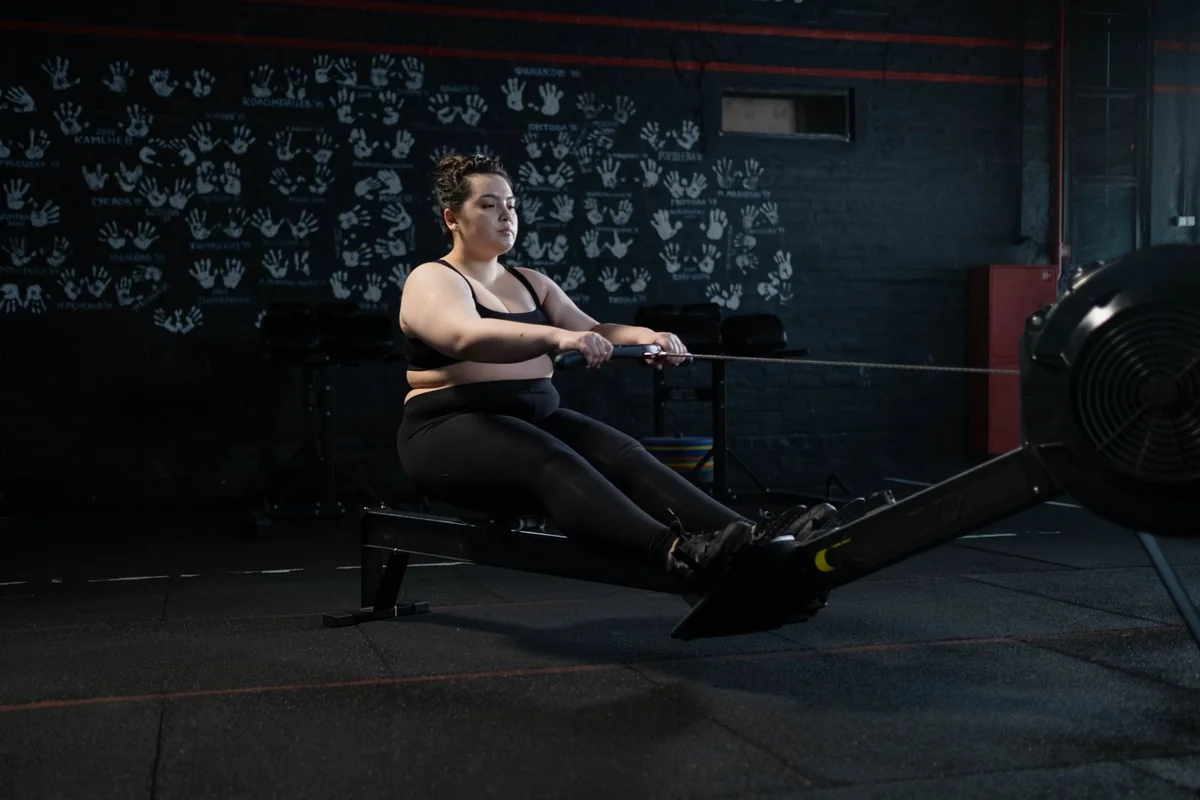
Rowing engages a fundamentally different movement chain. Research examining cardio-respiratory and electromyographic responses to ergometer rowing found that rowing simultaneously activates eight distinct muscle groups - trapezius, latissimus dorsi, biceps brachii, quadriceps, hamstrings, tibialis anterior, vastus medialis, and vastus lateralis (2). The rowing stroke captures approximately 86% of total body musculature, making it one of the most efficient total-body exercises available on a single piece of equipment.
Rowing Machine - Muscles by Stroke Phase Contribution
- Legs - quads, hamstrings, calves: approximately 60% of total stroke effort
- Core - spinal erectors, abdominals, obliques: approximately 30% of total stroke effort
- Upper body - lats, biceps brachii, rhomboids, trapezius: approximately 10% of total stroke effort
Recumbent Bike - Primary Muscles Worked
- Quadriceps (front thighs): primary driver through the push-down phase
- Hamstrings (back thighs): significant secondary activation
- Gluteus maximus and medius: active through hip extension
- Calves (gastrocnemius and soleus): moderate pedal support
- Core and upper body: minimal activation
I noticed in reviewing the research that recumbent bikes consistently underperform rowing in upper-body development - but framing it that way misses the point for many exercisers. For lower-body rehabilitation, joint-sparing leg conditioning, or maintaining aerobic fitness after injury, the bike's targeted isolation is precisely the advantage.
Riders whose rehabilitation involves the knee specifically will find my guide on exercise bike and knee pain a complete clinical reference for setup, progressions, and warning signs.
Understanding muscles an exercise bike works helps clarify why each machine serves different training goals rather than competing for the same objective.
Calorie Burn - Which Machine Generates More Calories Per Hour
In the recumbent exercise bike vs rowing machine comparison, a rowing machine holds a consistent calorie-burning edge at every intensity level. At moderate effort, rowing generates approximately 600-800 calories per hour, while a recumbent bike produces 400-600 calories per hour under comparable conditions. The gap narrows at low intensities and widens significantly at vigorous effort.
For riders who want to maximize that vigorous-effort output on the bike, my guide on HIIT on exercise bike covers interval structures, resistance settings, and the work-to-rest ratios that drive the strongest cardiovascular adaptations.

A frequently asked question is how many minutes on a recumbent bike equals 10,000 steps. At a moderate pedaling pace of 70-80 RPM with light-to-moderate resistance, roughly 50-70 minutes on a recumbent bike provides a cardiovascular stimulus comparable to 10,000 walking steps - though the comparison is imprecise because steps measure impact-based movement while cycling is entirely non-impact.
Intensity Level | Recumbent Bike (cal/hr) | Rowing Machine (cal/hr) |
Light (low resistance) | 250-350 | 300-400 |
Moderate (sustained effort) | 400-600 | 600-800 |
Vigorous (intervals or high resistance) | 600-700 | 800-900+ |
Estimates are for a 155-lb person. Actual burn varies with body weight, resistance level, and individual effort.
Rowing also produces higher post-workout calorie burn through greater excess post-exercise oxygen consumption (EPOC), because more total muscle mass was recruited during the session. For time-limited exercisers who want maximum calorie output per minute, a rowing machine delivers. That said, many users report significantly longer recumbent bike sessions because the comfortable, reclined posture lets them watch TV or read while pedaling - and a 60-minute moderate-effort bike session routinely produces more total caloric output than a 25-minute rowing session cut short by fatigue.
Riders looking to maximize caloric output from their bike time will find structured HIIT and steady-state formats, session durations, and a progressive timeline in my cycling workout plan to lose weight.
For a head-to-head look at how rowing stacks up against standard upright cycling specifically, my cycling vs rowing guide covers the full performance comparison.
For a focused look at how rowing's calorie output and EPOC advantage translate into actual fat loss results over structured programs, my guide on rowing machine good for weight loss covers the realistic 8-12 week timeline.
When evaluating the best exercise bike for home use, session duration tolerance is one of the most underrated factors in equipment selection.
Joint Impact - Which Machine Protects Your Body Better
Both machines are low-impact cardio options, meaning neither involves the repetitive joint loading of running, jumping, or stair climbing. This distinction is central to the recumbent exercise bike vs rowing machine decision for anyone managing joint pain, recovering from surgery, or building aerobic capacity while reducing orthopedic stress.

A recumbent bike's reclined seat design provides inherent lumbar support without any technique requirement. The backrest distributes spinal loading across the seat structure, which makes it one of the most joint-friendly cardio options in any gym or home setting. Rehab facilities report lower injury rates on recumbent bikes compared to treadmills and rowing machines - this pattern holds because the equipment itself enforces a supported, safe posture throughout every session.
Rowing requires proper form to protect your lower back. The most common injury pattern is lumbar rounding at the catch position - knees bent, handle extended forward, about to push - which concentrates compressive force on lumbar discs. Rowers with solid technique experience minimal back issues. Rowers with poor form frequently develop lower-back strain, and the form barrier is very real for beginners who have never been guided through the stroke sequence.
For a full breakdown of which back conditions are compatible with rowing and which are not, my guide on is rowing bad for your back covers the evidence by condition type and identifies the form errors that account for most rowing-related lumbar injuries.
Buyers new to rowing who want a machine with built-in structure and a form-friendly resistance system will find seven options reviewed in our guide to rowing machines for beginners.
Signs a recumbent bike is the better joint-safety choice:
- Existing lumbar disc problems or chronic lower-back pain
- History of knee replacement, hip surgery, or hip labrum issues
- Osteoporosis or low bone density, where fall risk and repetitive loading matter
- Any condition where an unsupported seated position causes discomfort or pain
For those specifically researching the best exercise bike for back problems, recumbent designs consistently outperform upright bikes and rowing machines for lumbar protection because the backrest actively supports your spine through the full pedaling motion.
For those with osteoporosis or low bone density who are specifically evaluating rowing, where spinal loading is an advantage rather than a risk, my guide on rowing machine for osteoporosis covers how to approach the distinction safely.
Comparing the recumbent bike vs upright on joint comfort follows similar logic - recumbent models win on spinal support for most clinical populations, while upright bikes require less floor space and offer a more natural posture for people without spinal issues.
For a full breakdown of how all four main stationary bike formats compare on joint impact, calorie burn, and riding feel, my guide to stationary bike types and differences covers what separates upright, recumbent, spin, and air bikes in practical use.
Cardiovascular Benefits - What the Research Tells Us
Both the recumbent exercise bike and rowing machine produce meaningful cardiovascular improvements with consistent use, but the mechanisms and magnitudes differ. A direct comparison study found that rowing increases stroke volume and cardiac output to a significantly greater extent than cycling at equivalent workloads (3). For exercisers focused on maximizing VO2max gains or cardiac efficiency, rowing holds a measurable physiological edge. For the full breakdown of the cardiovascular evidence behind rowing, including VO2 improvements, stroke volume data, and timeline for visible adaptation, my rowing machine benefits breakdown covers the research in depth.
For clinical populations, recumbent cycling has strong evidence of cardiovascular safety. Research in patients with coronary artery disease confirmed that recumbent cycle ergometry produces comparable heart rate, oxygen consumption, and rate-pressure product responses to upright cycling - establishing it as a safe and interchangeable exercise prescription option for cardiac patients (4). A 12-week rowing intervention in adults with spinal cord injury increased peak oxygen consumption by 16% and peak power output by 27% (5), demonstrating that rowing drives substantial cardiovascular adaptation even in populations with limited lower-body function.
In our evaluation of the cardiovascular literature for the recumbent exercise bike vs rowing machine topic, I weighted the cardiac safety evidence heavily when developing population-fit recommendations. The research pattern is consistent: rowing is better for healthy adults chasing higher fitness ceilings, while recumbent cycling is the safer starting point for anyone managing cardiac conditions or returning from extended inactivity.
Key cardiovascular takeaways from the evidence:
- Rowing produces greater stroke volume and cardiac output improvements per session
- Recumbent cycling is the safer choice for people with existing cardiac conditions
- Both machines reliably improve aerobic endurance, VO2max, and resting heart rate with consistent use
- Time spent in your target heart rate zone matters more than the machine choice for cardiovascular benefit
If you are building a home gym around low-impact cardio options, a recumbent bike pairs well with other space-efficient equipment. Our best folding treadmill guide covers space-saving walking and running options that complement recumbent biking without overlapping muscle patterns excessively.
My guide on why exercise bikes are good for weight management covers the calorie burn, cardiovascular, and metabolic evidence for stationary cycling across different training approaches.
Who Should Choose the Recumbent Exercise Bike vs. the Rowing Machine
Our research across both machines produced clear population-fit patterns that hold up across fitness levels and health conditions - I would summarize them this way: the recumbent bike removes barriers, the rowing machine raises the ceiling. For the anatomical detail behind that ceiling, our guide on muscles a rowing machine works covers the full posterior chain activation that makes rowing such a demanding full-body stimulus.
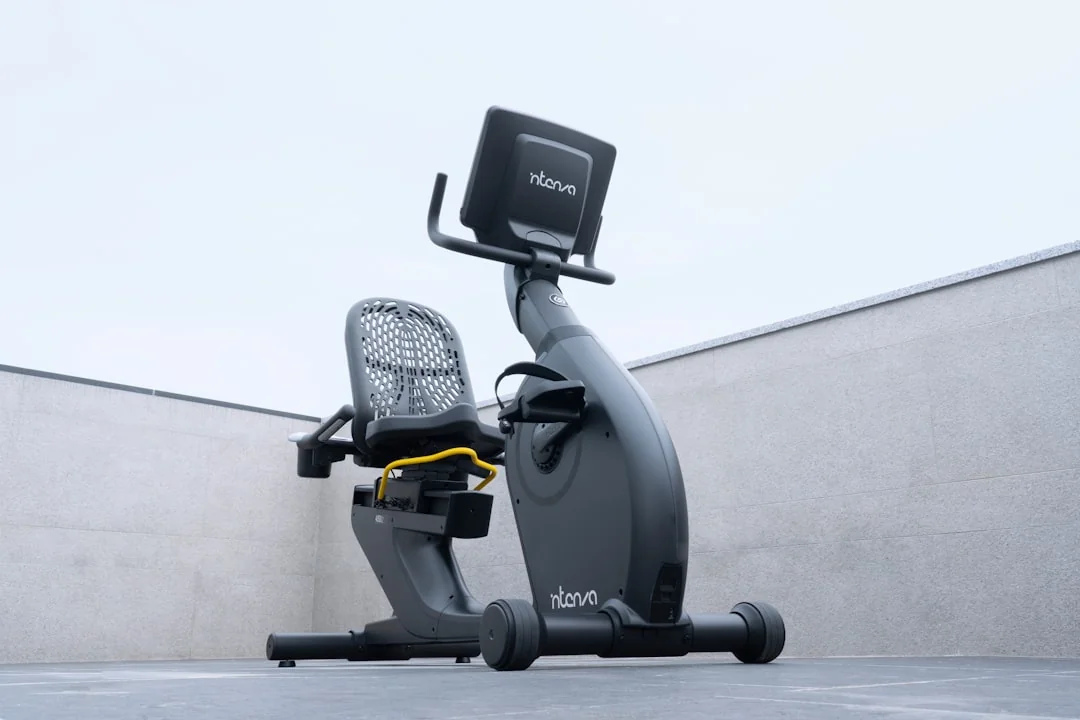
Choose a recumbent exercise bike if you:
- Have lower back pain, herniated discs, hip problems, or knee instability
- Are recovering from injury and need supported cardiovascular exercise
- Are an older adult seeking accessible, daily-use cardio without balance demands
- Want to exercise while reading, watching television, or working on a laptop
- Have limited floor space (5-6 feet vs 8-9 feet for a rower)
- Prefer immediate accessibility without learning a new stroke technique
- Have Parkinson's disease - recumbent bikes operated at high cadence are clinically validated
Choose a rowing machine if you:
- Want full-body muscle engagement and upper-body conditioning alongside cardiovascular work
- Prioritize calorie burn efficiency per session minute
- Are injury-free and willing to invest time in learning proper rowing form
- Have a dedicated 8-9 feet of floor space available
- Enjoy interval training and higher perceived effort sessions
- Want to build strength and endurance across multiple muscle groups simultaneously
Parkinson's Disease - A Critical Evidence-Based Note
For people managing Parkinson's disease, the recumbent exercise bike is the supported clinical choice. A 6-week intervention study found that high-speed, low-resistance recumbent cycling produced significant improvements in motor function, mobility, balance, and manual dexterity in participants with mild-to-moderate Parkinson's disease within six weeks of twice-weekly sessions (6).
Specialized motorized forced-exercise bikes like Theracycle or MOTOmed - designed to maintain pedaling speed at 80+ RPM independent of leg strength - have the strongest clinical backing, while standard recumbent bikes with smooth magnetic resistance systems are a practical and accessible starting point for most people.
If a folding format is on your shortlist, my post on whether folding exercise bikes are a practical home training tool covers the stability, resistance, and durability trade-offs that determine whether the convenience is worth the compromise.
For those unfamiliar with what separates a performance rowing ergometer from a standard home rower, my breakdown of what the erg machine actually is covers the resistance mechanism, monitor precision, and build standards that define the category.
Questions about what a recumbent exercise bike is in a clinical context are particularly relevant here: broadly defined as a pedaled exercise device with a reclined seat and backrest, the research consistently validates it as an effective, low-risk cardiovascular tool for populations ranging from healthy adults to patients with neurological conditions.
Heart Failure Considerations
For heart failure patients, rowing is appropriate only with explicit cardiologist clearance and careful heart rate monitoring during every session. The cardiovascular demand of rowing significantly exceeds that of recumbent biking at comparable perceived effort, making the bike the safer progressive starting point for cardiac rehabilitation. Exercise bikes for seniors managing cardiac conditions typically feature a stable step-through frame, wide handlebars for balance support, and a heart rate monitor display built into the handlebars.
User Profile | Recommended Machine | Primary Reason |
Chronic lower back pain | Recumbent bike | Built-in lumbar support, no technique barrier |
Seniors (65+) | Recumbent bike | No form requirement, low fall risk |
Parkinson's disease | Recumbent bike (high-cadence) | Clinically validated motor function improvements |
Beginners | Recumbent bike | Zero technique barrier, immediate comfort |
Athletes or advanced exercisers | Rowing machine | Full-body engagement, higher intensity ceiling |
Time-limited exercisers | Rowing machine | Higher calorie output per session minute |
Apartment or small-space users | Recumbent bike | Smaller footprint (5-6 feet vs 8-9 feet) |
Heart failure (with cardiologist clearance) | Recumbent bike | Lower cardiovascular demand, safer progression |
Choosing the Right Machine for Your Fitness Goals
The recumbent exercise bike vs rowing machine comparison ultimately comes down to one honest question: which machine will you use week after week? Our research consistently shows that superior objective metrics deliver zero benefit if the equipment goes unused. I found in reviewing user adherence patterns that recumbent bikes win on long-term consistency for most recreational exercisers because the comfort and multitasking ability remove the biggest friction points to showing up.
Riders who commit to the recumbent bike long-term often want to understand their actual energy expenditure; my guide on calories burned on a stationary bike covers output by intensity, body weight, and session length.
For readers who cannot decide, the Stamina Conversion II Recumbent Bike switches between a bike, a rower, and an arm exerciser in one folding frame.
If resistance type is part of what makes a bike easy to use consistently, my guide on how a magnetic exercise bike works covers the flywheel mechanism, noise profile, and maintenance differences that make magnetic systems the preferred choice for most home setups.
For readers who have narrowed it to the rowing machine and want a focused decision framework, my post on whether a rowing machine suits your home covers the space, budget, and skill curve factors in detail.
If the recumbent bike is the right direction, my guide on choosing an exercise bike covers every practical decision point from resistance type to seat geometry and budget range.
For buyers who want to understand the full price landscape before settling on a type, my guide on what a stationary bike costs covers recumbent, upright, and spin bike pricing across every quality tier.
For recumbent bike users who prefer wrist-free tracking, my ankle-mounted fitness tracker guide covers purpose-built options that clip to footwear for reliable step and activity monitoring.
For those who choose rowing, our guide on how to use a rowing machine correctly covers the technique fundamentals that determine whether rowing becomes sustainable from the first session.
Buyers who have settled on rowing but are working within a limited budget can find five reviewed options in our guide to the top budget rowing machines in this category.
For anyone seriously weighing both options, the best recumbent exercise bike for home use offers a lower barrier to entry, meaningful cardiovascular results at 30-45 minutes of moderate daily use, and a joint-friendly design that works for nearly every body type. The best exercise bike for back problems will nearly always be a recumbent design for people managing lumbar conditions. Compact folding exercise bikes also offer compact storage options for smaller spaces, with several recumbent models designed to fold vertically.
I recommend thinking about it this way: if you already lift weights and want upper-body cardio volume you are not getting from resistance training, a rowing machine fills a genuine gap. If cardio consistency is your primary challenge and comfort is the barrier, a recumbent exercise bike removes the obstacles. Reorganizing a home gym to accommodate a larger rowing machine also takes practical planning - our treadmill disassembly and equipment-handling guide covers the hands-on side of moving and repositioning home gym equipment.
For those curious about how a magnetic resistance exercise bike works: magnetic resistance uses opposing magnets to create frictionless, near-silent resistance that adjusts smoothly without mechanical wear. It is the system most recommended for older adults and rehabilitation users because resistance changes are gradual, and the drive train requires minimal maintenance over the life of the machine.
Buyers who decide rowing is the right modality and want that low-maintenance magnetic resistance system can compare options in our dedicated magnetic rowing machine guide.
FAQs
Which is better, a rowing machine or a recumbent bike?
The question of which is better between a rowing machine and a recumbent bike depends entirely on your goals, physical condition, and which machine you will use consistently. A rowing machine activates approximately 86% of total body musculature and burns more calories per session hour, while the recumbent exercise bike vs rowing machine comparison on joint impact and accessibility clearly favors the bike for people with lower back problems, limited mobility, or active injury recovery.
Riders whose primary goal is fat reduction around the midsection will find my guide on exercise bike fat loss research a comprehensive breakdown of what the clinical evidence shows.
Riders who have settled on the exercise bike and want to understand what to expect in the first 30 days will find my exercise bike transformation timeline guide a useful reference.
How many minutes on a recumbent bike equals 10,000 steps?
Approximately 50-70 minutes on a recumbent bike at a moderate pace of 70-80 RPM with light-to-moderate resistance provides a cardiovascular stimulus roughly comparable to 10,000 walking steps. The comparison is imprecise because steps count impact-based movement while cycling is entirely non-impact, meaning the cardiovascular benefit is similar, but the step-based measurement does not translate directly between the two activities.
Riders who want to calibrate that cardiovascular stimulus against precise intensity targets will find my guide on heart rate zones for stationary cycling a complete framework for structuring effort across either machine.
What is the best exercise bike for Parkinson’s disease?
The best exercise bike for Parkinson's disease is a high-cadence recumbent model, with research demonstrating that fast-pedaling, low-resistance recumbent cycling significantly improves motor function, balance, and mobility within six weeks of twice-weekly sessions. Specialized motorized forced-exercise bikes like Theracycle or MOTOmed - designed to maintain 80+ RPM cadence independent of leg strength - have the strongest clinical backing, while standard recumbent bikes with smooth magnetic resistance are a practical and accessible starting point for most people managing the condition.
Is rowing good for heart failure?
Rowing is appropriate for heart failure patients only with a cardiologist's explicit approval and careful heart rate monitoring during every session, because the cardiovascular demand of rowing significantly exceeds that of recumbent biking at comparable perceived effort. Most cardiac rehabilitation programs begin heart failure patients on recumbent bikes or upright cycles at low intensity before advancing to higher-demand modalities, and many patients benefit more from the lower cardiovascular load of consistent recumbent exercise over the long term.
For a full breakdown of the best rowing machines tested across resistance types, my best rowing machine guide covers 11 options — useful context if you have decided rowing is the right modality for your setup.
References:
- Bouillon L, Baker R, Gibson C, Kearney A, Busemeyer T. Comparison of trunk and lower extremity muscle activity among four stationary equipment devices: Upright bike, recumbent bike, treadmill, and ElliptiGO. Int J Sports Phys Ther. 2016;11(2):190-200.
- Bazzucchi I, Sbriccoli P, Nicolò A, Passerini A, Quinzi F, Felici F, Sacchetti M. Cardio-respiratory and electromyographic responses to ergometer and on-water rowing in elite rowers. Eur J Appl Physiol. 2013;113(5):1271-1277. doi:10.1007/s00421-012-2550-2.
- Horn P, Ostadal P, Ostadal B. Rowing increases stroke volume and cardiac output to a greater extent than cycling. Physiol Res. 2015;64(2):203-207. doi:10.33549/physiolres.932853.
- Bonzheim SC, Franklin BA, DeWitt C, Marks C, Goslin B, Jarski R, Dann S. Physiologic responses to recumbent versus upright cycle ergometry, and implications for exercise prescription in patients with coronary artery disease. Am J Cardiol. 1992;69(1):40-44. doi:10.1016/0002-9149(92)90673-M.
- Hansen RK, Samani A, Laessoe U, et al. Rowing exercise increases cardiorespiratory fitness and brachial artery diameter but not traditional cardiometabolic risk factors in spinal cord-injured humans. Eur J Appl Physiol. 2023;123(6):1241-1255. doi:10.1007/s00421-023-05146-y.
- Uygur M, Bellumori M, Knight CA. Effects of a low-resistance, interval bicycling intervention in Parkinson's disease. Physiother Theory Pract. 2017;33(12):897-904. doi:10.1080/09593985.2017.1359868.