
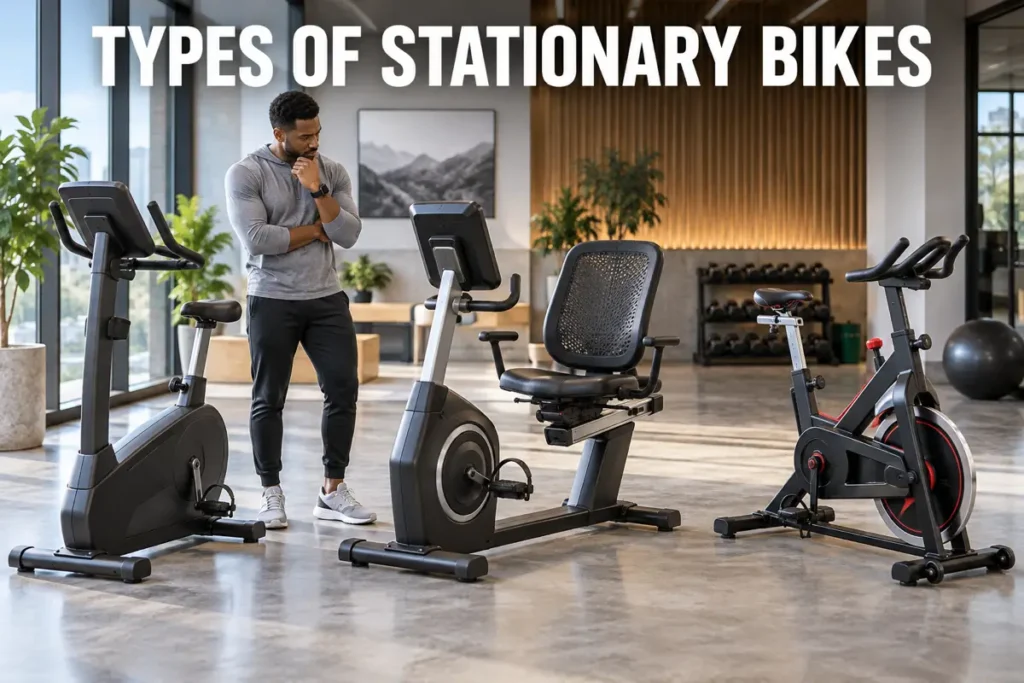
The main types of stationary bikes are the upright, the recumbent, the spin (indoor cycling) bike and the air (fan) bike, with folding bikes as a space-saving version. Pick an upright for general fitness, a recumbent for a backrest and an easy seat, a spin bike for hard cycling-style rides, and an air bike for all-out arms-and-legs conditioning.
The types of stationary bikes differ in how you sit, how the bike makes its resistance and how hard it lets you push. The four main designs are the upright, the recumbent, the indoor cycling (spin) bike and the air (fan) bike, and folding bikes are a space-saving version. Below is what defines each type, what lab studies measured when they compared them, where each type falls short and which one I would pick for your situation.
Types of Stationary Bikes Explained by Design and Purpose
The four main categories are the upright bike, the recumbent bike, the spin bike (also called an indoor cycling bike) and the air bike (also called a fan bike). These are the different types of exercise bikes you'll meet in gyms and home setups, and a folding bike is a compact frame that folds away between rides. A stationary bike is also called an exercise bike, or a cycle ergometer in a lab. Each type is defined by its riding position, its resistance system and the effort it is built for.
Upright Bikes for Everyday Cardio
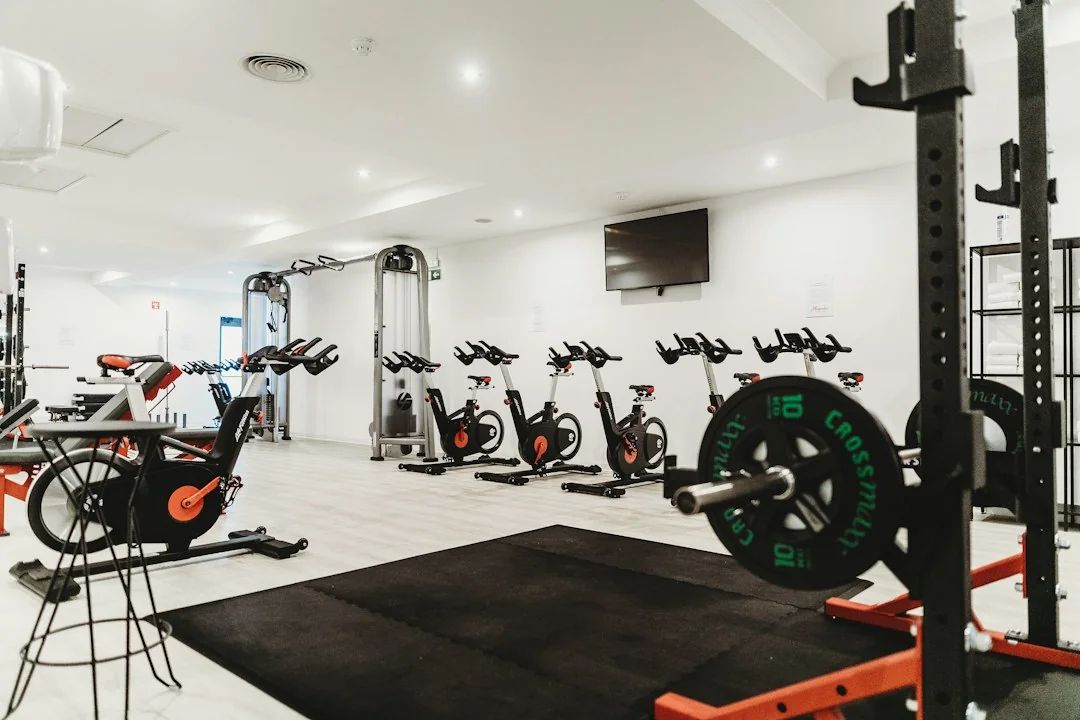
The upright bike, or upright stationary bicycle, is the closest of the types of stationary bikes to an ordinary bike. It sits you over the pedals with your torso tilted slightly forward, your weight on the saddle and your hands on the handlebars, in a posture close to a road bike's.
Upright bikes differ in how they make resistance, so read the maker's wording for the exact model. Schwinn's 130 Upright lists 16 magnetic resistance levels and its 190 Upright lists 25 (1). On a magnetic bike, a level sets how strongly the magnets act on the spinning flywheel, and magnetic drag rises with speed and falls to zero when the motion stops (2), so the same level feels harder when you pedal faster.
Comparing resistance levels across bike types or brands. A level is a step on one bike's own scale, so level 8 on a magnetic upright says nothing about level 8 on a spin bike; judge the effort by how hard it feels, or by watts if the console shows them.
Who benefits most from an upright bike:
- Beginners building their first cardio base
- Riders who want a familiar, road-bike-like riding position
- People training at low to moderate intensity several times per week
- Those with limited floor space who want a standard stationary bike
The main limitation of an upright bike is the seat. There is no backrest, and your weight rests on a small saddle, so in my view seat comfort decides whether an upright suits you on long rides. If the stock saddle bothers you, try a wider saddle or a padded cover first.
Recumbent Bikes for Full Support and Low-Impact Training
The recumbent bike seats you in a reclined position with a full backrest and a wide bucket seat. Pedals sit out in front of the body rather than beneath it, distributing your body weight across the seat and backrest rather than concentrating it on a narrow saddle.
Which is better, upright or recumbent exercise bike? When you weigh a recumbent exercise bike against the standard upright design, the recumbent versus upright decision comes down to comfort against peak output. The upright reached higher peak power, oxygen uptake and heart rate in 18 healthy adults (mean age 47, 10 women) tested to exhaustion on both (3), and its frame is often shorter: Schwinn's 130 Upright is 41.3 inches long against 64 inches for its 230 Recumbent (1).
Muscle use is closer than the seat suggests. In 10 men who were not cyclists, leg-muscle activity did not differ significantly between a recumbent and an upright ergometer at a moderate load (4). In 12 recreationally active adults riding for 2 minutes at a moderate effort, the outer calf (lateral gastrocnemius) was most active on the upright bike, while the glutes, a hamstring (biceps femoris) and the trunk muscles worked at similar, low to moderate levels on both (5).
Who benefits most from a recumbent bike:
- Riders who want back support, including people with back or knee conditions once a doctor or physical therapist agrees
- Older adults who find it hard to swing a leg over a saddle
- Riders who want long, easy sessions in a supported seat
- Anyone returning after a lower-body injury, once their clinician has approved the bike
Some recumbents have a step-through frame, a low entry point you walk into instead of swinging a leg over, which makes getting on easier for people with limited hip mobility. Recumbent bikes often take more floor length, so compare the exact models: Schwinn's 290 Recumbent is 66.4 inches long against 47 inches for its 190 Upright (1). For all-out efforts the upright has the edge on peak power (3), but in my view that trade matters little to riders who pick a recumbent for comfort. The best recumbent exercise bikes guide compares models, and the Schwinn 230 Recumbent Bike has its own page.
Spin Bikes for Performance-Focused Indoor Cycling
Spin bikes are built for hard riding: a forward lean like a road racing bike, and room to stand on the pedals for climbs and sprints. The flywheel and the brake differ by model. Schwinn's IC3 uses a felt friction pad on a 40 lb perimeter-weighted flywheel, while its IC4 uses a magnetic eddy current brake with 100 levels of micro-adjustment and states no flywheel weight (1).
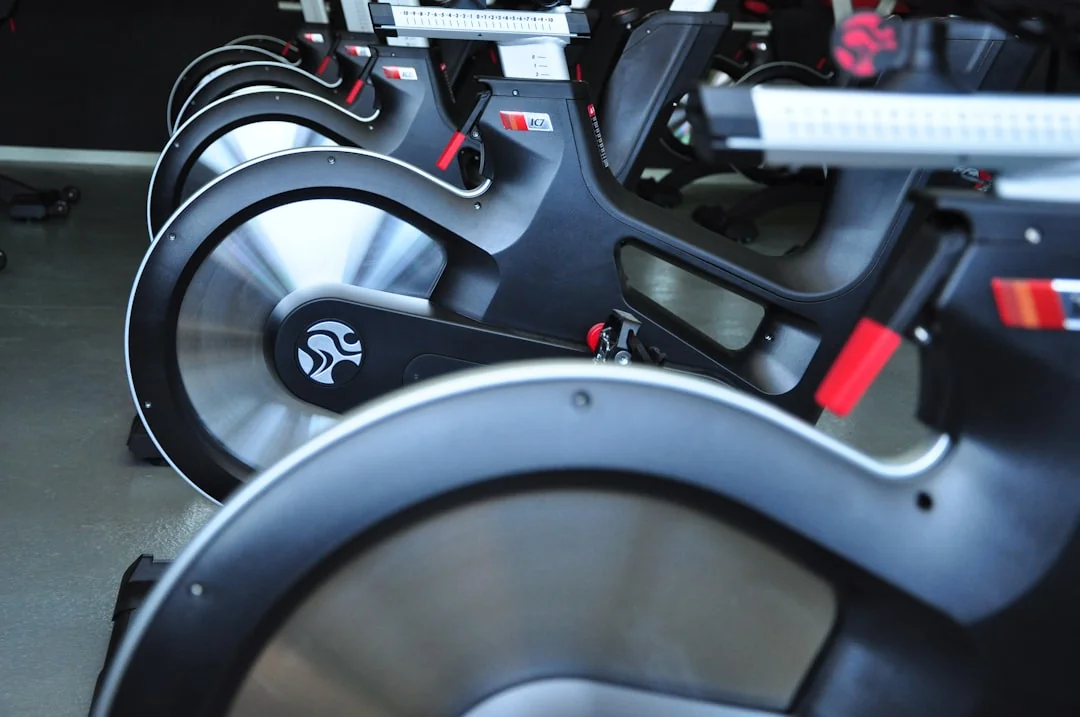
The difference between a spin bike and a standard upright exercise bike comes down to riding position, standing room and how hard you can push. In a lab study of 30 fit, experienced men aged 35 to 49, each riding one machine of each type for 12 minutes at the same very hard effort (17 on the 6 to 20 Borg scale), mean energy use was 12.45 kcal a minute on the spin bike against 11.94 on the upright, a statistically significant but small difference (6). With the stand-up position and the hard efforts it allows, spin bikes are my first choice for high-intensity bike intervals at home.
A 2019 systematic review of 13 studies with 372 participants, 306 of them women, found that indoor cycling may improve aerobic capacity, blood pressure, lipid profile and body composition, and the authors advised caution because few randomized controlled trials exist (7). In a 12-week study of 18 women aged 40 to 60 with obesity, with no control group, three supervised 55-minute indoor-cycling classes a week lowered average body weight from 95.2 to 93.0 kg and waist size from 111.7 to 106.4 cm; the women were asked to keep their usual diet (8).
Who should approach spin bikes with caution:
- Beginners: keep the first rides at an easy effort and build up over several weeks
- Riders with back pain: no study cited here measured back load on a spin bike, so ask your doctor or physical therapist whether the forward lean suits you
- Riders who cannot hold a forward lean comfortably: an upright keeps the trunk more upright and a recumbent supports it
Air Bikes With Self-Regulating Resistance for Maximum Output
Air bikes use a fan wheel instead of a magnetic or friction brake. On a model such as the AssaultBike you drive the fan with both arms and legs, and the faster the fan turns, the more work it takes (9). This self-regulating system has no level to set: resistance rises with your effort, and Schwinn describes its AirDyne AD6 and AD7 as having infinite levels of air resistance (1).
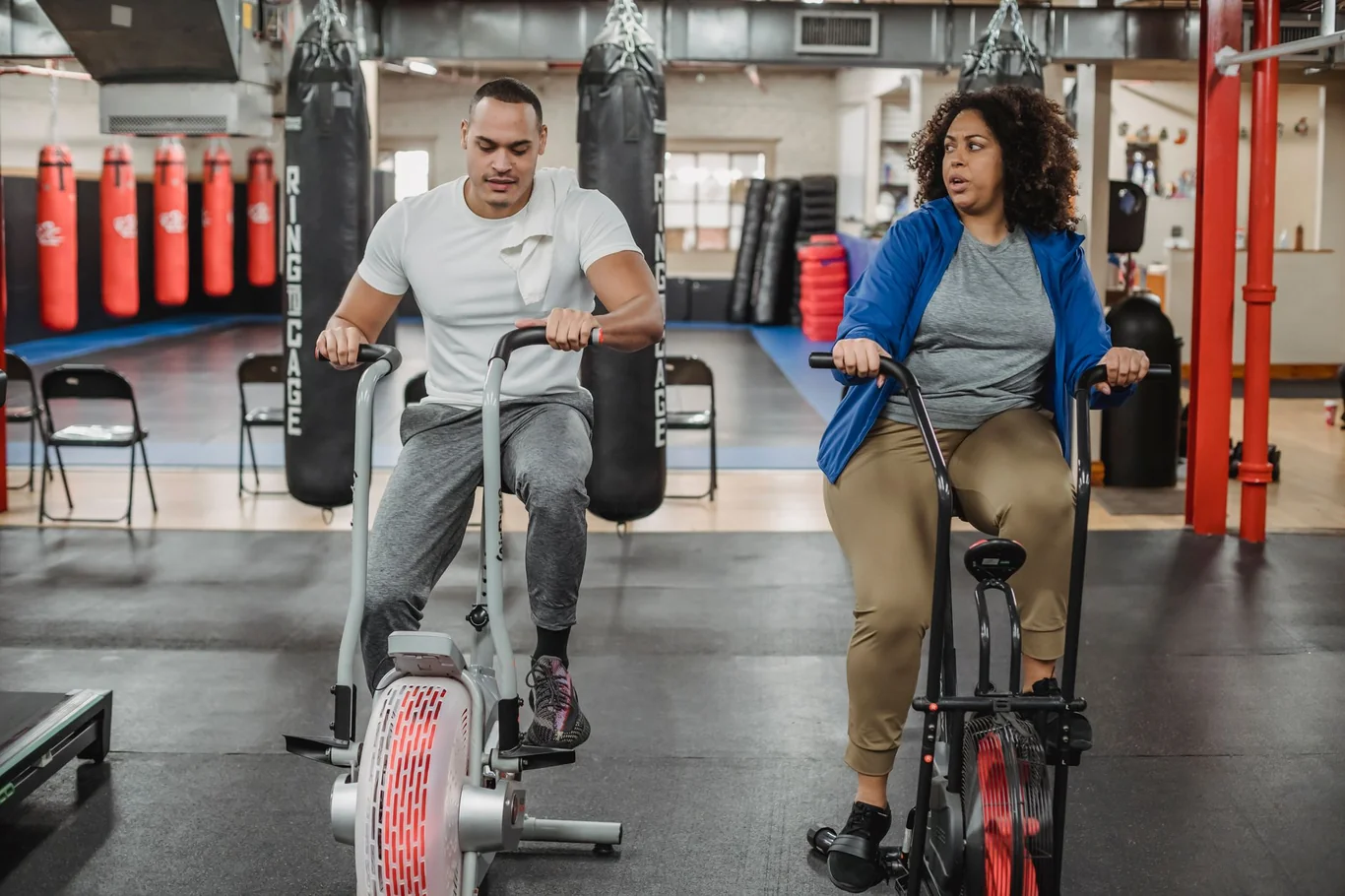
One lab study compared an air bike vs a standard upright ergometer. In 12 healthy, active young men, a staged maximal test on an AssaultBike Classic produced a higher mean VO2max (47.9 against 44.7 ml/kg/min), a higher maximum heart rate (189 against 181 beats a minute) and higher lactate after exercise than a ramp test on a standard electromagnetically braked cycle ergometer (9). The authors linked it to the arms adding work, which they did not measure directly. In my view that makes the air bike the stronger pick for full-body, all-out conditioning, not for easy rides.
Who benefits most from an air bike:
- Functional fitness and conditioning athletes
- Riders who want arms and legs working together in hard intervals
- Experienced exercisers who want interval resistance that rises with their own effort
The fan makes noise and blows air as you ride, so listen to one running before you buy if you share walls. The frame is not small either: Schwinn's AirDyne AD6 is 49.7 inches long and weighs 115 lb, against 41.3 inches and 58.4 lb for its 130 Upright (1).
How the Four Types of Stationary Bikes Compare
The table below sets all four types side by side. The length column uses one Schwinn model of each type as an example, so compare the exact models you are considering. The energy column comes from the lab study of 30 men described above, which did not include an air bike (shown as a dash).
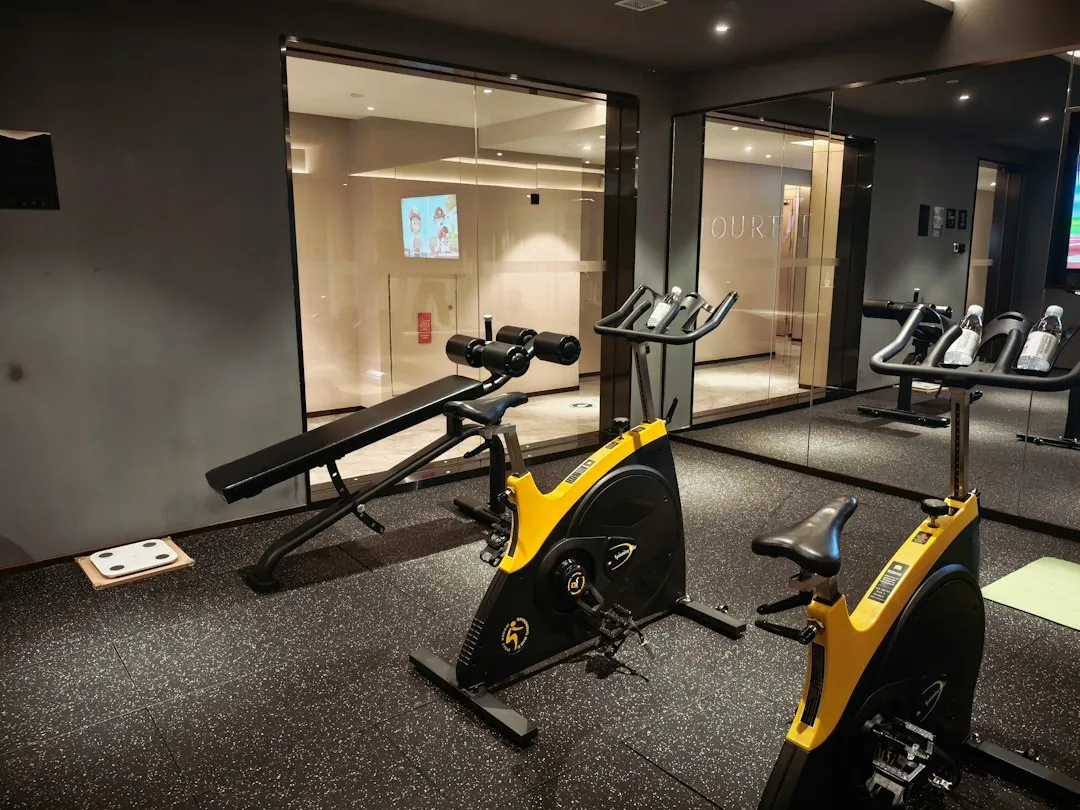
| Bike Type | Resistance System | Riding Position | Example Length (Schwinn) | Energy at Very Hard Effort (30 Men) |
|---|---|---|---|---|
| Upright | Varies; magnetic on Schwinn's models | Seated over the pedals, slight lean | 41.3 in (130 Upright) | 11.94 kcal a minute |
| Recumbent | Varies; magnetic on Schwinn's models | Reclined, back supported | 64 in (230 Recumbent) | 11.07 kcal a minute |
| Spin | Friction pad or magnetic brake | Forward lean, can stand | 54.6 in (IC4) | 12.45 kcal a minute |
| Air bike | Fan (air resistance) | Seated, arms and legs drive the fan | 49.7 in (AirDyne AD6) | - |
Calorie Burn by Bike Type
Calorie burn depends on effort, body weight and session length. In the lab study of 30 fit, experienced men above, the spin bike used the most energy of the three bike types at the same very hard effort and the recumbent the least (6). It used one model of each type, so read it as a lab tendency.
For estimates at home, the 2024 Compendium of Physical Activities lists stationary cycling by watts and by general effort, not by upright or recumbent design (10). At a general effort, a 70 kg (155 lb) rider burns an estimated 240 kcal in 30 minutes of stationary cycling, and about 320 kcal in a 30-minute spin class. The Compendium has no code for an air bike ridden with arms and legs together; its only Airdyne entry is for the arms alone. These are estimates, not lab measurements, so do not compare them with the per-minute figures above. They use METs x body weight in kg x hours, rounded to the nearest 10 kcal.
Fat loss from stationary bike training happens across the whole body. No bike type can burn stubborn belly fat from one chosen area: six weeks of abdominal exercises five days a week did not reduce belly fat in 24 sedentary adults (11). Cycling is not a sure route to fat loss either: in a 2017 meta-analysis of 13 trials in adults aged 18 to 45 with overweight or obesity, the running programs reduced fat mass but the cycling programs did not (12). In my view, riding week after week matters more than which type you ride.
Joint Impact and Low-Impact Suitability
All types of stationary bikes are seated, so no step lands on the floor as it does in running. No study cited here measured joint load across the four types, so the points below are design differences:
- Recumbent: a backrest supports the trunk and the pedals sit in front of you; whether that lowers knee or spine load compared with an upright has not been measured
- Upright: no backrest and a small saddle; if your back or seat aches on longer rides, raise the handlebars where the bike allows or try a recumbent
- Spin: standing climbs are part of the design; if your knees or back complain, stay seated and ask a physical therapist to check your setup
- Air: the arms push and pull with every stroke, so with a shoulder problem ask your doctor or physical therapist before you ride one
Stationary Bikes vs. Bike Trainers
In the stationary bike vs trainer choice, a stationary bike is a self-contained machine; a bike trainer holds your own road or mountain bike so you can ride it in place. For road cyclists who already own a good bike, I'd lean toward a trainer, because they keep their own fit and position; for everyone else, a stationary bike is the simpler choice.
Is a Stationary Bike Better Than Walking for Cardio?
It depends on how hard you ride and walk, and a stationary bike lets you raise the effort without running. Using 2024 Compendium values for a 70 kg (155 lb) person over 30 minutes, walking at 2.8 to 3.4 mph comes to an estimated 130 kcal and brisk walking at 3.5 to 3.9 mph about 170 kcal, against about 140 kcal for stationary cycling at 50 watts, about 210 kcal at 90 to 100 watts and about 240 kcal at a general effort (10). These are estimates from METs x body weight in kg x hours, rounded to the nearest 10 kcal.
Both cycling and walking avoid the impact of running, and they work the legs differently. In 12 recreationally active adults, the shin muscle (tibialis anterior) worked harder in treadmill walking than on the recumbent bike, while the glutes, a hamstring and the trunk muscles worked at similar, low to moderate levels on all four machines tested (5).
In my view the two work best combined across the week: the bike for harder sessions and walking for easy days, since walking is simple to fit around a workday and carries your body weight, which a seated ride does not.
How to Choose Between the Different Types of Stationary Bikes
The right choice among the different kinds of exercise bikes comes down to four factors: your fitness goal, your joint health, the floor space you have and how you will store the bike. Once the type is settled, I'd check the resistance system, the console and the maximum user weight next when you choose an exercise bike. The table below is a starting point for common situations.
Judge a bike only after the seat fits. Slide a recumbent seat or raise an upright saddle a little at a time, pedal a few easy minutes after each change, and stop if a setting brings on knee pain.
Your Situation | Recommended Type |
Building base cardio as a beginner | Upright bike |
Lower back pain or knee osteoarthritis | Ask a doctor or physical therapist first |
Cycling-specific training or HIIT at home | Spin bike |
Full-body metabolic conditioning | Air bike |
Limited floor space, want folding option | Folding bike |
Older adult with limited mobility | Recumbent bike |
Off-season road cyclist | Bike trainer or spin bike |
Returning from lower-body injury | The bike your clinician approves |
Matching Your Goal to the Right Type
For cardiovascular fitness: all four types of stationary bikes give you seated aerobic exercise. A 2026 systematic review of 47 stationary bike studies in adults aged 60 and older, 28 of them randomized trials, reported significant improvements in VO2max, cycling efficiency, cognition, executive function, quality of life and mobility, each in at least five studies, and rated acceptance as moderate (13). It covers stationary bikes in general, not one type.
For weight loss: in my view effort and consistency matter more than machine type. Neither lab study above measured weight loss: in the 30 men the spin bike used the most energy per minute of the three bike types (6), and the air bike study measured peak oxygen uptake, not calories (9). Upright and recumbent bikes suit longer steady sessions. The weight-loss bike workouts I'd suggest mix both, because the sessions you can repeat every week matter more than any single hard ride.
For seniors: I'd look at a recumbent bike first for older adults who find it hard to get on a bike. It gives seated support with a backrest, and step-through models remove the need to swing a leg over a saddle. For exercise bikes for seniors, I'd weigh the height of the step-through and how easily the seat adjusts before anything else.
With a medical condition, or after an injury or surgery, check with your doctor or physical therapist before you start, and remember that no exercise bike is a treatment. The Sunny SF-RB424006 recumbent, for example, is labelled not suitable for therapeutic use (14).
Storage and Space Considerations
Upright bikes are often the shortest standard option, but compare the exact models: Schwinn's 130 Upright is 41.3 inches long and its 190 Upright 47 inches (1).
Folding bikes are the type built to be put away between rides. Limits and features differ by model: the XTERRA FB350 (2021 US manual) has a 225 lb weight limit, is for residential use only, and calls for checking the seat nuts, stabilizer bolts and handlebar before each workout (15); the ATIVAFIT Glide R8 is rated to 265 lb (16) and the pooboo X428 to 300 lb (17). If your space is truly tight, I'd look at folding exercise bikes before a full-size spin bike.
Recumbent bikes often need more floor length because of the extended frame and seat: Schwinn's 230 and 290 Recumbent are 64 and 66.4 inches long (1), and Sunny asks for at least 2 feet of free space all around its SF-RB424006 (14). Measure the floor with the seat pushed all the way back before you browse recumbent bike models, and add the clearance the maker asks for.
Spin bikes range from simple friction models to connected bikes with touchscreens and class memberships, and the resistance system differs even within one maker's range, as the Schwinn IC3 and IC4 show (1). The Echelon vs Peloton comparison covers two connected bike makers and their memberships.
Pick the type first and compare models within it; what drives stationary bike prices across the types is covered separately.
Schwinn's AirDyne AD6 and AD7 keep the electronics simple: they run a high-strength fan on a single-stage belt drive and list no app connection (1). Whatever type you pick, the guide to bike maintenance and cleaning covers belt care and troubleshooting.
The Right Type of Stationary Bike for Your Training
The types of stationary bikes serve different riders and goals. Upright bikes are the familiar all-round option, recumbent bikes add a backrest, spin bikes suit hard cycling-style training, and air bikes bring the arms in. If you are choosing between a spin bike and a standard model, the comparison of spin bikes and exercise bikes lays out the differences.
- STEP 1Start with your body With a back, hip, knee or heart condition, ask your doctor or physical therapist which position suits you.
- STEP 2Match the goal Hard intervals point to a spin or air bike; long, easy rides point to an upright or recumbent.
- STEP 3Measure the floor Take the bike's full length plus the clearance its maker asks for, or plan where a folding bike will be stored.
- STEP 4Read the limits Check the maximum user weight, the seat range and the resistance wording of the exact model.
I'd recommend most new riders start with an upright bike, unless joint pain or mobility is a concern, in which case I'd look at a recumbent first after a word with your doctor or physical therapist. For hard intervals, look at spin bikes or air bikes. The same order works when comparing the best exercise bikes for a home gym: type first, then the model.
Whichever type you choose, try one before you commit if you can. Sit on it, adjust the seat and pedal for a few minutes.
Frequently Asked Questions
What type of stationary bike is best for seniors?
In my view a recumbent bike suits most seniors who find it hard to get on a bike, because the backrest and low seat remove the need to balance once seated. A 2026 review of 47 studies in adults aged 60 and older reported improvements in fitness, mobility, cognition and quality of life with stationary bikes in general; with a health condition, check with your doctor first.
Which type of stationary bike should I choose?
Choose by your goal, your body and your floor space: an upright suits general fitness, a recumbent suits riders who want a backrest, and a spin or air bike suits hard intervals. Popularity is a poor guide, and no sales data cited here ranks the types of stationary bikes.
Is riding a stationary bike for 30 minutes as good as walking for 30 minutes?
It depends on effort: using 2024 Compendium estimates for a 70 kg (155 lb) person, 30 minutes of moderate walking comes to about 130 kcal and brisk walking about 170 kcal, against about 140 kcal for light stationary cycling at 50 watts and about 240 kcal at a general effort. A hard ride burns more per minute, but the one you do more often helps you more.
What is the best exercise bicycle for home use?
The best exercise bicycle for home use depends on your goal and your space: an upright bike suits most beginners and general fitness, a recumbent bike suits riders who want a backrest, and a spin bike suits hard or cycling-style training. Once the type is settled, compare the maximum user weight, the resistance system and the floor length of the exact models.
What are the 3 different types of stationary bikes?
The answer to what are the 3 different types of stationary bikes is the upright bike, the recumbent bike and the spin bike. The air bike is a fourth type, because a fan driven by the arms and legs makes its resistance, and folding bikes are a space-saving frame.
 Tech Fitness Lab
Author
Vanja Vukas
I founded Tech Fitness Lab and hold a master's degree from the Faculty of Sport and Physical Education in Novi Sad. I have competed in sport and coached clients, and my writing has appeared on Fitness Volt and BOXROX. I research products from their manuals, spec sheets and warranty terms, and I flag thin evidence.
This content is for informational and educational purposes only. It is not a substitute for professional medical advice, diagnosis, or treatment. Always consult with your healthcare provider before starting any new fitness program or using fitness technology for health monitoring. We are always looking for expert inputs to make our content even better and more useful.
References
- Johnson Health Tech Trading, Inc. Schwinn Fitness: compare bikes. Accessed November 20, 2026.
- Ling SJ, Moebs W, Sanny J. Eddy currents. In: University Physics Volume 2. OpenStax; 2016: section 13.5. Accessed November 20, 2026.
- Wehrle A, Waibel S, Gollhofer A, Roecker K. Power output and efficiency during supine, recumbent, and upright cycle ergometry. Front Sports Act Living. 2021;3:667564. doi:10.3389/fspor.2021.667564
- Lopes AD, Alouche SR, Hakansson N, Cohen M. Electromyography during pedaling on upright and recumbent ergometer. Int J Sports Phys Ther. 2014;9(1):76-81.
- Bouillon L, Baker R, Gibson C, Kearney A, Busemeyer T. Comparison of trunk and lower extremity muscle activity among four stationary equipment devices: upright bike, recumbent bike, treadmill, and ElliptiGO. Int J Sports Phys Ther. 2016;11(2):190-200.
- Prieto-González P, Yagin FH. Energy expenditure, oxygen consumption, and heart rate while exercising on seven different indoor cardio machines at maximum and self-selected submaximal intensity. Front Sports Act Living. 2024;6:1313886. doi:10.3389/fspor.2024.1313886
- Chavarrias M, Carlos-Vivas J, Collado-Mateo D, Pérez-Gómez J. Health benefits of indoor cycling: a systematic review. Medicina (Kaunas). 2019;55(8):452. doi:10.3390/medicina55080452
- Ratajczak M, Skrypnik D, Krutki P, Karolkiewicz J. Effects of an indoor cycling program on cardiometabolic factors in women with obesity vs. normal body weight. Int J Environ Res Public Health. 2020;17(23):8718. doi:10.3390/ijerph17238718
- Pearson RC, Garcia SA, Jenkins NT. Comparison of a ramp cycle ergometer and a staged Assault Fitness AssaultBike protocol for the assessment of VO2max. Int J Exerc Sci. 2023;16(4):613-619. doi:10.70252/RDUK7353
- Herrmann SD, Willis EA, Ainsworth BE, et al. 2024 Adult Compendium of Physical Activities: a third update of the energy costs of human activities. J Sport Health Sci. 2024;13(1):6-12. doi:10.1016/j.jshs.2023.10.010
- Vispute SS, Smith JD, LeCheminant JD, Hurley KS. The effect of abdominal exercise on abdominal fat. J Strength Cond Res. 2011;25(9):2559-2564. doi:10.1519/JSC.0b013e3181fb4a46
- Wewege M, van den Berg R, Ward RE, Keech A. The effects of high-intensity interval training vs. moderate-intensity continuous training on body composition in overweight and obese adults: a systematic review and meta-analysis. Obes Rev. 2017;18(6):635-646. doi:10.1111/obr.12532
- Akter T, Moneruzzaman M, Maduray K, Kader M. Acceptability and effectiveness of stationary bike intervention on health outcomes among older adults: a systematic review of intervention studies. BMC Geriatr. 2026;26(1):130. doi:10.1186/s12877-025-06757-0
- Sunny Health & Fitness. Corezy 16-Level Smart Magnetic Resistance Recumbent Bike With Workout Bands, SF-RB424006: User Manual. EN V1.3. January 15, 2026. Accessed November 20, 2026.
- XTERRA Fitness. FB350 Folding Bike Owner's Manual. Version FB350_VER9_20210827. 2021. Accessed November 20, 2026.
- ATIVAFIT. Ativafit Glide R8 Foldable Exercise Bike with Resistance. Product page. Accessed November 20, 2026.
- pooboo. X428 Folding Exercise Bike Indoor. Product page. Accessed November 20, 2026.