
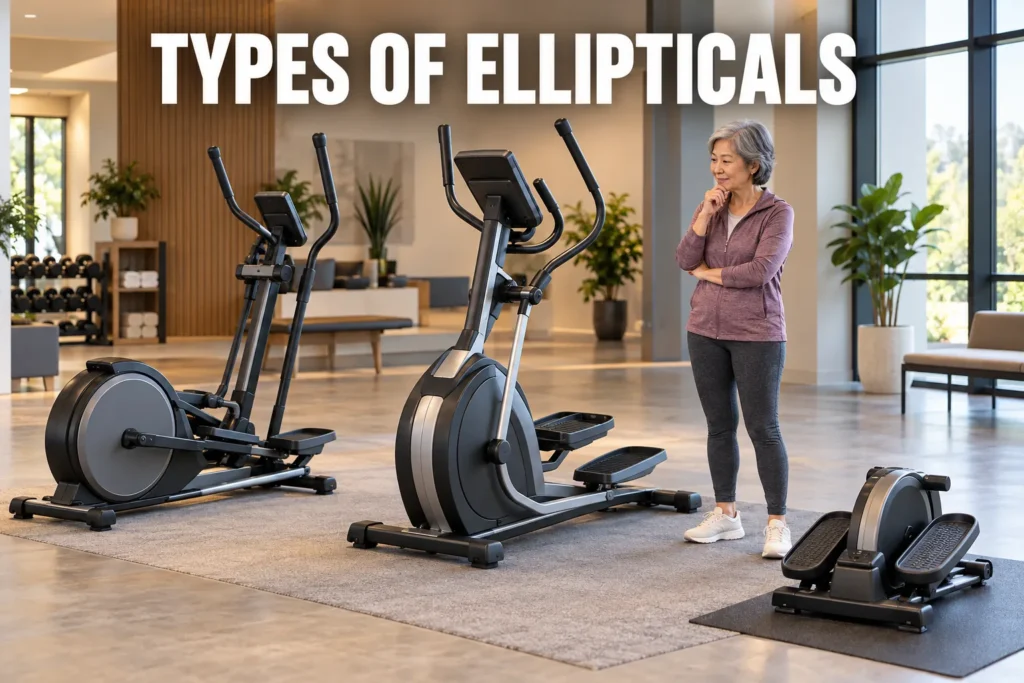
The types of ellipticals available today span everything from the classic rear-drive machine found in most gyms to seated models built for back rehabilitation. I look at every machine through joint loading first, a habit from my sports science background and competitive Brazilian Jiu-Jitsu. I have trained on rear-drive, front-drive, center-drive, and seated ellipticals across gym floors and home setups, and the differences show up within minutes: stride length, posture, and how much your core has to work all change with the type. In this guide, I break down every major type, from front, rear, and center drive to seated, standing, under-desk, and outdoor models, so you can match the machine to your actual needs. Where research exists on calorie burn, joint loading, and muscle activation, I cite it, and where the evidence is thin, I say so.

Types of Ellipticals Defined by Drive Position
The most fundamental way to categorize types of ellipticals is by where the flywheel sits. Drive position determines stride angle, foot path, and overall feel more than almost any other design variable. A machine with its flywheel at the back produces a different movement pattern than one with its flywheel at the front, even if both look similar from across the room.
Rear-Drive Ellipticals: The Original and Most Common Design
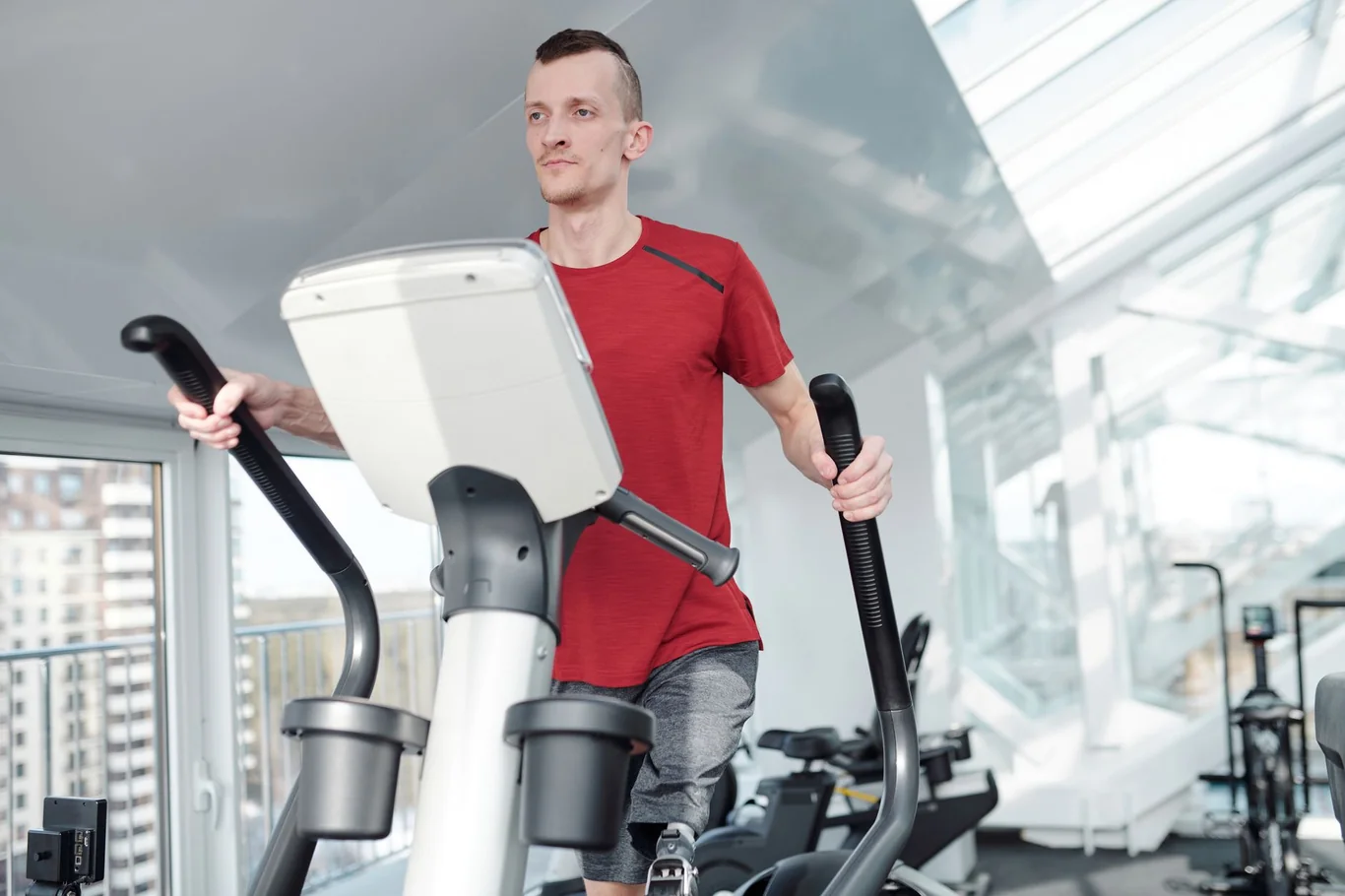
Rear-drive ellipticals place the flywheel behind the user, which creates a longer, more horizontal elliptical path. The motion closely resembles natural walking or running gait, and most users find it smoother than the alternatives. The flywheel position at the back also keeps sweat away from the drive mechanism, which extends the machine's lifespan under regular use.
Rear-drive models tend to be quieter than front-drive designs, and their longer stride accommodates taller users more comfortably. If you are over six feet tall, rear-drive is usually the better starting point. These machines typically cost more than front-drive models at the same feature level, but the stride quality difference is noticeable. Most commercial gym chains use rear-drive mechanisms because of their durability and user-friendly stride. If you have ever used the types of ellipticals at Planet Fitness or a similar large chain, you have most likely trained on a rear-drive machine.
In my own sessions, the gap is easy to feel: a rear-drive stride feels natural right away for taller users, while a short front-drive path tends to bring on the cramped-stride fatigue that cuts longer sessions short. If you plan on sessions longer than 30 minutes, I recommend testing the stride length in person before you buy.
Front-Drive Ellipticals: Compact and Budget-Friendly
Front-drive ellipticals position the flywheel at the front of the machine, which pushes the user's foot path into a more vertical oval. This upright body position requires more core engagement and feels noticeably different from rear-drive motion, especially on longer sessions. Some users describe front-drive as feeling more like stair climbing than walking.
The main advantage of front-drive is size. These machines have a smaller footprint and typically cost less, making them a practical choice for home gyms with limited space. The trade-off is that the stride can feel more cramped, particularly for taller riders whose natural gait requires a longer arc. Front-drive models are a solid entry point if budget and space are the deciding factors. My tip: stand on the pedals at the top of the stride and check whether your knee drifts well past your toes, because on a short front-drive path that is the position that loads the kneecap most.
Center-Drive Ellipticals: Balanced Stride, Compact Frame
Center-drive ellipticals use two smaller flywheels positioned on either side of the user. This design creates a symmetric, balanced stride that many users find the most natural of the three. The shorter overall frame makes center-drive machines one of the most compact full-size elliptical options, despite having a slightly wider stance than other types.
Center-drive machines tend to track well for users who feel unstable on traditional rear or front designs, partly because the flywheel placement lowers the machine's center of gravity. They are less common than rear and front-drive models but worth considering if stride smoothness and compact footprint are both priorities. Most center-drive ellipticals use magnetic resistance, which is quieter and requires less maintenance than friction-based systems, so factor that into your drive-type decision. After a 90-minute jiu-jitsu session, the lower, wider center-drive stance is the one I trust most on tired legs.
Elliptical Type | Stride Feel | Best For | Typical Footprint | Noise Level |
Rear-Drive | Long, horizontal, natural | Tall users, experienced athletes | Larger | Low |
Front-Drive | Shorter, more vertical, stair-like | Budget buyers, small spaces | Medium | Moderate |
Center-Drive | Balanced, symmetric | Stability-focused users, compact homes | Small | Low |
Comparing these three types of ellipticals side by side highlights how drive position shapes the entire workout experience, from stride feel to noise level.
Seated, Standing, and Under-Desk Elliptical Types
Beyond drive position, types of ellipticals also vary by whether the user stands upright, sits supported, or pedals from a chair. These design differences shift muscle recruitment, cardiovascular demand, and who the machine is appropriate for. Understanding the difference between a seated elliptical and a standing elliptical matters more for certain populations than drive position ever will.
Seated Ellipticals: Low-Impact Support for the Back
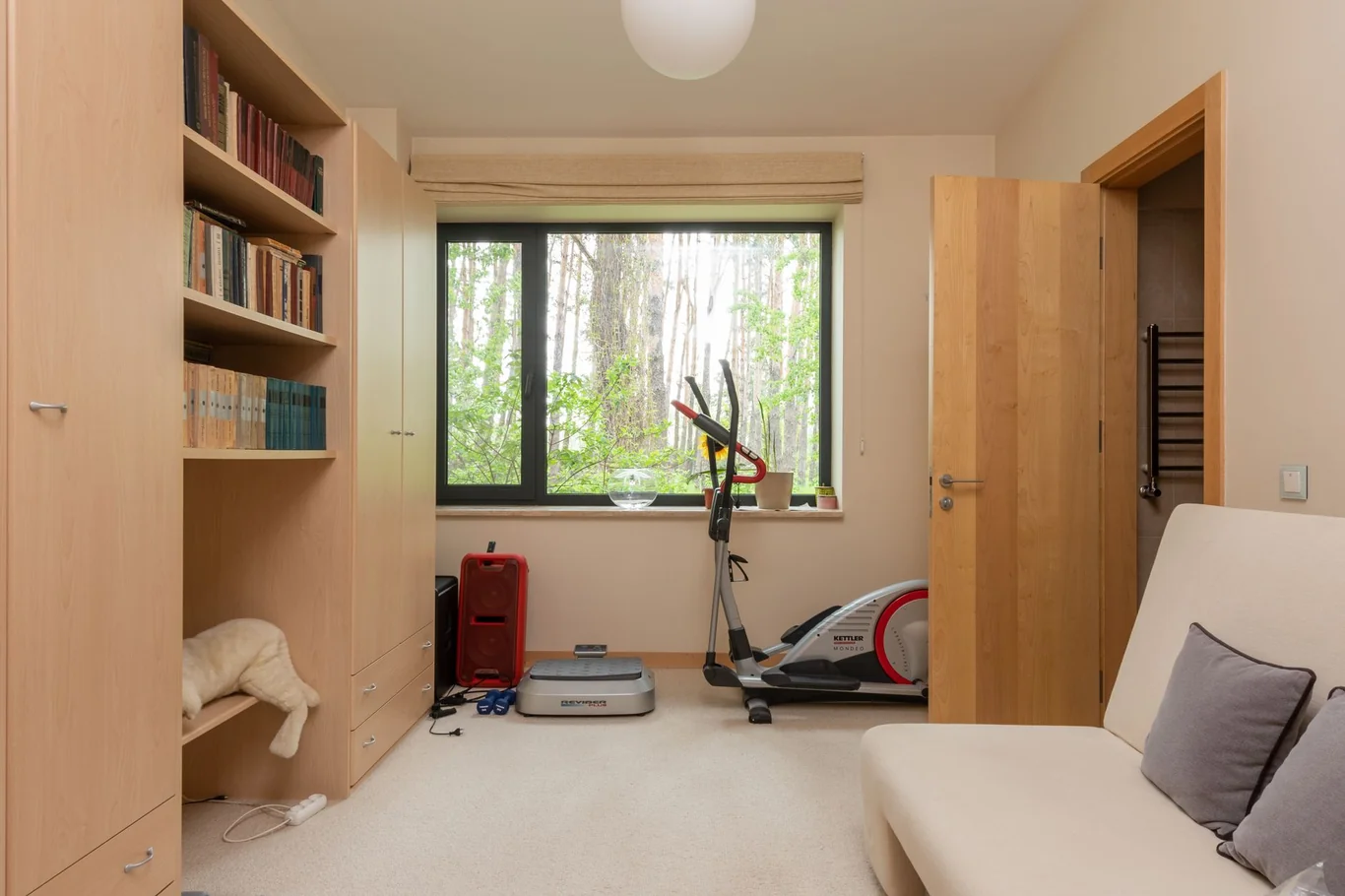
Seated ellipticals, sometimes called recumbent ellipticals, add a seat and backrest to the pedaling motion. The supported position offloads spinal compression and removes the balance demand of standing, which makes these machines genuinely different from standard ellipticals in both muscle recruitment and clinical application. The Teeter FreeStep recumbent cross trainer is a clear example of the design, and its linear stepping motion is the reason I suggest it to people whose knees dislike the deep bend of a bike pedal stroke.
Research supports their use for back pain specifically. A 2025 randomized controlled trial of 54 patients with chronic low back pain found that six weeks of seated elliptical exercise significantly reduced pain intensity and pain interference compared to standard care alone (1). It is a single trial of 54 patients, so I treat it as promising early evidence, but it is a meaningful finding for anyone considering this type for rehabilitation or general back health.
Who seated ellipticals suit best:
- People with chronic low back pain or recovering from lumbar injury
- Older adults who need back support during cardio
- Users returning to exercise after prolonged inactivity
- Anyone with balance issues that make standing cardio risky
- Riders seeking longer low-intensity sessions without postural fatigue
The trade-off is reduced core demand and somewhat lower calorie burn compared to standing designs. If you are weighing a seated elliptical against a recumbent bike, both give you back support, but the elliptical adds a gliding stride and arm handles that most types of stationary bikes lack. For people over 65 I also check step-through height and seat access first, which is why the ellipticals built for seniors I trust all have a low entry point.
Standing Ellipticals: Traditional Design with Higher Output
The standing elliptical is what most people picture when they think of this category: upright posture, handlebars to hold or push, pedals moving in an oval path. This is the most commonly studied elliptical type, and the one supported by the broadest body of research on calorie burn, muscle activation, and cardiovascular adaptation.
A 2022 EMG study found that elliptical exercise reduces lower extremity muscular activation by up to 60% compared to treadmill running at equivalent intensities (2). That reduction in muscle force demand is exactly what makes the elliptical lower-impact than running, because the ellipse path removes the high-force contact phase that generates joint stress on a treadmill. For most users pursuing weight loss or cardiovascular conditioning without running injuries, the standing elliptical is the benchmark to evaluate all other types against, and it is the machine to try first in any elliptical vs treadmill decision.
Under-Desk Ellipticals: Light Movement at the Office
Under-desk ellipticals are compact, motor-free pedal units designed for use while seated at a desk or sofa. They are genuinely useful for accumulating steps and low-intensity movement throughout the day, but they are not a substitute for a structured cardio session. The resistance and range of motion are both limited by their seated, compact design.
Realistic expectations for under-desk ellipticals:
- Increases daily step count and non-exercise activity thermogenesis (NEAT)
- Burns roughly 150-200 calories per hour at a typical pedaling pace for a 155-pound person, far less than standing elliptical sessions
- Keeps legs moving during seated work, which reduces prolonged sitting risks
- Does not provide the cardiovascular stimulus needed for fitness improvement
In my experience, the realistic payoff is modest but real: when I pedaled through about two hours of calls a day for three weeks, it added movement I would not otherwise have gotten, without taking any extra time out of my day. The quieter under-desk elliptical models are the ones I would pick, because a unit that creaks or creeps across the floor gets pushed aside within a week.
Used as a supplement to your regular workouts rather than a replacement, they deliver real value, and that narrower role is the honest answer to whether under-desk ellipticals work.
Outdoor Elliptical Cycles: Cardio Beyond the Gym
An outdoor elliptical cycle is a pedal-powered vehicle that uses an elliptical stepping motion to propel the rider forward on roads, paths, or trails. The motion is essentially the elliptical stride applied to outdoor locomotion, without a motor or treadmill deck beneath you.
Brands like ElliptiGO and StreetStrider popularized this category, and it has found a particularly strong niche among runners managing overuse injuries. The outdoor elliptical cycle provides cardiovascular demand comparable to running while removing heel-strike impact forces. Riders who cannot currently run due to knee, hip, or foot injuries frequently use these as training substitutes during recovery.
These machines carry a significantly higher price point than standard home ellipticals and are also weather-dependent and require appropriate terrain.
The outdoor elliptical cycle is worth considering if any of these apply to you:
- You are a runner managing an overuse injury and need to maintain cardiovascular fitness without impact
- You find indoor cardio monotonous and want an outdoor training option with elliptical-style joint protection
- You live in an area with bike-friendly roads or multi-use trails and want a full-body cardio alternative to cycling
For users who meet these criteria, the outdoor elliptical cycle represents one of the most versatile low-impact options available.
Elliptical Comparisons for Weight Loss and Joint Health
Most elliptical comparisons center on two practical questions: which type burns the most calories, and which type is easiest on the joints. The types of ellipticals covered above each answer these questions differently, and the answers shift based on machine type, user bodyweight, and intensity. If you are still working out which of the types of ellipticals is right for you, the calorie and joint data below offers the most objective comparison available.

Which Types Burn the Most Calories
A 2024 study measuring energy expenditure across seven indoor cardio machines found that the elliptical ranked third in calorie burn at self-selected submaximal intensity, producing approximately 12.8 kcal per minute for recreationally active men (3). Those are average values under controlled conditions, and actual calorie burn varies with bodyweight, resistance level, and whether moving arm handles are used.
Standing types of ellipticals with active moving arms burn measurably more than the same machine used without arm engagement, because upper body involvement increases total metabolic demand. That is why arm drive is one of the first things I check when someone using an elliptical for weight loss feels their results have stalled. Seated ellipticals burn less than standing designs at the same resistance, partly because the supported position reduces the core and stabilizer contribution.
Types Best Suited for Joint Issues
All elliptical types produce lower joint loading than running, but the degree varies. The up to 60% reduction in lower extremity muscular force during elliptical versus treadmill exercise documented by Eken et al. (2022) applies primarily to standing ellipticals. Seated ellipticals reduce this even further by removing the standing load component entirely.
For knee health specifically, direction and incline matter. A 2021 biomechanical study found that reversing pedal direction on an elliptical reduces peak knee flexion across all incline levels while increasing knee valgus at lower inclines (4). This means users with anterior knee sensitivity may benefit from forward-only pedaling at moderate incline, while users managing different knee conditions may need to experiment with both directions. What I suggest to anyone with a sensitive kneecap is two weeks of forward-only pedaling at a moderate ramp before trying reverse at all.
How Incline Changes the Elliptical Experience
Most standing types of ellipticals offer adjustable incline, typically from 0% to 20% or 30% grade depending on the model. Higher incline settings shift load toward the glutes and hamstrings, changing which muscle groups the movement targets.
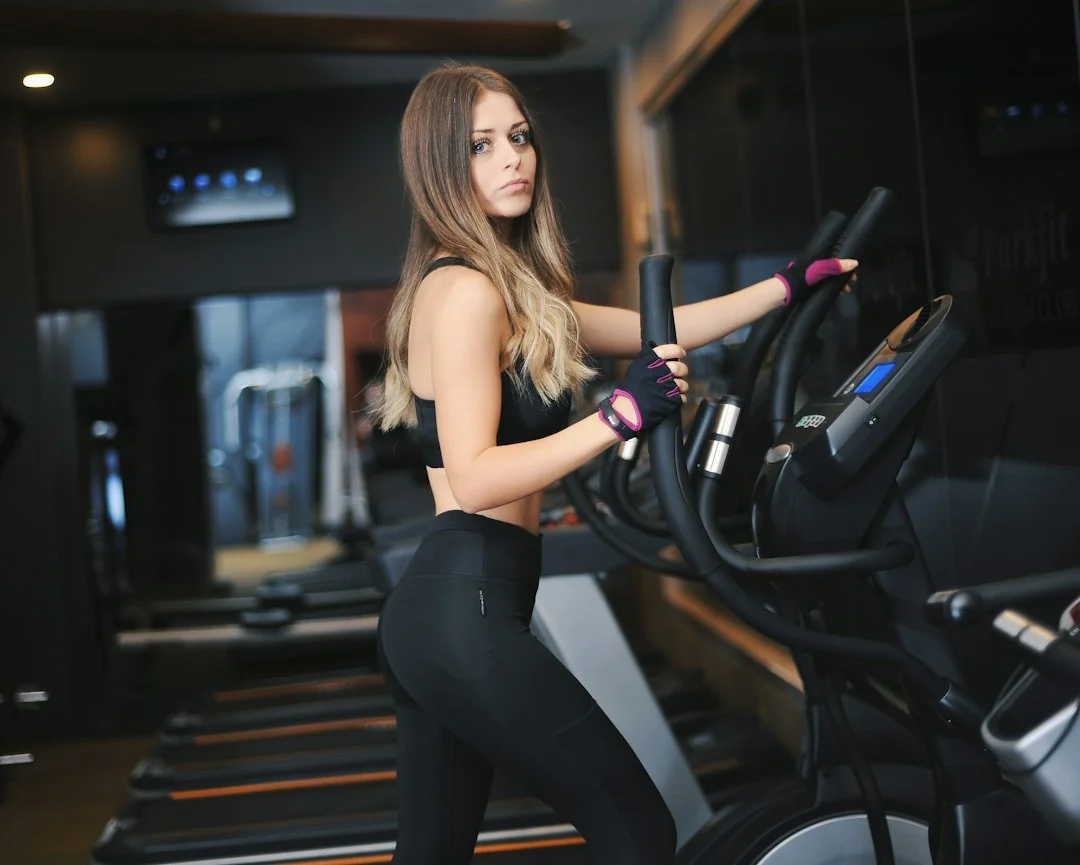
At lower inclines, the quadriceps carry a larger share of the workload. As incline increases, the emphasis shifts toward the glutes and hamstrings. Research examining off-axis elliptical designs found that modified movement patterns significantly increased gluteus medius activation compared to standard forward elliptical motion (5). While that study looked at lateral motion rather than incline specifically, the principle is consistent with what practitioners observe at higher incline settings: the posterior chain becomes more involved.
Lateral ellipticals, a less common variant that adds side-to-side pedal motion to the standard oval path, extend this effect further by directly targeting the hip abductors. They complement standard elliptical designs and serve as a useful addition for users focused on hip stability or gluteus medius development. Many gyms also place arc trainers next to their ellipticals; they use a curved foot path instead of an oval, so treat the arc trainer vs elliptical choice as a separate decision.
Muscles targeted by incline adjustment on a standing elliptical:
- Low incline (0-5%): Quadriceps dominant, some hamstring contribution, moderate glute activation
- Moderate incline (6-15%): Balanced quad-hamstring load, increased glute recruitment, greater calf demand
- High incline (16-30%): Posterior chain dominant, significant glute and hamstring demand, reduced quad emphasis
In my own incline sessions, heart rate climbs noticeably within the first few minutes once the ramp moves past the moderate range, even at an unchanged pedaling speed, which shows the incline shifts cardiovascular demand as well as muscle emphasis.
An incline elliptical session at moderate to high grade also elevates heart rate faster than flat-stride elliptical work at the same pedaling speed, which can reduce the time needed to reach an effective training zone. A 2006 validation study found that heart rate reserve tracks oxygen consumption reserve accurately on elliptical machines, meaning standard heart rate-based intensity guidelines apply directly to elliptical training (6). Tracking heart rate during incline sessions gives you a reliable window into actual cardiovascular effort.
Making the Right Elliptical Choice for Your Goals
Understanding the types of ellipticals in detail makes the buying decision much more straightforward. My default recommendation for most people starting from scratch is a rear-drive standing elliptical, because it hits the best combination of stride quality, durability, and research-backed performance. If back pain is a factor, the trial evidence for seated ellipticals is encouraging, and if budget and space are the primary constraints, a front-drive model delivers effective cardio at a lower price point. When I compare top-rated elliptical machines for a client, stride length is the first spec I check, before resistance levels or console features. Older lists of the best ellipticals were dominated by rear-drive commercial designs, while today's home elliptical lineup also includes magnetic-resistance center-drive and under-desk options at every price tier.
Before purchasing, check the three things I look at first when choosing an elliptical: your available floor space (center-drive and front-drive are significantly more compact than rear-drive designs), your height against the machine's stride length (adults above 5'10" benefit from a stride over 18 inches, typically on rear-drive models), and whether the model has adjustable incline and moving arm handles, the features that determine which types of ellipticals actually match your goals. My lifeguard training makes me think about the worst case first, so I also check that the pedals have a raised outer lip and that nothing pinches at the end of the handle stroke.
Goal | Recommended Type | Key Advantage |
Maximum calorie burn | Standing elliptical, arms active | Highest metabolic demand |
Weight loss with joint protection | Rear-drive standing elliptical | Long stride, smooth motion |
Back rehabilitation | Seated elliptical | Lumbar support, reduced spinal load |
Knee rehabilitation | Standing elliptical, forward direction, moderate incline | Controlled knee kinematics |
Small apartment or limited budget | Front-drive or center-drive | Compact footprint, lower cost |
Outdoor training or injury cross-training | Outdoor elliptical cycle | No impact, variable terrain |
FAQs
What’s the best elliptical for home use?
The best ellipticals for home use depend on your space, budget, and fitness goals, with rear-drive models offering the smoothest stride for most users who have the room. Front-drive and center-drive ellipticals are valid alternatives when footprint is the primary constraint, delivering effective cardio in a more compact frame without sacrificing the core low-impact benefit.
Which type of elliptical is best for weight loss?
The type of elliptical best suited for weight loss is a standing model with active moving arm handles, because the combined upper and lower body demand produces higher calorie burn than stationary-handle or seated versions. Rear-drive designs with adjustable incline allow progressive overload over time, which sustains calorie expenditure as fitness improves.
Is a lateral elliptical better than a regular elliptical?
Lateral ellipticals engage the hip abductors and gluteus medius more than standard forward-motion designs, which matters most for users targeting those muscle groups or seeking hip stability work. Research on off-axis elliptical motion shows significantly increased gluteal activation compared to conventional elliptical exercise, making lateral machines a useful option for users specifically targeting those muscle groups or seeking greater hip stability work.
Is it better to use the elliptical with moving arms or without?
Using the elliptical with moving arms burns more calories and distributes the workload across both upper and lower body, which increases total cardiovascular demand per session. Choosing stationary handles instead reduces upper body engagement but shifts more emphasis to the legs, which can be useful when targeting lower body conditioning specifically or recovering from an upper body injury.
This content is for informational and educational purposes only. It is not a substitute for professional medical advice, diagnosis, or treatment. Always consult with your healthcare provider before starting any new exercise program, particularly if you have a chronic health condition, history of back pain, or joint injury.
We are always looking for expert inputs to make our content even better and more useful.
References
- Ebrahimi A, Taseh A, McLeod H, et al. The Effect of Seated Elliptical Exercise on Chronic Low Back Pain: A Randomized Controlled Trial. Cureus. 2025;17(12):e99064. doi:10.7759/cureus.99064.
- Eken MM, Withers A, Flanagan K, Burger J, Bosch A, Lamberts RP. Muscular Activation Patterns During Exercise on the Treadmill, Stepper, and Elliptical Trainer. Journal of Strength and Conditioning Research. 2022;36(7):1847-1852. doi:10.1519/JSC.0000000000003743.
- Prieto-Gonzalez P, Yagin FH. Energy expenditure, oxygen consumption, and heart rate while exercising on seven different indoor cardio machines at maximum and self-selected submaximal intensity. Frontiers in Sports and Active Living. 2024;6:1313886. doi:10.3389/fspor.2024.1313886.
- Hummer ET, Murphy EN, Suprak DN, Brilla LR, San Juan JG. Movement direction impacts knee joint kinematics during elliptical exercise at varying incline angles. The Knee. 2021;29:201-207. doi:10.1016/j.knee.2021.02.008.
- Lin CY, Tsai LC, Press J, Ren Y, Chung SG, Zhang LQ. Lower-Limb Muscle-Activation Patterns During Off-Axis Elliptical Compared With Conventional Gluteal-Muscle-Strengthening Exercises. Journal of Sport Rehabilitation. 2016;25(2):164-172. doi:10.1123/jsr.2014-0307.
- Dalleck LC, Kravitz L. Relationship between %Heart Rate Reserve and %VO2 Reserve during Elliptical Crosstrainer Exercise. Journal of Sports Science and Medicine. 2006;5(4):662-671.