
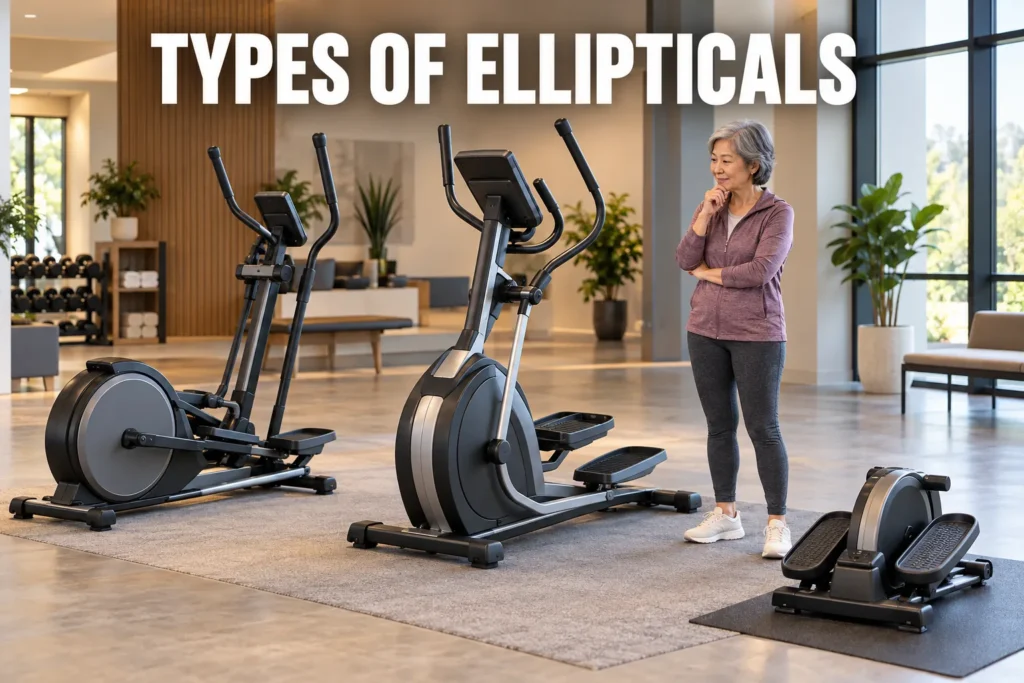
Ellipticals are grouped by where the flywheel sits (front, rear or center drive), by whether you stand or sit, and by maker product names such as Max Trainer and Arc Trainer. No maker or study cited here shows that one drive position feels or performs better, so compare each model's listed stride, user limit and footprint.
The types of ellipticals fall into groups that makers define by construction: where the flywheel sits (front, rear or center drive), whether the user stands or sits, and whether the device is a full-size machine, a compact pedal unit or a hybrid sold under its own product name. Below, each of these elliptical types gets a definition, model examples with the figures the makers list, and what studies measured on calories, joint loading and muscle use, and in whom. No maker or study cited here measures how front, rear or center drive feels, so in my view stride feel is something to settle by trying the machine itself.
Types of Ellipticals Defined by Drive Position
The most common way to sort elliptical types is by where the flywheel and drive system sit. Front drive puts the flywheel at the front of the machine and rear drive puts it at the back (1). Center drive splits the flywheel system into two wheels, one on each side of the machine (2). Not every maker uses these labels: Life Fitness names a Link 6 Elliptical Drive System for its E1 without a position. Each elliptical design carries these labels only where the maker prints them, so the sections below stick to construction and model examples.
Rear-Drive Ellipticals
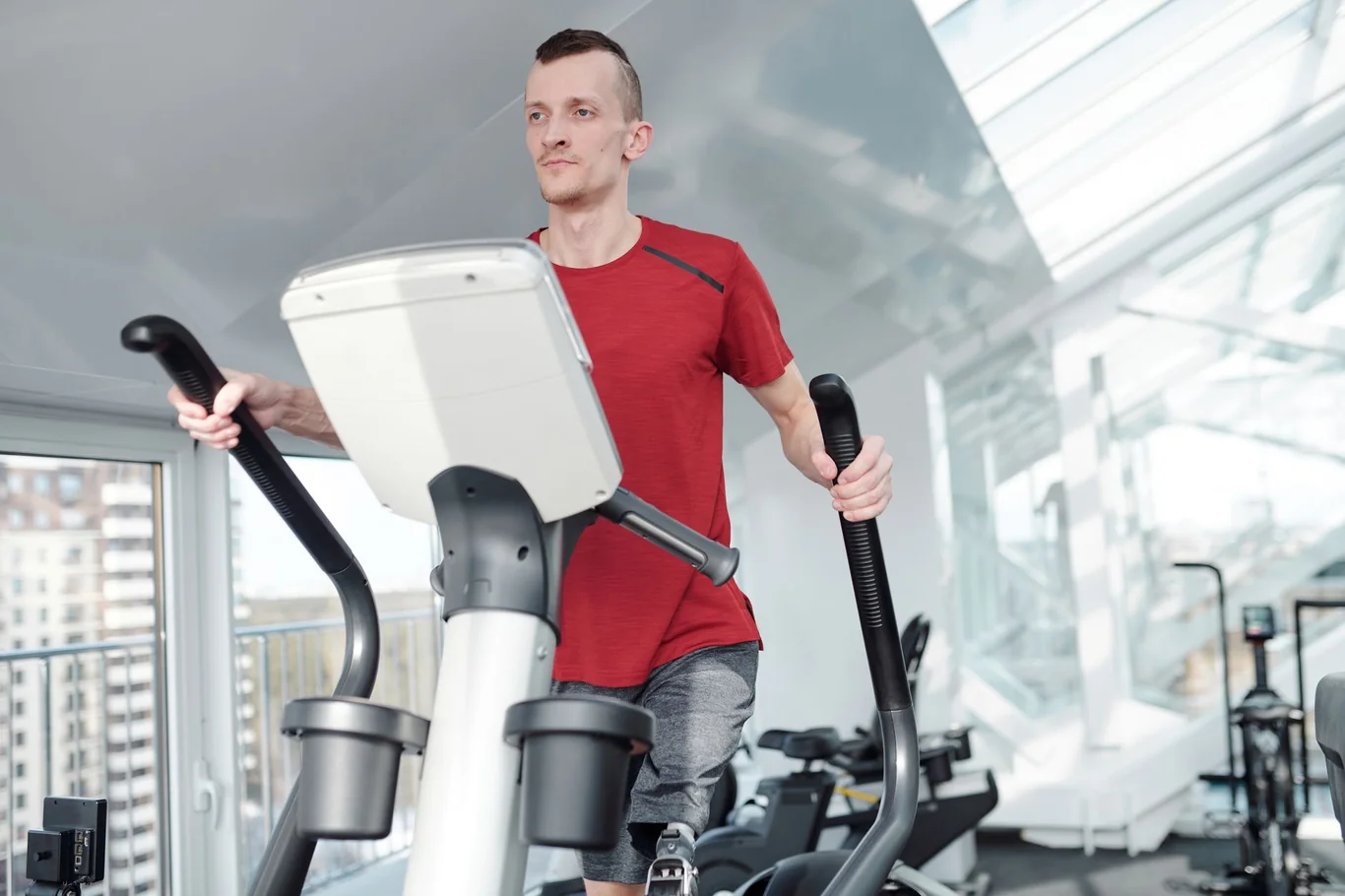
A rear-drive elliptical has its flywheel at the back of the machine. TRUE Fitness describes rear drive as the closest to the original elliptical models of the late 1990s (1). Octane states that rear-drive machines use a larger, less compact flywheel to avoid tipping over in use (2). The Precor EFX635 is a model example: its 2021 product sheet describes it as designed for multi-family housing complexes, corporations and hospitality venues, and lists a covered rear drive housing for cleaning and service, a ramp angle of 10 to 35 degrees, 20 resistance levels, self-powered operation and a step-up height of 8 in (3). The maximum user weight is 350 lb (4).
Footprint belongs to the model, not to the type. The two Precor documents for the EFX635 list different sizes (82 x 30 x 68 in on the 2021 sheet, 86 x 28 x 68 in on the product page), so measure the room against the manual for your unit. The front-drive SportsArt E866 below lists 79.1 in of length, which is a few inches shorter than the Precor figure and says nothing about every model of each type.
In my judgement the useful test is one a table cannot supply: step onto the machine and check that stride, handle reach and pedal spacing suit your body at workout pace.
Front-Drive Ellipticals
A front-drive elliptical has its flywheel at the front of the machine (1). SportsArt names its E866 a front-drive elliptical and lists an electronically adjustable stride of 16 to 28 in, 40 resistance levels, a maximum user weight of 500 lb, self-powered operation and a size of 79.1 x 28.1 x 66.3 in (5).
The E866 also weighs 336.6 lb, so a front-drive label does not mean a light or small frame. Before choosing any model, I compare the three figures a maker prints: the stride (fixed, or an adjustable range as on the E866), the maximum user weight and the footprint.
Center-Drive Ellipticals
Octane describes center drive as a flywheel system alongside the user, with two wheels split on either side of the machine, and states that the flywheels can be very compact depending on the structural design (2). Body-Solid calls the Endurance E5000 a Patented Center Drive design and lists a 21 in stride, 20 levels of resistance, a 325 lb user capacity and an internal generator that removes any power requirement (6). The step-up height is described as easy, with no figure given.
Body-Solid lists the E5000 at 68 x 31 x 69 in and 249 lb in its specification table (6).
| Elliptical Type | Flywheel position | Model example | Listed stride | Listed size (L x W x H) |
|---|---|---|---|---|
| Rear-Drive | At the back of the machine | Precor EFX635 | - | 82 x 30 x 68 in (2021 sheet); 86 x 28 x 68 in (product page) |
| Front-Drive | At the front of the machine | SportsArt E866 | 16 to 28 in, electronically adjustable | 79.1 x 28.1 x 66.3 in |
| Center-Drive | Two wheels, one on each side of the machine | Body-Solid Endurance E5000 | 21 in | 68 x 31 x 69 in |
The table shows one maker-labelled example per drive position and is not a full lineup. A dash means the figure is not printed for that model: no stride length for the Precor EFX635. Stride and footprint vary by model inside each type.
Seated, Standing, and Under-Desk Elliptical Types
Elliptical types also differ by how the user is positioned: standing on the pedals, sitting in the machine's own reclined seat, or sitting in an ordinary chair with a compact pedal unit on the floor. Makers set different use rules for each. Some seated-only units warn against standing on them, and at least one compact unit allows both positions, as the models below show.
Standing on a seated-only unit. Cubii's rule for the Go is "Never stand on the pedals, no matter your weight." The Stamina E1000 allows standing only with good balance. Rules differ by model, so check the manual for yours.
Seated Ellipticals
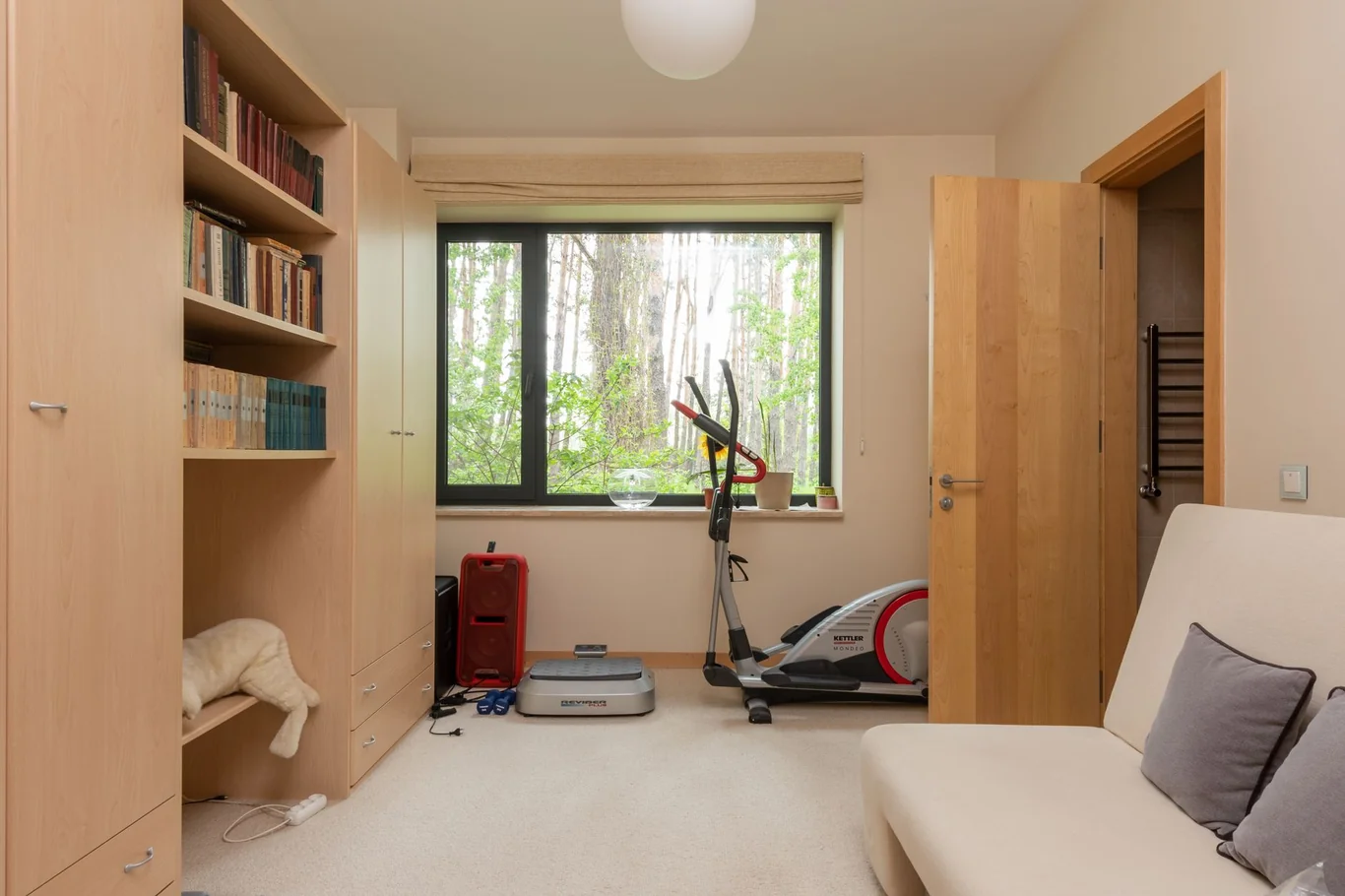
Seated ellipticals, also sold as recumbent cross trainers, put the user in a built-in reclined seat. The Teeter FreeStep recumbent cross trainer is one example: the LT3 lists 13 levels of magnetic resistance, a 300 lb weight capacity, a height range of 4 ft 11 in to 6 ft 6 in and a size of 62.1 x 32.7 x 55.4 in (7). Teeter markets it as a zero-impact workout, which is the maker's description and not a measured result. Octane's commercial xRide XR6000s seated elliptical lists 30 resistance levels and a 400 lb maximum user weight (8).
The one seated-pedalling trial cited here did not use a machine of this kind. The device was a compact under-desk unit, the Cubii Total Body+, and the trial was funded by Cubii's maker, Fitness Cubed Inc. Of 54 adults with chronic low back pain enrolled, 47 were analysed across the two groups. Six weeks of 15 to 30 minutes a day, five days a week, of seated pedalling added to standard care were compared with standard care alone (9). Pain scores fell in the pedalling group and did not change significantly in the standard-care group, but the trial was small and not blinded, and the authors reported no significant change in global physical or mental health. In my view that makes it an early result for one device, not a reason to pick a seated elliptical as a back treatment.
Facts that decide whether a seated elliptical fits:
- Weight and height limits are model figures: 300 lb and 4 ft 11 in to 6 ft 6 in on the Teeter FreeStep LT3, and 400 lb on the Octane XR6000s.
- No study cited here compared a seated elliptical with a standing one for calories or joint loading.
- With back pain, balance problems or a long break from exercise, check with your doctor or physical therapist before you start.
Teeter describes the LT3's Dual Power Motion as engaging both the upper and lower body (7), a point to weigh against the types of stationary bikes. For an older reader I would check step-through height and seat access first, and a separate page covers ellipticals built for seniors.
Standing Ellipticals: Traditional Design
The standing elliptical is the full-size machine most people picture: the user stands on the pedals, holds handles that may move, and the pedals follow an oval path. The Life Fitness E1 is one example. It lists 20 resistance levels, a 400 lb maximum user weight and a size of 82 x 30 x 59 in (10).
In 17 well-trained runners working at the same share of each machine's peak workload, most leg muscles showed less electrical activity on an elliptical than in treadmill running, by up to 60% for some muscles, and the quadriceps did not differ (11). That is muscle activity in trained runners, not a measure of impact or joint stress, and it does not carry over to people who do not run. A separate page compares elliptical vs treadmill in more detail.
Hybrid trainers use product names of their own. BowFlex describes its Max Trainer as a combination of the low impact benefits of an elliptical and the high intensity movements of a stepper, which is the maker's description. BowFlex lists 16 or 20 resistance levels depending on the model, a recommended height up to 6 ft 6 in, a recommended maximum user weight of 300 lb and a ceiling at least 20.9 in taller than the user (12). Max Trainer is BowFlex's product name, not a type of elliptical.
Under-Desk Ellipticals: Light Movement at the Office
Compact pedal units that sit under a desk are used from a chair or sofa, and the maker's rules decide how a model may be used. Cubii's rule for the Go is "Do not use when standing. Only use when sitting." The Go measures 23.6 x 17.3 x 9.5 in, has 10 resistance levels and a 300 lb limit (13). The Stamina InMotion E1000, model 55-1610F in the 2019 edition, allows standing if you have good balance and are familiar with the elliptical, keeps a separate seated position in which you do not stand, and lists a 250 lb limit and a size of 24.3 x 17 x 11.4 in (14).
What a study measured on a compact seated elliptical:
- In a lab test of 32 inactive adults pedalling one Stamina InMotion E-1000 while seated at a pace they chose, energy use was a median of about 88 kcal an hour above sitting, with a range from 20 to 179 (15).
- The median effort was 2.2 METs (range 1.3 to 3.9). The 2024 Compendium has no seated or under-desk elliptical entry.
- The test was a short laboratory measurement at a self-chosen pace. It did not measure a work day, body weight or any health outcome.
- No trial cited here tested an under-desk elliptical for weight, blood markers or work performance.
Light movement during sitting hours is what the measured device did, and in my view it does not replace a structured session. A separate page lists quieter under-desk elliptical models.
The question of whether under-desk ellipticals work has its own page, and the measured answer is a small rise in energy use while seated.
Outdoor Elliptical Cycles: Cardio Beyond the Gym
An outdoor elliptical cycle is a bicycle with a stand-up, elliptical stepping motion. ElliptiGO describes its bikes as stand up and elliptical bikes that engage the legs, core and upper body (16). It is a different device from an elliptical machine, so a study of one does not describe the other.
ElliptiGO calls the pedaling motion smooth, low-impact and easy on the joints. That is the maker's claim, with no study named.
No study cited on this page tested an outdoor elliptical bike, so none of the calorie or joint figures below apply to it.
Elliptical Comparisons: Calories and Joint Loading
Elliptical machine types are compared on calories and on joint loading. The studies below tested particular machines in particular groups, and none compared front, rear and center drive.
Calories: What Was Measured
Three kinds of calorie figure exist, and they are not interchangeable. The first is an estimate from the 2024 Adult Compendium of Physical Activities, which has two elliptical entries: Elliptical trainer, moderate effort at 5.0 METs and Elliptical trainer, vigorous effort at 9.0 METs (17). The estimate is kilocalories = MET x body weight in kilograms x hours, rounded to the nearest 10. At 70 kg, 30 minutes comes to about 180 kcal at moderate effort and about 320 kcal at vigorous effort (estimates). At 59, 84 and 100 kg the 30-minute moderate figures are about 150, 210 and 250 kcal and the vigorous figures about 270, 380 and 450 kcal. A separate guide covers calories burned on elliptical by weight and time.
The second kind is a value measured in a lab. In 30 recreationally active men aged 35 to 49 with more than 10 years of experience on indoor cardio machines, working at a very hard effort (RPE 17) with one machine of each type, one SportsArt E840 elliptical used 12.82 kcal a minute. That was below the treadmill (15.18) and a stepper (13.35) and above a rower (11.45) and three bikes (11.07 to 12.45) (18). Other studies found no treadmill-elliptical difference: oxygen use did not differ in 18 untrained college-age adults at a moderate effort (RPE 12 to 13) (19) or in 18 trained runners at the same share of each machine's peak workload (20).
The third kind is the console number. In a study of 34 adults on one Precor EFX 883 with no body weight entered, the display read higher than the lab measurement over 30 minutes of moderate exercise (21). A separate study of 26 adults found the manufacturer's calculated energy expenditure overestimated in both tests, with oxygen use at the same settings varying widely from person to person (22). Each study tested one machine and other consoles were not tested. Do not set a console figure beside a Compendium estimate or a lab value.
Moving handles raise the effort: in a study of 26 adults, most of whom did one test with the arm poles and one without, oxygen use, ventilation and perceived exertion were higher with arms and legs together than with legs only at the same intensity, and heart rate did not differ significantly (22). No percent applies to every reader. No trial has tested elliptical training alone for weight loss in healthy adults, so the guide to using an elliptical for weight loss works from energy use and not from a promised loss.
Joint Loading: What Was Measured
Whether an elliptical means lower joint loading than running is not settled by any study cited here, because none measured both in the same healthy people.
The closest direct measurement is from three older adults with an instrumented knee replacement (two men aged 83 and 81 and one woman aged 67, one year after surgery). Peak knee force was about 2.2 times body weight on an elliptical: lower than jogging (consistently greater than 4 times body weight) but not lower than treadmill walking (about 2.1), and above a stationary bike (about 1.0) (23). In 15 men, the vertical force on the pedal and the rate at which load built up were smaller on an elliptical, with no resistance workload and pedal rate and step length matched to each man's walking, than the ground force in walking, but the knee-extensor and hip-flexor moments were larger (24). In 12 healthy young men, calculated knee torque was higher on an elliptical than on a stationary bike at 50 and 70 revolutions a minute (25).
Resistance and ramp settings were measured under the foot: in a study that recruited 30 adults without symptoms, who pedalled without holding the side handles, load under the whole foot averaged 70% to 81% of body weight across resistance and incline settings (26). That measures the foot, not the knee, and it compared no other activity. The joint-load research is covered in more detail in how the elliptical affects knees.
For knee or hip pain, check with your doctor or physical therapist before choosing a machine. MedlinePlus advises that you should never feel pain when exercising and to stop right away if you do, and to go to the hospital right away or call 911 or the local emergency number if you have chest pain during or after exercise (27).
Incline, Lateral Motion and Arc Trainers: What Makers List
Makers state incline in different units, and the units cannot be converted into one another. Precor lists a ramp angle of 10 to 35 degrees for the EFX635 (3), and Life Fitness lists 21 incline levels on its Arc Trainer models (28). Read the unit on the page of the model you are looking at.
What incline does to muscle use on a standard elliptical was not measured in any study cited here, so no table of muscles by incline setting appears on this page. The nearest study used an off-axis research trainer with motorized foot plates, not a standard machine. In 12 healthy volunteers, gluteus medius activity was 22.4% of maximum when the exercise resisted an adduction force and 6.4% in regular elliptical exercise (29).
A lateral elliptical adds side-to-side pedal motion to the oval path, and no study cited here compared a lateral model with a standard one in home users. Life Fitness describes its Arc Trainer models as designed to mimic gliding, striding and climbing (28). In 18 young adults in bouts set at 55, 65 and 75% of treadmill maximal oxygen uptake, oxygen use did not differ between an elliptical cross-trainer and an Arc Trainer, heart rate was higher on the elliptical, and hip discomfort ratings were higher on the elliptical while knee and lower-back ratings did not differ (30). Arc Trainer is a maker's product name, so treat the arc trainer vs elliptical choice as a separate decision.
Incline and ramp figures as makers list them:
- Precor EFX635: ramp angle of 10 to 35 degrees.
- Life Fitness Arc Trainer models: 21 incline levels, with 100 resistance levels.
- Other makers use percent or fixed ramps: read the unit on the model's page and do not convert it.
In 48 adults who took a maximal elliptical test, percent of heart-rate reserve tracked percent of oxygen-uptake reserve in the same way it does on a treadmill, as shown in the 24 who also did a treadmill test (31). That supports heart-rate reserve as an intensity guide. It does not show that a heart-rate-based calorie estimate is accurate, because that study did not test it.
Making the Right Elliptical Choice for Your Goals
The types of ellipticals above differ in construction, in user position and in maker rules, and the studies cited here do not rank them. In my view the default for most people is a full-size standing elliptical from a maker that prints its figures plainly, because most studies cited here used standing machines and the figures are easy to compare. That is a judgement, not a finding. When top-rated elliptical machines are compared, stride, user limit and footprint are the first figures to check, before resistance levels or console features. The home elliptical lineup is on a separate page.
Before choosing, check four things on the model's own page or manual, in my view the four checks that matter when choosing an elliptical: the footprint (82 to 86 in long for the Precor EFX635, 79.1 in for the SportsArt E866, 23.6 x 17.3 in for the Cubii Go); the maximum user weight (250 lb for the Stamina E1000, 325 lb for the Body-Solid E5000, 500 lb for the SportsArt E866); the ceiling clearance where the maker states one (the BowFlex Max Trainer needs a ceiling at least 20.9 in taller than the user); and whether the device is seated-only.
| Need | Type to look at | Model example and listed facts |
|---|---|---|
| Full-size standing machine | Standing elliptical | Life Fitness E1: 20 resistance levels, 400 lb limit, 82 x 30 x 59 in |
| Flywheel at the back | Rear drive | Precor EFX635: ramp 10 to 35 degrees, 350 lb limit, self-powered |
| Adjustable stride | Front drive | SportsArt E866: stride 16 to 28 in, 500 lb limit, self-powered |
| Center-drive frame | Center drive | Body-Solid E5000: 21 in stride, 325 lb capacity, internal generator |
| Built-in reclined seat | Seated or recumbent | Teeter FreeStep LT3: 13 resistance levels, 300 lb capacity |
| Pedals under a desk or sofa | Compact seated device | Cubii Go: 10 levels, 300 lb limit, seated only; Stamina E1000: 250 lb limit, standing allowed with good balance |
Frequently Asked Questions
What’s the best elliptical for home use?
No study cited here ranks home ellipticals, so the best one is the model that fits your floor space, your body size and the maker's use rules. Compare the listed stride, maximum user weight and footprint, and try the machine before you commit.
Which type of elliptical is best for weight loss?
No trial has tested elliptical training alone for weight loss in healthy adults, so no elliptical type can be named best for it. Calorie estimates differ by effort level, and any change in body weight depends on total energy balance and not on machine type.
Is a lateral elliptical better than a regular elliptical?
No study cited here compared a lateral elliptical with a regular one in people using home machines. One lab study of a research trainer with motorized foot plates measured higher gluteus medius activity in 12 healthy volunteers when they resisted an adduction force than in regular elliptical exercise, which does not describe a lateral home machine.
Is it better to use the elliptical with moving arms or without?
In a study of 26 adults, using the moving arm poles raised oxygen use compared with legs only at the same intensity, while heart rate did not differ significantly. No single percent applies to every reader, because oxygen use varied widely between people.
 Tech Fitness Lab
Author
Milutin Tucakov
I am in the final year of my degree at the Faculty of Sport and Physical Education in Novi Sad. I am a certified lifeguard with first aid training and I compete in Brazilian Jiu-Jitsu. I write about safe use: the limits and setup steps in the manual, and what the warranty really says.
This content is for informational and educational purposes only. It is not a substitute for professional medical advice, diagnosis, or treatment. Always consult with your healthcare provider before starting any new exercise program, particularly if you have a chronic health condition, history of back pain, or joint injury.
We are always looking for expert inputs to make our content even better and more useful.
References
- TRUE Fitness. The origins of the elliptical training machine. Accessed November 21, 2026.
- Octane Fitness. Commercial elliptical machine buying guide. Accessed November 21, 2026.
- Precor. EFX 635 Experience Series Elliptical Fitness Crosstrainer product sheet (North America). Precor Incorporated; 2021.
- Precor. EFX635 product page. Accessed November 21, 2026.
- SportsArt. E866 Front-Drive Elliptical product page. Accessed November 21, 2026.
- Body-Solid. Endurance E5000 Premium Elliptical Trainer product page. Accessed November 21, 2026.
- Teeter. FreeStep LT3 Recumbent Cross Trainer product page. Accessed November 21, 2026.
- Octane Fitness. xRide XR6000s seated elliptical product page. Accessed November 21, 2026.
- Ebrahimi A, Taseh A, McLeod H, et al. The effect of seated elliptical exercise on chronic low back pain: a randomized controlled trial. Cureus. 2025;17(12):e99064. doi:10.7759/cureus.99064.
- Life Fitness. E1 Elliptical Cross-Trainer product page. Accessed November 21, 2026.
- Eken MM, Withers A, Flanagan K, Burger J, Bosch A, Lamberts RP. Muscular activation patterns during exercise on the treadmill, stepper, and elliptical trainer. J Strength Cond Res. 2022;36(7):1847-1852. doi:10.1519/JSC.0000000000003743.
- BowFlex. Explore Max Trainers. Accessed November 21, 2026.
- Cubii Go Owner's Manual (MAN-05-0046, Rev 1, US edition). Fitness Cubed Inc.
- Stamina InMotion E1000 Compact Strider Owner's Manual (model 55-1610F). Stamina Products, Inc.; 2019.
- Rovniak LS, Denlinger L, Duveneck E, et al. Feasibility of using a compact elliptical device to increase energy expenditure during sedentary activities. J Sci Med Sport. 2014;17(4):376-380. doi:10.1016/j.jsams.2013.07.014.
- ElliptiGO. Home page. Accessed November 21, 2026.
- 2024 Adult Compendium of Physical Activities: conditioning exercise entries. Accessed November 21, 2026.
- Prieto-Gonzalez P, Yagin FH. Energy expenditure, oxygen consumption, and heart rate while exercising on seven different indoor cardio machines at maximum and self-selected submaximal intensity. Front Sports Act Living. 2024;6:1313886. doi:10.3389/fspor.2024.1313886.
- Brown GA, Cook CM, Krueger RD, Heelan KA. Comparison of energy expenditure on a treadmill vs. an elliptical device at a self-selected exercise intensity. J Strength Cond Res. 2010;24(6):1643-1649. doi:10.1519/JSC.0b013e3181cb2854.
- Bosch AN, Flanagan KC, Eken MM, Withers A, Burger J, Lamberts RP. Physiological and metabolic responses to exercise on treadmill, elliptical trainer, and stepper: practical implications for training. Int J Sport Nutr Exerc Metab. 2021;31(2):135-142. doi:10.1123/ijsnem.2020-0155.
- Glave AP, Didier JJ, Oden GL, Wagner MC. Caloric expenditure estimation differences between an elliptical machine and indirect calorimetry. Exerc Med. 2018;2:8. doi:10.26644/em.2018.008.
- Mier CM, Feito Y. Metabolic cost of stride rate, resistance, and combined use of arms and legs on the elliptical trainer. Res Q Exerc Sport. 2006;77(4):507-513. doi:10.1080/02701367.2006.10599385.
- D'Lima DD, Steklov N, Patil S, Colwell CW. The Mark Coventry Award: in vivo knee forces during recreation and exercise after knee arthroplasty. Clin Orthop Relat Res. 2008;466(11):2605-2611. doi:10.1007/s11999-008-0345-x.
- Lu TW, Chien HL, Chen HL. Joint loading in the lower extremities during elliptical exercise. Med Sci Sports Exerc. 2007;39(9):1651-1658. doi:10.1249/mss.0b013e3180dc9970.
- He MY, Lo HP, Chen WH. Effects of stationary bikes and elliptical machines on knee joint kinematics during exercise. Medicina (Kaunas). 2024;60(3):498. doi:10.3390/medicina60030498.
- Kaplan Y, Nyska M, Palmanovich E, Shanker R. Clinical implications of changing parameters on an elliptical trainer. Orthop J Sports Med. 2014;2(6):2325967114535553. doi:10.1177/2325967114535553.
- MedlinePlus. Exercise safety: patient instructions. Review date July 15, 2026.
- Life Fitness. Arc Trainers catalog page. Accessed November 21, 2026.
- Lin CY, Tsai LC, Press J, Ren Y, Chung SG, Zhang LQ. Lower-limb muscle-activation patterns during off-axis elliptical compared with conventional gluteal-muscle-strengthening exercises. J Sport Rehabil. 2016;25(2):164-172. doi:10.1123/jsr.2014-0307.
- Turner MJ, Williams AB, Williford AL, Cordova ML. A comparison of physiologic and physical discomfort responses between exercise modalities. J Strength Cond Res. 2010;24(3):796-803. doi:10.1519/JSC.0b013e3181cc2472.
- Dalleck LC, Kravitz L. Relationship between %heart rate reserve and %VO2 reserve during elliptical crosstrainer exercise. J Sports Sci Med. 2006;5(4):662-671.