
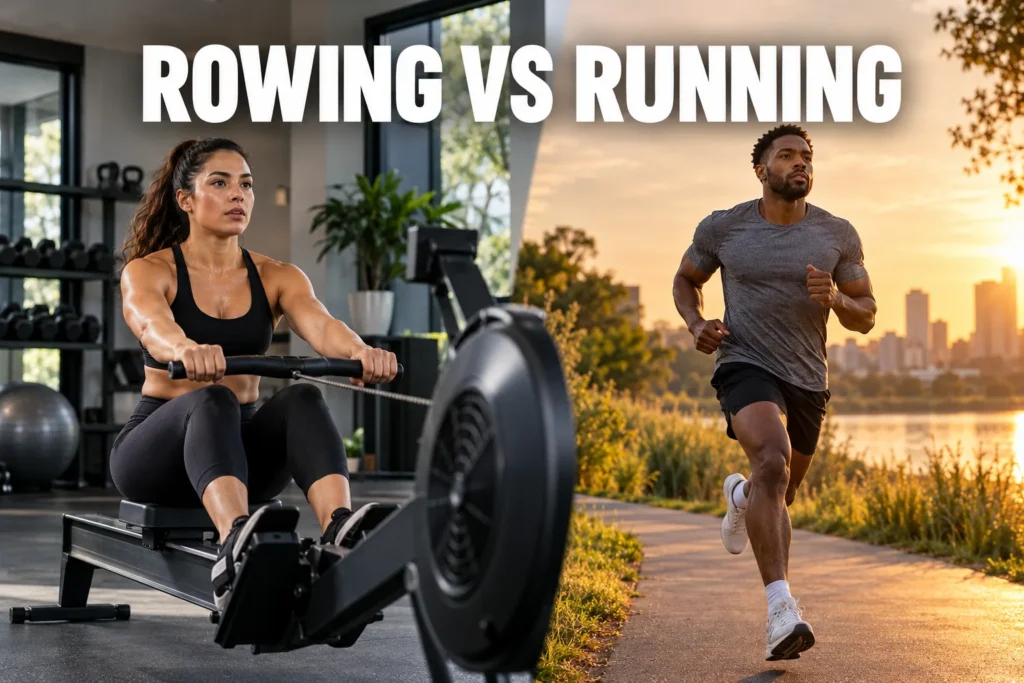
Running wins on calories per minute: at the same very hard effort, a treadmill used about 33% more energy per minute than a rower in a lab study of 30 fit men. Rowing wins if you want your legs, trunk and arms in one seated movement with no landing on each stride, and in my view many runners do best with both.
Rowing vs running comes down to what you want from your cardio. At the same very hard effort, running on a treadmill used more energy per minute than rowing in a lab study of fit, experienced men, while a rowing machine trains the legs, trunk and arms in one seated stroke with no landing on each stride. I compared the two on calorie use, joint load, the muscles each one trains, heart and lung fitness and the practical side of a home machine. Each study below is named with the people it tested, because most of them were small groups of men or patients, not the general public.
Rowing vs Running: Key Differences at a Glance
Choosing between rowing and running comes down to your goals, your joints and the equipment you have. Both are aerobic exercise that trains the heart and lungs. Running is weight-bearing: each stride lands on one leg. A rowing machine is seated: your feet stay strapped to the footrests while your legs, back and arms move the handle.
Both build aerobic fitness, and both can sit in a weight-loss plan when your overall calorie balance supports it. Neither wins for everyone, so in my view the choice turns on your joints, your goal and the time you have, with calories last.
Calorie Burn: Does Running Burn More Than Rowing?
Calorie burn is where running holds its clearest advantage in the rowing vs running comparison, but the size of the gap depends on how the two efforts are matched. Three yardsticks exist, and they must stay apart: the same felt effort in a lab, the same oxygen cost or power output, and published estimates for typical efforts. Estimates by body weight for rowing alone are in the breakdown of how many calories rowing burns.
Setting a calorie number from your rowing monitor beside one from a running app or a published table. Each uses its own method and assumptions, so compare like with like or not at all.

How Intensity and Body Weight Shift the Numbers
Same felt effort. A 2024 lab study compared seven indoor cardio machines in 30 fit, experienced men aged 35 to 49, each with more than 10 years of regular indoor-machine training, using one machine of each type; the rower was a Concept2 RowErg (1). In 12-minute bouts at RPE 17, which is "very hard" on the 6 to 20 Borg scale, mean energy use was 15.18 kcal a minute on the treadmill and 11.45 kcal a minute on the rower, about 33% more for the treadmill. The rower ranked sixth of seven machines at that effort; only the recumbent bike was lower. At maximum effort the means were 17.35 and 13.46 kcal a minute, and at that level the rower did not differ significantly from the upright or the recumbent bike. Mean heart rate at RPE 17 was about 160 beats a minute on the treadmill and 132 on the rower. A smaller effort-matched study points the same way: in 10 recreationally active men, 20 minutes at a hard effort (RPE 15) ran at 86.1% of peak oxygen uptake on a treadmill and 83.7% on a rower, with mean heart rates of about 175 and 166 beats a minute (2).
Same power or oxygen cost. A treadmill shows no watts, so there is no same-power comparison of rowing and running. The classic same-power study compared rowing with cycling: in 60 men and 47 women aged 20 to 74, rowing took more oxygen and a higher heart rate than cycling at every matched power output (3).
Published estimates. The table uses the 2024 Adult Compendium of Physical Activities (4) and the site's one calorie method: kcal = MET x body weight in kg x hours, rounded once to the nearest 10. It pairs the general vigorous rowing-machine entry (code 02070, 7.3 METs) with running at 10 minutes a mile (code 12050, 9.3 METs). These two entries are not matched for effort: a vigorous row and a 10-minute mile feel different from person to person, so read each cell as an estimate for that description only, and do not compare these values with the lab figures above.
| Body Weight | Rowing machine, vigorous (02070), 30 min | Running, 10 min/mile (12050), 30 min |
|---|---|---|
| 59 kg / 130 lb | About 220 kcal | About 270 kcal |
| 70 kg / 155 lb | About 260 kcal | About 330 kcal |
| 84 kg / 185 lb | About 310 kcal | About 390 kcal |
Effort moves these estimates more than the machine does. If your monitor shows watts, the Compendium lists rowing at 150 to 199 watts (code 02073) at 11.0 METs, the same value as running at 7 miles an hour (code 12070): about 390 kcal in 30 minutes at 70 kg for either. At the gentle end, rowing under 100 watts (code 02071, 5.0 METs) comes to about 180 kcal in 30 minutes at 70 kg, against about 260 kcal for jogging at a self-selected pace (code 12020, 7.5 METs). Over 10 minutes at 70 kg, general vigorous rowing and jogging at a self-selected pace both come to about 90 kcal on these estimates. The calorie gap matters less than the effort you can hold: a hard row and an easy jog are different workouts on any machine.
Calorie estimates for the stair machine are in the stairmaster calorie output guide.
Rowing vs Running for Fat Loss and Belly Fat
Fat use during a session is a separate question from fat loss. In 9 healthy men who did a peak test on each machine, maximal fat oxidation was higher on the treadmill (0.61 g a minute) than on the rower (0.40 g a minute) (5). That measures the share of fat in the fuel burned during exercise, not body fat lost over weeks, so it does not show that running removes more body fat.
No cardio machine targets belly fat. Fat loss comes from a sustained calorie deficit, and no trial has compared weight or fat loss from rowing alone with running alone. The rowing studies with body measures are small, in special groups and mostly without a control group, so read rowing machine before and after results with that in mind. My advice for belly fat is plain: pick the machine you will use most weeks and pair it with an eating plan you can keep.
Joint Impact: How Each Workout Loads Your Body
Joint load is often the deciding factor for people comparing rowing vs running, and the two load the body in different ways.
Why Rowing Is a Low-Impact Option
Every running stride lands on one leg, so the legs take a landing force many times in every run. On a rowing machine the seat carries your body weight, both feet stay on the footrests and there is no landing. Concept2 calls its rower a low-impact movement (6), but no study compares the joint loads of machine rowing and running directly, so "lower impact" describes the movement, not a measured safety benefit. Running injuries are common in newcomers: a 2015 review of 13 studies put the rate at about 17.8 running-related injuries per 1,000 hours of running in novice runners and 7.7 in recreational runners (7). Rowing injury studies cover competitive rowers, so they give no fair comparison for someone exercising at home.
Start each stroke with your legs, then swing your back, then pull with your arms, and keep your grip relaxed. Add minutes before you add effort, and stop if anything hurts.
In 38 older adults with mild knee osteoarthritis, 12 weeks on a computer-aided rowing system improved knee symptom scores and leg strength more than an elastic-band exercise program; after adjustment, knee extensor strength was 1.80 kg higher and hip flexor strength 4.01 kg higher in the rowing group than in the band group (8). That device was a legs-only push on a sliding seat that drove a video game, not a full stroke on a home rowing machine, and it is one small trial in people with a diagnosis; no exercise is a treatment on its own. If running or rowing hurts, stop right away (9), and check with your doctor or physical therapist before you continue. In my view, the lower back deserves the most attention on a rower: most research on rowing-related back pain comes from competitive rowers, and those figures are not a risk estimate for someone rowing at home.
Running and Bone Density
Running is weight-bearing exercise, and jogging or running is among the weight-bearing activities that NIAMS lists as putting force on bones (10); rowing is not on that list. The rowing evidence is mixed: in 17 young men new to college rowing, 7 months of training (mostly rowing, plus weights and running) raised lumbar-spine bone density by 2.9%, with no change at the hip (11). In a comparison of 20 world-class male rowers with 20 active men, total bone density did not differ significantly, but the rowers carried a larger share of their bone mineral in the trunk and a smaller share in the legs (12). In my view, if bone health is a priority, keep some running, brisk walking or other weight-bearing work in your week. MedlinePlus advises people with osteoporosis to avoid movements that bend forward from the waist or twist the spine (13). It does not mention rowing machines, but each rowing stroke starts with the upper body leaning forward, so in my view that is reason enough to ask before you row. If you have low bone density or osteoporosis, talk to a health care provider before starting an exercise program, and ask a physical therapist which movements suit you.
Muscles Worked in Rowing vs Running
This is where rowing vs running differs most. Running is driven by the legs, with the trunk holding posture. Concept2 describes rowing as a coordinated action that involves every large muscle group: the legs start the drive, the back swings the trunk open, then the arms finish the pull (14).
The same lower-body versus full-body question comes up in the stairmaster vs elliptical guide.

The Full-Body Demand of Rowing
A complete rowing stroke spans four phases: catch, drive, finish, and recovery. Each phase recruits a different set of the muscles a rowing machine works:
- Legs: the quadriceps, glutes and hamstrings drive the stroke, and the hamstrings and calves work again as you slide forward on the recovery
- Back and trunk: the back muscles work harder as the torso swings open, and the abdominals stabilize the body at the finish
- Arms and shoulders: the shoulder muscles contract through the drive, the biceps finish the pull and the triceps push the arms away on the recovery
A 2020 review describes rowing as using almost all muscles during the stroke (15), but no study gives a reliable percentage split between the legs, trunk and arms, so treat any such figure with suspicion. Rowing is first an aerobic exercise. No trial has shown muscle growth from rowing-machine training alone in healthy adults, so in my view it complements strength training rather than replacing it.
Running’s Lower-Body Focus
Running works the lower body and leaves the upper body with little load. The main muscles at work:
- Quadriceps and hamstrings for impact absorption and forward propulsion
- Glutes for hip extension and push-off power
- Calves and the Achilles tendon for elastic energy storage and release
- Core muscles (transverse abdominis, obliques) maintaining upright posture
In running the arms swing for balance and carry no load. For anyone who wants upper-body and trunk work alongside cardio, I rate rowing the more complete single machine.
Setup and technique for the stair machine are in the stairmaster setup and technique guide.
Workout templates for the stair machine are in the stairmaster workout templates guide.
Cardiovascular Benefits: Rowing vs Running Cardio
Both rowing and running push the heart and lungs hard. The sections below cover aerobic capacity, heart rate and mood.
VO2max Development and Aerobic Capacity
The usual marker of aerobic capacity is VO2max, the most oxygen your body can use in a minute, often given per kilogram of body weight.
Most rowing training studies use trained rowers. In 17 well-trained rowers aged about 15, doing two interval sessions a week instead of two extra steady sessions for 8 weeks improved VO2peak and 2,000 m time in the interval group, but the difference between the interval and steady groups was not significant, so the study does not show that intervals beat steady rowing (16). No training trial has compared rowing with running for VO2max gains in the general public. In a one-off lab test of 55 healthy young men, maximal oxygen uptake was slightly higher on a rower than on a treadmill (4.50 vs 4.35 litres a minute) (17).
Heart Rate Responses
Heart rate runs lower on a rower at the same relative intensity. In those 55 young men, heart rate on the rower was lower at each blood-lactate level and at maximum (194 vs 198 beats a minute) (17), and the 2024 machine comparison above showed the same pattern. One proposed reason is that the seated position and the larger working muscle mass help blood return to the heart (17). If you train by heart rate, set zones for each machine separately rather than assuming your normal running heart rate carries over to the rower. Go to the hospital right away or call 911 or the local emergency number if you have chest pain during or after exercise (9).
Mental Benefits and Long Term Adherence
Regular physical activity can reduce anxiety and improve sleep quality, and that applies to rowing and running alike (18). No study compares the mood effects of the two directly. I'd steer people who find treadmill sessions monotonous toward the rower, because the machine you enjoy is the one you keep using.
Does Rowing Help with Running?
Rowing can support running as cross-training: it works the glutes, hamstrings, back and trunk and adds aerobic work with no landing forces. No trial has tested whether adding rowing makes runners faster, so this is my judgement, not a finding. For a runner whose legs need a break from impact, an easy row keeps aerobic work going without extra strides.
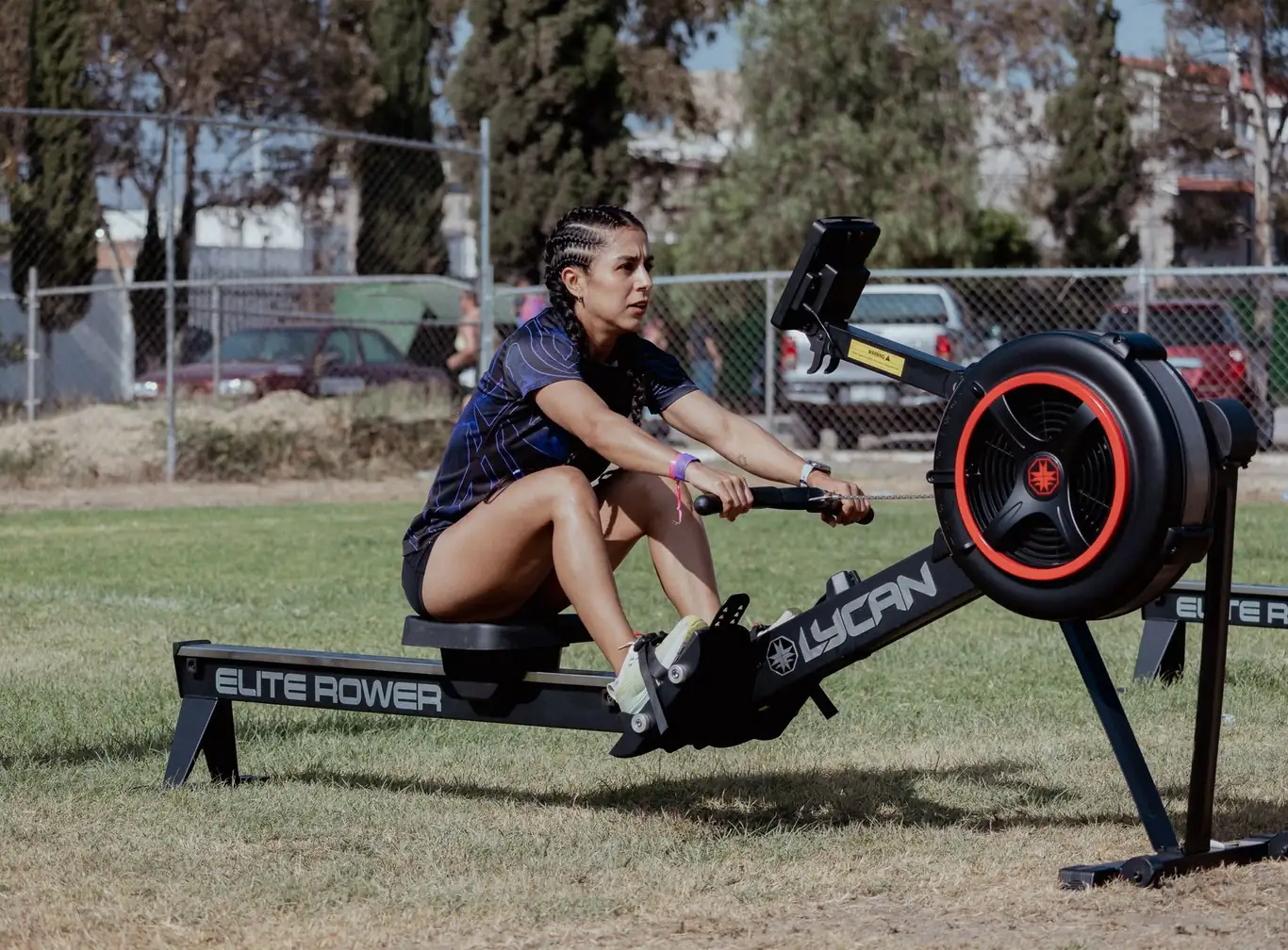
What rowing can add to a running week, in my view:
- Trunk work: the abdominals and back muscles hold and swing the trunk through every stroke
- Glute and hamstring work: both extend the hip in the drive, as they do in the running push-off
- Aerobic work without landing forces, on days when your legs need a break from impact
- Upper-back and arm work that running leaves mostly unloaded
500m rowing times depend on the machine, technique and the rower's body weight, so there is no reliable rowing-to-running distance conversion. I'd add rowing to a running week only once the stroke is learned properly, before the intensity goes up.
Rower vs Treadmill: Which Is Better for Home Use?
The rower vs treadmill decision for home comes down to space, noise and your fitness goals.
Buying criteria and machine types for a stair climber are in the stair climber machine guide.
The rowing machine set against the stair machine is covered in the stairmaster vs rowing machine guide.

Treadmill Advantages for Home Athletes
Where a treadmill pays off at home:
- Easy to start: walking and running need no new technique
- Closest to outdoor running for runners training for road events
- Weight-bearing exercise, the kind listed for bone health
- Available in many sizes, from folding walking models to full running decks
Rowing Machine Advantages for Home Athletes
Where a rower pays off at home:
- Many models store upright or fold, and the Concept2 RowErg splits into two pieces for storage
- Trains the legs, trunk and arms in one movement
- No motor or belt, though noise still varies by resistance type and model
- Seated, with no landing on each stride
| Feature | Rowing Machine | Treadmill |
|---|---|---|
| Joint Impact | Seated, no foot landing | A foot lands on every stride |
| Muscle Groups | Full body: legs, back, core, arms | Lower body dominant |
| Noise Level | No motor; varies by model | Motor and belt; varies by model |
| Weight-Bearing | No | Yes |
| Storage Footprint | Many store upright or fold | Larger; some fold |
| Technique Required | Yes (learning curve) | No new technique to learn |
Making the Final Equipment Decision
The treadmill vs rowing machine comparison has no universal winner. In my view, a rower is the better home buy if running bothers your joints or you want upper-body and trunk work with your cardio, and a treadmill is the better buy if you want the most energy per minute at a very hard effort and running feels fine (1). Floor space is often the first filter when choosing the best rowing machine for home use, and a compact rowing machine that stores upright can take less room than a running treadmill. The Concept2 RowErg with PM5 splits into two pieces for storage with no tools (6).
How to Choose Between Rowing and Running
There is no universally better option in rowing vs running. Your best choice depends on your injury history, training goals, available equipment, and what you will actually do consistently over time.
Choose Rowing If You...
- Find that running aggravates your knees, hips or ankles, and have had it checked
- Want a single cardio machine that develops your upper body, core, and legs simultaneously
- Are a runner looking for a low-impact option on recovery days
- Prefer a seated workout
- Want back and upper-body work alongside cardiovascular fitness
Choose Running If You...
- Want the most energy per minute at a very hard effort, with minimal equipment
- Want weight-bearing exercise for bone health
- Enjoy outdoor training or are preparing for running events (5K, half marathon, marathon)
- Are already proficient at running and want to maximize sport-specific performance
- Value simplicity: running needs only shoes and safe ground
In my view, the most productive plan for many runners is to combine both: keep most of your runs and add one or two rows a week. The budget rowing machines page covers lower-cost models, and you can compare current air, magnetic and water models in the rowing machines shop.
The Cardio That Fits Your Life Is the Best Cardio
Rowing vs running ultimately comes down to what you will do consistently. Running used more energy per minute at the same very hard effort and is weight-bearing; rowing trains the legs, trunk and arms with no landing on each stride. If joint load is your main concern, the list of joint-friendly cardio exercises covers more options.
The case for the stair machine is made in the stairmaster benefits guide.

For people rebuilding fitness after an injury, a rowing machine can keep aerobic work going without the landing forces of running, at a pace set with their doctor or physical therapist. For runners, I'd pick rowing as cross-training ahead of cycling, because it adds back and arm work without adding running mileage.
A combined week can be three or four runs plus one or two rows; those counts are my judgement, not a tested dose. Adults need 150 minutes of moderate-intensity or 75 minutes of vigorous-intensity activity a week, plus at least 2 days of muscle-strengthening activity, and rowing and running both count toward the aerobic part (19). If you are new to rowing, learn proper rowing form before chasing intensity, and add time before you add speed.
Frequently Asked Questions
What is 10 minutes of rowing equivalent to?
On the 2024 Compendium estimates, 10 minutes of general vigorous rowing and 10 minutes of jogging at a self-selected pace both come to about 90 kcal for a 70 kg (155 lb) person. At the same very hard effort in a lab study of 30 fit men, the treadmill used about 33% more energy per minute than the rower, so the answer depends on how hard you row.
Is 20 minutes a day on a rowing machine enough?
Twenty minutes a day adds up to 140 minutes a week, which meets the 75-minute weekly guideline if you row at a vigorous effort but falls just short of the 150 minutes if the effort is moderate. Add two days of muscle-strengthening work and vary the effort through the week.
Is running or rowing better for losing weight?
Running used more energy per minute than rowing at the same very hard effort, but no trial has compared weight loss from the two directly. Weight loss depends on a sustained calorie deficit, so the better choice is the one you will do most weeks.
How much rowing is equivalent to running?
There is no reliable distance conversion, because rowing pace depends on body weight, technique and the machine. On the Compendium estimates, rowing at 150 to 199 watts and running at 7 miles an hour carry the same 11.0 METs, so if your monitor shows watts, that is the closest published pairing.
What muscles does the rowing machine work the most?
The legs start the drive, the back then swings the trunk open and the arms finish the pull, so the stroke uses most large muscle groups in sequence. No study gives a reliable percentage split between the legs, trunk and arms.
 Tech Fitness Lab
Author
Filip Marić
I am a strength and conditioning coach and I work with professional tennis players. I hold three ISSA certifications and worked as a fitness coach at the Tipsarevic Academy. I also write for Fitness Volt. I judge equipment as a coach: what it trains, how far it lets you progress and what its numbers mean.
This content is for informational and educational purposes only. It is not a substitute for professional medical advice, diagnosis, or treatment. Always consult your healthcare provider before starting any new fitness program.
We are always looking for expert inputs to make our content even better and more useful.
References
- Prieto-Gonzalez P, Yagin FH. Energy expenditure, oxygen consumption, and heart rate while exercising on seven different indoor cardio machines at maximum and self-selected submaximal intensity. Front Sports Act Living. 2024;6:1313886. doi:10.3389/fspor.2024.1313886.
- Edwards AM, Lander PJ. Physiological responses to self-paced exercise: effort-matched comparisons across running and rowing modalities. J Sports Med Phys Fitness. 2012;52(4):344-350.
- Hagerman FC, Lawrence RA, Mansfield MC. A comparison of energy expenditure during rowing and cycling ergometry. Med Sci Sports Exerc. 1988;20(5):479-488. doi:10.1249/00005768-198810000-00009.
- Herrmann SD, Willis EA, Ainsworth BE, et al. 2024 Adult Compendium of Physical Activities: a third update of the energy costs of human activities. J Sport Health Sci. 2024;13(1):6-12. doi:10.1016/j.jshs.2023.10.010.
- Filipovic M, Munten S, Herzig KH, Gagnon DD. Maximal fat oxidation: comparison between treadmill, elliptical and rowing exercises. J Sports Sci Med. 2021;20(1):170-178. doi:10.52082/jssm.2021.170.
- Concept2. RowErg. Concept2 website. Accessed November 20, 2026.
- Videbaek S, Bueno AM, Nielsen RO, Rasmussen S. Incidence of running-related injuries per 1000 h of running in different types of runners: a systematic review and meta-analysis. Sports Med. 2015;45(7):1017-1026. doi:10.1007/s40279-015-0333-8.
- Lin PL, Yu LF, Kuo SF, Wang XM, Lu LH, Lin CH. Effects of computer-aided rowing exercise systems on improving muscle strength and function in older adults with mild knee osteoarthritis: a randomized controlled clinical trial. BMC Geriatr. 2022;22(1):809. doi:10.1186/s12877-022-03498-2.
- MedlinePlus. How to avoid exercise injuries. US National Library of Medicine. Accessed November 20, 2026.
- National Institute of Arthritis and Musculoskeletal and Skin Diseases. Exercise for your bone health. National Institutes of Health. Accessed November 20, 2026.
- Cohen B, Millett PJ, Mist B, Laskey MA, Rushton N. Effect of exercise training programme on bone mineral density in novice college rowers. Br J Sports Med. 1995;29(2):85-88. doi:10.1136/bjsm.29.2.85.
- Mourtakos S, Kavouras S, Vasiliou S, et al. Bone mineral content distribution in response to long-term training of elite rowers. In Vivo. 2023;37(2):611-617. doi:10.21873/invivo.13119.
- MedlinePlus. Osteoporosis. US National Library of Medicine. Updated September 30, 2025. Accessed November 20, 2026.
- Concept2. Rowing muscles used. Concept2 website. Accessed November 20, 2026.
- Volianitis S, Yoshiga CC, Secher NH. The physiology of rowing with perspective on training and health. Eur J Appl Physiol. 2020;120(9):1943-1963. doi:10.1007/s00421-020-04429-y.
- Kirchenberger T, Ketelhut S, Ketelhut RG. Effects of moderate- versus mixed-intensity training on VO2peak in young well-trained rowers. Sports (Basel). 2021;9(7):92. doi:10.3390/sports9070092.
- Yoshiga CC, Higuchi M. Heart rate is lower during ergometer rowing than during treadmill running. Eur J Appl Physiol. 2002;87(2):97-100. doi:10.1007/s00421-002-0599-z.
- Office of Disease Prevention and Health Promotion. Top 10 things to know about the second edition of the Physical Activity Guidelines for Americans. US Department of Health and Human Services. Accessed November 20, 2026.
- Centers for Disease Control and Prevention. Adult activity: an overview. Published December 20, 2023. Accessed November 20, 2026.