
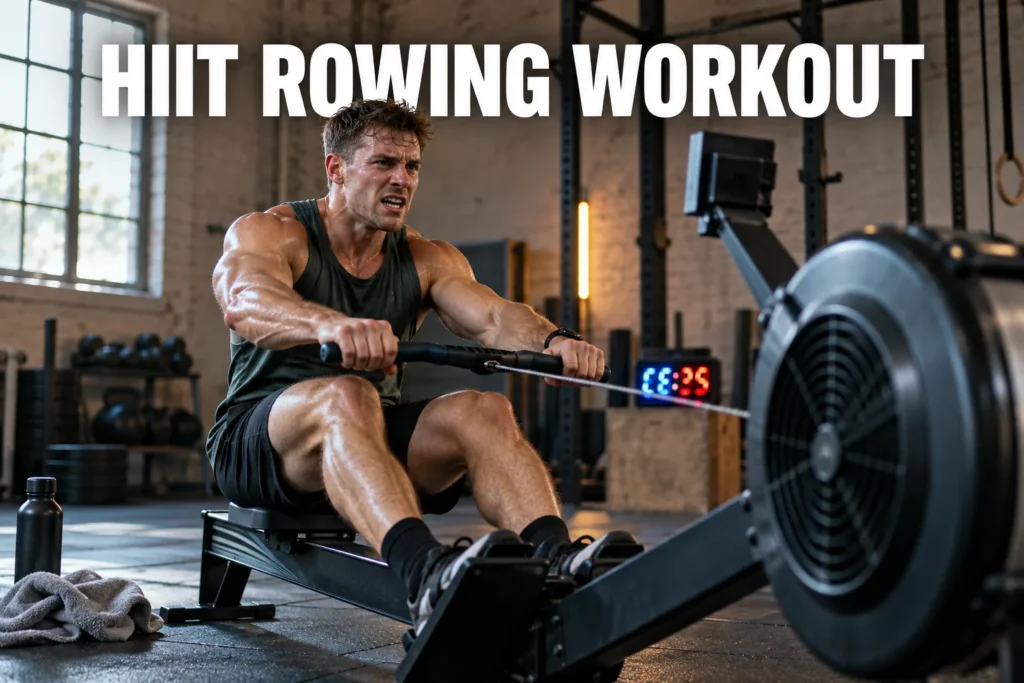
A hiit rowing workout combines two of the most time-efficient tools in cardio training: the full-body demand of the rowing stroke and the metabolic output of interval-based effort. Fat loss, endurance gains, and cardiovascular capacity all respond strongly to this pairing, and the rowing machine delivers it without the joint stress of running or jumping. I have coached beginners and competitive athletes through these exact interval formats on air and magnetic rowers, and I still row them myself. The plans below are the ones I actually use, with honest notes on where each one falls short. You will find 20-minute beginner sessions, 30-minute fat-loss workouts, a four-week progression plan, and the technique faults I correct most often.

HIIT Rowing Workout: How This Format Activates Every Muscle Group
A hiit rowing workout loads more muscle per minute than most cardio formats, because the muscles a rowing machine works span the legs, core, back, shoulders, and arms in a single coordinated movement: roughly 60% of power comes from the legs, approximately 20% from the core, and 20% from the upper body, according to widely-used coaching guidelines from Concept2 and other major rowing organizations. This is a well-established training heuristic rather than a fixed biomechanical constant, as actual force distribution shifts with athlete experience level. Applying a HIIT protocol to that movement means pushing multiple major muscle systems toward near-maximal output during every work interval.
Why Rowing and HIIT Work So Well Together
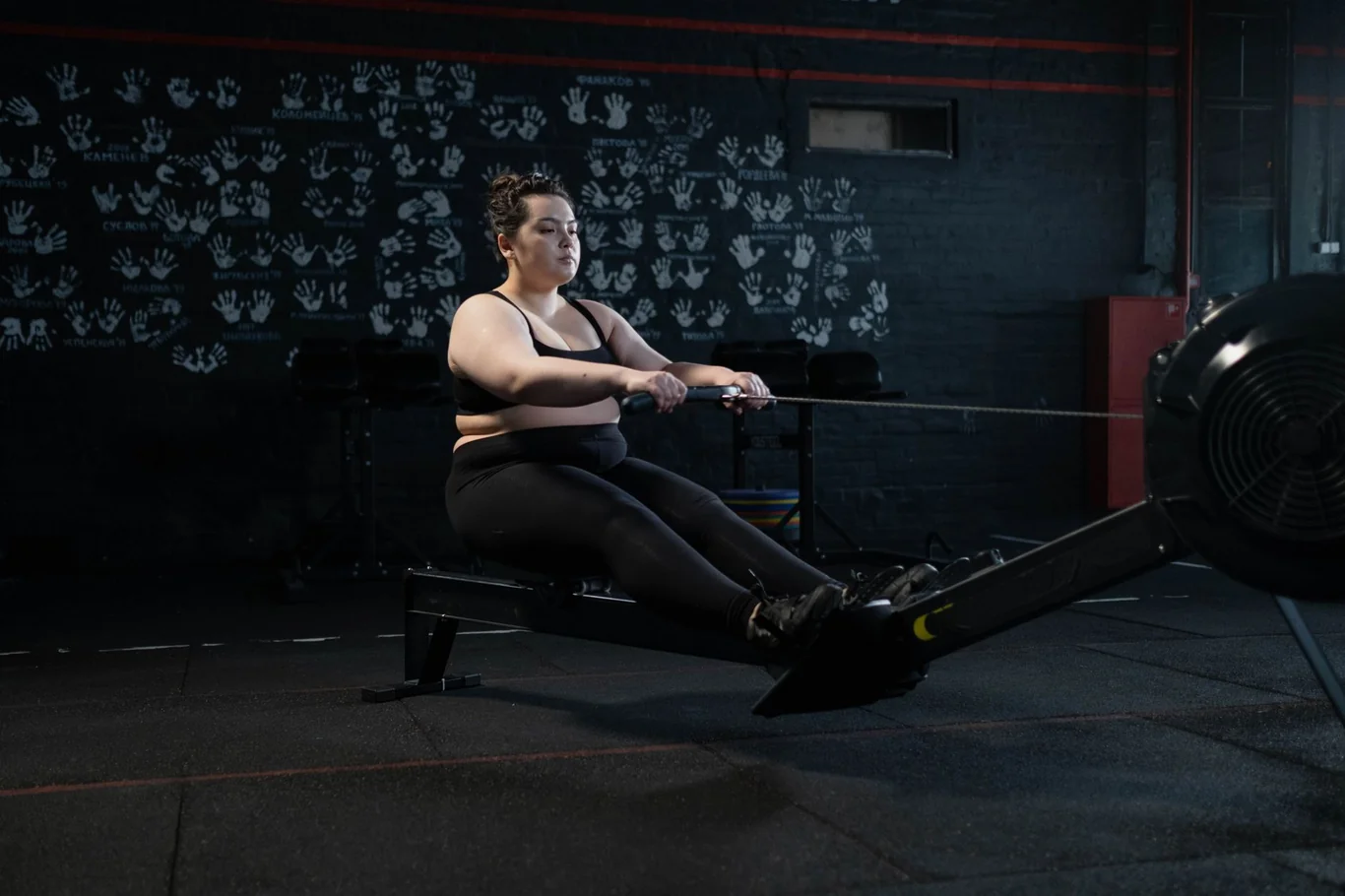
HIIT (high-intensity interval training) alternates short bursts of hard effort with structured recovery periods. This structure suits rowing particularly well because the machine lets you shift from a slow, easy stroke to near-maximal effort within seconds, without changing equipment or leaving the seat. You control intensity through stroke rate and how hard you drive each stroke, which means beginners and experienced athletes can use the same machine at very different physiological demands.
Rowing also keeps impact on hips, knees, and ankles low. For anyone who finds running-based HIIT hard on their joints, a hiit rowing machine workout delivers comparable cardiovascular stimulus without repetitive ground contact. That joint-friendly profile is the biggest practical difference between rowing and running for most people I coach, and it is why I move joint-sensitive clients onto the rower for their hardest interval days.
The core rowing machine workout benefits of adding HIIT structure to your rowing sessions include:
- Cardiovascular efficiency - peak heart rate and oxygen uptake match other high-intensity formats
- Time savings - 20-minute HIIT sessions produce adaptations comparable to longer steady-state efforts
- Low joint impact - no repeated ground-strike forces on ankles, knees, or hips
- Full-body demand - upper body, lower body, and core all engage on every stroke
- Scalability - adjusting stroke rate and effort level scales the workout to any fitness level
What the Research Says About Rowing HIIT Performance
A 2025 randomized crossover study published in Sports Medicine and Health Science measured the cardiometabolic response to rowing-based HIIT in 22 active adults. Participants reached a peak heart rate of 167 plus or minus 15 beats per minute, approximately 92% of maximum heart rate, with a mean oxygen uptake of 1.93 plus or minus 0.50 L/min (1). That cardiovascular demand is comparable to other high-intensity formats, but with lower blood lactate accumulation, which suggests rowing HIIT may be more sustainable across multiple sessions per week.
A 2025 systematic review and network meta-analysis of 51 controlled trials confirmed that HIIT, sprint interval training, and repeated sprint training all significantly increased VO2max compared to control groups (2). The review spanned multiple sport modalities rather than rowing exclusively, but identified an effective general interval structure: approximately 140-second work intervals, 165-second recovery periods, and three sessions per week across 3 to 6 weeks.
When I coach rowing intervals, I give more weight to power per stroke than stroke rate at beginner level. Athletes who chase SPM before building leg drive tend to plateau sooner than those who focus on improving their split time. I saw this clearly with a 29-year-old client who held 30 SPM on every interval for three weeks without moving his split; when I capped him at 24 SPM and asked for a harder leg push, his average split dropped by about 6 seconds within two weeks. The cardiovascular data above reflects why: the rowing machine rewards efficient mechanics over raw output.
How to Build a HIIT Rowing Workout Session
Every effective hiit rowing workout shares the same foundational structure: a warm-up, alternating work and rest intervals, and a cooldown. The variables you control are work duration, rest duration, stroke rate, and total session length. Adjusting these variables changes whether you are targeting fat loss, cardiovascular capacity, or muscular endurance.
Work-to-Rest Ratios That Drive Adaptation
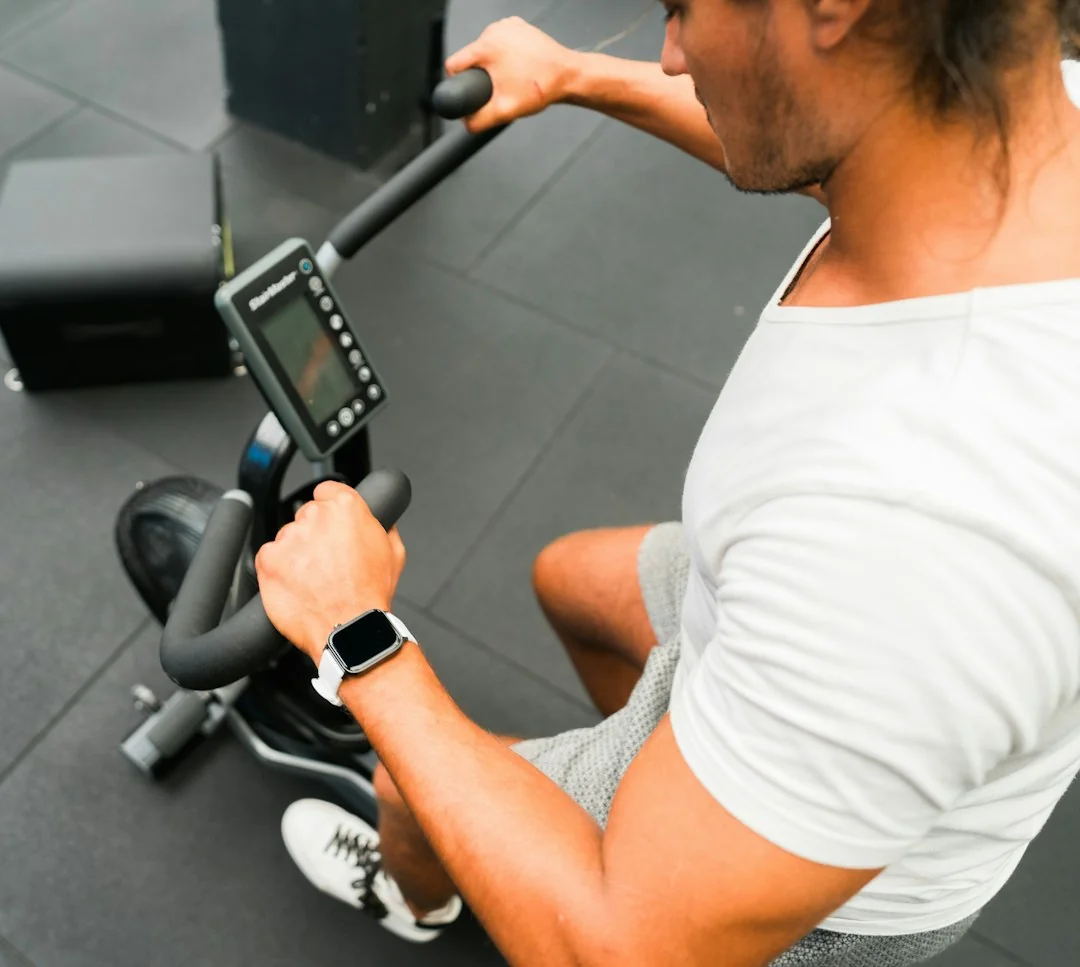
The work-to-rest ratio is the most important variable in your programming. The table below maps ratios to fitness levels and goals.
Ratio | Work Duration | Rest Duration | Best For |
1:2 | 20 sec | 40 sec | Beginners, weeks 1-4 |
1:1 | 30 sec | 30 sec | Intermediate, weeks 4-8 |
1:1 | 1 min | 1 min | Aerobic base and fat loss |
2:1 (Tabata) | 20 sec | 10 sec | Advanced, 8+ weeks |
Long interval | 2 to 4 min | 2 to 3 min | VO2max development |
A 1:2 ratio is the most beginner-accessible option because extended recovery lets your heart rate drop before the next interval starts. A 1:1 ratio suits intermediate athletes who can maintain stroke quality under moderate fatigue. Tabata-style intervals at a true 20 second maximum effort are intense: they are only appropriate for athletes who have already built four or more weeks of lower-intensity interval base. This is where I push back on most beginner programs I see: eight clean rounds at 1:2 build more fitness than a ragged all-out Tabata that breaks down after a few intervals.
Stroke Rate and Split Time Targets
Stroke rate (strokes per minute, or SPM) is your rowing equivalent of pace. For HIIT work intervals, beginners should target 22 to 26 SPM with an emphasis on power per stroke rather than spinning the handle quickly. Intermediate and advanced rowers can push 26 to 32 SPM during sprint intervals. A low stroke rate with strong leg drive outperforms a high stroke rate with weak, arm-dominated pulls.
500m split time is the rower's primary pace metric: it shows how long it would take to row 500 meters at your current effort level. Split times depend heavily on sex, age, body weight, and the machine's damper setting, which is why full 500m rowing benchmarks are broken down by age and sex. The ranges below are starting reference points for interval work rather than fixed standards.
Fitness Level | Work Interval Split (per 500m) | Stroke Rate |
Beginner | 2:30 to 3:00 | 20 to 24 SPM |
Intermediate | 2:00 to 2:30 | 24 to 28 SPM |
Advanced | 1:45 to 2:00 | 26 to 32 SPM |
Four HIIT Rowing Workout Plans You Can Start Today
A solid hiit rowing workout plan starts simple and builds deliberately. Short work intervals, long recovery periods, and strict attention to stroke mechanics form the foundation. Volume and intensity increase only after the movement pattern becomes reliable under fatigue. The four plans below cover a range of goals and fitness levels. Each plan fits on a single page, so you can save it as a rowing machine workout plan pdf and keep it beside the rower.
20-Minute HIIT Rowing Workout for Beginners
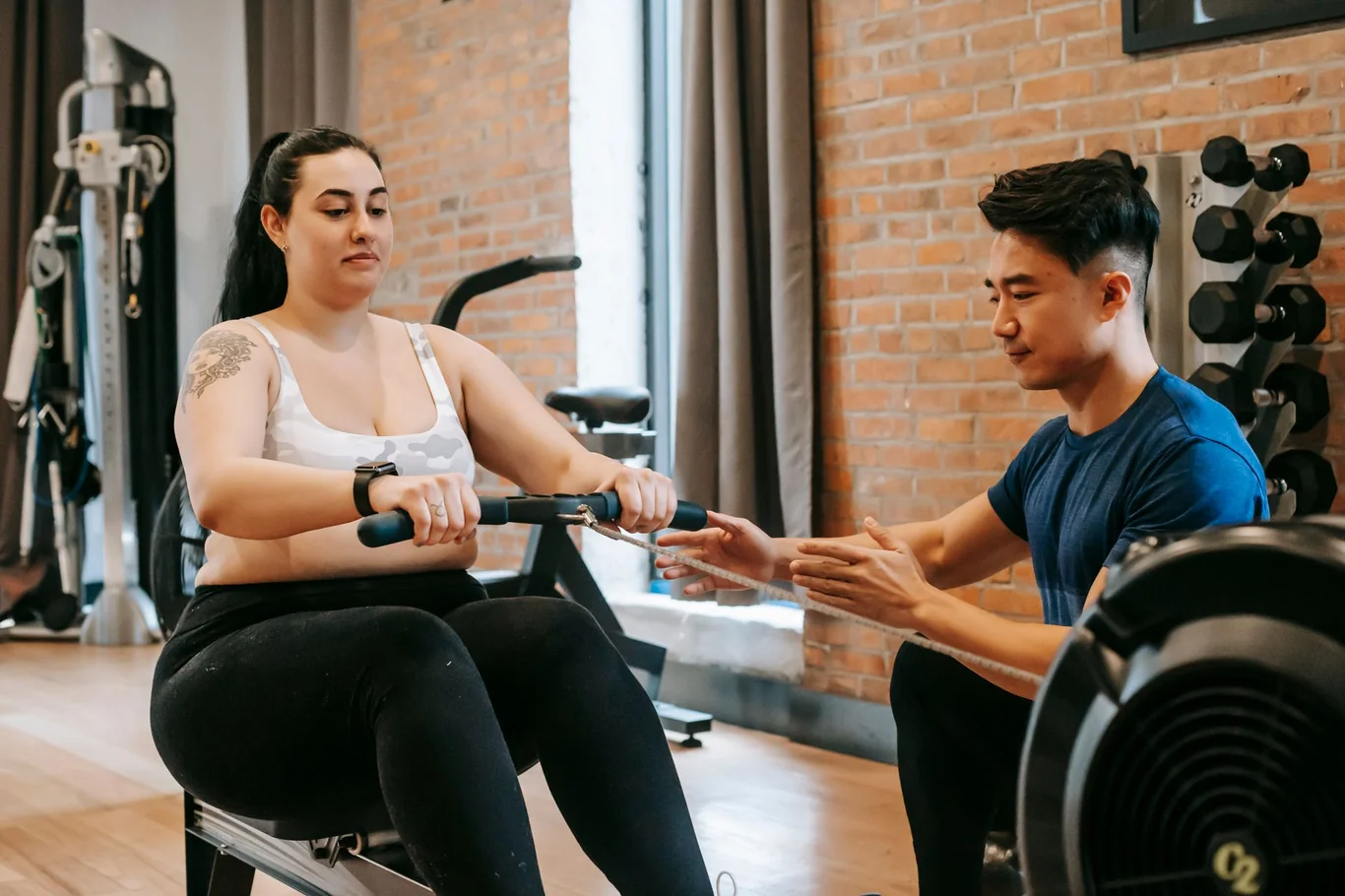
This hiit rowing workout for beginners suits athletes who are new to the rowing machine or returning after time away. If you have never rowed before, spend one easy session learning how to use a rowing machine first. In my experience, beginners who lock in proper stroke mechanics before their first interval day progress faster and complain far less about their lower back. If you are still choosing a machine, the beginner-friendly rowing machines with smooth, predictable resistance make this first week much easier.
Session structure (20 minutes total):
- 3 minutes: easy warm-up at 18 to 20 SPM, focus entirely on leg drive and smooth recovery
- 8 rounds: 20 seconds at 22 to 24 SPM with strong effort, then 40 seconds easy rowing
- 5 minutes: steady-state row at comfortable pace to maintain movement quality
- 4 minutes: cooldown at 16 to 18 SPM with gradual reduction in effort
Keep your damper setting at 3 to 5 on Concept2 machines, or at the equivalent mid-range on other rower brands. A damper set too high slows the flywheel response and turns each stroke into a grind rather than a sprint. On Concept2 rowers, you can also monitor your drag factor (a setting of 110-130 is appropriate for most HIIT programming) in the monitor's Settings menu to standardize intensity across different machines. I program most of my interval sessions on a Concept2 RowErg with PM5 for exactly this reason, because a repeatable drag factor lets me compare a client's week 1 and week 6 intervals fairly.
10-Minute HIIT Rowing Workout: Quick Option
This hiit rowing workout variation strips the session down to a 10-minute quick option for time-constrained days or active recovery. It maintains enough cardiovascular stimulus to keep the rowing workout habit consistent even on your busiest weeks.
Session structure (10 minutes total):
- 2 minutes: easy warm-up at 18 to 20 SPM
- 6 rounds: 20 seconds at 22 to 24 SPM with hard effort, then 40 seconds easy rowing
- 2 minutes: cooldown at 16 to 18 SPM
This short version does not replace your longer hiit rowing workout sessions. I program it for days when the real alternative is skipping training altogether, because keeping the habit alive matters more than any single session. Use it on a third training day when time is limited, or as a standalone effort on recovery days to keep movement quality sharp without adding cumulative fatigue.
30-Minute HIIT Rowing Workout for Fat Loss
This 30 minute rowing workout targets fat loss and cardiovascular output for intermediate athletes who can sustain higher intensity across longer work intervals. Equal work and rest periods maintain power quality across all rounds.
Session structure (30 minutes total):
- 3 minutes: progressive warm-up building from 18 to 24 SPM
- 10 rounds: 1 minute at 24 to 28 SPM with hard effort, then 1 minute easy
- 5 minutes: steady-state at moderate pace
- 2 minutes: cooldown with gradual decrease in rate and effort
Total high-intensity work time is 10 minutes inside a 30-minute session. If the final three rounds feel controlled and your stroke rate holds, increase your split pace by 10 to 15 seconds per 500m in your next session. My tip: write down the split of round 1 and round 10; if round 10 is more than 8 seconds slower, you started too hard.
20-Minute HIIT Rowing Workout: Advanced Tabata Format
The advanced 20-minute hiit rowing workout uses Tabata-style intervals as its centerpiece. True Tabata requires 8 rounds at maximum effort with only 10 seconds of rest between rounds. I recommend starting with two Tabata blocks separated by two minutes of full rest rather than chaining blocks back to back.
Session structure (20 minutes total):
- 4 minutes: warm-up at 20 to 22 SPM
- Block 1: 8 rounds of 20 sec at maximum effort / 10 sec rest (4 minutes)
- 2 minutes: full rest or very easy rowing
- Block 2: 8 rounds of 20 sec at maximum effort / 10 sec rest (4 minutes)
- 2 minutes: easy recovery
- 4 minutes: cooldown
Spend the first two weeks on Block 1 only before adding Block 2. I learned this the hard way in my own training: the first time I chained two blocks without the full rest, my last four rounds turned into arm pulls. Tabata rowing at genuine maximum effort is not appropriate unless you have completed at least four weeks of lower-intensity interval training.
HIIT Rowing Workout Plan for Beginners: 4-Week Progression
This rowing machine workout plan for beginners uses a rolling four-week block that builds frequency and intensity gradually. Print the table or save a screenshot so the rowing machine workout plan is in front of you during each session.
Week | Sessions Per Week | Interval Format | Session Duration |
1 | 2 | 20 sec on / 40 sec off, 8 rounds | 20 min |
2 | 2 to 3 | 25 sec on / 35 sec off, 8 rounds | 22 min |
3 | 3 | 30 sec on / 30 sec off, 8 rounds | 22 min |
4 | 3 | 1 min on / 1 min off, 8 rounds | 28 min |
After week 4, you can transition to the intermediate 30-minute fat-loss format. If you experience joint discomfort or sharp lower-back pain during any session, stop and evaluate your form before continuing. The most common causes are a rounded lower back at the catch or a damper set too high for your current strength level, the same two faults I see behind most rowing-related back pain.
Rowing Machine Workout for Weight Loss: What the Evidence Shows
The case for a rowing machine workout for weight loss rests on two solid pillars: calorie expenditure during sessions and the post-exercise metabolic elevation that follows high-intensity work. Both effects are real, and both depend on variables specific to you, such as body weight, session intensity, and how consistently you train. In my experience, rowing for weight loss works best when interval days and eating habits are planned together.

Calorie Burn Ranges During HIIT Rowing
Calorie burn during a hiit rowing workout varies with body weight, sex, age, stroke rate, and the specific interval structure you use. The rowing machine workout benefits for body composition extend well beyond the session window itself. An 8-week intervention study published in Frontiers in Endocrinology found that participants completing a combined rowing and cycling HIIT program three times per week reduced total fat mass by 1.6 to 2.3 kg and gained 0.6 to 1.5 kg of lean body mass across fitness levels that included both individuals with obesity and lean controls (3). That is a meaningful body composition shift in two months of consistent training.
General estimates for 30 minutes of rowing at moderate to vigorous intensity range from roughly 210 to 440 calories depending on body weight and effort level. HIIT rowing pushes toward the upper end of this range because of elevated heart rate and greater total muscle recruitment during work intervals. A heart rate monitor gives you the most practical real-world calorie feedback during sessions. I treat the calorie number on any rower monitor or watch as a rough estimate, and I find it more useful for comparing one session against another than for matching against a food log.
HIIT Rowing vs. Steady-State Rowing for Fat Loss
Steady-state rowing at a consistent moderate pace burns calories during the session but does not generate the same post-exercise oxygen consumption (EPOC) elevation as HIIT. EPOC is the increased calorie burn that continues after a high-intensity session ends, a result of the body restoring oxygen stores, clearing lactate, and repairing tissue stressed by near-maximal effort. Research consistently shows that HIIT produces greater EPOC than steady-state cardio of equal duration, with measured EPOC values roughly double those of moderate-intensity continuous training (4). This contributes to HIIT's efficiency for fat-loss goals over the full 24-hour recovery window.
The most practical approach combines both formats. A balanced rowing machine workout for weight loss uses two to three HIIT sessions - including at least one 20-minute high-intensity row - and one steady-state session per week, with the steady-state row serving as both active recovery and aerobic base maintenance. A week I often give clients looks like HIIT on Monday and Thursday, a steady row on Saturday, and full rest or walking in between.
Rowing Machine Workout for Beginners: Form Fixes That Prevent Injury
Good technique is not optional in rowing. Poor form limits power output and transfers load to the lower back and shoulders in ways that accumulate over weeks of training. A rowing workout performed with clean mechanics builds strength and fitness. The same rowing workout performed with sloppy mechanics builds overuse injuries.
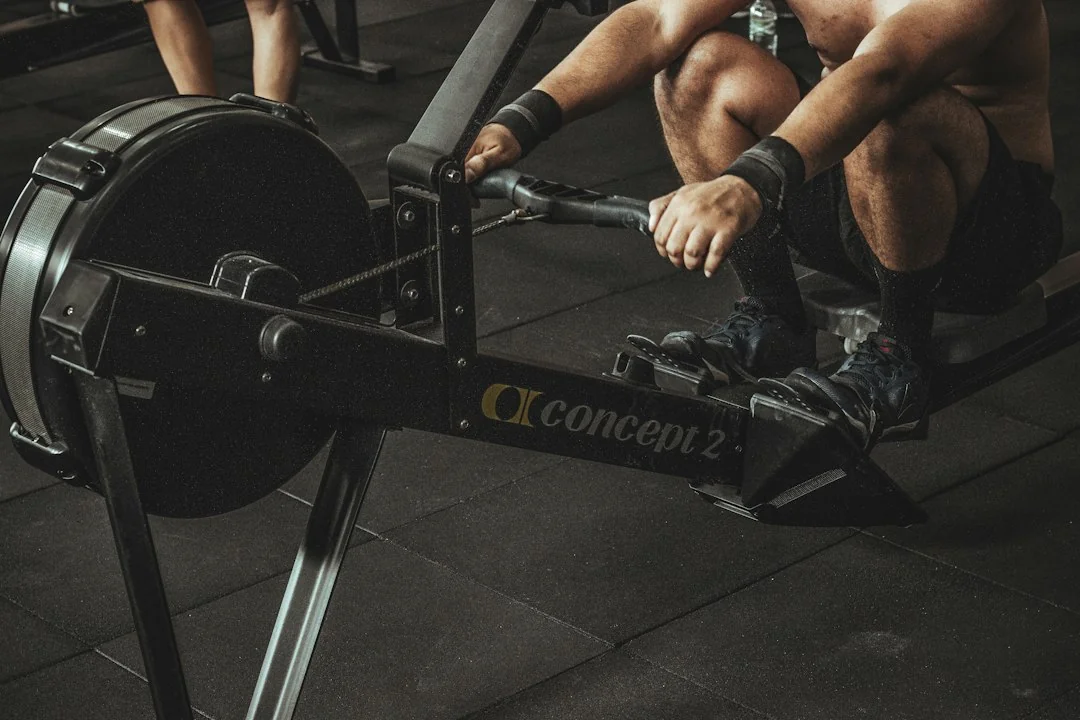
The Four Phases of an Efficient Rowing Stroke
Every rowing stroke consists of four distinct phases. Mastering their sequencing prevents the most common power leaks and injury risks.
- The catch - shins are vertical, arms are long, torso hinges slightly forward from the hips. Do not reach excessively forward, which rounds the lower back under load.
- The drive - push through both feet simultaneously, extending the legs before any arm pull begins. The legs generate the power; the arms transmit it.
- The finish - legs are fully extended, the handle is drawn to the lower chest, shoulders are slightly behind hips. Hold this position briefly with control.
- The recovery - arms extend first, then the torso hinges forward, then the knees bend to slide forward on the seat. This sequence is the reverse of the drive. Rushing it is the most common beginner error.
Keep your grip relaxed throughout. A tight grip fatigues the forearms and stiffens the shoulders, which reduces stroke efficiency across longer intervals.
Common Mistakes That Limit Power Output
Most form errors in a hiit rowing machine workout fall into predictable patterns that are easy to correct once you know what to look for:
- Early arm pull - yanking the handle before the legs have driven through wastes most of the power your legs were supposed to generate; fix by thinking "legs, then body, then arms"
- Rounded lower back at the catch - rounding under load on every stroke stresses the lumbar spine repetitively; fix by hinging from the hip, not the waist
- Rushed recovery - sliding forward before the handle clears the knees creates a collision that breaks rhythm and increases split time; slow the slide to fix it
- Damper set too high - a damper at 10 (maximum) slows flywheel responsiveness and favors raw strength over cardiovascular output; most athletes train effectively at 3 to 5
- Skipping the warm-up - entering sprint intervals on a cold body is the fastest route to a pulled muscle or back strain
I have found that spending the first two minutes of every session at 16 to 18 SPM with deliberate attention to each phase ingrains the pattern before fatigue sets in. That habit carries over directly into the power and consistency of your high-intensity intervals.
How Often to Do HIIT Rowing Workouts for Best Results
For most people, two to three hiit rowing workouts per week is the effective starting frequency. Yang et al. (2025) identified three sessions per week as the standard dose for VO2max gains in a network meta-analysis of trained athletes across multiple sport modalities. A parallel randomized controlled trial with competitive youth rowers found that twice-weekly HIIT produced statistically significant improvements in relative VO2peak, increasing from 59.4 to 62.1 mL per kg per minute, and improved 2000-meter rowing performance over eight weeks (5). Recreational rowers adapting to the same protocol can expect a comparable directional response, though absolute gains depend on training age and baseline fitness.
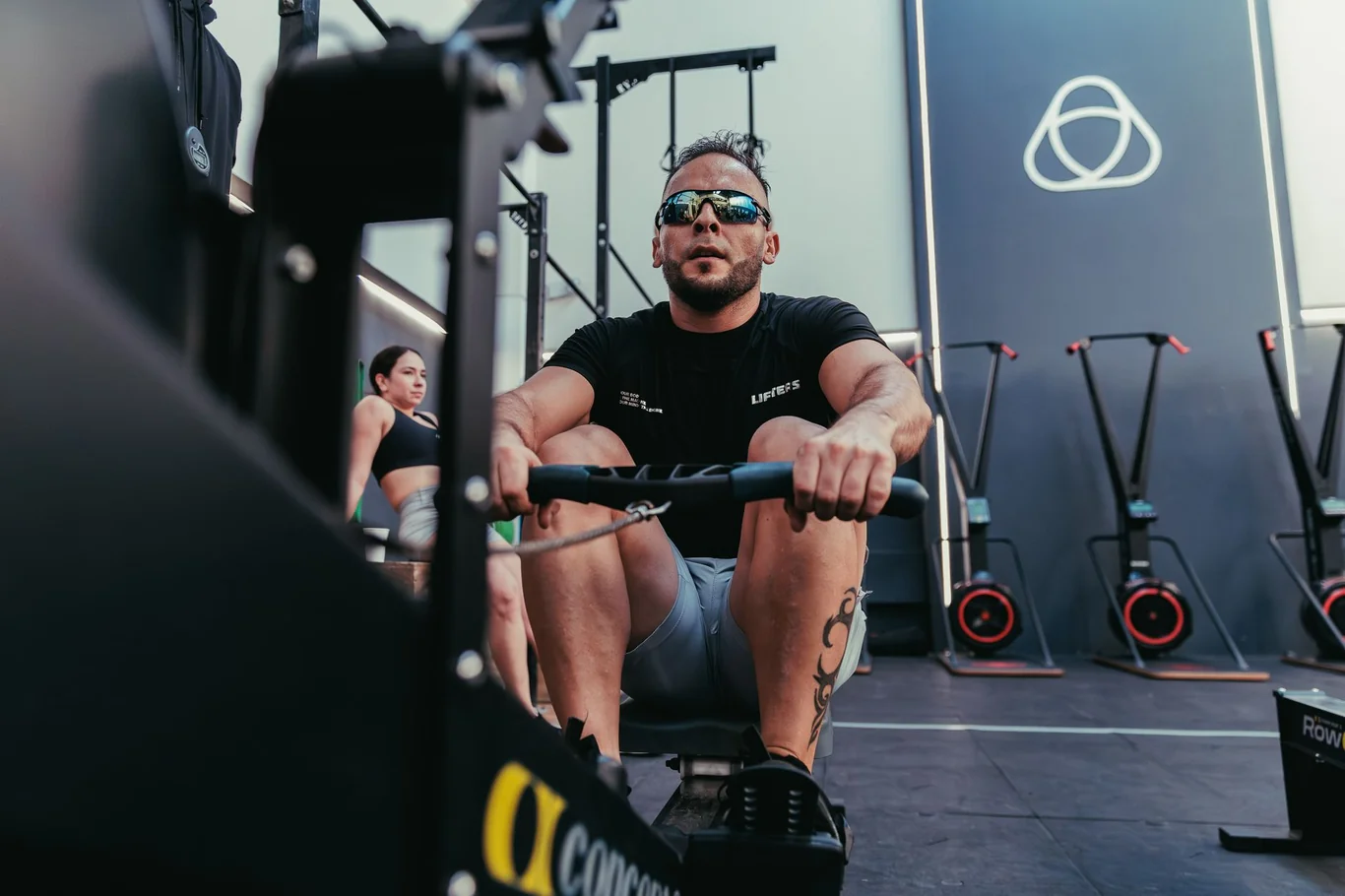
Rest days between HIIT sessions give the muscular and cardiovascular systems time to adapt. Rowing daily at high intensity is not recommended in the first three months, because the coordinated movement pattern requires time to become reliable under fatigue. On off days, a short 15 to 20-minute steady-state row at 18 to 20 SPM supports recovery without adding cumulative fatigue, and it slots neatly into a full weekly rowing workout plan alongside your interval days.
Progress tracking is what converts effort into improvement. Record your average 500m split time, your stroke rate, and your session duration after every workout. The split time improvement you see from week 2 to week 8 will be the clearest evidence that the training is working. A wearable device makes tracking heart rate per session straightforward, but constant gripping and wrist flexion on the rower can disturb optical sensors, which is a known limit of smartwatch heart rate accuracy. For interval work I prefer a chest strap, and I use the watch reading mainly to compare sessions.
Building Your Best HIIT Rowing Routine
A hiit rowing workout is one of the most effective cardio formats available because it applies measurable intensity to a full-body movement with minimal joint impact. The research supports VO2max gains, fat mass reduction, and cardiovascular efficiency improvements across a range of fitness levels and training durations. Start with the beginner 20-minute plan, progress through the four-week block, and introduce longer intervals or Tabata formats when the basics feel consistent and automatic.
I track split times from the very first session with every athlete who starts rowing-based HIIT. The number from week one becomes a personal baseline, and watching it drop steadily over months is one of the clearest feedback signals available in cardio training. For interval work I favor rowers with a responsive flywheel and a monitor that shows split time and stroke rate on every stroke, the same traits that decide the ranking of the best rowers for conditioning. If you also care about noise, footprint, or water resistance, the broader rowing machine rankings cover those trade-offs, and the rowing machines shop lists the air and magnetic models I would trust for hard intervals.
FAQs
Is rowing a good HIIT workout?
Rowing is an excellent platform for HIIT because the machine allows you to shift from very low to near-maximal effort within seconds without changing equipment or setup. A 2025 randomized crossover study recorded peak heart rates of approximately 92% of maximum during rowing HIIT, confirming that the format generates cardiovascular demand comparable to other high-intensity training methods.
Is 10 minutes of rowing a day enough?
Ten minutes of daily rowing provides a genuine cardiovascular stimulus for beginners, especially when structured as intervals rather than a slow continuous pace. For meaningful fat loss or VO2max improvements, research points to sessions of 20 minutes or longer at two to three times per week as the effective minimum dose for measurable adaptation.
How much rowing equals 10,000 steps?
Rowing does not map directly to step counts because it is a non-ambulatory movement, but 10,000 steps typically represents roughly 60 to 75 minutes of moderate-pace walking or approximately 30 to 40 minutes of moderate-intensity rowing based on comparable energy expenditure estimates. The exact equivalency depends on body weight, stroke rate, and effort level throughout the session.
Can rowing reduce belly fat?
Rowing can contribute to overall fat reduction, including abdominal fat, because the body reduces fat stores across its entire system rather than from one targeted area. An 8-week rowing-based HIIT intervention found a reduction of 1.6 to 2.3 kg of total fat mass across participants, with changes distributed throughout the body rather than concentrated in any single region.
This content is for informational and educational purposes only. It is not a substitute for professional medical advice, diagnosis, or treatment. Always consult with your healthcare provider before starting any new fitness program or using fitness technology for health monitoring.
We are always looking for expert inputs to make our content even better and more useful.
References
- Astorino TA, Mower M, Flores A, Flannery M. Cardiometabolic response to high intensity functional training versus rowing-based high intensity interval training. Sports Medicine and Health Science. 2025;8(3):311-318. doi:10.1016/j.smhs.2025.01.003.
- Yang Q, Wang J, Guan D. Comparison of different interval training methods on athletes' oxygen uptake: a systematic review with pairwise and network meta-analysis. BMC Sports Science, Medicine and Rehabilitation. 2025;17:156. doi:10.1186/s13102-025-01191-6.
- Petersen MH, de Almeida ME, Wentorf EK, Jensen K, Ortenblad N, Hojlund K. High-intensity interval training combining rowing and cycling efficiently improves insulin sensitivity, body composition and VO2max in men with obesity and type 2 diabetes. Frontiers in Endocrinology. 2022;13:1032235. doi:10.3389/fendo.2022.1032235.
- Faleiro MJ, et al. Isocaloric High-Intensity Interval and Circuit Training Increases Excess Post-Exercise Oxygen Consumption and Lipid Oxidation Compared to Moderate-Intensity Continuous Training. Sports (Basel). 2025. doi:10.3390/sports13100355.
- Kirchenberger T, Ketelhut S, Ketelhut RG. Effects of Moderate- versus Mixed-Intensity Training on VO2peak in Young Well-Trained Rowers. Sports (Basel). 2021;9(7):92. doi:10.3390/sports9070092.