
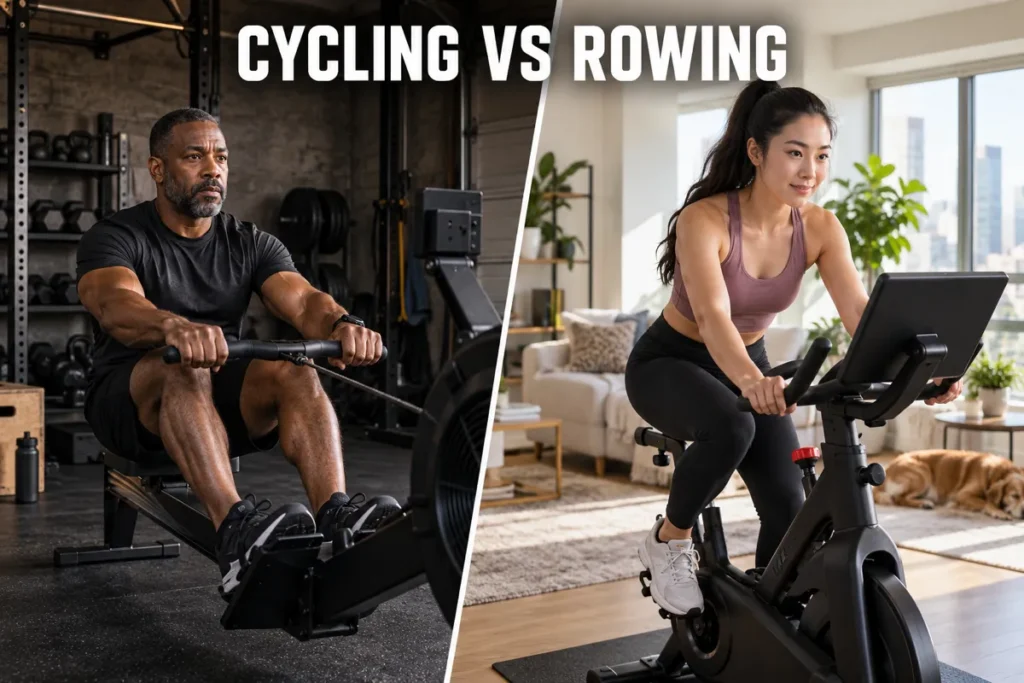
Cycling and rowing both deliver low-impact cardiovascular training, burn serious calories, and suit a wide range of fitness levels, but the wrong choice for your goals, back health, or available space can quietly limit your progress. Having trained on both and coached athletes through this exact decision, the answer almost always depends on injury history and training goals more than any single fitness metric.
In this guide, I'll break down the real differences - calorie burn, muscle activation, cardiovascular demand, injury risk, and long-term consistency - and cover the assault bike vs rower matchup for HIIT-focused home gyms. By the end, you'll have a clear framework for deciding which machine fits your goals.

Cycling vs Rowing - Calorie Burn, Muscles, and Cardio at a Glance
When comparing cycling vs rowing, the most useful starting point is a direct side-by-side snapshot. Most training decisions come down to how many calories you burn, how many muscles you recruit, and what kind of cardiovascular demand each session creates. The table below summarizes both machines for a 155-lb (70 kg) person working at a vigorous pace.
Metric | Stationary Cycling | Rowing Machine |
Calorie burn (60 min, vigorous) | 420-630 kcal | 500-750 kcal |
Primary muscles | Quadriceps, glutes, hamstrings | Full body - legs, back, core, arms |
VO2max development | High | Higher |
Fat oxidation rate | Baseline | ~45% higher than cycling |
Lower back demand | Low | Moderate |
Learning curve | Low | Moderate (3-4 weeks) |
Suitable for back pain history | Yes | Caution advised |
Both machines belong in the low-impact cardio category, which is why coaches and clinicians recommend them as injury-friendly alternatives to running. Where rowing machine vs cycling differs most is in muscle recruitment breadth, fat oxidation rate, and the technical investment needed to get full value from the rowing stroke. Our how to choose an exercise bike guide covers the bike side of this decision in more depth if cycling is your primary focus.
Which Machine Burns More Calories - Cycling or Rowing?
Calorie burn is the first question most people ask when comparing these two machines, and the honest answer requires a range rather than a single number. Neither machine has a fixed calorie output - intensity, body weight, session duration, and individual metabolic rate all shift the result meaningfully. Different cardio machines produce meaningfully different energy expenditure outcomes even at matched effort levels (1). I've seen athletes track identical heart rate targets on a rower and a bike and land at noticeably different calorie counts - machine type and the muscle mass recruited both play a role.
Calorie Burn Ranges by Intensity
For a person weighing 155 lb (70 kg), a 60-minute vigorous rowing session burns approximately 500-750 calories based on MET calculations for vigorous-intensity exercise. The same person cycling vigorously for the same duration burns approximately 420-630 calories. The difference narrows at moderate intensity and widens at near-maximal effort, largely because rowing recruits more muscle mass and therefore demands more oxygen from the cardiovascular system.
A worked example: a 175 lb (80 kg) person completing 45 minutes of vigorous rowing three times per week burns roughly 1,500-2,100 calories per week from cardio alone - comparable to running but without the repetitive foot-strike impact on joints.
The calories burned cycling guide examines the exact formula for estimating bike energy expenditure by body weight, speed, and duration, which is useful for comparing your actual numbers. Accurate heart rate data matters here too - our guide on how accurate smart watches are for heart rate explains what device accuracy looks like during sustained cardio efforts.
Fat Oxidation - Where Rowing Has a Measurable Edge
Calorie burn and fat oxidation are related but distinct. Fat oxidation measures the rate at which your body burns fat as fuel during exercise, and here rowing holds a consistently documented advantage over cycling. A direct comparison by Egan et al. found that fat oxidation was 45% higher during rowing compared to cycling across multiple intensity levels, despite similar total oxygen consumption between modalities (2). A subsequent study confirmed this, measuring peak fat oxidation at 0.23 g/min during rowing vs 0.18 g/min during cycling in 22 active adults across three intensity stages (3).
I want to be clear about what this means in practice: cycling remains effective for fat loss, but rowing produces a measurable metabolic advantage at matched intensity levels, particularly in the moderate-to-high effort range where most recreational athletes train. The practical calorie difference per session is modest - roughly 50-100 calories at equal effort - but it compounds meaningfully over weeks and months.
After tracking back-to-back sessions on both machines at matched heart rate zones, I consistently came out of rowing workouts 70-100 calories higher per 45-minute session than cycling at the same perceived effort - the difference was most pronounced above moderate intensity, which is where most structured training happens.
Muscle Activation - Full-Body Rowing vs Lower-Body Cycling
This is where cycling vs rowing separates most clearly. Cycling is primarily a lower-body exercise, while a rowing machine distributes the workload across the full body in a coordinated sequence. That difference matters enormously for people addressing muscular imbalances or wanting upper-body conditioning without adding free weight sessions.
Muscles the Rowing Machine Works
Rowing is marketed as a "full-body" workout, and the science supports the claim - with one important caveat that the marketing tends to oversell. Established rowing biomechanics shows that the legs contribute approximately 60-70% of total power output per stroke, with the back, core, and arms handling the remaining 30-40%. Surface electromyography research on indoor rowing confirms that each stroke produces a coordinated activation sequence across all major muscle groups, with meaningful differences in timing patterns between trained rowers and beginners (4). The stroke follows a precise sequence: legs push first, then the torso swings back, then the arms pull to the finish position.
The primary muscles the rowing machine works include: Quadriceps and hamstrings during the drive phase, Gluteus maximus at the drive and finish, Erector spinae and latissimus dorsi through the back swing, Rhomboids and rear deltoids in the pull phase, Core stabilizers including the transverse abdominis throughout, Biceps and forearms during the handle pull.
For a complete breakdown of the stroke phases and which muscles dominate each, our article on which muscles a rowing machine works covers it in detail. I've found that athletes who come to rowing from a cycling background typically notice posterior chain and upper-back development within 6-8 weeks of consistent training - a benefit cycling simply cannot provide on its own.
Understanding how to use a rowing machine correctly from the start makes a significant difference in how much of this full-body benefit you actually capture.
Muscles Cycling Targets
Stationary cycling does a thorough job developing the lower extremities, which explains why cyclists typically have well-developed quads, hamstrings, and calves. The primary muscles cycling targets include: Quadriceps as the dominant muscle in the push phase, Gluteus maximus and medius particularly at higher resistance settings, Hamstrings in the pull phase (more pronounced with clip-in pedals), Calves through pedal stroke completion, Hip flexors during the recovery phase.
The upper body stays largely passive during standard cycling. Over time, this creates a muscle recruitment imbalance - well-developed lower body, relatively underdeveloped posterior chain and upper back. Many experienced cyclists add rowing as cross-training specifically to address this gap, and the carry-over effects on overall athletic capacity tend to be noticeable.
Muscle Group | Rowing Machine | Stationary Cycling |
Quadriceps | Drive phase | Primary push phase |
Hamstrings | Drive phase | Pull phase |
Glutes | Drive and finish | Active at higher resistance |
Upper back and lats | Pull phase | Inactive |
Core stabilizers | Throughout each stroke | Minimal |
Arms and forearms | Pull phase | Inactive |
Cardiovascular Benefits of Rowing vs Cycling
We compared the cardiovascular demands of rowing and cycling across heart rate response, calorie burn, and aerobic capacity to see which mode builds a stronger engine. VO2max is the clearest signal of that difference, so we start there.
Rowing vs Cycling for VO2max Development
The cycling vs rowing cardiovascular comparison goes deeper than calorie output alone. Both machines develop aerobic capacity effectively, but the physiological mechanism differs in ways that matter for long-term training. Research comparing VO2max values between rowing and cycling consistently shows that rowing produces higher maximal oxygen uptake than cycling in the same individuals. A direct comparison found that rowing VO2max values were significantly higher than cycling values in both younger subjects (average age 27) and older subjects (average age 58), with a more pronounced difference in younger athletes (5).
The reason comes back to muscle mass. More active muscle mass forces the cardiovascular system to work harder, which drives greater aerobic adaptation over time. A 24-week sliding-seat rowing program produced improvements of 63-94 meters in 6-minute walk test distance in breast cancer survivors, with additional benefits to body composition and muscular endurance (6). Cycling studies show comparable cardiovascular gains at matched training volumes - the machine difference is real but not dramatic at the recreational level.
Metric | Rowing | Stationary Cycling |
VO2max development | Higher across younger and older adults | High |
Cardiovascular driver | Full body muscle mass | Lower body muscle mass |
Aerobic adaptation over time | Greater | Comparable at matched volume |
Applying Heart Rate Zones on Bike and Rower
Understanding heart rate zones cycling helps structure training intensity on either machine, since the target zones translate directly between bike and rower once you know your aerobic and anaerobic thresholds. The rowing machine benefits of improved VO2max and whole-body endurance make it a strong complement to cycling-based programs for this reason.
Joint Impact and Injury Risk - Which Is Safer?
Both machines belong in the low-impact category. Neither involves the repetitive foot-strike forces that make running hard on knees, hips, and ankles. For people with lower-limb arthritis, recovering from ACL injuries, or returning from a long training break, both machines are generally considered safe starting points - though individual health conditions always warrant a conversation with a clinician before starting.

Are Rowing Machines Bad for Your Back?
This is the most common concern I encounter when people compare cycling vs rowing, and it deserves a precise answer. Rowing places meaningfully more lumbar demand on the lower back than cycling does. A 2025 systematic review and meta-analysis of 10 studies covering 2,082 rowers found that previous low back pain was the only significant risk factor for rowing-related lumbar pain (odds ratio 2.65, 95% CI: 1.86-3.78) (7). Training volume, age, sex, and BMI showed no significant association with low back pain incidence.
The practical takeaway: if you have no prior history of lower back issues, rowing carries low lumbar risk when performed with proper technique. If you have a history of disc herniation or chronic lower back pain, cycling is the safer default. Our dedicated guide on is a rowing machine bad for your back covers the anatomy, risk factors, and technique corrections in detail. Those asking whether rowing suits specific health contexts can also find relevant information in the guide on is a rowing machine good for osteoporosis.
For older adults weighing up the cycling vs rowing decision specifically, the key consideration is cumulative load over time. Both machines avoid joint compression - the differentiator for back-sensitive individuals is rowing form quality, which takes deliberate practice to develop correctly.
Assault Bike vs Rower - The High-Intensity Option
For those building a HIIT-focused home gym, the assault bike vs rower debate shifts the conversation toward maximum-intensity output rather than steady-state comparison. Assault bikes (also called air bikes) add arm-driven resistance to the cycling motion, pushing the upper body into the effort and creating a near-total-body training stimulus. The fan-based resistance system on an assault bike makes it nearly impossible to pace yourself gently - output rises exponentially with effort, and it becomes genuinely brutal within 20-30 seconds of maximum work.

Performance and Output at High Intensity
Comparing the air bike vs rower at high intensity: Calorie burn per minute: Both machines produce among the highest per-minute calorie output of any cardio equipment at near-maximal effort, often exceeding 15-25 calories per minute depending on body weight and output. Muscle activation: Both target the full body. Air bikes emphasize a simultaneous push-pull handle movement; rowing machines use sequenced drive-and-pull mechanics that require coordinated timing. Learning curve: Air bikes require almost no technique. Rowing requires 3-4 weeks of focused practice to develop proper stroke mechanics. Recovery demand: Both are highly taxing and most programs cap intervals at 10-20 minutes of true high-intensity effort.
Space, Noise, and Equipment Considerations
Metric | Assault Bike | Rowing Machine |
Calorie burn per minute (max effort) | 15-25 calories | 15-25 calories |
Muscle activation | Full body, simultaneous push-pull | Full body, sequenced drive-pull |
Learning curve | Minimal | 3-4 weeks for proper technique |
Space footprint | More compact | 8-9 feet of floor length |
Noise level | High (fan resistance) | Moderate |
Space and noise: Air bikes are more compact but substantially louder due to the fan. The Concept 2 rowing machine - the benchmark ergometer used in most commercial gyms and rowing competitions - needs 8-9 feet of floor length and operates at moderate noise levels. Water rowing machines offer a quieter alternative with a fluid resistance feel that many home users prefer.
The assault bike favors beginners and people who want maximum output with minimal technical overhead. The rowing ergometer rewards those who invest time in technique, after which the sequenced full-body stimulus and specific posterior-chain development are difficult to replicate on any other machine. For athletes serious about conditioning, our best rowing machine for conditioning guide examines the rowing machines best suited to interval-based training protocols.
Rowing vs Running and Rowing vs Elliptical - How Do They Compare?
Rowing does not exist in a vacuum, so we stacked it against two of the most common cardio alternatives: running and the elliptical. Here is how each stacks up on endurance, joint stress, and everyday practicality.
Rowing vs Running for Endurance and Joint Health
Understanding where rowing fits in the broader cardio landscape helps with programming decisions. The rowing vs running question comes up frequently for endurance athletes. Running typically burns slightly more calories per hour for most people due to the weight-bearing demand, but it generates substantially higher cortisol-related joint stress and offers no upper-body benefit. For long-term joint health, many coaches recommend rowing as the primary cardio base for athletes over 40, particularly those with a history of knee or hip issues.
Rowing vs Elliptical for Low Impact Cardio
Metric | Rowing | Running | Elliptical |
Joint impact | Low | High (foot-strike) | Low |
Upper body involvement | High | None | Moderate |
Calorie burn | High | Slightly higher than rowing | Lower than rowing |
Lower back load | Moderate | Moderate | Slightly lower than rowing |
The rowing vs elliptical comparison is a closer matchup. Both are low-impact and involve the upper body to some degree. Elliptical machines reduce lower-back load slightly more than rowing, making them a better initial option for people recovering from lumbar injuries. However, rowing produces a higher metabolic demand and more complete muscle engagement at matched perceived effort. I'd lean toward rowing for people who want measurable fitness progress over a 12-week horizon, and toward the elliptical for those whose primary objective is maintaining activity with minimal fatigue.
For those who want to explore other low-impact alternatives, our article on the benefits of walking backwards on a treadmill covers a surprisingly effective option that many people overlook. The recumbent exercise bike vs rowing machine comparison is another highly relevant guide for anyone deciding between a seated low-impact option and full-body rowing.
Which Machine Is Right for You - A Practical Decision Framework
There is no universal answer to cycling vs rowing - the right choice depends on your starting fitness level, primary goal, injury history, and how much time you're willing to invest in learning proper technique. Here is a practical decision framework:
Choosing the Right Machine for Your Goals
Choose a stationary bike if: You're new to cardio and want a forgiving, immediately accessible machine. Lower back pain or disc issues make rowing a higher-risk starting point. You want to sustain longer sessions (45-90 minutes) without significant technical overhead. Your primary goal is lower-body strength combined with cardiovascular conditioning. Space is limited - bikes have a substantially smaller footprint than most rowing machines.
Choose a rowing machine if: You want whole-body conditioning without adding a separate resistance training program. You're a cyclist looking to address upper-body and posterior-chain imbalances. You're building a high-intensity interval training program. You want maximum calorie burn per unit of time at vigorous effort. You're comfortable investing 3-4 weeks in developing proper stroke mechanics.
Consider using both if: You're a triathlete or endurance athlete who benefits from cross-training variety. You have both the space and budget for two machines. You want to alternate between upper-body emphasis days and lower-body focus days.
Budget, Space, and Equipment Selection
On price: entry-level stationary bikes and rowing machines typically start in the $200-400 range, with solid mid-range options around $500-1,000. Premium models - including the Concept 2 rowing machine and connected exercise bikes - run $1,500 and above. Buyers will find the widest selection in the $300-800 range across Amazon and specialist retailers, and the best rowing machine for home guide covers standout picks at each price tier. Noise-sensitive home gym setups should prioritize magnetic bikes or water rowing machines, which operate at the lowest volume.
The right equipment choice also depends on what you buy. The right model depends on your situation: beginners, multi-user households, and conditioning athletes each have distinct requirements covered in dedicated buying guides. For space-conscious buyers, the best compact rowing machine guide covers practical picks. The best foldable rowing machine guide is another good option for tight spaces. Budget-focused shoppers will find value options covered in the best budget rowing machine guide, while those prioritizing minimal maintenance will benefit from the best magnetic rowing machine guide.
Your Next Step in the Cycling vs Rowing Decision
Cycling vs rowing ultimately comes down to what you are building toward. Cycling wins on ease of entry, longer sustainable sessions, and lower back safety. Rowing wins on full-body muscle recruitment, fat oxidation rate, and cardiovascular ceiling when effort is matched.

I've seen cyclists add rowing to their winter training and come back to the bike significantly stronger by spring - the posterior chain and cardiovascular gains carry over clearly. New users often buy a rower based purely on calorie projections, struggle with technique for three weeks, and quietly switch back to the bike. Your adherence patterns and injury history matter as much as any physiological metric when making this decision.
If you're genuinely unsure, try both machines at a gym for two or three weeks before committing to a purchase. For monitoring intensity on either machine, understanding what a smartwatch does for workout tracking is a useful next step. Our guide on is a rowing machine good for weight loss covers the longer-term fat-loss picture in more detail for those focused specifically on body composition change.
FAQs
Is rowing healthier than cycling?
The reason rowing is often considered healthier than cycling is that it activates significantly more muscle mass, produces higher VO2max development, and creates a greater afterburn (EPOC) effect after each session. That said, cycling is easier to sustain for longer sessions and carries lower lumbar risk, making it the healthier long-term choice for people with back issues or those who need a lower-barrier entry point into regular cardio.
Can you get in shape by just rowing?
The reason rowing alone can build strong fitness is that it combines cardiovascular conditioning with full-body muscle recruitment in every stroke, creating simultaneous aerobic and muscular adaptation. For complete fitness development over time, supplementing rowing with some resistance training addresses strength gaps in areas like the chest, triceps, and anterior deltoids that the rowing stroke underloads.
What is 10 minutes on a rowing machine equivalent to?
Ten minutes on a rowing machine at a vigorous pace burns approximately 80-130 calories depending on body weight and intensity level, which is roughly equivalent to 15-20 minutes of moderate cycling for a 155-175 lb person. At near-maximal intensity, 10 minutes of continuous rowing is among the most demanding cardio efforts possible on any machine.
Is a bike or rowing machine better for belly fat?
A rowing machine has a slight edge for belly fat reduction because it burns more calories per minute at matched intensity and recruits more total muscle mass, both of which support a larger calorie deficit. That said, the machine you will use consistently week after week is the one that produces the best fat-loss results - both options work effectively when adherence is high.
Are rowing machines bad for your back?
Rowing machines are not inherently bad for your back when used with proper technique and when you have no prior lumbar injury history. Research confirms that previous low back pain is the only significant risk factor for rowing-related lumbar issues, while training volume and age show no meaningful statistical association, meaning technique and injury history matter far more than how much or how long you row.
This content is for informational and educational purposes only and is not a substitute for professional medical advice. Always consult your healthcare provider before starting a new fitness program.
References
- Prieto-González P, Yagin FH. Metabolic energy expenditure during aerobic exercise on different exercise machines. Front Sports Act Living. 2024;6:1359872. doi:10.3389/fspor.2024.1359872.
- Egan B, Ashley DT, Kennedy E, et al. Higher rate of fat oxidation during rowing compared with cycling ergometer exercise across a range of exercise intensities. Scand J Med Sci Sports. 2016;26(6):630-637. doi:10.1111/sms.12498.
- Astorino TA, White AC, Dalleck LC, et al. Higher peak fat oxidation during rowing vs cycling ergometry. J Strength Cond Res. 2021;35(1):9-15. doi:10.1519/JSC.0000000000002612.
- Grzejszczak T, Prokopowicz M, Janusz-Grynczel A, et al. Muscle activation pattern differentiation in rowing ergometer using surface electromyography. Sensors. 2024;24(6):1964. doi:10.3390/s24061964.
- Kim CH, Wheatley CM, Behnia M, Johnson BD. The effect of aging on relationships between lean body mass and VO2max in rowers. PLoS One. 2016;11(7):e0160275. doi:10.1371/journal.pone.0160275.
- Gavala-González J, Salvatierra-Serrano F, Merino-Enrique M, et al. Effects of rowing-based exercise on functional capacity and body composition in breast cancer survivors. Cancers. 2024;16(12):2207. doi:10.3390/cancers16122207.
- Xu Z, Zhang S, Long X, Zhou P. Epidemiology and risk factors for low back pain in competitive rowers: a systematic review and meta-analysis. BMC Sports Sci Med Rehabil. 2025;17:23. doi:10.1186/s13102-025-01153-y.