
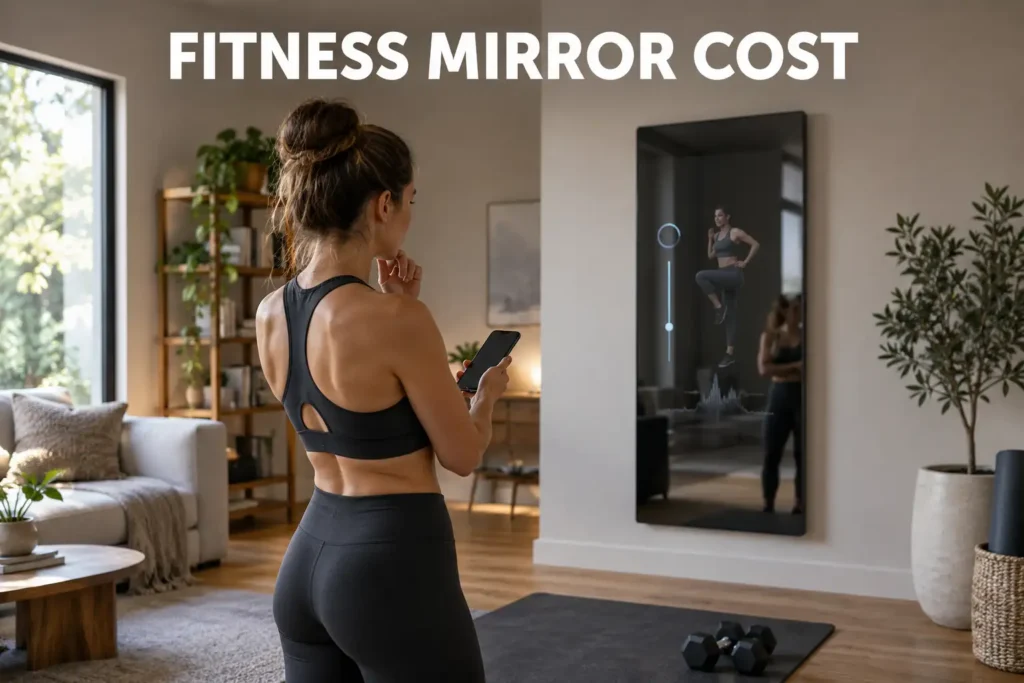
Fitness mirror cost is the first question most people type into a search bar - and one of the most misunderstood numbers in the home fitness market. The hardware price on a brand's website tells you less than half the story. Tonal, NordicTrack, Tempo, and their competitors layer monthly subscription fees on top, and hidden expenses like delivery and professional installation push the real first-year number several hundred dollars higher than advertised.
I've tracked pricing across every major fitness mirror brand to put together a complete, honest breakdown. This guide covers hardware costs, subscription fees, no-subscription alternatives, a realistic comparison with other home workout options, and the key factors that determine whether the investment makes sense for your situation.

Fitness Mirror Cost - What You Are Paying For
Fitness mirror cost varies so dramatically because you are not buying one thing - you are buying three. For a broader look at how this category fits into the smart home gym landscape, our complete smart home gym guide gives useful context before you start comparing specific prices.

A smart fitness mirror is a display panel that streams live and on-demand workout classes, tracks your movements through built-in cameras, and delivers real-time form feedback using AI. Some models - like Tonal 2 - also incorporate motor-driven resistance cables directly into the frame, making them a full strength-training system in addition to a content streaming device.
The Three Layers of Fitness Mirror Cost
The total fitness mirror cost breaks down across three layers:
- Hardware purchase price - the mirror or display unit itself, ranging from $495 to $4,295
- Monthly subscription fee - ongoing access to the content platform powering the workouts, typically $39-$60 per month
- Delivery and installation - often $400-$700 combined and almost never included in the advertised price
The hardware price reflects screen size, display resolution, processing power, built-in resistance systems, and the sophistication of the AI tracking technology. Tonal 2 commands a premium because electromagnetic resistance cables, advanced movement detection, and a large interactive display are engineered into a single wall-mounted unit. ProForm Vue, at the lower end, uses a smaller touchscreen focused on streaming classes without resistance hardware.
Subscriptions unlock the ongoing content engine - live instructor classes, on-demand workouts, trainer feedback, and app integrations. Research across diverse populations suggests that video-guided exercise consistently outperforms text-based instruction for adherence - a pilot study in stroke rehabilitation found 75.6% adherence with video guidance versus 55.2% with paper-based instruction (1). Without the subscription, most interactive fitness mirrors become expensive screens with limited ongoing functionality.
Fitness Mirror Subscription Cost - Monthly and Annual Breakdown by Brand
The mirror subscription landscape in 2026 has consolidated around a $39-$50 per month price band for dedicated platforms. Below is the complete breakdown across every major brand, with hardware included for context:

Brand / Model | Hardware Price | Monthly Fee | Annual Fee | Year 1 Estimate |
Tonal 2 | $4,295 | $59.95 | $719 | $5,200+ |
Tempo Studio (discontinued) | $2,495-$3,495 at launch | $39 | $468 | Not sold new, used market only |
NordicTrack Vault (discontinued) | $1,999 at launch | $15-$40 | ~$300 | Not sold new, used market only |
FORME Studio | $2,495 | $49 | $588 | $3,083 |
Echelon Reflect 50 SE | $1,999.99 | $39.99 | $399.99 (annual plan) | $2,400 |
Fiture Core (discontinued in the US) | $1,495 | $39 | $468 | Not sold new; membership free since 2023 |
ProForm Vue (discontinued) | $999 | $39 | $468 | Not sold new, used market only |
Tempo Move | $495 | $39 | $468 | $963 |
Several patterns stand out immediately. The NordicTrack Vault Standalone bundled one free year of iFit membership, which made it one of the more competitive mid-range options before it was discontinued, so it now only turns up on the used market. Tempo Move at $495 represents the most accessible entry point into guided mirror workouts, though it uses your smartphone for tracking rather than a built-in camera system.
If you are considering a discontinued unit and want a full picture of what that system offered, my NordicTrack Vault review covers the hardware, the iFit integration, and how the used-market price compares to its original cost.
What the subscription buys also varies by brand. Tonal's $59.95/month covers AI coaching, progression tracking, and live-class access. NordicTrack's iFit membership covers a library of over 10,000 workouts including outdoor running routes and studio classes. Echelon's platform leans toward cycling and cardio content. Understanding what content style fits your workouts matters as much as the monthly price.
If you are drawn to the class-streaming mirror format specifically, my Fiture Mirror review covers one of the notable platforms in that category and what its subscription includes.
Subscription Fees Versus Financing Payments
Understanding the full fitness mirror subscription cost before purchase matters because the recurring fee often exceeds the monthly hardware payment under financing plans. When I reviewed each brand's checkout flow, subscription pricing appeared as a separate line item only after hardware was added to the cart - the product pages consistently advertised hardware-only prices upfront.
Financing plans are worth accounting for at the higher end of the price range. Tonal, NordicTrack, and Tempo offer split-pay options through third-party lenders, with typical APR ranges running 0-36% depending on credit and promotional timing. A $4,295 Tonal financed over 36 months can add $200-$600 in interest if you carry a balance, pushing the effective hardware cost past $4,900. Zero-percent promotional financing, when available, eliminates this exposure.
Lululemon and Peloton Mirror Pricing Today
One category that no longer exists for new shoppers is lululemon mirror price. The Lululemon Studio Mirror launched in 2018 and became the defining product in this category, but the hardware has been discontinued since late 2023; our Lululemon Mirror discontinued guide covers what existing owners still get through the lululemon Studio membership. Anyone searching for that device needs to consider current alternatives. There is also no standalone peloton mirror cost to compare - Peloton became the exclusive digital fitness content provider for Lululemon under a five-year strategic partnership rather than launching its own mirror hardware.
Our best workout mirror guide covers every current option and ranks them by use case, budget, and workout style preference.
For a full breakdown of payment plans, long-term cost math, and whether the hardware justifies the tonal cost for strength-focused users, our Tonal value analysis covers it in complete detail.
Smart Fitness Mirror Options Without a Subscription
Fitness mirror cost does not always include a recurring monthly fee. A growing segment of the market offers no-subscription alternatives - either through open Android operating systems that accept any fitness app, or hardware designed with lifetime content access built in from the start.

Brand / Model | Hardware Price | Subscription | How It Works |
$3,698 (Amazon) | None (lifetime access) | Motor-driven resistance, 320+ movements, built-in AI form tracking | |
$1,199 | None required | Open Android 12, runs Peloton, YouTube, Apple Fitness+ | |
$999 | None required | Open Android, open app store, voice control | |
Basic gym mirrors | $50-$300 | None | Traditional reflection only - no tech features |
Lifetime Access Instead of Monthly Fees
The AEKE K1 deserves close attention despite its higher upfront hardware price. Its lifetime content model means zero ongoing fees - and over a five-year window, it outperforms mid-range subscription devices on total cost of ownership. Before committing at this price point, our AEKE K1 product page walks through the hardware in detail so you understand exactly what you are buying.
Open Android Mirrors That Run Your Apps
Open-Android devices like LumaVue and HARZHI take a fundamentally different approach. They run standard tablet operating systems that let you download any fitness app you already own or subscribe to. If you have a Peloton membership or Apple Fitness+ subscription, those run on these devices without paying a separate mirror-specific content fee - you're simply adding a display.
For anyone focused on the best fitness mirror without subscription, these alternatives represent a genuinely underserved option in the market. The trade-off is clear: you lose the proprietary AI coaching, branded content libraries, and integrated resistance systems that closed-platform devices offer. For anyone who primarily wants a large-screen display and already have workout content they enjoy, the trade-off works strongly in their favor.
Our guide to the best budget smart home gym covers subscription-free alternatives alongside other cost-effective equipment options if you are working within a tight budget.
Fitness Mirror Cost vs. Other Home Workout Options
Fitness mirror cost looks different when placed next to what you would spend on the alternatives over the same timeframe. Here is a five-year total cost comparison across the major home workout categories:
Option | Upfront Cost | Annual Recurring | 5-Year Total |
Fitness mirror (mid-range) | $1,500-$2,000 | $468-$588 | $3,840-$4,940 |
Gym membership (mid-tier) | $0 | $600-$1,800 | $3,000-$9,000 |
Peloton bike + membership | $1,445 | $468 | $3,785 |
Traditional home gym | $1,000-$3,000 | $0-$100 | $1,100-$3,500 |
Tonal 2 (strength system) | $4,295 | $719 | $7,890 |
The comparison shifts significantly depending on the gym membership cost you use as a baseline. Someone paying $120 per month at a commercial gym spends $7,200 over five years. A $1,999 mirror-style system with a $300 annual membership reaches approximately $3,500 over the same period. A mid-range fitness mirror becomes cost-competitive with mid-tier gym membership around the three-year mark - assuming consistent use on both sides.
What the table cannot capture is the engagement variable. A systematic review found that virtual reality exercise enhanced enjoyment and engagement compared to traditional methods across multiple populations (2). A fitness mirror you actually use outperforms any gym membership or equipment you avoid, regardless of price per session.
Traditional home gym equipment - free weights, a bench, bands - carries the lowest five-year cost but offers no guided instruction. Anyone who thrives on self-directed training will often find this combination produces better long-term value. Those who need the instructor-led structure to maintain consistency will find the fitness mirror's subscription cost pays for something concrete.
For a full comparison across all smart home gym categories, our best smart home gym guide covers every major system at every price tier.
Is the Fitness Mirror Cost Worth It?
The honest answer depends on three factors: how consistently you will use the device, what kind of workout environment keeps you motivated, and how comfortably your household absorbs a recurring monthly fee.
When the Fitness Mirror Cost Makes Sense
The fitness mirror cost makes financial sense for you if you:
- Need instructor-led structure and real-time feedback to stay consistent
- Have limited time for gym commutes and value the convenience of at-home workouts
- Want form coaching without the expense of a personal trainer
- Have space for a wall-mounted or floor-standing display unit
- Are comfortable with subscription models and already pay for similar services elsewhere
When the Cost Is Harder to Justify
The fitness mirror cost is harder to justify if you:
- Focus primarily on heavy barbell strength training (most mirrors have resistance weight limits) If none of those apply to you, our fitness mirror comparison breaks down current pricing across the models we have reviewed.
- Have unreliable home WiFi - virtually all interactive mirrors depend on cloud connectivity
- Already maintain consistency with free YouTube fitness content or low-cost apps
- Are uncertain about whether their workout habit will sustain after the initial enthusiasm fades
- Have existing gym contracts or equipment investments that adequately meet their needs
The Research Behind the Engagement Premium
The research case for the engagement premium is solid. A 24-week randomized controlled trial of online-supervised home exercise in breast cancer patients found significantly higher adherence - 114 minutes per week versus 35 minutes per week in the standard-recommendation group (3). A meta-analysis of 11 RCTs found that immersive virtual reality exercise produced large effects on enjoyment and moderate effects on positive affective valence compared to traditional exercise (4). The interactive fitness mirror's core value proposition - more enjoyable workouts that you're more likely to complete - has direct research backing.
Trial Periods and Return Costs
Most major brands offer a 30-day in-home trial period, which substantially reduces the financial risk at these price points. Tonal's 30-day trial allows a full return within that window; Tempo offers similar terms. Return shipping for a panel-style device typically costs $200-$400, and some brands charge restocking fees on top. Verifying the trial and return terms before purchase is worth the two minutes - if the format does not match your workout habits, the trial window is your lowest-cost exit point.
I would apply one practical threshold to this decision: if you have maintained a consistent workout routine using any lower-cost solution for at least three months, a fitness mirror adds a genuine upgrade to that existing habit. If you are counting on the hardware purchase itself to create a workout habit from scratch, the research does not reliably support that outcome.
Our Tempo Move review covers the $495 Tempo Move in detail if you want to test the guided-workout model at the lowest possible price before committing to a premium device.
For a side-by-side comparison of fitness mirrors against Peloton's bike ecosystem specifically, our Peloton value analysis addresses the bike-versus-mirror decision in full detail, including peloton mirror cost context and the impact of the Lululemon-Peloton platform partnership.
Hidden Fitness Mirror Costs Most People Miss
The advertised fitness mirror cost is almost never the real number. Delivery, professional installation, and accessories add several hundred dollars before you complete your first session - and most people do not account for these during the initial purchase decision.

Delivery and Professional Installation Charges
Delivery is the most commonly overlooked cost. Most panel-style fitness mirrors weigh 70-135 pounds and ship via freight carriers rather than standard parcel services; full-system units like the NordicTrack Vault exceed 250 pounds. Standard ground delivery with curbside drop-off runs $200-$300. White-glove delivery including room placement and packaging removal costs more. Some brands include delivery in the advertised price; others add it during checkout.
Installation matters specifically for wall-mounted systems. Tonal and FORME both require mounting into structural wall studs with proprietary hardware - this is not a DIY-friendly task. Third-party installation typically runs $250-$400. Factor this into your total tonal cost planning before finalizing a budget.
If you are weighing Tonal against a class-streaming mirror display as your next fitness purchase, my Tonal vs Mirror comparison breaks down the differences in cost structure, training model, and long-term value.
Accessories That Push the Cost Higher
Accessories push the fitness mirror cost higher across every brand. Common add-on purchases include:
- Heart rate monitors compatible with the brand's platform: $40-$120
- Smart floor mats or grip tiles: $50-$150
- Resistance bands, kettlebells, or adjustable dumbbells for content that requires them: $100-$300+
- Supplemental wall brackets or mounting hardware when not included: $50-$100
- One-on-one live personal training sessions where available: $40-$60 per session (Tonal, Tempo, and NordicTrack platforms)
Financing Interest and Purchase Timing
Hidden Cost | Typical Range | When It Applies |
Standard ground delivery | $200-$300 | Curbside drop off for freight shipped panel mirrors |
Professional installation | $250-$400 | Wall mounted systems such as Tonal and FORME |
Accessories | $40-$300+ | Heart rate monitors, mats, bands and adjustable dumbbells |
Live personal training | $40-$60 per session | Tonal, Tempo and NordicTrack platforms |
Financing interest | $200-$600 | 24 to 36 month plans at a high APR |
Sale timing savings | $200-$500 off | Black Friday and Labor Day promotional windows |
Financing interest and timing are two additional costs people often overlook. A mid-range device financed at a high APR over 24-36 months can add $200-$600 to the effective purchase price. Hardware prices also drop materially during Black Friday, Labor Day, and major fitness promotional windows - savings of $200-$500 on mid-range models are common, and timing a purchase to a sale event can offset delivery and installation costs entirely.
The realistic first-year total for a mid-range fitness mirror typically runs $600-$1,000 above what the hardware-plus-subscription math suggests. Factor in all three cost categories - hardware, subscription, and setup expenses - before setting your final budget.
For a specific look at what the Peloton Mirror ecosystem costs across hardware and content subscription, my Peloton Mirror cost breakdown covers the full pricing picture for both new and secondary market buyers.
For more context on what to look for when evaluating smart home gym value across all categories, our guide to what makes a smart home gym worthwhile is a useful companion resource.
Making the Right Call on Fitness Mirror Cost
The fitness mirror cost picture is clearer now. Hardware ranges from $495 for a smartphone-dependent entry model to $4,295 for a full strength-training system with integrated electromagnetic resistance. Subscriptions add $39-$60 per month on top. And a growing list of fitness mirror without subscription options exists for anyone who wants the display without the ongoing content fee.

I would approach this purchase in two steps. First, confirm that your workout habits genuinely benefit from the structure an instructor-led subscription platform provides. If guided classes and real-time feedback are what keeps you consistent, the monthly cost pays for something concrete. Second, account for delivery, installation, and accessories before you finalize a budget - the sticker price is routinely $600-$1,000 lower than the true first-year cost.
For a full look at how fitness mirrors work as a workout format and what drives the platform costs, my full mirror workout guide covers the technology, class structure, and subscription value in detail.
The open-platform and closed-platform split now defines the market for new shoppers. With lululemon mirror discontinued - and the lululemon mirror price no longer an active benchmark - the best options split between premium closed-platform systems with proprietary AI coaching and open-Android devices that support the apps you already use. Both paths are valid depending on your budget, workout format preference, and tolerance for recurring fees.
If you are still comparing categories, our guide to the best smart home gym is the logical next step, and our best workout mirror roundup will help narrow down the right model for your space and goals.
FAQs
How much does a mirror fitness subscription cost?
The mirror fitness subscription cost ranges from $39 to $60 per month depending on the brand, with most major platforms clustered around $39-$49 per month in 2026. Annual billing plans typically reduce the effective monthly rate by 10-20% compared to month-to-month pricing.
Is a fitness mirror worth it?
A fitness mirror is worth it if you rely on structured, instructor-led workouts to stay consistent - research shows that guided, technology-mediated exercise produces significantly higher adherence rates than self-directed training. The value weakens considerably for anyone with inconsistent usage habits, unreliable WiFi connections, or a strong preference for free, self-guided content.
Is there a fitness mirror available without a subscription?
Several fitness mirrors operate without a recurring monthly subscription, including the AEKE K1 with lifetime content access and open-Android options like LumaVue and HARZHI that let you use any fitness app you already pay for. These devices trade proprietary AI coaching for subscription flexibility and lower long-term total cost.
Which fitness mirror is best?
The best fitness mirror depends on your budget, workout style, and subscription tolerance - the AEKE K1 is our top overall pick for AI coaching with built-in resistance, the Echelon Reflect offers the most established live-class platform, Tonal 2 leads for strength-focused training, and open-Android devices suit users who prioritize app flexibility and no recurring mirror-specific fees.
This content is for informational and educational purposes only. It is not a substitute for professional medical advice, diagnosis, or treatment. Always consult with your healthcare provider before starting any new fitness program or using fitness technology for health monitoring.
We are always looking for expert inputs to make our content even better and more useful.
References
- Chung BPH, Chiang WKH, Lau H, et al. Pilot study on comparisons between the effectiveness of mobile video-guided and paper-based home exercise programs on improving exercise adherence, self-efficacy for exercise and functional outcomes of patients with stroke with 3-month follow-up: A single-blind randomized controlled trial. Hong Kong Physiotherapy Journal. 2020;40(1):63-73. doi:10.1142/S1013702520500079
- Qian J, McDonough DJ, Gao Z. The effectiveness of virtual reality exercise on individual's physiological, psychological and rehabilitative outcomes: A systematic review. Int J Environ Res Public Health. 2020;17(11):4133. doi:10.3390/ijerph17114133
- Garcia-Roca ME, Catala-Vilaplana I, Hernando C, et al. Effect of a Long-Term Online Home-Based Supervised Exercise Program on Physical Fitness and Adherence in Breast Cancer Patients: A Randomized Clinical Trial. Cancers. 2024;16(10):1912. doi:10.3390/cancers16101912
- Bitencourt Dos Santos E, Amaral Teixeira JM, Bird J, Stubbs B, Barreto Schuch F. Immersive virtual reality exercise prompts more positive affective valence and enjoyment compared to traditional exercise: a meta analysis of clinical trials. Psychol Health. 2026;0(0):1-14. doi:10.1080/08870446.2026.2632073