
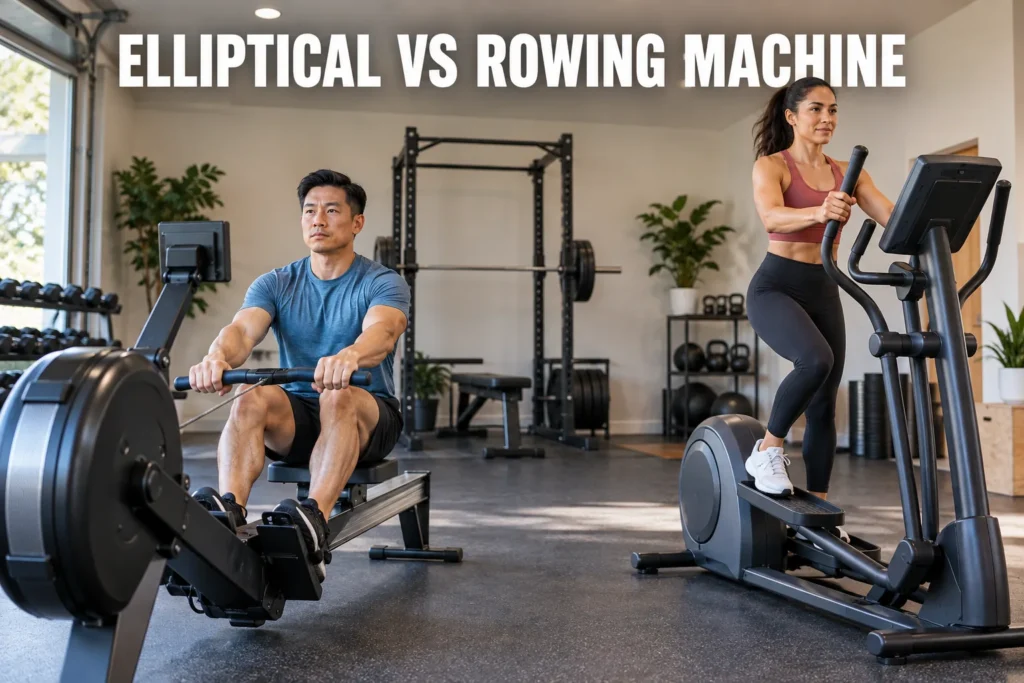
At the same very hard effort, an elliptical used more energy per minute than a rower in one lab study of 30 recreationally active men aged 35 to 49 (12.82 against 11.45 kcal a minute). The elliptical has no stroke to learn; the rower adds a stroke and a forward bend at the catch, so ask a doctor or physical therapist first if you have back, bone or knee problems.
The elliptical vs rowing question has less direct evidence than most comparisons suggest. I compare the two on calories, joint and back load, muscles, learning, space and upkeep, say who each study measured, and say where the evidence stops.
Elliptical vs Rowing: A Side-by-Side Comparison
When you put the elliptical vs rowing machine head to head, the first difference is posture. On an elliptical you stand with your feet on the pedals, and the handles can move too. On a rowing machine you sit: the drive starts with the legs, the back swings through vertical, and the arm pull comes last (1). The table summarizes the differences, and each row is explained below with its source.
| Feature | Elliptical | Rowing Machine |
|---|---|---|
| Primary motion | Standing; feet stay on the pedals | Seated; legs, then back, then arms move the handle |
| Muscles | A front-thigh muscle was more active than in walking or cycling in 10 adults | Concept2 names legs, back, abdominals, shoulders and arms by stroke phase |
| Moving arms | Moving handles raised oxygen use in a study of 26 adults | The arm pull is the last part of the drive |
| Knee force, 3 people with knee replacements | 2.24 times body weight (treadmill walking: 2.05) | 0.85 times body weight |
| Trunk | Lower back generally bent forward and rotated more than in walking, 40 men | Spine bends forward about 30 degrees at the catch, in competitive rowers |
| Energy at the same very hard effort, 30 recreationally active men | 12.82 kcal a minute | 11.45 kcal a minute |
| Size, one example each | Life Fitness E1: 82 x 30 x 59 in | Concept2 RowErg: 8 ft x 2 ft assembled, 9 ft x 4 ft with clearance for use |
Sources by row: muscle activity 2, 3; moving arms 4; knee force 5; trunk 6, 7; calories at the same effort 8; sizes 9, 10. Knee force is the peak force on the implant. The calorie row is one machine of each type.
Calorie Burn: What the Research Shows
Calories can be compared on three bases, which this page keeps apart: the same felt effort in a lab, Compendium estimates for named efforts, and the numbers a console or monitor shows. Each figure names its basis, and no figure from one basis is set beside a figure from another.
Same felt effort. A 2024 lab study compared seven indoor cardio machines in 30 recreationally active men aged 35 to 49, each with more than 10 years of indoor-machine training, using one machine of each type (8). At a very hard effort (RPE 17), the elliptical used 12.82 kcal a minute and the rower 11.45. The elliptical ranked third of seven machines and the rower sixth. These are experienced, recreationally active men at a very hard effort, so the figures do not carry over to other people or lighter efforts. Elliptical estimates by weight and time are in calories burned on the elliptical.
Fat burning during a test is a separate measure. In nine healthy men, the peak rate of fat burning during a test was higher on a treadmill (0.61 g a minute) than on an elliptical (0.41) or a rower (0.40) (11). That is the fuel mix during exercise, not body fat lost, and the elliptical and rower were close in these nine men.
How Intensity Shapes the Numbers
Compendium estimates. The 2024 Adult Compendium of Physical Activities lists two elliptical efforts and five stationary rowing efforts (12). The elliptical is 5.0 METs at moderate effort (code 02048) and 9.0 METs at vigorous effort (02049). Rowing is 5.0 METs under 100 watts (02071), 7.3 METs at general vigorous effort (02070), 7.5 METs at 100 to 149 watts (02072), 11.0 METs at 150 to 199 watts (02073) and 14.0 METs at 200 watts or more (02074).
Moderate elliptical effort and rowing under 100 watts share 5.0 METs. Vigorous elliptical effort (9.0) sits between general vigorous rowing (7.3) and rowing at 150 to 199 watts (11.0). The entries describe effort in different words for the two machines, so these are estimates for named efforts, not matched pairs. The watt entries apply only if your monitor shows watts; interval sessions are covered in the HIIT rowing workout guide.
In my view the stroke is the first limit on a rower: no study cited here timed how long beginners hold a hard effort on either machine, so choose an effort you can keep for the whole session.
What moves a Compendium estimate, and what does not:
- Effort: the vigorous entry carries more METs than the moderate entry on both machines (12)
- Body weight: the estimates here multiply METs by body weight in kilograms and by hours, so a heavier person gets a higher figure
- Moving handles: oxygen use was higher with the arm poles than with legs only at every setting in a study of 26 adults on an elliptical (4); the Compendium has no separate entry for that
- Who was measured: the lab figures above come from recreationally active, experienced men (8), and the Compendium has no separate entry for beginners
Console and monitor numbers are a third basis, and they are estimates. In a 2018 study of 34 adults on one Precor EFX 883 with no body weight entered, the console read about 100 calories higher per 30 minutes of moderate exercise than the lab measurement (13). In a 2006 study of 26 adults, an elliptical's calculated energy expenditure was also overestimated (4). Those studies tested their own machines, so no percentage applies to yours. Concept2 monitors use a formula based on a 175 pound/79.5 kg individual for calories per hour (14). Wrist-tracker heart rate is covered in smartwatch heart rate accuracy.
Calorie Estimates by Body Weight
Compendium estimates for 30 minutes at three body weights, from kcal = MET x body weight in kg x hours, rounded once to the nearest 10 kcal (12). The lab rates and console numbers are different bases and are not in this table.
| Body Weight | Elliptical (30 min) | Rowing (30 min) |
|---|---|---|
| 130 lbs (59 kg) | Moderate (02048): 150 kcal. Vigorous (02049): 270 kcal. | Under 100 W (02071): 150 kcal. General vigorous (02070): 220. 100 to 149 W (02072): 220. 150 to 199 W (02073): 320. 200 W or more (02074): 410. |
| 155 lbs (70 kg) | Moderate (02048): 180 kcal. Vigorous (02049): 320 kcal. | Under 100 W (02071): 180 kcal. General vigorous (02070): 260. 100 to 149 W (02072): 260. 150 to 199 W (02073): 390. 200 W or more (02074): 490. |
| 185 lbs (84 kg) | Moderate (02048): 210 kcal. Vigorous (02049): 380 kcal. | Under 100 W (02071): 210 kcal. General vigorous (02070): 310. 100 to 149 W (02072): 320. 150 to 199 W (02073): 460. 200 W or more (02074): 590. |
At 70 kg, the two 5.0 MET entries both come to 180 kcal. Vigorous elliptical effort comes to 320 kcal, against 260 for general vigorous rowing and 390 for rowing at 150 to 199 watts. These are estimates for named efforts, not a prediction for any one person.
Muscles Worked: What the Studies Measured
Muscle activity here means electromyography (EMG), which records how active a muscle is, not how much it grows or how much work it does. The studies below measured different muscles in different people, so no source ranks the machines on muscles worked, and no percentage of the body's muscles is given for either.
In 10 healthy young adults, one front-thigh muscle (the rectus femoris) was more active on an elliptical than in overground walking, treadmill walking or stationary cycling, and so was its coactivation with a hamstring muscle (the semitendinosus) (2). Only those two muscles were measured, and running was not tested.
Muscles the Elliptical Machine Targets
Each finding below comes from its own study and group:
- Rectus femoris (front thigh): more active than in walking or cycling in 10 adults (2)
- Gluteal muscles: consistently more active than in walking in 40 healthy young men (6)
- Arms: moving handles raised oxygen use in a study of 26 adults (4), which recorded oxygen use and heart rate, not muscle activity
- Trunk: the lower back generally bent forward and rotated more than in walking in the same 40 men (6)
In those 40 men, hand position, speed and stride length each changed lumbar motion and muscle activity (6). Which handle position suits you is a question for the manual of your model; how to use an elliptical covers a first session.
Muscles the Rowing Machine Targets
Concept2 describes rowing as "a coordinated muscle action that involves every large muscle group in the body" (3). The muscles a rowing machine works in each phase of the stroke:
- Catch: the triceps extend the arms and the abdominals flex the torso forward
- Drive: the legs start it, the shoulder muscles contract, the back muscles work more as the torso swings open, and the glutes and hamstrings extend the hip
- Drive, arms: the biceps engage as the handle is pulled toward the abdomen
- Finish: the abdominals stabilize the body, and the glutes and quads are contracting
- Recovery: the triceps push the arms forward, the abdominals flex the torso forward, and the hamstrings and calves contract as you slide up to the catch
That is a description of which muscles act, not of how hard each works. No trial has shown muscle growth from rowing-machine training alone in healthy adults. For muscle strength in general, US guidelines ask adults for muscle-strengthening activity on at least 2 days each week (15).
No source cited here ranks the two machines on muscles worked. Choose the movement you can do comfortably and will repeat.
Joint Impact and Injury Considerations
Both machines are called low impact, and Concept2 calls its rower's movement low impact (9). The phrase describes how a movement lands, not how much load the joints carry, so the sections below use what was measured on each machine.
Elliptical Knee and Hip Loading
Measured on the pedal, an elliptical loads the body less sharply than walking: in 15 men on an elliptical with no added workload, vertical force on the pedal and the rate at which load built up were smaller than the ground force in walking, but knee-straightening and hip-bending moments were larger (16). Measured inside the knee, the elliptical was not lighter than treadmill walking. In three people with knee replacements (two men aged 83 and 81, one woman aged 67, a year after surgery), peak knee force was 2.24 times body weight on an elliptical and 2.05 on a treadmill, and jogging was consistently greater than 4 times body weight (5). The same three peaked at 0.85 times body weight on a rowing machine. The patients chose their own effort, and these are three older people with knee implants, so the figures do not carry over to other knees.
No source cited here shows that either machine protects the knees or the back, and no study cited here compared these two machines in people with knee pain. The guide to exercise machines for bad knees compares low-impact options.
In the one small trial found (28 adults with grade 1 or 2 knee osteoarthritis, 12 weeks), adding elliptical training to physical therapy did not improve pain, function or X-ray joint space more than physical therapy alone (17). With a diagnosed joint condition or knee pain, ask your doctor or physical therapist before you start either machine. The guide to how the elliptical affects knees goes through the load research.
Rowing and Lower Back Considerations
The rowing catch involves forward trunk flexion. A 2012 review of rowing injuries, drawn mostly from college and elite rowers, reports a spine flexion angle of about 30 degrees at the catch, and in the two US college programs it covers the knee was the most common site of pain, followed by the back (7). These are data from rowers who train and compete, not a risk estimate for a home exerciser, and no study cited here measured back pain from rowing machines in home users.
The same review links ergometer pieces longer than 30 minutes with low back pain in college rowers (7). That is not a limit for home use. Concept2 advises against pulling too hard until the technique fundamentals are comfortable (1). More is in the guide to rowing-related back pain.
MedlinePlus advises people with osteoporosis to avoid movements that involve "Bending forward from the waist, like sit ups and toe touches" (18). The rowing stroke starts with a forward lean. In my view that is reason enough to ask first, though no agency page cited here names rowing machines. If you have low bone density, osteoporosis or back pain, ask your doctor or physical therapist before you row.
Learning Curve: Which Machine Is Easier to Start Using?
No study cited here timed how long beginners take to learn either machine, so no number is put on it. The rower has a published stroke to learn; the sources cited here give the elliptical no equivalent sequence.
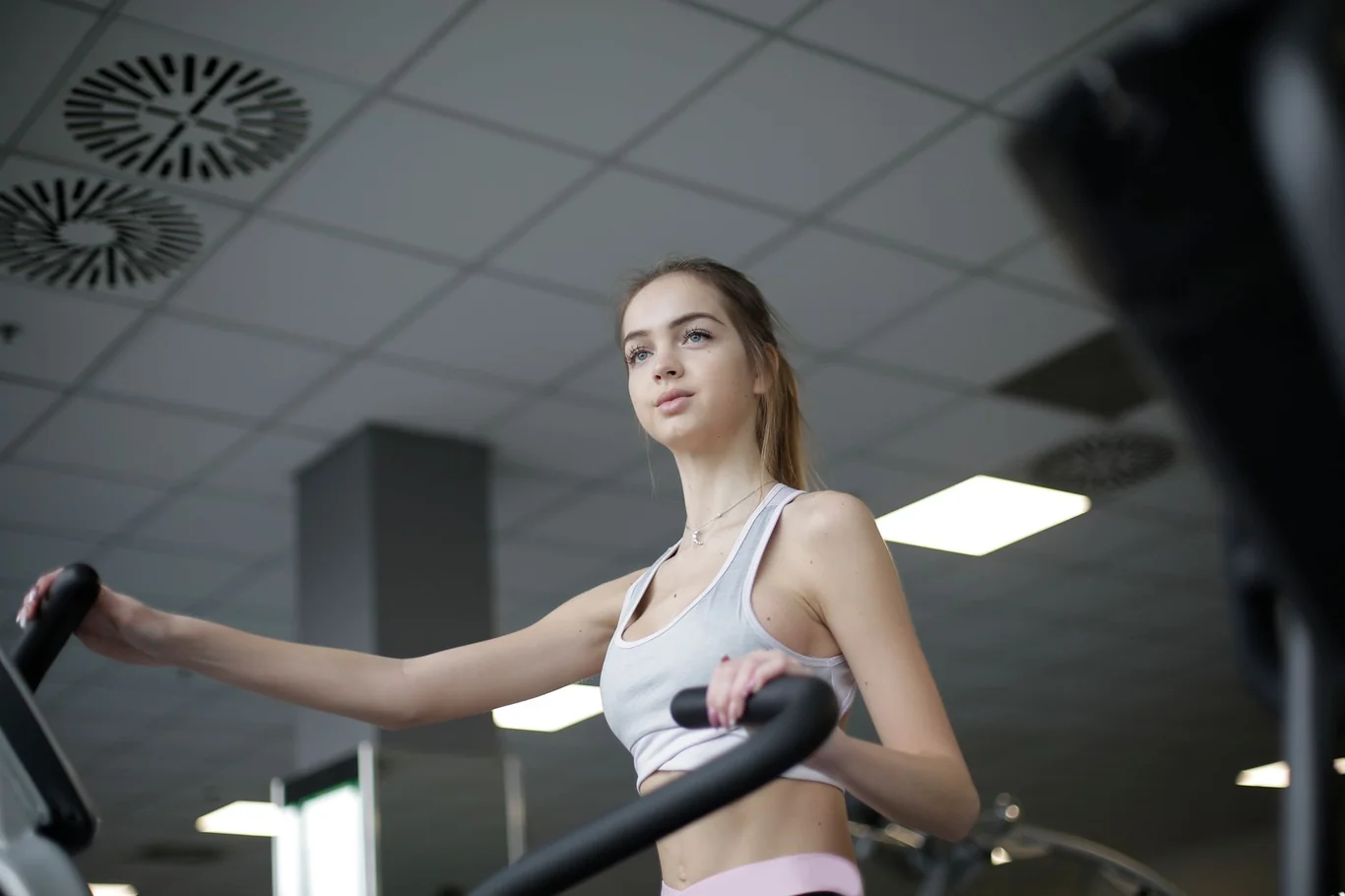
The rowing stroke has four phases, and the legs lead:
- Catch: arms straight, shoulders level, upper body leaning forward from the hips, shins vertical or as close to it as is comfortable (1)
- Drive: press with the legs, swing the back through vertical, then add the arm pull
- Finish: upper body leaning back slightly with support from the core, handle held lightly below the ribs, wrists flat
- Recovery: extend the arms until straight, lean from the hips toward the flywheel, and bend the knees once the hands clear them
Concept2 says not to pull too hard until the technique fundamentals are comfortable (1). In my view that means learning the stroke at an easy effort before chasing pace or distance, and the guide to basic rowing technique goes through it.
Who Should Choose Elliptical vs Rowing?
The best choice is the machine you will use week after week; no study cited here compares how long people keep using each machine, so that is my judgement, not a finding. To place both beside treadmills and bikes, the guide to choosing the best cardio machine is the place to start.
Weight Loss and Calorie Burn
No trial has tested elliptical training alone for weight loss in healthy adults. No rowing-only trial found fat or weight loss in the general public. US guidelines ask adults for at least 150 to 300 minutes of moderate-intensity aerobic activity a week (15). For weight in general, an American College of Sports Medicine position stand says moderate-intensity activity between 150 and 250 minutes a week "will provide only modest weight loss" and more than 250 minutes has been associated with clinically significant weight loss (19). That is about physical activity in general, not these machines.
At the same very hard effort the elliptical used more energy per minute than the rower in those 30 men (8), but weight depends on total energy over weeks, not on one rate. I would choose the machine you can keep doing. That is my judgement; no study cited here compares weight loss between the two.
Older Adults and Sensitive Joints
No trial has tested standing elliptical training for balance or falls in older adults, and no rowing trial of balance or falls is cited here, so neither machine can be called the safer start for older adults on evidence. Ask your doctor or physical therapist first. A low step-up and stable handles are what I would check first on a model; the guide to ellipticals made for seniors lists options.
If you are also weighing a stationary bike, the bike versus elliptical choice has its own guide. In the three people with knee replacements, knee force on a stationary bicycle was 1.03 times body weight against 2.24 on the elliptical (5).
Best for Athletes and Cross-Training
Athletes cross-training should know that the rowing injury data come from competitive rowers (7), and that the Compendium writes four of its five rowing entries in watts, from under 100 W to 200 W or more (12). For a rower that reports watts, I'd pick the Concept2 RowErg with PM5; the 2024 lab study used a Concept2 RowErg (8).
Space Requirements and Home Gym Setup
Sizes differ by model, so these are two examples. The Concept2 RowErg is listed at 8 ft x 2 ft assembled and 9 ft x 4 ft with clearance for use, and it separates into two parts for storage, with a stored size of 25 x 33 x 54 in with standard legs (9). The Life Fitness E1 elliptical cross-trainer is listed at 82 x 30 x 59 in and 211 lb, with a maximum user weight of 400 lb (10).
On these two examples the rower needs a longer, narrower strip and comes apart for storage. Measure the exact model, its clearance and your ceiling before you buy.
What Decides the Cost: Elliptical vs Rowing Machine
This guide gives no prices, because prices change; check current prices on the maker's page. Upkeep is documented by model, and the two examples differ. Concept2 calls for lubricating the RowErg chain every 50 hours of use with "a teaspoon of purified mineral oil, 3-IN-ONE® oil, or 20W motor oil" and no cleaner or solvent such as WD-40 on the chain (20). On the Schwinn 430 elliptical, the weekly step is to wipe the rails with silicone lubricant on a dry cloth, never a petroleum based product (21). Follow the manual for your model.
Models change often, and the best rowing machine options and the available rowing machines pages list current rowers. Try each type in a gym or store before you choose.
Choose the elliptical if | Choose rowing if |
| You want to stand, with no stroke sequence to learn | You want a seated stroke that uses the legs, back and arms in turn |
| You want to stay upright, with no forward reach to a catch | The forward bend at the catch is no problem for you; ask a clinician first if you have back or bone problems |
| You have limited floor length: the E1 is listed at 82 x 30 x 59 in | You can give a RowErg 9 ft x 4 ft, or store it in two parts |
| You want the machine that used more energy per minute at the same very hard effort (30 recreationally active men) | You are not choosing on calories per minute: the rower ranked sixth of seven at that effort |
| Weight loss is the goal: no trial tested elliptical training alone, so pick the one you will use | Weight is the goal and you want rowing: no rowing-only trial found fat or weight loss in the general public, so pick the one you will use |
Making Your Choice Count
The elliptical vs rowing decision rests on what the sources can and cannot say. At the same very hard effort the elliptical used more energy per minute than the rower in 30 recreationally active men (8). Knee force on an elliptical was not lower than in treadmill walking in three people with knee replacements (5), and the forward bend at the catch is the main caution on a rower (7, 18).
I weigh how likely you are to keep using a machine more heavily than peak calorie rates, because a rate means nothing on a machine you skip.
For most people starting or restarting a cardio routine, I would begin with the machine whose movement you can do comfortably today. An elliptical has no stroke sequence to learn, and a rower is a reasonable second machine for anyone who wants the seated stroke. To narrow the elliptical choice, start from these top-rated home ellipticals and check each model's maker page for size, user limit and warranty.
Frequently Asked Questions
Is rowing better than elliptical for weight loss?
No trial has tested elliptical training alone for weight loss in healthy adults, and no rowing-only trial found fat or weight loss in the general public. Weight change depends on total energy over time, so pick the machine you will use most weeks.
Is 20 minutes a day on a rowing machine enough?
Twenty minutes a day adds up to 140 minutes a week, just under the 150 minutes of moderate-intensity activity that US guidelines set as the low end of the weekly range for adults. Adults also need muscle-strengthening activity on at least 2 days each week.
How much rowing is equivalent to 10,000 steps?
No source cited here gives a steps equivalent for rowing, so there is no figure to quote. For 30 minutes at 70 kg the Compendium estimates 180 kcal for rowing under 100 watts and 260 kcal for general vigorous rowing, which describes the effort, not a step count.
Is 30 minutes on the elliptical better than walking?
It depends on the effort: for 30 minutes at 70 kg the Compendium estimates 180 kcal for moderate elliptical effort and 320 kcal for vigorous effort, and no trial cited here compared fitness results of elliptical training and walking. Knee force on an elliptical was not lower than in treadmill walking in three people with knee replacements, so better for the knees is not shown.
Does the elliptical work your stomach?
In 40 young men, the internal obliques, one of the abdominal muscle groups, were more active on an elliptical than in walking only in selected conditions, while gluteal activation was consistently higher. A trunk effect is not a belly-fat effect, and no trial cited here measured belly fat on an elliptical.
 Tech Fitness Lab
Author
Vanja Vukas
I founded Tech Fitness Lab and hold a master's degree from the Faculty of Sport and Physical Education in Novi Sad. I have competed in sport and coached clients, and my writing has appeared on Fitness Volt and BOXROX. I research products from their manuals, spec sheets and warranty terms, and I flag thin evidence.
This content is for informational and educational purposes only. It is not a substitute for professional medical advice, diagnosis, or treatment. Always consult with your healthcare provider before starting any new fitness program or using fitness technology for health monitoring.
We are always looking for expert inputs to make our content even better and more useful.
References
- Concept2. Indoor rowing technique. Concept2 website. Accessed November 21, 2026.
- Prosser LA, Stanley CJ, Norman TL, Park HS, Damiano DL. Comparison of elliptical training, stationary cycling, treadmill walking and overground walking. Electromyographic patterns. Gait Posture. 2011;33(2):244-250. doi:10.1016/j.gaitpost.2010.11.013.
- Concept2. Muscles used while rowing. Concept2 website. Accessed November 21, 2026.
- Mier CM, Feito Y. Metabolic cost of stride rate, resistance, and combined use of arms and legs on the elliptical trainer. Res Q Exerc Sport. 2006;77(4):507-513. doi:10.1080/02701367.2006.10599385.
- D'Lima DD, Steklov N, Patil S, Colwell CW. The Mark Coventry Award: in vivo knee forces during recreation and exercise after knee arthroplasty. Clin Orthop Relat Res. 2008;466(11):2605-2611. doi:10.1007/s11999-008-0345-x.
- Moreside JM, McGill SM. How do elliptical machines differ from walking: a study of torso motion and muscle activity. Clin Biomech (Bristol). 2012;27(7):738-743. doi:10.1016/j.clinbiomech.2012.03.009.
- Hosea TM, Hannafin JA. Rowing injuries. Sports Health. 2012;4(3):236-245. doi:10.1177/1941738112442484.
- Prieto-Gonzalez P, Yagin FH. Energy expenditure, oxygen consumption, and heart rate while exercising on seven different indoor cardio machines at maximum and self-selected submaximal intensity. Front Sports Act Living. 2024;6:1313886. doi:10.3389/fspor.2024.1313886.
- Concept2. RowErg. Concept2 website. Accessed November 21, 2026.
- Life Fitness. E1 Elliptical Cross-Trainer. Life Fitness website. Accessed November 21, 2026.
- Filipovic M, Munten S, Herzig KH, Gagnon DD. Maximal fat oxidation: comparison between treadmill, elliptical and rowing exercises. J Sports Sci Med. 2021;20(1):170-178. doi:10.52082/jssm.2021.170.
- Herrmann SD, Willis EA, Ainsworth BE, et al. 2024 Adult Compendium of Physical Activities: a third update of the energy costs of human activities. J Sport Health Sci. 2024;13(1):6-12. doi:10.1016/j.jshs.2023.10.010.
- Glave AP, Didier JJ, Oden GL, Wagner MC. Caloric expenditure estimation differences between an elliptical machine and indirect calorimetry. Exerc Med. 2018;2:8. doi:10.26644/em.2018.008.
- Concept2. Calorie calculator. Concept2 website. Accessed November 21, 2026.
- Office of Disease Prevention and Health Promotion. Top 10 things to know about the second edition of the Physical Activity Guidelines for Americans. US Department of Health and Human Services. Accessed November 21, 2026.
- Lu TW, Chien HL, Chen HL. Joint loading in the lower extremities during elliptical exercise. Med Sci Sports Exerc. 2007;39(9):1651-1658. doi:10.1249/mss.0b013e3180dc9970.
- Bukhari SSUK, Aftab A, Munir S, Ahmad Z, Anwar K, Rauf S. Effects of low impact elliptical training on knee osteoarthritis outcomes and knee joint space. Rehabil J. 2024;8(4):03-12. doi:10.52567/trehabj.v8i04.84.
- MedlinePlus. Osteoporosis. US National Library of Medicine. Updated September 30, 2025. Accessed November 21, 2026.
- Donnelly JE, Blair SN, Jakicic JM, Manore MM, Rankin JW, Smith BK. American College of Sports Medicine position stand. Appropriate physical activity intervention strategies for weight loss and prevention of weight regain for adults. Med Sci Sports Exerc. 2009;41(2):459-471.
- Concept2. RowErg maintenance. Concept2 website. Accessed November 21, 2026.
- Schwinn. 430 Elliptical owner's manual. Schwinn Fitness. Accessed November 21, 2026.