


In the trials below, interval training and steady state cardio changed body fat by similar amounts, and both raised fitness, with intervals slightly ahead on aerobic fitness in healthy adults. The better choice is the one you can repeat safely each week, and US guidelines count both toward the weekly total. Anyone with heart disease, symptoms or another chronic condition should check with a doctor first.
- Reviews mostly found no difference in fat loss between intervals and steady training, and the losses were small in both groups.
- Afterburn is small: in one lab study it was tens of kilocalories, not hundreds.
- US guidelines count a minute of vigorous effort as two minutes of moderate effort, and they allow a mix of both.
- Go to the hospital right away or call 911 or the local emergency number if you have chest pain during or after exercise. Check with a doctor first if you have heart disease or another chronic condition.
HIIT vs steady state cardio is a choice between hard efforts with recovery and one moderate effort held for the whole session. Below I set out what the trials found, on whom, and where they disagree, then show how I would combine the two.
I compare fat loss, calories, afterburn and fitness gains. Every study figure names its group, because a result from young college students with obesity does not carry over to every reader.
HIIT vs Steady State Cardio - What Each Method Actually Means
The two methods differ in how hard and how long you work. HIIT alternates hard efforts with easier recovery, and steady state holds one moderate effort. A treadmill, bike or rower can do either, and the guide to the best treadmills for home use covers machine choice.

What Is HIIT?
The US Physical Activity Guidelines define high-intensity interval training (HIIT) as “a form of interval training that consists of alternating short periods of maximal-effort exercise with less intense recovery periods.” They add that there are “no universally accepted lengths for the maximal-effort period, the recovery period, or the ratio of the two” 1. No single work-to-rest ratio is the correct one, so the protocols below are examples.
Is a HIIT workout cardio or strength training? The guidelines list HIIT among vigorous-intensity aerobic activities, so it counts as cardio. They ask adults to do muscle-strengthening activities on 2 or more days a week as a separate item 1.
Two formats from trials show how different HIIT can look:
- Treadmill intervals: 3-minute bouts at 90% of VO2max with 2 minutes of recovery at 25% of VO2max, used in one lab session by 21 untrained male college students with obesity 2
- Cycle sprints: seven to eight sets of 20 seconds at about 170% of VO2max (a work rate above the one that produces VO2max) with 10 seconds of rest, on a mechanically braked cycle ergometer, five days a week for six weeks, in seven subjects 3
A Starter HIIT Protocol
For inactive adults the guidelines advise starting with moderate-intensity activity and avoiding “relatively vigorous-intensity activity, such as shoveling heavy snow or running,” and they raise minutes and days before intensity 1. Intervals fit adults who already walk, cycle or jog most weeks.
Treating the first interval session as a test of how hard you can go. Start with efforts you could repeat, and change one thing at a time.
This is my judgement for a healthy adult with no symptoms who already does steady state cardio, not a trial protocol. After a warm-up, do five rounds of 30 seconds hard, a 7 or 8 on the 0 to 10 effort scale where you can say only a few words, with 90 seconds of easy movement between rounds, then cool down. Use one session a week and change one thing at a time, such as one more round. Young adults can probably add small amounts every week or two, and older adults appear to need 2 to 4 weeks 1. In my view a stationary bike is the simplest machine for a first interval session, because you can ease off without stepping off a moving belt. People with heart disease, high blood pressure or joint problems check with a clinician before all-out intervals.
What Is Steady State Cardio and LISS?
Steady state cardio, also called LISS or low intensity steady state, holds one effort for the whole session. Trials call it moderate-intensity continuous training, and each trial sets its own intensity. The guidelines describe moderate effort as a 5 or 6 on a 0 to 10 scale, or an effort where you “can talk, but not sing” 1. The guide to fasted morning cardio covers exercising before eating.
HIIT vs LISS and HIIT vs steady state describe the same comparison. For steady state at home, the best incline treadmill guide covers machines that add incline walking as another way to set the effort.
Calorie Burn, Fat Loss, and the EPOC Effect
A popular claim is that HIIT afterburn closes the calorie gap with steady state over a week. The measured afterburn below is small, so the calories used during the session carry most of the difference. Wearables and apps give estimates of that total, and the calorie tracker options guide covers wearable trackers.
Estimated energy use in 30 minutes, from the 2024 Compendium of Physical Activities (kcal = METs x body weight in kg x hours, rounded to the nearest 10) 4: stationary cycling at 60 watts, light to moderate effort (code 01216, 5.0 METs) comes to about 150, 180, 210 and 250 kcal at 59, 70, 84 and 100 kg (130, 155, 185 and 220 lb), and cycling intervals (code 01305, 8.8 METs) to about 260, 310, 370 and 440 kcal. These are estimates, and the interval entry gives one value for the whole session. At 70 kg, 20 minutes of the interval entry comes to about 210 kcal, still above 30 minutes of light to moderate cycling at about 180 kcal.

HIIT vs Cardio for Fat Loss - The Research Evidence
A 2023 meta-analysis of 29 randomized trials with 807 adults (inclusion range 18 to 60 years) compared HIIT with moderate-intensity continuous training. Waist circumference fell 0.96 cm more with HIIT (95% CI -1.84 to -0.08) and body-fat percentage 0.48 points more (95% CI -0.86 to -0.10), but fat mass in kilograms did not differ significantly (-0.22 kg, 95% CI -0.98 to 0.55). Only two of the 29 studies set exercise time by energy expenditure, so most compared sessions that were not energy-matched 5.
A 2026 systematic review of 12 randomized trials in 476 college students with overweight or obesity found no statistically significant differences between HIIT and moderate continuous training across the major outcomes, and rated the evidence low to very low certainty 6.
Earlier analyses mostly agree. In 13 trials of adults aged 18 to 45 with overweight or obesity, averaging 10 weeks of 3 sessions a week, both methods reduced fat mass and waist circumference with no significant difference between them, and HIIT took about 40% less training time 7. In 31 studies of at least four weeks, there were no differences for any body-fat outcome, interval training was “not necessarily” more time-efficient, and neither method produced clinically meaningful reductions in body fat 8. A 2021 analysis of randomized trials in healthy children and adults called the fat-mass difference trivial (-0.016 standardized, 95% CI -0.07 to 0.04) 9. One 2019 analysis (36 studies pooled) found 2.28 kg more fat mass lost with interval training (95% CI -4.00 to -0.56) but no difference in body-fat percentage, and the journal later attached an expression of concern to it 10. How cardio compares with weights for weight loss is a separate question.
Brisk walking, cycling and swimming all work as steady state options. For a walking version with incline, the 12-3-30 incline workout has its own guide.
The EPOC Effect - What the Afterburn Actually Adds
EPOC (excess post-exercise oxygen consumption), the so-called afterburn, is the extra oxygen, and so extra energy, the body uses after exercise while it returns to rest. A review of the EPOC literature found that even where exercise produced an EPOC lasting 3 to 24 hours, it comprised only 6 to 15% of the net total oxygen cost of the exercise, and concluded that “the earlier research optimism regarding an important role for the EPOC in weight loss is generally unfounded” 11.
One lab study of 21 untrained male college students with obesity (average age 22) used a randomized crossover design. Each man ran on a treadmill twice, planned at about 300 kcal: once as 3-minute intervals at 90% of VO2max with 2 minutes at 25%, once continuously at 60% of VO2max. After the interval run the extra energy used was 66 kcal against 54 kcal after the steady run, measured over the half hour that followed, and the interval session was shorter, 29.5 minutes against 37.6 2.
That extra energy is small next to the roughly 300 kcal each session itself used. The review above concluded that the effect of exercise on body mass comes mainly from the energy used during the exercise.
Cardiovascular Fitness - VO2 Max, Heart Rate, and Training Adaptations
Fitness is the other thing the two methods are compared on. VO2max, the maximal oxygen consumption, is the standard lab measure of aerobic fitness. For bike-specific intervals, the guide to high-intensity training on an exercise bike is the next stop.

Steady State Cardio Heart Rate Zones Explained
“Zone 2” is a training-plan label, not an agency term, and a plan that uses it should say which zone model it follows. The ranges here are the American Heart Association's. It puts moderate activity at about 50 to 70% of maximum heart rate and vigorous activity at about 70 to 85%, estimates maximum heart rate as about 220 minus your age, and says “The figures are averages, so use them as a general guide” 12.
Use the talk test beside any heart-rate reading: if you can talk but not sing, the effort is moderate; if you cannot say more than a few words without pausing for a breath, it is vigorous.
At age 35 the AHA chart lists an age-predicted maximum of 185 beats per minute and a 50 to 85% target zone of 93 to 157 beats per minute 12. Some medicines lower maximum heart rate, and anyone with a heart condition or on medication should ask a health care professional what their heart rate should be.
The guidelines separate moderate from vigorous effort by how it feels:
- You can talk, but not sing: moderate effort, a 5 or 6 on the 0 to 10 scale 1
- You cannot say more than a few words without pausing for a breath: vigorous effort, 7 or 8 and above
- Older or less fit adults may find an activity labelled moderate feels vigorous, so the effort you feel matters more than the label
No trial cited here tested whether a base of steady training must come before intervals. The guidelines do say that a person who is habitually active at moderate intensity can gradually increase to vigorous intensity without needing to consult a health care provider 1. A separate guide covers walking backwards on a treadmill.
How HIIT and Steady State Cardio Change VO2 Max
In 28 controlled trials of healthy adults aged 18 to 45 (723 participants, mean baseline VO2max 40.8 mL/kg/min), endurance training raised VO2max by 4.9 mL/kg/min and HIIT by 5.5 mL/kg/min against no-exercise controls. Head to head, HIIT had “a possibly small beneficial effect” of 1.2 mL/kg/min (±0.9) 13. In an 8-week trial of 55 untrained college-aged subjects who trained three times a week on a cycle ergometer, VO2max rose 19% with steady state (n = 19), 18% with the Tabata protocol (n = 21) and 18% with Meyer intervals (n = 15), with no significant differences between groups 14.
A 2025 meta-analysis of 26 studies (randomized and non-randomized) of 1,078 children and adolescents aged 9 to 19 with overweight or obesity found HIIT ahead of moderate continuous training for VO2max (standardized difference 0.81) and systolic blood pressure, and advised cautious interpretation 15. In 22 randomized trials of 1,364 patients with coronary artery disease, a 2025 meta-analysis found peak oxygen uptake 1.42 mL/kg/min higher with HIIT (95% CI 0.87 to 1.98) 16. These results come from patients with coronary artery disease, and the guidelines say adults with chronic conditions should be under the care of a health care provider 1.
These trials measured fitness, not heart attacks or lifespan. The guidelines say HIIT “may provide similar reductions in cardiovascular disease risk factors as those observed with continuous moderate-intensity physical activity” 1.
Steady State Cardio Examples and How to Use Them
For someone building a base, steady state options are easy to start and easy to scale. The guidelines call the safest activities moderate intensity and low impact, list walking, riding a stationary bike and swimming among the lowest injury rates, and note that in the amounts commonly done by adults walking has “a third or less of the injury risk of running” 1. The HIIT rowing workout guide covers rowing intervals.
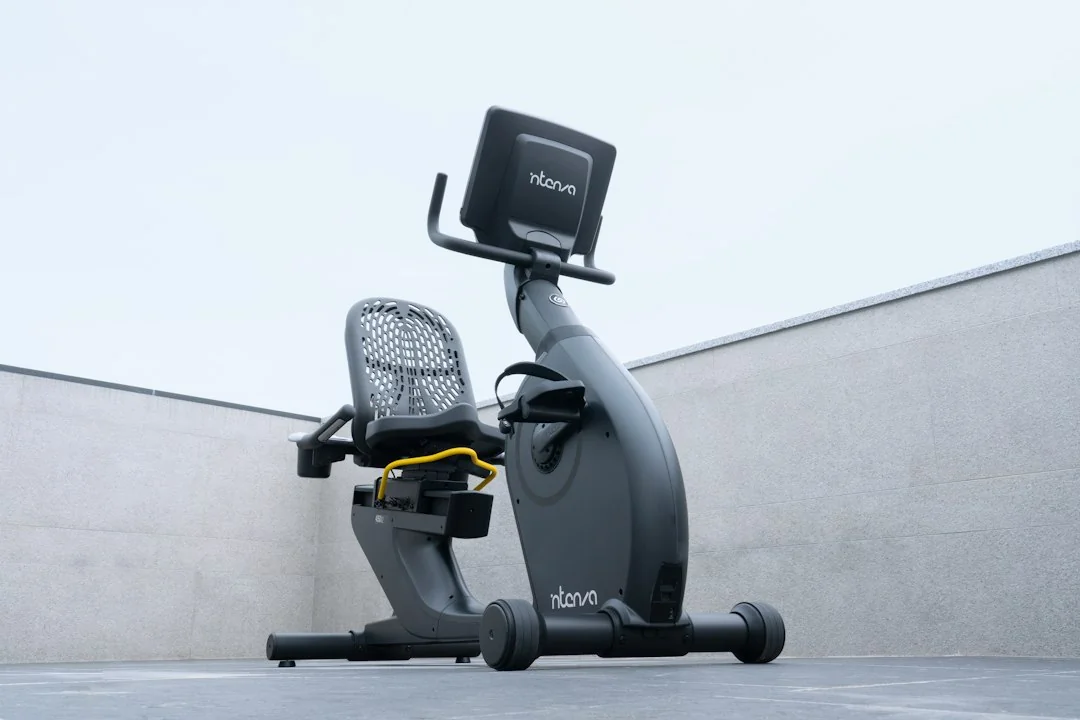
Compendium estimates for 30 minutes of steady state activity at 59, 70, 84 and 100 kg (nearest 10 kcal) 4:
- Brisk walking, 3.5 to 3.9 mph, level (code 17200, 4.8 METs; treadmill code 17358 has the same value): about 140, 170, 200 and 240 kcal
- Stationary cycling, 60 watts, light to moderate effort (code 01216, 5.0 METs): about 150, 180, 210 and 250 kcal
- Swimming laps, freestyle, slow, recreational pace (code 18240, 5.8 METs): about 170, 200, 240 and 290 kcal
- Rowing machine, moderate effort under 100 watts (code 02071, 5.0 METs): about 150, 180, 210 and 250 kcal
- Elliptical trainer, moderate effort (code 02048, 5.0 METs): about 150, 180, 210 and 250 kcal
How the guidelines count weekly minutes 1:
| Effort level | Weekly minutes | How it feels |
|---|---|---|
| Moderate | 150 to 300 | Can talk, but not sing |
| Vigorous | 75 to 150 | Cannot say more than a few words without pausing for a breath |
| Mix of both | Equivalent combination | 1 minute of vigorous counts as 2 minutes of moderate (rule of thumb) |
Warm-up and cool-down are an acceptable part of a plan, and usually mean the same activity at a slower pace or lower intensity 1. On early sessions check effort with the talk test or the 0 to 10 scale, because the AHA heart-rate figures are averages.
Steady state treadmill sessions are the subject of the treadmill weight loss guide.
Who Suits HIIT vs Steady State Cardio?
The trials give no universal winner. The better method depends on health status, schedule and what you can sustain, and the guidelines add that some physical activity is better than none 1. How consistent cardio at any intensity affects health is covered in the treadmill benefits guide.
Adults with chronic conditions should be under the care of a health care provider, while people without diagnosed chronic conditions and without symptoms such as chest pain or pressure, dizziness or joint pain “most likely do not need to consult with a health care provider about physical activity” 1. People who develop new symptoms when increasing activity should consult one, and anyone unsure should check with a doctor or physical therapist before starting intervals. Go to the hospital right away or call 911 or the local emergency number if you have chest pain during or after exercise 17.
When HIIT Fits Better
Intervals fit best in these situations:
- Time is short: the guidelines count 1 minute of vigorous effort as 2 minutes of moderate effort 1, and in adults aged 18 to 45 with overweight or obesity HIIT took about 40% less training time for similar body-composition changes 7. Another review found interval training not necessarily more time-efficient 8.
- Aerobic fitness is the goal: in healthy adults aged 18 to 45, HIIT had a possibly small edge of 1.2 mL/kg/min in VO2max over endurance training 13
- You already do moderate activity most weeks: the guidelines say such a person can gradually increase to vigorous intensity 1
When Steady State Cardio Fits Better
Steady state fits better in these situations:
- You are new to structured cardio: the guidelines start with moderate-intensity activity and raise minutes and days first (the beginner cardio plan covers starting out)
- You have a chronic condition or symptoms: adults with chronic conditions should be under the care of a health care provider, who can say which intensity suits you
- Your week already holds hard strength sessions: in my view hard intervals and hard lifting compete for the same recovery, so space them apart
- You are returning after illness or injury: ask your doctor or physical therapist which intensity to use
- Hard efforts are uncomfortable on your joints: the low impact exercises guide covers alternatives, and a doctor or physical therapist can advise on pain
Enjoyment also counts. In the 8-week trial of 55 untrained college-aged subjects, the Tabata group rated its program significantly less enjoyable than steady state or Meyer intervals, and enjoyment fell in all three groups over the 8 weeks. The authors concluded that HIIT protocols are time efficient but “not superior to conventional exercise training in sedentary young adults” 14.
How to Combine HIIT and Steady State Cardio
The guidelines allow “an equivalent combination of moderate- and vigorous-intensity aerobic activity” toward the weekly target 1, so combining the two is allowed. No study cited here tested a combined program against either method alone, so the week below is my judgement. The treadmill workout guide covers treadmill sessions.

A sample week for a healthy adult who already does steady state cardio. It is my judgement, not a trial protocol:
| Day | Session type | Duration |
|---|---|---|
| Monday | Steady state | 45 min |
| Tuesday | Intervals | 20 min including warm-up and cool-down |
| Wednesday | Muscle strengthening | Separate session |
| Thursday | Steady state | 45 min |
| Friday | Muscle strengthening | Separate session |
| Saturday | Steady state, longer | 60 min |
| Sunday | Rest | - |
The three steady sessions add up to 150 minutes (45 + 45 + 60), the low end of the guideline range for moderate activity, and the hard efforts on Tuesday count on top. Two strength days meet the muscle-strengthening line 1. Principles behind the week:
- Start with one interval session a week and add a second only when the first feels routine. The guidelines give no maximum number of interval sessions, so this cap is my judgement.
- Keep hard interval days and hard strength days apart when the week allows. This is my judgement, not a trial result.
- Build on regular moderate activity first: the guidelines start with moderate-intensity activity, raise minutes and days, and add intensity later 1.
- Check effort on steady days with the talk test, so easy days stay easy.
At home, a folding treadmill can host steady walking or jogging and intervals, and a stationary bike works for both. Pick a machine whose speed or resistance you can change without losing your footing or balance.
Your Cardio Plan Starts Here
The right choice depends on your goal, health and schedule. If aerobic fitness is the goal, intervals had a small edge in the trials of healthy adults above. If you are starting out or have a condition, steady moderate activity is where the guidelines begin. The guide on how often to do cardio covers weekly frequency.

No study cited here tested a combined program against either method alone. The mix on this page rests on the guideline rule that moderate and vigorous minutes can be added together, and on my judgement of how to space them.
In my view beginners start with steady state and add one interval session once the steady sessions feel routine, then check energy, sleep and recovery before adding a second. The treadmill HIIT workout guide covers interval sessions on a treadmill.
Frequently Asked Questions
Is 20 minutes of steady-state cardio enough?
The guidelines say some physical activity is better than none and that bouts of any length count toward the weekly total, so 20 minutes counts. The guideline range is 150 to 300 minutes of moderate activity a week, so one 20-minute session is a start and three add up to 60 minutes.
What is 20 minutes of HIIT equivalent to?
The guidelines use a rule of thumb that 1 minute of vigorous activity counts the same as 2 minutes of moderate activity, so 20 minutes spent at vigorous effort counts like about 40 minutes of moderate effort toward the weekly total. That is a way of counting minutes, not a measured match for fat loss or fitness.
What is the 3-3-3 rule in cardio?
There is no standard 3-3-3 rule in cardio: the name is used for different plans, and no study cited here tests one. The sourced reference point is the guideline range of 150 to 300 minutes of moderate or 75 to 150 minutes of vigorous activity a week.
Is 30 minutes of steady-state cardio good?
Thirty minutes of moderate steady state cardio on five days a week comes to 150 minutes, the low end of the guideline range for moderate activity. As a Compendium estimate, 30 minutes of brisk walking at 3.5 to 3.9 mph is about 170 kcal at 70 kg (155 lb).
Is walking steady state cardio?
Brisk walking can be steady state cardio: the guidelines list walking briskly at 2.5 miles per hour or faster as moderate intensity, and the talk test (you can talk, but not sing) shows whether your pace qualifies. The effort you feel matters more than the speed, because older or less fit adults may find an activity labelled moderate feels vigorous.
Medical disclaimer: This content is for informational and educational purposes only. It is not a substitute for professional medical advice, diagnosis, or treatment. Always consult your healthcare provider before starting any new fitness program, particularly if you have cardiovascular conditions, diabetes, pregnancy, or joint injuries.
References
- US Department of Health and Human Services. Physical Activity Guidelines for Americans. 2nd ed. US Department of Health and Human Services; 2018. Accessed November 21, 2026.
- Jiang L, Zhang Y, Wang Z, Wang Y. Acute interval running induces greater excess post-exercise oxygen consumption and lipid oxidation than isocaloric continuous running in men with obesity. Sci Rep. 2024;14:9178. doi:10.1038/s41598-024-59893-9.
- Tabata I, Nishimura K, Kouzaki M, et al. Effects of moderate-intensity endurance and high-intensity intermittent training on anaerobic capacity and VO2max. Med Sci Sports Exerc. 1996;28(10):1327-1330. doi:10.1097/00005768-199610000-00018.
- Herrmann SD, Willis EA, Ainsworth BE, et al. 2024 Adult Compendium of Physical Activities: a third update of the energy costs of human activities. J Sport Health Sci. 2024;13(1):6-12. doi:10.1016/j.jshs.2023.10.010.
- Guo Z, Li M, Cai J, Gong W, Liu Y, Liu Z. Effect of High-Intensity Interval Training vs. Moderate-Intensity Continuous Training on Fat Loss and Cardiorespiratory Fitness in the Young and Middle-Aged: a Systematic Review and Meta-Analysis. Int J Environ Res Public Health. 2023;20(6):4741. doi:10.3390/ijerph20064741.
- Chen C, Yu C, Li S. Effects of high-intensity interval and moderate-intensity continuous training on overweight or obese college students: A systematic review and meta-analysis. iScience. 2026;29(1):114361. doi:10.1016/j.isci.2025.114361.
- Wewege M, van den Berg R, Ward RE, Keech A. The effects of high-intensity interval training vs. moderate-intensity continuous training on body composition in overweight and obese adults: a systematic review and meta-analysis. Obes Rev. 2017;18(6):635-646. doi:10.1111/obr.12532.
- Keating SE, Johnson NA, Mielke GI, Coombes JS. A systematic review and meta-analysis of interval training versus moderate-intensity continuous training on body adiposity. Obes Rev. 2017;18(8):943-964. doi:10.1111/obr.12536.
- Steele J, Plotkin D, Van Every D, et al. Slow and steady, or hard and fast? A systematic review and meta-analysis of studies comparing body composition changes between interval training and moderate intensity continuous training. Sports (Basel). 2021;9(11):155. doi:10.3390/sports9110155.
- Viana RB, Naves JPA, Coswig VS, et al. Is interval training the magic bullet for fat loss? A systematic review and meta-analysis comparing moderate-intensity continuous training with high-intensity interval training (HIIT). Br J Sports Med. 2019;53(10):655-664. doi:10.1136/bjsports-2018-099928. Expression of concern: Br J Sports Med. 2019. doi:10.1136/bjsports-2018-099928eoc1.
- LaForgia J, Withers RT, Gore CJ. Effects of exercise intensity and duration on the excess post-exercise oxygen consumption. J Sports Sci. 2006;24(12):1247-1264. doi:10.1080/02640410600552064.
- American Heart Association. Target heart rates chart. Last reviewed August 12, 2024. Accessed November 21, 2026.
- Milanovic Z, Sporis G, Weston M. Effectiveness of high-intensity interval training (HIT) and continuous endurance training for VO2max improvements: a systematic review and meta-analysis of controlled trials. Sports Med. 2015;45(10):1469-1481. doi:10.1007/s40279-015-0365-0.
- Foster C, Farland CV, Guidotti F, et al. The effects of high intensity interval training vs steady state training on aerobic and anaerobic capacity. J Sports Sci Med. 2015;14(4):747-755.
- Zheng W, Yin M, Guo Y, et al. Effects and moderator of high-intensity interval training and moderate-intensity continuous training among children and adolescents with overweight or obese: a systematic review and meta-analysis. Front Physiol. 2025;16:1625516. doi:10.3389/fphys.2025.1625516.
- Gao C, Yue Y, Wu D, Zhang J, Zhu S. Effects of high-intensity interval training versus moderate-intensity continuous training on cardiorespiratory and exercise capacity in patients with coronary artery disease: A systematic review and meta-analysis. PLOS ONE. 2025;20(2):e0314134. doi:10.1371/journal.pone.0314134.
- MedlinePlus. How to avoid exercise injuries. US National Library of Medicine. Reviewed July 15, 2026. Accessed November 21, 2026.