
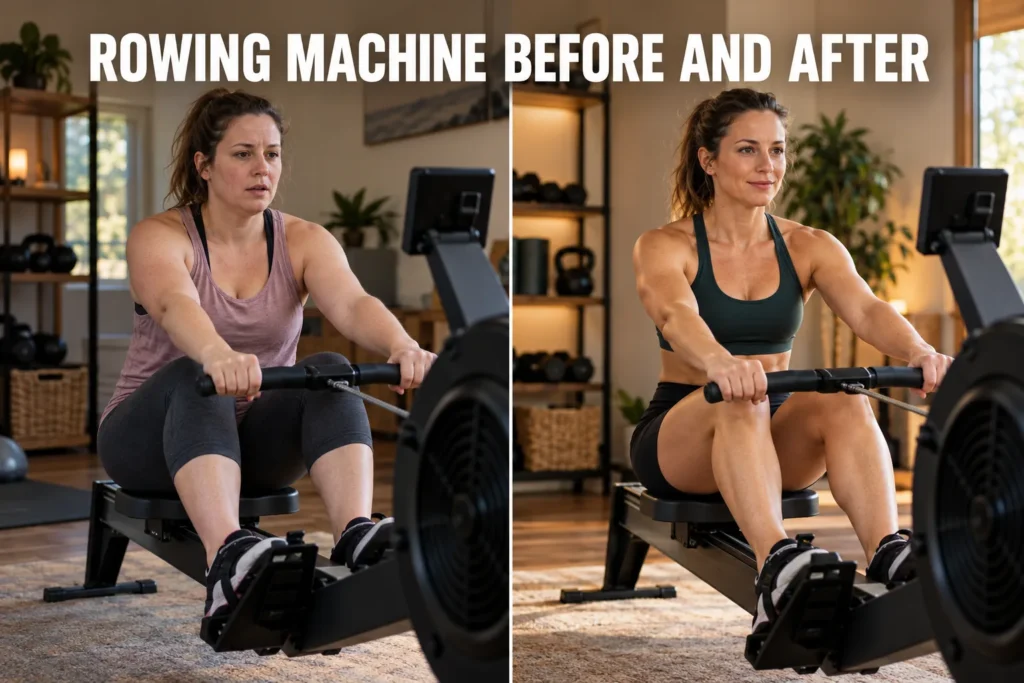
Rowing machine before and after transformations circulate everywhere online, and most of them skip the details that actually explain them. Real results depend on your starting fitness level, how consistently you row, and whether your nutrition supports fat loss or muscle retention. I coach new rowers, I have trained on both air and magnetic rowers myself, and I track split times, waist measurements, and progress photos for my clients, so I can tell you that what I see matches the research: rowers who understand what to expect at each stage stick with it longer and see more complete transformations. This guide covers what peer-reviewed research shows at each stage, what women and men typically experience differently, and what I change when progress slows down.

Rowing Machine Before and After: What Changes in Your Body
Rowing is one of the few cardio modalities that engages most major muscle groups in every stroke. The legs drive roughly 60-70% of the power output, the core stabilizes through each pull, and the arms and back finish each stroke. That full-body involvement produces the variety of changes that consistent rowers report across different body areas and fitness markers over weeks and months. The low-impact nature of the stroke also makes it accessible for people with joint sensitivity who cannot sustain high-impact cardio long enough to see meaningful results.
Cardiovascular Changes: The First Improvements You Notice
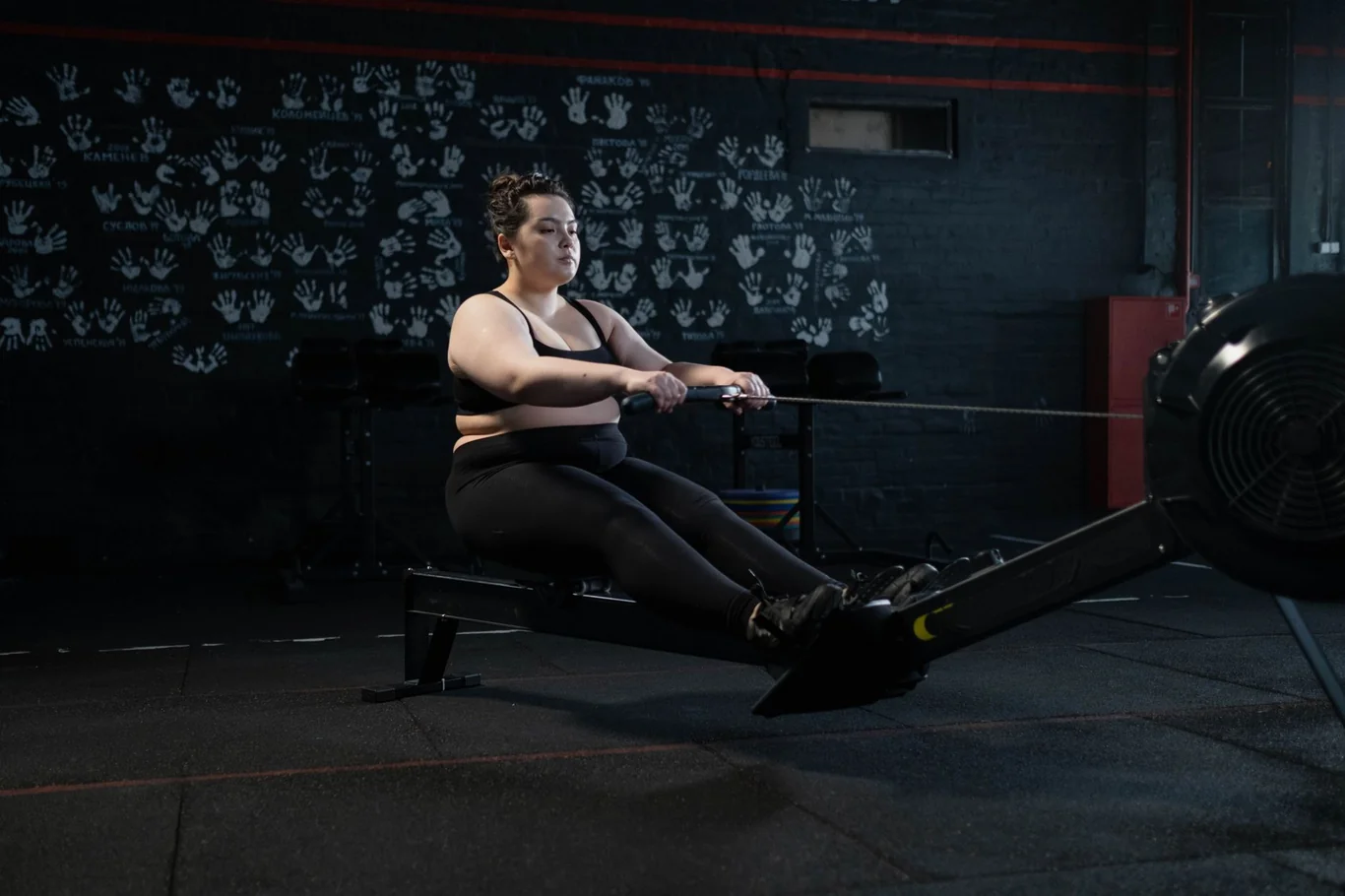
Cardiovascular adaptations arrive before any visible body changes. Within two to four weeks of consistent rowing, most people notice improved breathing capacity, faster recovery between efforts, and lower perceived exertion during daily activities. A 10-week study in post-menopausal women who rowed three sessions per week at 60-80% of peak heart rate found significant increases in peak oxygen uptake, stroke volume, and cardiac output - alongside reduced heart rate per unit of work after just six weeks (1).
These cardiorespiratory gains are measurable before any mirror-visible changes appear. Learning proper technique from the start accelerates this adaptation, because poor form reduces the cardiovascular demand per stroke. With every new rower I coach, I lock in the basic rowing stroke sequence (legs, then body, then arms) in the first two weeks, before any attention goes to pace. In my experience, clients who skip this step plateau around week three because their arms tire long before their legs do.
Body Composition Changes: Fat Loss and Muscle Development
Body composition changes take longer than cardiovascular changes, but the research documents them clearly. A 12-week rowing program produced a body fat decrease of 2.63% and a lean mass increase of 2.18 kg alongside a resting heart rate reduction of 12.63 beats per minute (2). A longer, 24-week intervention found weight reductions of 1.75 to 1.93 kg, waist circumference reductions of 2.83 to 3.66 cm, and hip circumference reductions of 2.02 to 2.88 cm (3).
These figures represent averages from structured programs. Individual results will be higher or lower based on starting body composition, training frequency, and nutrition. The key studies consistently show that rowing builds muscular endurance and lean tone rather than the hypertrophy that progressive resistance training produces. Body recomposition - simultaneous fat loss and lean mass gain - is the most common outcome across studies, which means the scale may stay flat even as body shape changes significantly. I warn every client about this in the first session, because a flat scale in week two is the most common reason people quit.
Study Length | Body Fat or Waist | Lean Mass or Weight | Additional Marker |
12 weeks | -2.63% body fat | +2.18 kg lean mass | Resting HR -12.63 bpm |
24 weeks | Waist -2.83 to -3.66 cm | Weight -1.75 to -1.93 kg | Hip circumference -2.02 to -2.88 cm |
Mental Health and Mood Benefits
Rowing produces consistent mental health benefits that often go unmentioned in before-and-after discussions. Sustained aerobic exercise at moderate intensity triggers endorphin release and reduces circulating cortisol over time, which translates to improved mood, lower perceived stress, and better sleep quality for most people who row regularly. These changes typically appear within the first two to four weeks - often earlier than visible physical changes.
For people using rowing as a mental health tool, the low-impact, rhythmic nature of the stroke cycle supports a meditative focus that many rowers describe as one of the most underrated benefits of the machine. The full-body engagement also makes it difficult to mentally check out, which increases session adherence for people who find monotonous cardio unsustainable.
Rowing Machine Results Timeline: Week by Week
How quickly you see rowing machine before and after results depends more on your habits than the machine. The timeline below combines what the research shows with what I typically see in new rowers who train three to five times per week.
Days 1-14: Energy and Endurance Come First
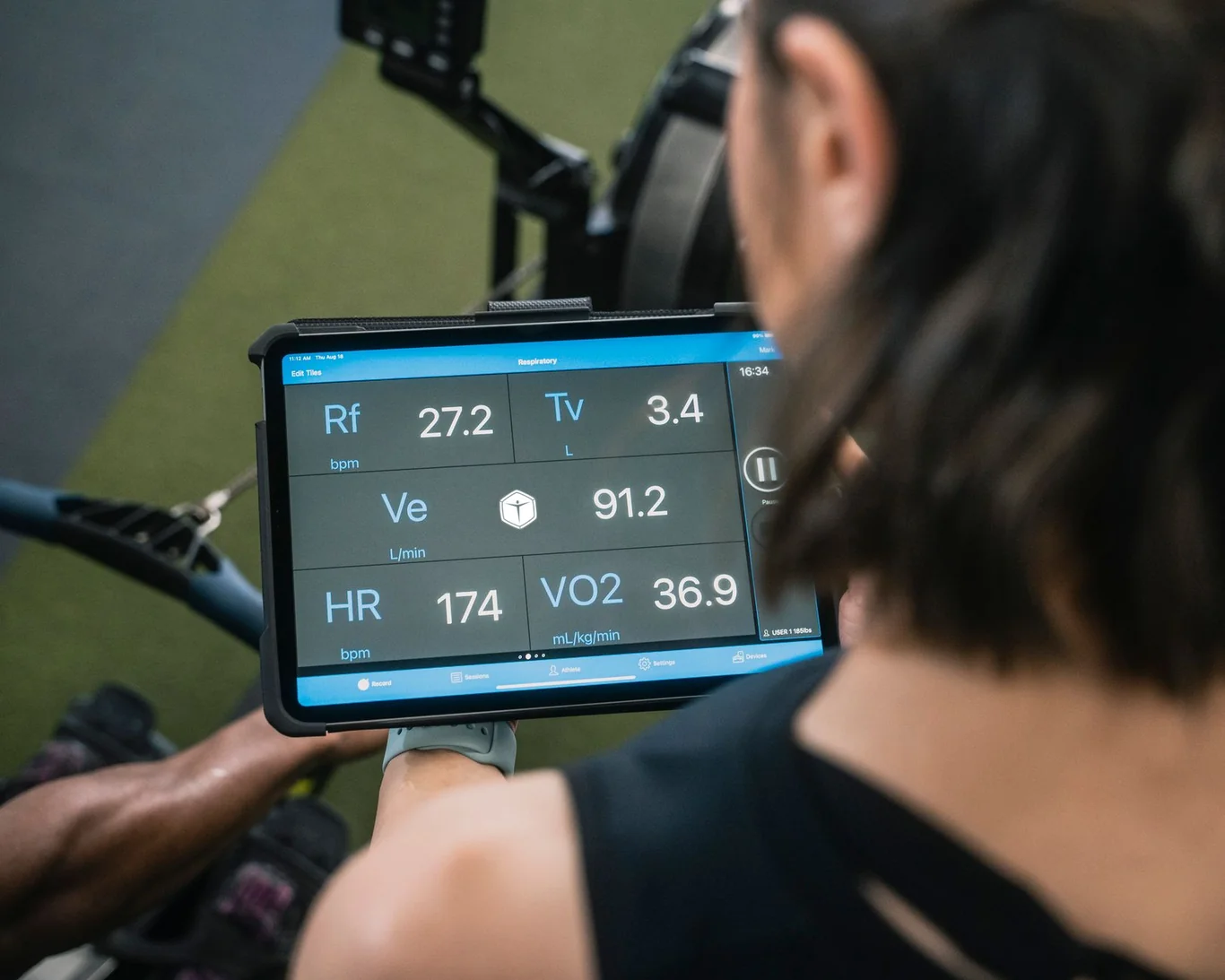
The first two weeks are about neurological and cardiovascular adaptation, not aesthetics. Your body learns the rowing movement pattern, builds its aerobic base, and adjusts to the metabolic demand. Expect soreness in the hamstrings, quads, and lower back, especially if these muscle groups are undertrained coming in.
One of the most reliable early markers is improving split times - most beginners see measurable improvements in their 500m pace within the first two weeks even without any visible physical changes. A flat scale is normal in this phase due to muscle glycogen and water retention from new training stimulus. I ask every client to log their split after every session and check it against typical 500m rowing times for your age and level as the weeks go by.
Weeks 3-4: The First Visible Rowing Machine Before and After Changes
By week three to four, early visible changes typically emerge for people training three to five times per week. These usually appear as:
- Reduced midsection puffiness from decreased water retention and early fat mobilization
- Improved standing posture from back and core strengthening
- Visible quad and hamstring definition, especially noticeable when climbing stairs
- Measurable resting heart rate decline, trackable with a heart rate monitor each morning
- Slightly looser waistband on pants or shorts
- Split time improvements of 5-10% from baseline at consistent effort
These are subtle changes that people who see you regularly may notice before you do. With my clients, a partner or coworker usually comments on the posture change around week four, well before the rower notices anything in the mirror.
30 Day Rowing Machine Before and After Results
The 30 day rowing machine before and after window is where expectations most often run ahead of physiology, so I want to frame it honestly. An eight-week HIIT protocol combining rowing and cycling produced fat mass reductions of 1.8 to 2.3 kg and lean mass gains of 0.2 to 2.0 kg (4). Scaling that to 30 days of moderate-intensity rowing, the realistic outcome for most people with consistent effort includes:
- 1 to 2.5 lbs of fat loss with a caloric deficit - the rowing alone without dietary adjustment rarely moves the scale
- Measurable cardiovascular fitness improvement, confirmed by faster split times and lower resting heart rate
- 1 to 2 cm waist circumference reduction in most cases
- Visible leg and back definition in people with lower starting body fat percentages
The 30 day rowing challenge before and after posts that show dramatic transformations almost always include dietary changes alongside the training. Weight loss results from a 30 day challenge follow the same rule: rowing without a caloric deficit builds fitness and lean mass quality, but the scale movement most people expect requires energy balance management. I like 30 day challenges as a habit builder, and I judge them by split times and energy levels rather than by the scale.
The 1 month rowing machine results you can genuinely expect are primarily cardiovascular and early compositional - the kind of changes you feel and measure more than you see in rowing machine before and after pictures.
60 to 90 Days: The 90 Day Rowing Machine Before and After
The 90 day rowing machine before and after is where transformation becomes genuinely photogenic. Research found VO2max improvements of 8-15% after eight weeks of HIIT combining rowing and cycling (4) - continued training over 90 days consolidates and extends those gains. With consistent three to five sessions weekly and nutrition that supports your goals:
- Body fat percentage has declined measurably, typically 2-4% from baseline
- Lean muscle definition is visible in the legs, back, and shoulders in photos
- Resting heart rate has decreased noticeably
- Split times at the same effort level have improved 10-20% from where they started
- Posture and everyday functional fitness have transformed in ways photos do not fully capture
Treat the first 30 days as the foundation. The kind of change that stands out in side-by-side progress photos typically requires 60 to 90 days of dedicated, consistent effort.
One client I coached, a 41-year-old office worker, rowed four times a week for 90 days while keeping a modest calorie deficit. His scale weight dropped only about 2 kg, but his waist measured roughly 5 cm smaller, and his 500m split at the same effort improved by around 15 seconds. His day 1 and day 90 photos convinced him far more than the scale did, which is why I never judge a 90-day block by body weight alone.
Timeframe | Main Adaptation | Visible Change | Key Metric |
Days 1-14 | Cardiovascular and neurological | None yet | 500m pace improves measurably |
Weeks 3-4 | Cardiovascular base builds | Reduced midsection puffiness, improved posture | Split times 5-10% better than baseline |
30 Days | Early body recomposition begins | Early leg and back definition | 1-2 cm waist reduction |
60-90 Days | Full body recomposition | Visible back, shoulder, and leg definition | Body fat -2 to -4%; VO2max +8-15% |
Rowing Machine and Belly Fat: What the Research Shows
Fat loss around the midsection follows the same rules as fat loss anywhere else on the body, and the research bears that out. This section covers what rowing actually does for belly fat and what the numbers show over time.
The Spot Reduction Myth and How Rowing Burns Fat
Belly fat is the area most people hope a rowing machine will change first, and the answer requires one important distinction. Rowing burns calories across your entire body, but no exercise can target belly fat specifically. Spot reduction is not physiologically possible.
What rowing accomplishes is contributing to the overall caloric deficit required for fat loss throughout the body, including the abdomen. Research comparing energy expenditure across seven indoor cardio machines found rowing generates meaningful caloric burn across a range of intensity levels (5). A 155 lb person burns roughly 260-400 calories per 30 minutes of moderate to vigorous rowing - but actual expenditure depends on drag factor, stroke rate, technique quality, and individual metabolic rate, which is why single flat numbers in other articles are misleading.
Research Results on Waist Circumference and Fat Loss
Over time, consistent rowing combined with a caloric deficit reduces fat stores throughout the body, including the midsection. Gavala-González et al. (2024) found waist circumference reductions of nearly 3 cm after 24 weeks of twice-weekly rowing (3). A six-week rowing program in another population also produced significant reductions in fat mass (6). The wider evidence on rowing for weight loss points the same way: nutrition, not the machine, decides how much of that midsection fat actually comes off.
Female Rowing Body Before and After: What Women Typically Experience
Women considering rowing often want a realistic picture of how their body will change, not marketing promises. The following breaks down the typical timeline, the physical changes to expect, and how to track progress accurately.
Will Rowing Make Women Look Bulky
Women who search for female rowing body before and after results typically want to know whether rowing will make them look leaner or bulkier. The fear of rapid muscle bulk from rowing is largely unfounded for most women. Rowing is an endurance activity, and the hormonal environment that drives large-scale hypertrophy in women requires a very different training stimulus.
The rowing machine before and after female results typically develop along these lines at three months of consistent training:
- Defined back and shoulders: The lats, rhomboids, and posterior deltoids strengthen with each stroke, improving posture and creating an athletic silhouette - not mass, but visible definition
- Leaner legs and glutes: Quad and hamstring development from the drive phase appears as firmer, more defined tissue rather than increased size
- Reduced waist measurement: Core engagement through every stroke strengthens the transverse abdominals and obliques over time
- Improved arm definition from the pull phase, though arm changes are subtler than leg and back changes
- Measurable lean mass and fat changes: Gavala-González et al. (2020) found a 12-week rowing program increased lean mass by 2.18 kg while decreasing body fat by 2.63% (2)
Body Recomposition and How to Track Progress
Body recomposition - simultaneous fat loss and muscle gain - frequently keeps the scale flat while body shape changes significantly. That flat scale can still be a positive result, and it is one reason people quit too early. Tracking waist circumference and how clothing fits across the hips and shoulders captures these changes more accurately than scale weight alone. My tip for female clients: measure the waist at the navel, not at the narrowest point, because that spot is easier to repeat week after week.
One nuance for women comparing their rower before and after experience to men's: the same training volume typically produces leaner definition in women at a slightly slower pace due to lower testosterone levels. The drive phase loads the legs and back hardest, so those are the rowing muscles that usually show visible change first, with the arms following later.
Can Rowing Build Muscle? What Before and After Results Tell Us
The muscle rowing builds looks different from what a barbell program produces, and understanding that distinction sets realistic expectations. This section covers which muscles respond most, the limits of that development, and how results tend to unfold for men.
What Muscles Rowing Develops and Its Limits
Rowing builds muscular endurance, lean tone, and posterior chain strength - primarily in the hamstrings, glutes, lats, and rhomboids. It does not produce the muscle mass that progressive resistance training generates, and expecting rowing alone to produce a heavily muscled physique is not supported by the evidence.
For people starting from a sedentary baseline, the muscle development from rowing is real and functional. Research tracking muscle architecture in elite female rowers observed structural adaptations in the vastus lateralis - including fascicle length changes and pennation angle shifts - over 16 weeks of competitive preparation (7). For recreational rowers, these adaptations translate to improved muscle quality and functional strength rather than visible hypertrophy.
Rowing Machine Before and After Results for Men
For men, rowing machine before and after results mirror the female pattern at a slightly accelerated pace due to higher baseline testosterone - lean definition in the back, legs, and shoulders builds noticeably by the 60-day mark. The before and after results that include significant muscle gain almost always involve concurrent resistance training, because rowing builds muscle through a moderate strength stimulus rather than the heavy loading that drives hypertrophy. If muscle mass is your main goal, I recommend pairing your rowing with two dedicated full-body lifting sessions per week, which is the split I use with most male clients who want both size and conditioning.
How to Maximize Your Rowing Machine Before and After Results
How quickly results appear comes down to three variables under your control: nutrition, training structure, and technique. Getting all three right in the first 30 days determines whether your rowing machine before and after results fall in the modest or significant range. When I coach new rowers, nutrition and consistency decide results far more often than machine type or programming sophistication, and the research I reviewed points the same way.
Nutrition Is the Decisive Variable
No amount of rowing compensates for mismatched nutrition. For fat loss, a caloric deficit of 300 to 500 calories per day produces sustainable progress without compromising the energy needed to train effectively. For muscle preservation or lean mass development, adequate protein intake - typically 1.6 to 2.2 g per kg of body weight daily - is non-negotiable.
Energy balance management alongside training is the decisive factor that separates modest from significant 30 day rowing challenge before and after results. In practice, I have clients log what they eat for the opening weeks of a challenge, because that is usually where the missing deficit hides.
Frequency and Duration That Drives Real Results
Research protocols that produce measurable results consistently use three to five sessions per week at 20 to 45 minutes per session. Rowing every day for a month produces meaningful caloric expenditure and enough cardiovascular stimulus for improvement across a wide range of body weights, though even three sessions per week produces measurable change within 30 days. For beginners, three sessions per week at 15-20 minutes is a sustainable entry point, with progression to four or five sessions over the following month. I would rather see a beginner row a few days a week for months than every day for a short stretch and then burn out.
For intensity structure, mixing steady-state rowing at 18-22 strokes per minute with interval work produces significantly greater VO2peak improvements than steady-state training alone - a pattern confirmed by research on structured mixed-intensity rowing protocols (8). A simple starting structure: two steady-state sessions and one interval session per week in the first month. If intervals are your priority, a machine from the best rowers for conditioning list handles fast changes in stroke rate better than most entry-level models I have used.
Common Technique Mistakes That Delay Results
Poor form reduces muscle engagement, slows cardiovascular adaptation, and increases injury risk. The mistakes that most consistently delay rowing machine before and after progress include:
- Pulling with the arms before completing the leg drive - reduces power output by 30-50% per stroke and limits leg development
- Rounding the lower back at the catch position - reduces core engagement, risks lumbar strain, and is a common source of rowing-related back pain
- Rushing the recovery phase - reduces the posterior chain stretch that drives muscle development on the next stroke
- Using maximum resistance from day one - drops stroke rate below the threshold needed for effective cardiovascular training
Fixing these in the first two weeks dramatically improves the trajectory of results over months two and three.
Technique Mistake | Impact on Results |
Arms pull before leg drive completes | Power output reduced 30-50% per stroke |
Lower back rounding at the catch | Reduces core engagement; lumbar strain risk |
Rushing the recovery phase | Reduces posterior chain stretch for next stroke |
Maximum resistance from day one | Stroke rate drops below cardiovascular training threshold |
Track More Than the Scale
Rowing before and after results look more complete when you measure multiple markers in parallel. This is where rowing machine before and after pictures become a genuinely useful tool - a photo every two weeks at the same angle captures change the scale consistently misses:
- Waist circumference with a tape measure, same time each week
- 500m split time at a consistent effort level - a reliable, objective cardiovascular benchmark
- Resting heart rate measured each morning before rising
- How clothing fits across the chest, waist, hips, and thighs
Progress on two or three of these simultaneously - even without scale movement - confirms that meaningful body composition change is occurring.
Setting Realistic Rowing Expectations
Rowing machine before and after results are real. They are also slower and more multidimensional than most challenge-format content suggests. Visible fat loss and muscle definition typically emerge after 60 to 90 days of consistent training combined with nutrition that supports your goals, well beyond the two to four weeks that most 30-day challenges imply. Across the research and the rowers I coach, people who commit past the 60-day mark get physical, cardiovascular, and postural results that genuinely match their investment. The mental health and mood benefits tend to arrive earliest, often within the first two to three weeks, which helps sustain motivation through the phase where visible change is still weeks away. My single most useful tip: repeat the same 500m test at the same effort every two weeks and take a photo on the same day, because those two markers show progress long before the scale does.
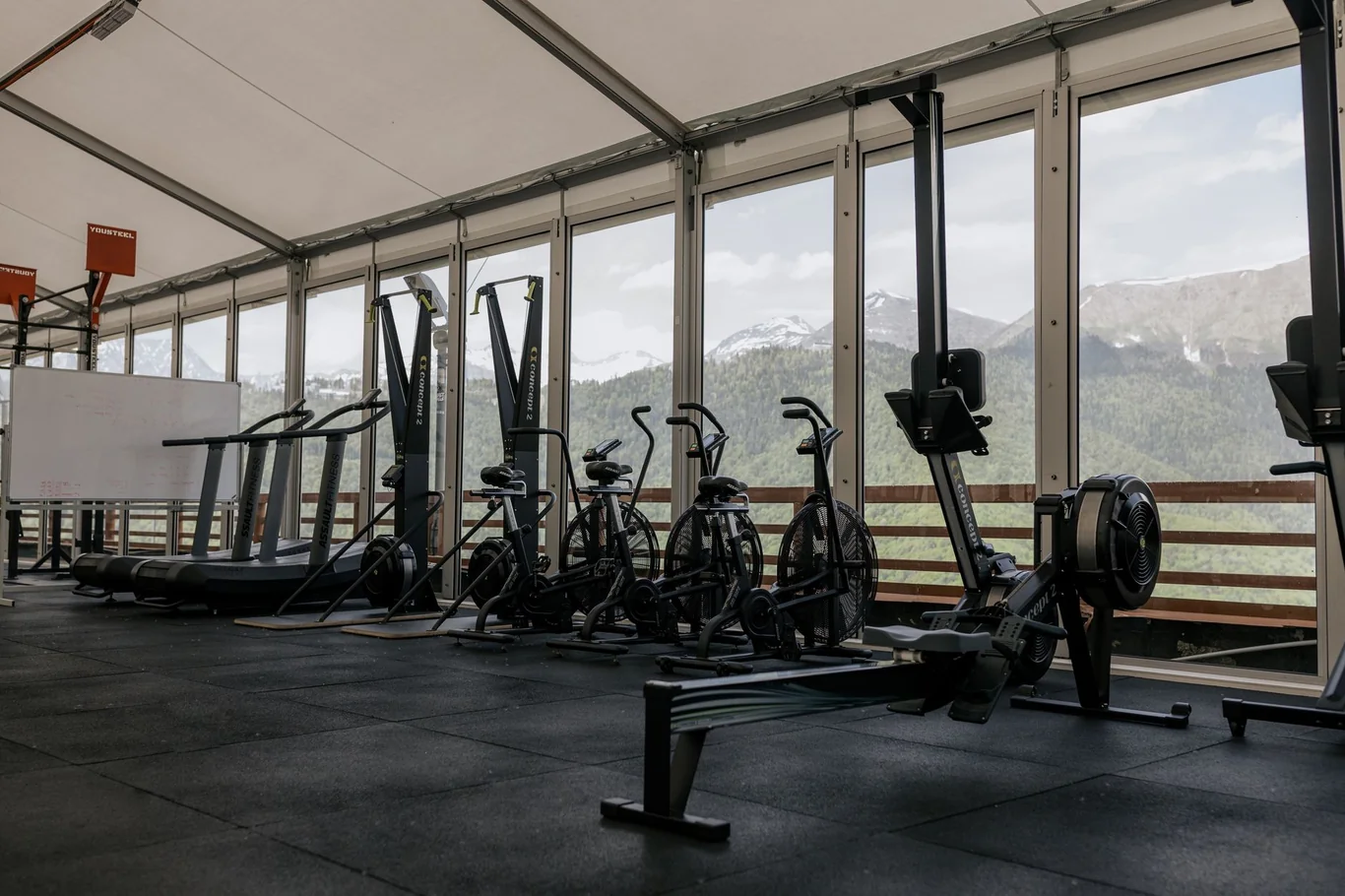
On equipment, what matters most for these results is a machine you will actually use three to five times a week. For most new rowers I recommend a quiet magnetic model with a comfortable seat and a monitor that shows your 500m split, and those traits matter more than maximum resistance when choosing among beginner rowing machines. For a compact home setup, I often point clients to a folding magnetic rower like the XTERRA ERG200 folding rower, since a rower that stays set up gets used more often. If you want to compare every resistance type first, start with the best rowing machine roundup, then browse current models in the rowing machines shop.
FAQs
How long before you see results from rowing machines?
You typically see the first results from a rowing machine within two to four weeks - cardiovascular improvements like better breathing, faster recovery, and lower perceived exertion appear first. Visible body composition changes, such as reduced body fat and improved muscle definition, typically require eight to twelve weeks of consistent training combined with appropriate nutrition.
Is 20 minutes of rowing a day enough?
Twenty minutes of rowing per day is enough to produce meaningful cardiovascular improvements and contribute to a caloric deficit for fat loss, particularly for beginners and intermediate rowers. For more significant body composition changes, increasing session length to 30-45 minutes or incorporating interval training over time will accelerate results.
What body shape does rowing give you?
The body shape rowing gives you is lean and athletic, with the most noticeable development in the legs, back, and shoulders. The posterior chain - hamstrings, glutes, lats, and rhomboids - strengthens most visibly, improving posture and creating a more defined, athletic frame over time. Significant muscle bulk is not typical without adding progressive resistance training alongside rowing.
Can you lose belly fat on a rowing machine?
You can lose belly fat on a rowing machine as part of an overall caloric deficit, but rowing cannot target abdominal fat directly - spot reduction is not physiologically possible. Rowing contributes to total calorie expenditure, which draws from fat stores throughout the body including the abdomen, when a sustained caloric deficit is maintained consistently.
This content is for informational and educational purposes only. It is not a substitute for professional medical advice, diagnosis, or treatment. Always consult with your healthcare provider before starting any new fitness program or using fitness technology for health monitoring.
We are always looking for expert inputs to make our content even better and more useful.
References
- Araujo RC, Rodrigues GD, Ferreira LF, Soares PP. The time course of cardiorespiratory adaptations to rowing indoor training in post-menopausal women. Int J Environ Res Public Health. 2023;20(4):3238. doi:10.3390/ijerph20043238.
- Gavala-González J, Gálvez-Fernández I, Mercadé-Melé P, Fernández-García JC. Rowing training in breast cancer survivors: a longitudinal study of physical fitness. Int J Environ Res Public Health. 2020;17(14):4938. doi:10.3390/ijerph17144938.
- Gavala-González J, Real-Pérez M, Benítez-García L, Fernández-García JC. Fixed-seat rowing versus sliding-seat rowing: effects on physical fitness in breast cancer survivors. Cancers (Basel). 2024;16(12):2207. doi:10.3390/cancers16122207.
- Petersen MH, de Almeida ME, Wentorf EK, Jensen K, Ørtenblad N, Højlund K. High-intensity interval training combining rowing and cycling efficiently improves insulin sensitivity, body composition and VO2max in men with obesity and type 2 diabetes. Front Endocrinol (Lausanne). 2022;13:1032235. doi:10.3389/fendo.2022.1032235.
- Prieto-González P, Yagin FH. Energy expenditure, oxygen consumption, and heart rate while exercising on seven different indoor cardio machines at maximum and self-selected submaximal intensity. Front Sports Active Living. 2024;6:1313886. doi:10.3389/fspor.2024.1313886.
- Shin KY, Choi EH, Lim JY, Cho AR, Lim YH. Effects of indoor rowing exercise on the body composition and the scoliosis of visually impaired people: a preliminary study. Ann Rehabil Med. 2015;39(4):592-598. doi:10.5535/arm.2015.39.4.592.
- van der Zwaard S, Jaspers GW, Attaallah AA, et al. Training-induced muscle adaptations during competitive preparation in elite female rowers. Front Sports Active Living. 2021;3:781942. doi:10.3389/fspor.2021.781942.
- Kirchenberger T, Ketelhut S, Ketelhut RG. Effects of moderate- versus mixed-intensity training on VO2peak in young well-trained rowers. Sports (Basel). 2021;9(7):92. doi:10.3390/sports9070092.