
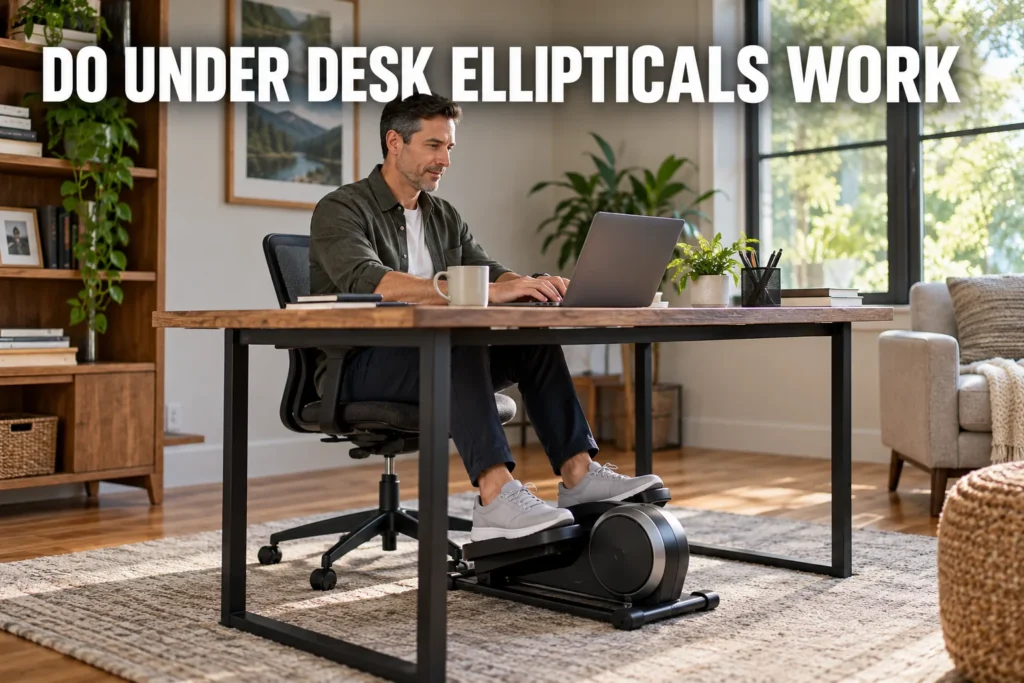
Do under desk ellipticals work, or do they end up as an expensive footrest? I have used seated pedal and elliptical units through full workdays and tracked what actually changed, and after years of conditioning competitive athletes, I judge them on one honest question: does the movement add up by the end of the week? Extended sedentary time is independently linked to cardiovascular risk, metabolic dysfunction, and chronic inflammation even in people who exercise regularly outside work hours (1). The peer-reviewed evidence increasingly supports under desk ellipticals as a tool for cutting sedentary time and improving metabolic health, with important caveats about what they can and cannot do. This guide covers what the science says, the muscles these devices target, realistic calorie ranges, and how I recommend using one to get real results.

Do Under Desk Ellipticals Work: What the Evidence Actually Shows
The honest answer is that under desk ellipticals work well as a NEAT tool and work poorly as a fitness replacement. NEAT - non-exercise activity thermogenesis - is the energy your body burns through everyday movement outside of formal exercise. Under desk exercise cycles, ellipticals, and pedal devices belong in this category: they increase light movement during hours that would otherwise be completely sedentary. This distinction matters because it reframes what success looks like.
Under Desk Elliptical Calorie Burn: Realistic Ranges
Calorie burn from a pedal device is not uniform - it depends on body weight, resistance setting, and pedaling cadence. For most people, realistic extra calories above baseline sitting look like this:
Body Weight | Low Resistance | Moderate Resistance | High Resistance |
55 kg (121 lb) | 55-65 kcal/hr | 85-95 kcal/hr | 115-125 kcal/hr |
70 kg (154 lb) | 70-80 kcal/hr | 110-120 kcal/hr | 145-155 kcal/hr |
85 kg (187 lb) | 85-95 kcal/hr | 130-140 kcal/hr | 180-190 kcal/hr |
100 kg (220 lb) | 100-110 kcal/hr | 155-165 kcal/hr | 210-220 kcal/hr |
In my own desk sessions on a Cubii Jr., the calorie readout at medium resistance landed in the same general range as the MET-based estimates above. The Cubii app also stayed reasonably close to a chest strap heart rate monitor worn during the same sessions.
These are estimates based on metabolic equivalents for light cycling activity. Actual values vary with individual fitness level and true pedaling output.
A worked example: A 75 kg person pedaling at moderate resistance for 60 minutes across an 8-hour workday burns roughly 120 extra calories compared to sitting still. At five days per week over 50 weeks, that adds approximately 30,000 extra calories per year - or around 3.9 kg of potential fat loss if eating habits remain constant. One comprehensive review of active workstation research estimated that consistent pedal desk use at moderate daily intensity could yield roughly 9 kg of fat loss over a full year (1). That figure assumes sustained, daily use - a high-adherence scenario for most people, but achievable.
Calorie figures are always estimates that scale with weight, intensity, and duration. Use ranges as planning benchmarks, not precision targets.
Under Desk Ellipticals as NEAT Boosters: The Primary Case
The strongest evidence for under desk exercise is not cardiovascular fitness gains. It is the reduction of sedentary time and its downstream health consequences. A network meta-analysis of 23 randomized controlled trials involving 1,428 office workers found that active workstation interventions - including pedal devices - were among the most effective strategies for reducing work-specific sitting time, with multicomponent interventions showing the largest effect (2). Even low-effort pedaling triggers muscle contractions in the lower limbs, maintains circulation, and keeps your metabolism slightly elevated compared to static sitting throughout the day.
This NEAT-boosting mechanism is why consistent daily use separates genuine results from a device that becomes an expensive footrest. A single 30-minute session changes almost nothing. Three months of daily 30-60 minute sessions produces measurable changes to cardiometabolic risk factors and daily movement patterns. What I tell desk-bound clients is to treat the device like a step count, not a workout.
Benefits of Under Desk Elliptical Use
The under desk elliptical benefits are clearest when you understand the baseline you are improving from: hours of unbroken sitting. Each benefit reflects improvements over doing nothing during that same time - not improvements over a structured gym session. Framing matters here because it determines whether the device adds genuine value to your life or just creates false expectations.
Cardiovascular and Vascular Benefits
A particularly important 2024 study compared three 3-hour protocols in 18 participants: uninterrupted sitting, sitting interrupted by regular standing breaks, and sitting with periodic seated elliptical use. Only the seated elliptical group reversed sitting-induced changes to central arterial wave reflection - a key marker of cardiovascular health - while standing breaks produced no measurable vascular benefit (3). This finding is worth emphasizing: standing desks are widely promoted as the solution to desk-bound cardiovascular risk, yet this data shows simple pedaling outperforms them for vascular health outcomes.
Heart rate elevation during an under desk workout qualifies as light aerobic activity for most users, making it a meaningful cardiovascular stimulus for people who otherwise get zero movement during the workday. If you want objective data on how much cardiovascular benefit you are actually accumulating per session, pairing your device with a heart rate monitor gives you real numbers to work with rather than estimates.
After 3 weeks of daily use, the heart rate data on my Garmin Fenix 7 made the pattern easy to see: pedaling blocks showed up as steady light-aerobic stretches instead of the flat line of a normal desk day. A wrist reading is not a clinical measurement of vascular health, but it did confirm the aerobic stimulus was real and repeatable.
Cardiometabolic Improvements with Consistent Use
A 12-week randomized controlled trial studied 32 healthy sedentary office workers who used portable pedal machines for 60 minutes per day during work hours. At the 12-week mark, researchers observed significant improvements in inflammatory markers (ultrasensitive C-reactive protein), total cholesterol, and LDL cholesterol, alongside reductions in daily sitting time and increases in light-intensity physical activity (4). These are clinically meaningful gains - reduced CRP and LDL are associated with meaningfully lower cardiovascular disease risk over time.
The under desk elliptical before and after picture for cardiometabolic health is realistic at a 3-month timeframe with consistent daily use. Twelve weeks of 60-minute daily sessions is an achievable commitment for someone who already sits at a desk all day and is looking to add movement without disrupting their workflow.
Under Desk Elliptical Benefits for Mental Well-Being and Productivity
Breaking up sedentary time carries measurable psychological effects. Research on sedentary behavior interventions in office workers found improvements in positive affect and reductions in fatigue among participants in active desk conditions compared to standard sitting controls (5). Users frequently describe a mid-afternoon energy lift from keeping their legs moving - light movement helps maintain cognitive alertness better than sustained static sitting, a pattern consistent with the broader NEAT literature on low-intensity movement and arousal regulation. I notice the same lift on days I pedal through the 3 p.m. slump instead of reaching for a second coffee.
What Muscles Do Under Desk Ellipticals Work
Under desk ellipticals primarily recruit the lower body muscle chain. The elliptical motion traces a slight oval rather than a pure circle, which means marginally more hip extension and glute engagement compared to a standard under desk bike at the same effort level. Here is the full set of muscles engaged during a typical session:
- Quadriceps (front of thigh) - primary driver of the downstroke, the most heavily recruited muscle group
- Hamstrings (back of thigh) - recruited during the upstroke and hip extension phase
- Gluteus maximus - activated especially at higher resistance settings
- Calves (gastrocnemius and soleus) - continuous low-level activation throughout the pedaling cycle
- Hip flexors (iliopsoas) - engaged during the lift phase at the top of the stroke
- Tibialis anterior (front of shin) - helps control foot positioning through the cycle

The under desk leg exercises provided by this motion are low-load and low-intensity. You are not doing a squat, a lunge, or a deadlift. The activation level is sufficient to maintain circulation, contribute to calorie burn accumulation, and support joint mobility - but not sufficient to build meaningful strength or visible muscle definition on its own.
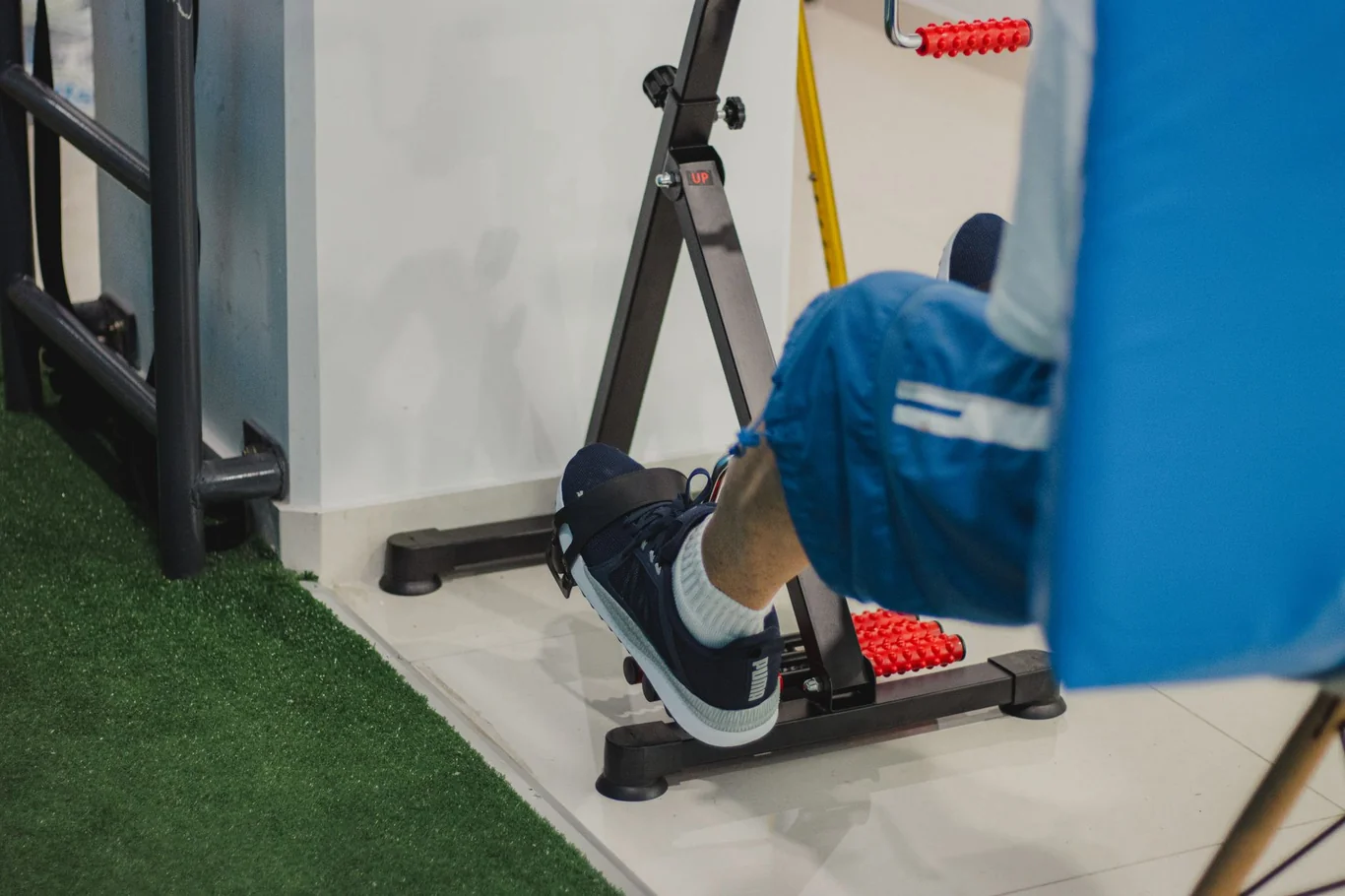
In my use of both, a seated unit feels like a gentle leg warm-up, while the standing stride and moving handles of a full-size machine bring in the glutes, core, and upper body. That difference is the main functional gap between seated and standing ellipticals, and it is why the two should not be judged by the same standard. When a client needs real conditioning rather than NEAT, I move them to a full-size home elliptical for three sessions a week and keep the desk unit for the hours in between.
Under Desk Elliptical Before and After: Setting Realistic Expectations
The most common source of disappointment with these devices is expectation mismatch. Here is what the evidence-based timeline actually looks like:
Timeframe | Observable Changes |
Weeks 1-2 | Reduced daily sedentary hours; mild leg adaptation; habit anchor forming |
Weeks 3-6 | Consistent daily movement; improved afternoon energy; 600-900 extra kcal per week accumulated |
Weeks 7-12 | Measurable CRP, cholesterol, and LDL improvements possible with 60 min/day; 6,000-10,000 extra kcal total |
6 months | Meaningful circulation improvement; 15,000-20,000 extra kcal accumulated depending on adherence |
12 months | ~30,000 extra kcal at high adherence; 3.9 kg potential fat deficit at stable diet; cardiometabolic risk markers measurably reduced |
Consistency is the only variable that determines whether these timelines materialize. Sporadic use produces no measurable benefit, and the device has no mechanism to help you if you only pedal twice a week.
Under Desk Bike vs Elliptical: Finding the Right Fit for Your Desk
The under desk bike vs elliptical question comes down to motion path, noise, and joint feel. A bike traces a pure circular rotation at a fixed pedaling angle; an elliptical traces an oval or slightly elongated path. The elliptical motion is gentler on ankles and promotes slightly more hip extension, which matters for people with tight hip flexors from prolonged sitting. Under desk bikes tend to be more compact and generate marginally less noise at equivalent effort levels. Having used both at a desk, I find the flatter elliptical path easier to keep going while typing because the knees rise less, although desk height changes that.
For users weighing an under desk elliptical against a walking pad or under desk treadmill, the comparison shifts significantly: walking pads deliver higher calorie burn in the 150-250 kcal/hr range and more full-body muscle engagement, but require more desk height clearance and generate more noise. Choose the under desk elliptical if your goal is quiet, low-profile NEAT accumulation during focused work. Choose a walking pad if your desk setup accommodates it and you want closer-to-cardio output.
Manual Under Desk Elliptical vs Motorized Options
A manual under desk elliptical relies entirely on your leg movement to drive the mechanism. A motorized version maintains a set cadence regardless of your effort. Here is how to think about the difference:
- Manual models cost less and are typically quieter at low resistance levels
- Manual models give you full control over intensity - you can reduce effort to near-zero during focused work
- Manual models require more conscious effort to keep moving when your attention is deeply focused on other tasks
- Motorized models maintain a consistent cadence automatically, which helps accumulate daily minutes without constant conscious attention
- Motorized models are generally bulkier and cost more, and some models generate more noise than manual equivalents
- For most office workers a quality manual model delivers comparable NEAT benefits at lower cost and noise
If you want a self-paced experience, the best motorized under desk elliptical options maintain cadence at a set RPM automatically, removing the need to consciously keep pedaling during focused work. The most widely reviewed mid-tier options are manual: the Cubii under desk elliptical line is pedal-powered, while motorized units, including some Ancheer under desk elliptical models, sit at the upper end of the consumer range. My advice on a manual unit: set the resistance one level lower than feels right, because at 2 p.m. with a deadline you will keep pedaling an easy setting and quit a hard one.
How to Use an Under Desk Elliptical Effectively
Knowing that under desk ellipticals are effective as NEAT tools is the starting point. The other half is building the habit so the device does not become an expensive footrest after 30 days. The pattern I see most often with clients is a burst of use in the first week followed by a unit that sits untouched by the second month, almost always because nothing in the workday cues it.

How Long to Use an Under Desk Elliptical Each Day
The research-supported sweet spot for daily use is 30 to 60 minutes total, accumulated across multiple shorter sessions rather than one continuous block. A practical daily protocol looks like this:
- Morning startup (first 15 minutes of the workday) - 10-15 minutes at low resistance while reviewing email or reading updates; establishes the habit anchor
- Mid-morning session - 10 minutes during lower-focus tasks; slightly higher resistance is fine here
- Post-lunch session - 10-15 minutes to counteract the post-meal energy dip and support glucose metabolism after eating
- Mid-afternoon - 10 minutes during routine calls, passive listening periods, or form completion
- Optional wind-down - 5-10 minutes at the end of the workday at low resistance; builds cumulative minutes without taxing mental energy
This schedule builds toward 45-60 minutes of daily under desk exercise without any session feeling effortful or disruptive to your workflow.
Under Desk Workout Integration Tips: Habit Stacking for Consistency
The most effective under desk workouts happen when pedaling is tied to specific recurring activities that already happen in your workday. Habit stacking removes the need for willpower:
- Video calls and virtual meetings - low-resistance pedaling during passive listening requires zero additional attention
- Reading documents or reviewing reports - sustained light activity pairs naturally with lower active-typing demand
- Podcast or training audio sessions - use these as active recovery between focused work blocks
- Scheduled movement alerts - set a 10-minute timer every 90 minutes as a movement cue that triggers a pedaling session
Are Under Desk Ellipticals Worth It: The Honest Verdict
Under desk ellipticals are worth it for the right person with accurate expectations. They are a genuinely useful tool for anyone who cannot or will not take movement breaks during the workday. A treadmill desk meta-analysis of 13 studies (n=351) confirmed meaningful increases in caloric expenditure above baseline sitting, with modest effect sizes for cardiometabolic outcomes at this intensity level (6). Choosing the best under desk elliptical means matching noise output, desk clearance, and resistance range to your actual workday conditions.

Under desk ellipticals work best for people who:
- Sit for 6 to 10 hours daily and have no practical way to add movement without leaving their desk
- Are recovering from lower-body injuries and want gentle joint movement during rest periods
- Are older adults looking for low-impact circulation support; the best under desk elliptical for seniors is a quiet, low-profile unit that fits standard desk heights and needs no setup beyond sliding it underfoot
- Work remotely and have lost the incidental movement that came with commuting
- Have joint concerns that make higher-impact options like walking pads or standing desk use uncomfortable
Under desk ellipticals are less useful for people who:
- Expect significant weight loss without making any changes to diet
- Want a primary fitness tool to replace structured exercise
- Have a desk height or leg clearance too shallow to pedal comfortably
- Work in shared quiet spaces where even low-level mechanical noise is disruptive
I introduced a Cubii Pro to my own desk setup for a 12-week period, using it for 40-50 minutes daily anchored to my morning email and afternoon review blocks. At the end of week 12, my seated sedentary hours dropped from 7.5 to 5.8 per day on average, measured through my Garmin watch's daily activity summary - a reduction of 1.7 hours daily that produced noticeable improvements in afternoon energy and end-of-day leg circulation.
Making Consistent Movement Work at Your Desk
So, do under desk ellipticals work? They do as a daily NEAT tool, and they fall short as a replacement for structured exercise. The research is clear that consistency separates a useful movement habit from an expensive footrest: the cardiovascular data, cardiometabolic improvements, and calorie projections all assume daily use sustained over weeks and months. For structured cardio at home, the top full-size elliptical machines cover the part a desk unit cannot, and I treat the two as partners rather than rivals.

Most desk workers have no other genuinely low-friction movement option during the workday. No single session is transformative on its own, but two hundred sessions across a year of daily use will meaningfully reduce sedentary time, contribute a real calorie deficit, and support circulatory and cardiometabolic health markers. The most practical tip from my own desk trials: start with 15 to 20 minutes daily, anchor it to your morning email review, and scale from there. When you are ready to buy, prioritize low noise, low pedal height, and smooth resistance, the same criteria I use to rank the best under desk ellipticals.
FAQs
How long should you use an under desk elliptical?
The recommended daily target for an under desk elliptical is 30 to 60 minutes total, accumulated across multiple 10 to 20 minute sessions throughout the workday rather than in one continuous block. Research on workplace pedal device protocols suggests that breaking sessions into shorter intervals is more practical for most office tasks and does not significantly impair work performance during focused work periods.
Will under desk elliptical tone legs?
An under desk elliptical will not tone legs in the way most people imagine - visible muscle definition requires resistance levels and training volume that low-impact seated pedaling does not provide. What regular use does deliver is maintained muscle activation, improved circulation in the lower limbs, and a modest contribution to the calorie deficit that, combined with appropriate nutrition over the long term, can support gradual fat reduction.
Which is better for me, an under-desk elliptical or a walking pad?
The better choice between an under-desk elliptical and a walking pad depends on your desk clearance, noise tolerance, and how much calorie burn you are targeting. Walking pads burn roughly 50 to 100 more calories per hour and engage more muscle groups, but they require greater vertical clearance beneath your desk, generate more noise, and demand more postural attention; an under desk elliptical is quieter, more compact, and easier to use during tasks that require typing or close concentration.
Is 30 minutes on the elliptical better than walking?
A traditional full-size elliptical at moderate intensity burns significantly more calories and engages the upper body through the handlebars, making it considerably more demanding on the cardiovascular system than walking at the same duration. Under desk ellipticals, by contrast, are low-intensity seated devices that operate closer to the metabolic level of very slow walking - useful for NEAT accumulation and cardiovascular health maintenance - so the answer depends entirely on which machine you are comparing to walking.
What muscles do under desk ellipticals work?
Under desk ellipticals work the quadriceps, hamstrings, glutes, calves, hip flexors, and tibialis anterior - the full lower body muscle chain involved in the pedaling motion. The activation level is low-to-moderate compared to walking or cycling at real exercise intensity, which is why these devices excel at circulation support and daily calorie burn accumulation rather than strength or hypertrophy development.
This content is for informational and educational purposes only. It is not a substitute for professional medical advice, diagnosis, or treatment. Always consult with your healthcare provider before starting any new fitness program or if you have concerns about joint health or cardiovascular conditions.
We are always looking for expert inputs to make our content even better and more useful.
References
- Rizzato A, Marcolin G, Paoli A. Non-exercise activity thermogenesis in the workplace: the office is on fire. Front Public Health. 2022;10:1024856. doi:10.3389/fpubh.2022.1024856.
- Zhou L, Deng X, Xu M, et al. The effects of active workstations on reducing work-specific sedentary time in office workers: a network meta-analysis of 23 randomized controlled trials. Int J Behav Nutr Phys Act. 2023;20:92. doi:10.1186/s12966-023-01467-5.
- Athaide CE, Robertson AD, Devries MC, Au JS. Seated elliptical exercise, but not periodic standing, alleviates sitting-induced changes to arterial wave reflections. Med Sci Sports Exerc. 2024;56(5):953-962. doi:10.1249/MSS.0000000000003367.
- Guirado T, Metz L, Pereira B, et al. A 12-week cycling workstation intervention improves cardiometabolic risk factors in healthy inactive office workers. J Occup Environ Med. 2022;64(8):e467-e474. doi:10.1097/JOM.0000000000002583.
- Falk GE, Mailey EL, Okut H, et al. Effects of sedentary behavior interventions on mental well-being and work performance while working from home during the COVID-19 pandemic: a pilot randomized controlled trial. Int J Environ Res Public Health. 2022;19(11):6401. doi:10.3390/ijerph19116401.
- Oye-Somefun F, Azizi B, Ardern CI, Rotondi MA. A systematic review and meta-analysis of the effect of treadmill desks on energy expenditure, sitting time and cardiometabolic health in adults. BMC Public Health. 2021;21:2082. doi:10.1186/s12889-021-12094-9.