
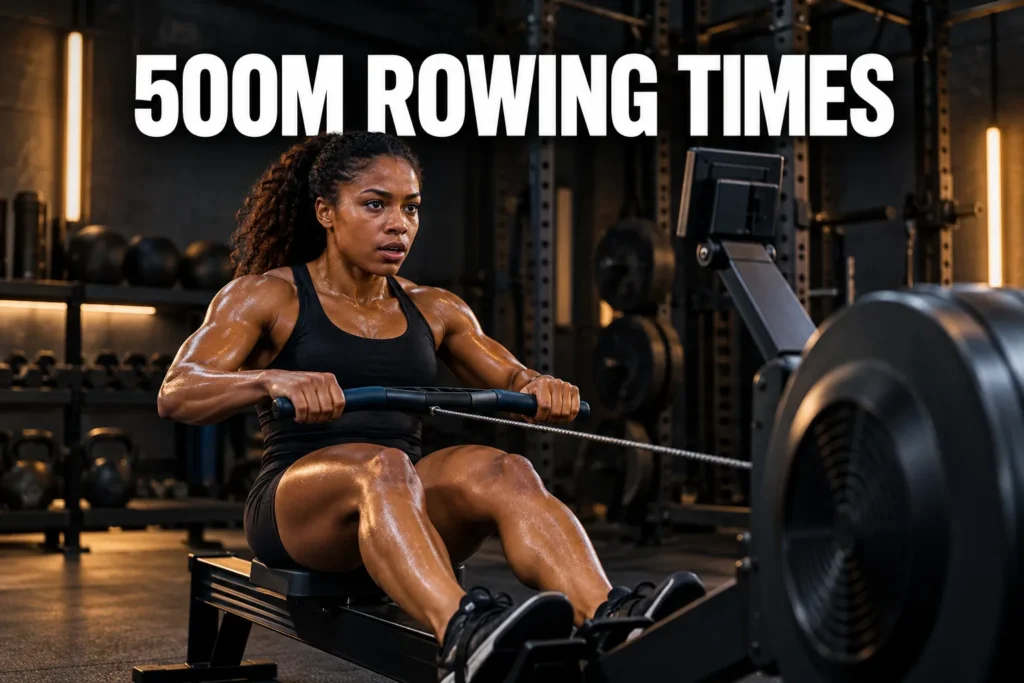
Rowing times 500m are the benchmark every erg athlete wants to understand, but a single generic average tells you almost nothing useful. Your good time depends on your age, sex, body weight, and training background, and comparing yourself to the wrong group leads to either false confidence or unnecessary discouragement. I use 500m and 2k tests as regular checkpoints with the athletes I coach, I test myself on the same distances, and the most common mistake I see is judging a first result against the wrong table. This guide covers benchmarks for 500m, 2k, 1000m, and 5000m rowing by experience level and age bracket, built from peer-reviewed performance research and Concept 2's published ranking data, with honest notes on where those numbers stop being reliable.
Rowing Times 500m: What the Numbers Actually Mean
The 500m is the shortest standardized test distance on an ergometer, and it measures your ability to produce very high power output for roughly 1:10 to 2:30 depending on your level. Unlike the 2000m, which is the primary competition distance in rowing, the 500m sits in a uniquely demanding zone - it pushes the anaerobic system hard while still requiring a solid aerobic base to sustain output through the final quarter of the effort. A 2025 systematic review of 34 studies covering 909 rowers confirmed that VO2max and peak power output are the strongest predictors of ergometer performance, particularly at the 2000m distance (1).
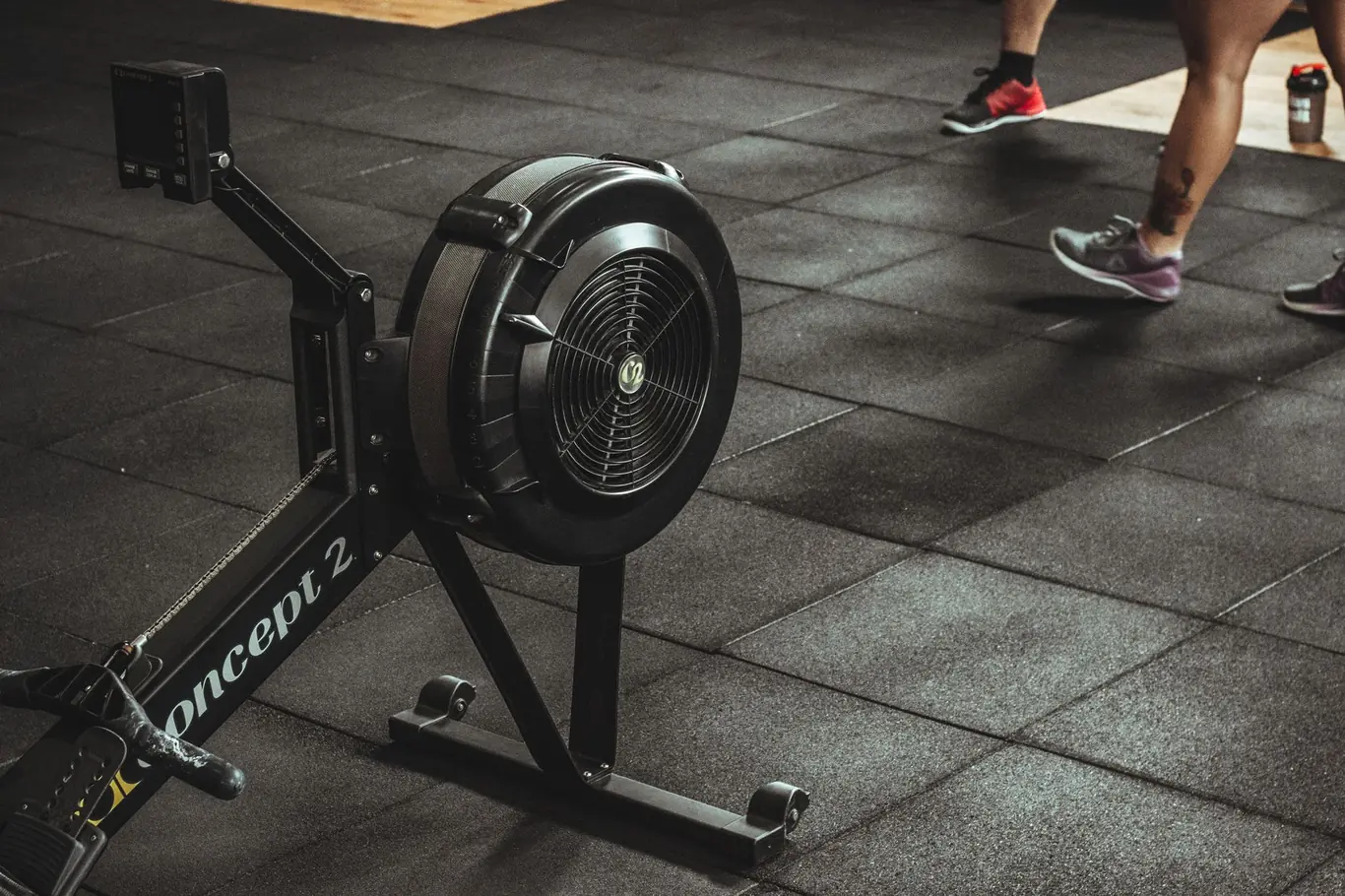
Before comparing your rowing times 500m against any table: drag factor matters. A Concept 2 damper set to 3 vs. 10 produces meaningfully different results even for the same rower at maximum effort. Most published benchmarks assume a drag factor of 110-130, which corresponds to a damper setting of roughly 3-5 on a Concept 2 Model D. Confirm your settings before treating a table comparison as authoritative. I log the drag factor next to every test result, because a retest at a different setting tells you little about real progress.
Two people with similar aerobic fitness can post very different 500m times, and much of that gap comes from how well they use the muscles a rowing machine works. The leg drive through the glutes, hamstrings, and quads provides approximately 60% of power per stroke. Rowers with stronger leg drive generate more watts per stroke, which directly lowers their split. When I retest clients after a block of leg-drive technique work, the split usually improves before their heart rate data shows any real fitness change.
Average 500m Rowing Times by Level
The ranges below show typical 500m performance by training background for full-effort, single-piece 500m rows - not split-paced efforts pulled mid-workout.
Level | Men | Women |
Beginner | 2:00 - 2:40 | 2:20 - 3:00 |
Intermediate | 1:40 - 2:00 | 1:55 - 2:20 |
Advanced | 1:25 - 1:40 | 1:40 - 1:55 |
Elite | Sub-1:25 | Sub-1:40 |
World-class | Sub-1:15 | Sub-1:22 |
These ranges reflect rowing times 500m completed on a standard ergometer at recommended drag factor settings. Individual results vary based on body weight, stroke rate, and technique efficiency.
Beginners often produce slower-than-expected times because they sprint the first 200m and fade hard, which leaves them with a poor average split. Rowers who learn even pacing often improve their 500m time by 5-10 seconds purely from better pacing strategy, without any change in fitness. When I review my clients' logged test pieces across experience levels, pacing is consistently the biggest gap between a rower's potential and their recorded split. A 36-year-old client of mine went from 1:58 to 1:51 on his second 500m test four weeks later, and almost all of that came from holding back over the first 150m.
500m Rowing Times by Age
Concept 2's online rankings separate results into five-year age brackets, which makes it the most accurate way to compare 500m rowing times by age group rather than against a broad population average. The 500m row times Concept 2 collects across millions of registered ergometers vary widely by demographic, so an age-group comparison is a far more realistic anchor for setting targets than an overall average.
- Ages 20-29: Peak physiological capacity in most people; expect the lower end of each level range
- Ages 30-39: Times typically increase by 5-10 seconds relative to the 20s
- Ages 40-49: A further 10-20 second increase per decade is typical for recreational rowers
- Ages 50-59: Well-trained rowers still post sub-2:00 (men) and sub-2:20 (women) 500m times regularly
- Ages 60 and older: Sub-2:30 for men and sub-2:50 for women represent excellent performance at this stage

Weight class also factors in. Concept 2 separates lightweight and heavyweight categories - lightweights under 74.8 kg (165 lbs) for men and 61.5 kg (135 lbs) for women are grouped separately because body mass scales directly with absolute power output. Comparing your result within your weight class gives a more useful picture of your actual fitness level than open-class comparisons. I always ask clients to note their body weight on test day, because a 3 kg change over a training block is enough to shift where they sit in the table.
2k Rowing Times and the Gold Standard Test
The 2000m row is the single most important benchmark in competitive rowing worldwide. It is the Olympic racing distance, the standard for national and collegiate team selection, and the test protocol used in almost every performance-focused rowing assessment. Understanding average 2000m rowing times puts your rowing times 500m in context - and shows you what your current fitness level can realistically support at longer distances.
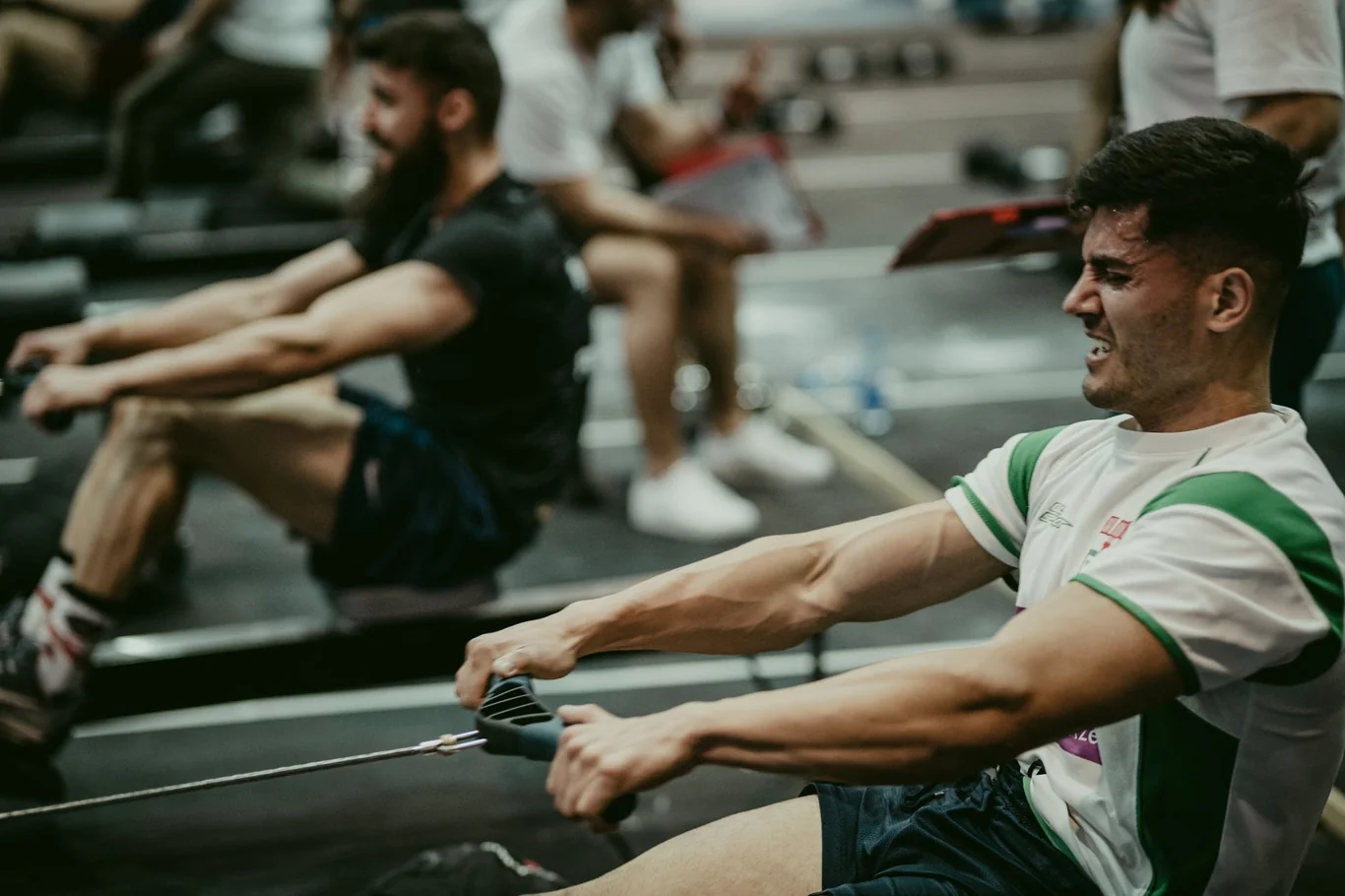
A true all-out 2k effort lasts roughly 5:35 to 9:00 for trained rowers. Research confirms that aerobic capacity is the dominant energy pathway in 2000m rowing - aerobic work capacity is the primary determinant of performance throughout the effort, with anaerobic contributions concentrated in the opening and closing surges (2). This physiological reality explains why pacing matters so much for rowing 2000 meters: spending too much effort early causes lactate to accumulate faster than your aerobic system can clear it, and your final 500m deteriorates badly.
Level | Men | Women |
Beginner | 7:30 - 9:00 | 8:30 - 10:30 |
Intermediate | 6:45 - 7:30 | 7:30 - 8:30 |
Advanced | 5:55 - 6:45 | 6:50 - 7:30 |
Elite | Sub-5:55 | Sub-6:50 |
World-class | Sub-5:45 | Sub-6:30 |
These good rowing times 2000m reflect rowing 2000 meters at full effort with standard Concept 2 drag factor settings and experienced pacing strategy. Consistent aerobic base training drives these times down over months, not individual sessions.
Good rowing times 2000m are built on a consistent aerobic base, with high-intensity intervals layered on top. The 2000 meter rowing distance is long enough that your aerobic engine sets the ceiling, while anaerobic capacity determines whether you can push that ceiling in the final 500m sprint.
What Research Shows About Average 2000m Rowing Times
A 2025 systematic review of 24 studies covering 797 athletes found that power output at the lactate threshold - specifically at 4 mmol/L blood lactate concentration - explained 28-92% of 2000m rowing ergometer performance variance depending on athlete population and methodology (3). This is a critical finding: your lactate threshold power matters more than your raw peak power for 2k rowing times.
Practically, this means training at "comfortably hard" steady-state intensity for extended periods builds the foundation for faster 2k results. Average 2000m rowing times improve most predictably through consistent threshold work, more than through sprinting hard twice a week. A 2k rowing time of 7:30 reflects your current aerobic ceiling, more than how hard you pushed on the day. My advice to anyone chasing a faster 2k: add one extra 30-minute threshold row per week before you add another sprint session.
Other Distance Benchmarks: 1000m, 250m, and 5000m
Rowing programs use multiple test distances for interval training, fitness tracking, and program variation. Each distance emphasizes a different energy system blend, which changes what your rowing times 500m and longer-distance splits reveal about your fitness. Use these benchmarks to set realistic training targets for each distance or to design interval sessions around a target split.
1000m Rowing Times
The 1000m sits between the sprint and endurance zones. Most trained rowers complete a full-effort 1000m in 3:00-5:00 depending on level:
- Beginner: 4:00 - 5:00 (men), 4:30 - 5:30 (women)
- Intermediate: 3:20 - 4:00 (men), 3:45 - 4:30 (women)
- Advanced: 2:50 - 3:20 (men), 3:15 - 3:45 (women)
- Elite / Competitive: Under 2:50 (men), Under 3:15 (women)
The 1000m is commonly used in interval training sets - 3 to 5 x 1000m at target 2k pace develops both aerobic capacity and speed endurance simultaneously.
250m Rowing Times
The 250m is a staple sprint interval in HIIT rowing workouts. At full effort, competitive rowers complete 250m in under 40 seconds (equivalent to sub-1:20/500m pace). Recreational rowers more typically land between 55 seconds and 1:15.
A useful rule: expect your 250m time to equal roughly half your all-out 500m time plus 5-8 seconds. The shorter distance allows a faster instantaneous pace, but the acceleration phase costs a few seconds regardless of fitness level.
5000m Rowing Times
The 5000m is a true aerobic endurance test. 5000m rowing times by level:
Level | Men | Women |
Beginner | 23:00 - 28:00 | 26:00 - 33:00 |
Intermediate | 18:30 - 23:00 | 21:00 - 26:00 |
Advanced | 15:30 - 18:30 | 17:30 - 21:00 |
Elite/Competitive | Sub-15:30 | Sub-17:30 |
A practical rule of thumb for 5000m rowing times: your sustainable 5000m split should run roughly 15-20 seconds per 500m slower than your rowing times 500m at full effort. If you max out at 1:50 for 500m, expect your 5000m average split to land around 2:05-2:10. I find this rule holds well across most recreational rowers, with fitter athletes sitting closer to the 15-second differential and beginners often closer to 20-25 seconds.
What Drives Your Rowing Split Times
Your rowing times 500m and at longer distances reflect a combination of physiology, technique, equipment settings, and training history. Understanding each factor helps you target the right variable when you want to improve.
Physiology and Energy Expenditure
Indoor rowing is one of the most metabolically demanding exercise modalities available. Research on Olympic-level male rowers found exercise energy expenditure ranging from 15.6 to 49.8 kcal/min across intensity zones (4). For recreational rowers, the numbers are lower but still significant - a 30-minute moderate-intensity session typically expends roughly 210 to 440 calories depending on body weight, stroke rate, and effort. These are estimates with meaningful individual variation: a 90 kg rower expends more than a 70 kg rower at equivalent relative effort, and stroke rate affects calorie expenditure significantly.
Tracking your effort zone accurately improves training effectiveness. Monitoring your heart rate during steady-state rowing helps you confirm you're in zone 2 (roughly 60-70% of max heart rate) during base-building sessions rather than drifting into threshold effort. I consistently recommend heart rate monitoring for anyone building a rowing base, because perceived effort alone isn't reliable enough to stay in the right zone once fatigue builds late in a session. Constant gripping and wrist flexion on the handle are a known weak spot for smartwatch heart rate accuracy, so for rowing I prefer a chest strap over a wrist reading.
On the question of whether rowing builds muscle, the honest answer is partly. Rowing builds and maintains significant posterior chain conditioning, and research consistently shows cardiovascular and body composition benefits. But it is primarily an endurance stimulus, not a substitute for progressive resistance training if hypertrophy is your main goal. The combination of rowing and strength work produces excellent results for overall fitness - rowing alone will not maximize muscle development.
How to Use a Rowing 500m Split Calculator
A rowing 500m split calculator converts your time at any distance into a per-500m pace. The formula: divide your total time in seconds by the number of 500m increments in the distance.
Worked example: A 2000m row completed in 7:30 (450 seconds) = 450 / 4 = 112.5 seconds per 500m = a 1:52.5/500m split. Most ergometer monitors display this as a live split readout during the row. When comparing results across machines, note that 500m row times on Concept 2 ergometers are the industry standard benchmark - non-Concept 2 ergometers calculate resistance differently, so cross-brand split comparisons are directionally useful but not precise. Different erg machine designs calculate resistance and split with their own calibration, so I only compare tests done on the same model. Most of my own test pieces are rowed on a Concept2 RowErg with PM5, since its numbers line up directly with the published rankings.
Factors That Affect Rowing Times 500m
Several variables beyond raw fitness determine rowing times 500m:
- Drag factor - Standard benchmarks use drag factor 110-130 on the Concept 2; higher drag increases resistance per stroke and generally slows splits
- Body weight - Absolute power generation scales with body mass; weight-class tables give a fairer comparison than open-class results alone
- Stroke rate - Higher strokes per minute can increase speed but often sacrifice power per stroke; most competitive 500m rows run around 28-36 strokes per minute
- Technique efficiency - Poor form creates wasted movement; addressing technique typically improves beginner times by 15-25 seconds before any fitness change occurs
- Warm-up state - A properly warmed-up body consistently produces faster 500m times; cold-start rows often run 5-15 seconds slower than a well-prepared effort
How to Improve Your Rowing Times
Improving average rowing times 500m and 2k requires both a strong aerobic base and targeted high-intensity work. The research is clear that both contribute, and skipping one limits how far the other can take you.
Training Approaches That Work
HIIT-based interval rowing has solid evidence behind it. A study of national-level rowers found that structured interval sessions produced 1.5-2.0% gains in 2000m performance within just 8 training sessions, reaching 2.2-2.5% improvement after 16 sessions (5). Both HIIT-style (longer race-pace intervals) and sprint-interval training (shorter maximal-effort pieces) produced similar improvements, indicating that total training dose matters more than the exact format chosen. For this kind of interval work I prefer machines from the best rowers for conditioning list, because a slow-responding flywheel blunts the hard starts that 500m pieces depend on.
For beginners, the most effective first step is an aerobic base, with intervals added later. Build a 3-4 month aerobic base first: three to four 20-30 minute steady-state rowing workouts per week at moderate intensity. This is the foundation that all faster rowing sits on. Without it, interval training produces limited gains because the aerobic ceiling is still too low.
Once your aerobic base is established, a simple interval progression works well for improving 500m times:
- Warm up for 10 minutes at easy, conversational-pace rowing
- Row 4 x 500m at hard effort - target 5-10 seconds faster than your current 500m time
- Rest 3-4 minutes between each piece to allow partial recovery
- Cool down 10 minutes at easy pace
Learning how to use a rowing machine with a clean legs-body-arms sequence is often the fastest way to drop time without increasing training volume. Form breakdowns at high intensity waste power and slow your split, and fixing them is free speed.
Injury prevention also matters for sustainable progress. Rounded-back rowing under fatigue is the most common cause of rowing-related back pain, so I cue a tall chest and a hip hinge at the catch to protect the spine whenever intensity climbs. With correct technique, rowing strengthens the posterior chain rather than stressing it.
Race Pacing Strategy for 500m
Pacing execution is the variable most likely to separate rowers at the same fitness level. A common mistake is going out at full sprint effort for the first 100-150m, which depletes the anaerobic system early and produces a severe fade in the final 200m. Even for a 500m effort, aerobic contribution increases significantly in the last two-thirds of the distance.
An effective 500m pacing approach: start at 95-97% of maximum effort rather than 100%, build to full intensity around the 150m mark, and hold controlled maximum through the finish. At race stroke rates of 28-36 strokes per minute, the first 3-4 strokes are the acceleration phase. Rowers who learn this approach typically see 5-10 second improvements in 500m times without any fitness change, simply from better energy management across the effort.
Getting the Most From Your Benchmark Numbers
Rowing times 500m are most useful when tracked over time, not as a single-point comparison. I look at benchmark tables as directional targets rather than pass/fail grades. A beginner landing at 2:20 for a 500m is right where they should be, and dropping 20-30 seconds with 6-12 months of consistent training is realistic and well within reach for most people.
For the intermediate rower sitting at 1:50 and aiming for 1:40, that gap requires both a stronger aerobic base and targeted interval work. Threshold sessions (20-30 minutes at race-pace effort) combined with weekly 500m interval work will move that number over a 3-6 month block. The progression is reliable, but it requires patience - no single session moves the needle meaningfully; the accumulation of sessions does.
To use benchmarks effectively, follow this sequence:
- Record your baseline - Complete a fresh 500m effort at standard drag factor (110-130) and log the split time along with your weight class
- Compare within your demographic - Use age-group and weight-class filtered results rather than open-class averages; the gap between categories is significant
- Retest every 4-6 weeks - Frequent retesting adds noise; monthly intervals show real training adaptation without the day-to-day variability of effort and fatigue
- Track the 2k alongside the 500m - Your 2k time reveals your aerobic ceiling; your 500m time reveals your power potential; improvements in one without the other signal where to direct training focus
The benchmarks in this guide reflect real performance spread across training populations. Use them as checkpoints to orient your training, not as ceilings that define what you're capable of. If you are still choosing a machine to test on, look for a monitor that shows split time, stroke rate, and drag factor, traits that weigh heavily in the ranking of the best rowing machines. You can compare current air, magnetic, and water models in the rowing machines shop, and I would not trust any benchmark comparison from a rower that hides the drag factor or split.
FAQs
Is a 500 meter row hard?
A 500 meter row at full effort is a high-intensity exercise that places significant demand on both aerobic and anaerobic energy systems simultaneously for roughly 1:10 to 2:30 depending on fitness level. Because rowing recruits nearly every major muscle group in a coordinated pattern - legs, core, back, and arms all working together - even a moderate 500m effort feels considerably harder than most single-muscle-group exercises at equivalent duration.
What is the average 500m row time for concept 2 rowers?
The 500m row times Concept 2 collects across millions of registered ergometers vary significantly by age and experience level, with recreational users typically completing a full-effort row between 1:40 and 2:00 for men and between 1:55 and 2:20 for women at intermediate level. Concept 2 publishes online rankings separated by five-year age brackets and weight class, which allow you to compare your result against others in your specific demographic rather than against a single population-wide average.
Is rowing 1000m in 4 minutes good?
Rowing 1000m in 4 minutes is a good recreational result, equivalent to a 2:00/500m average split, which sits right on the line between the beginner and intermediate ranges for men and inside the intermediate range for women. Competitive rowers targeting collegiate or national team selection typically aim for the advanced range, under 3:20 (men) or under 3:45 (women) for 1000m, so a 4:00 result reflects solid recreational fitness rather than competitive-level performance.
How long should a 250m row take?
A 250m row at moderate recreational effort typically takes between 55 seconds and 1:15 for most people, while trained athletes completing a max-effort sprint can finish in under 50 seconds. Your 250m time will roughly equal half your all-out 500m time plus a small buffer of 5-8 seconds, since the shorter distance allows a faster instantaneous pace but the acceleration phase absorbs a few seconds regardless of fitness level.
This content is for informational and educational purposes only. It is not a substitute for professional medical advice, diagnosis, or treatment. Always consult with your healthcare provider before starting any new fitness program or using fitness technology for health monitoring.
We are always looking for expert inputs to make our content even better and more useful.
References
- Borges I, Veiga S, González-Frutos P. The evaluation of physical performance in rowing ergometer: a systematic review. J Funct Morphol Kinesiol. 2025;10(4):437. doi:10.3390/jfmk10040437.
- Shirai Y, Hiura M, Nabekura Y. Contribution of aerobic and anaerobic capacity to 2000 m rowing performance. BMC Sports Sci Med Rehabil. 2015;7(Suppl 1):P1. doi:10.1186/2052-1847-7-S1-P1.
- Kilbey T, Vecchi E, Salbany P, Handa A, Stride E, Sheth M. Associations between lactate thresholds and 2000 m rowing ergometer performance: implications for prediction - a systematic review. Sports Med Open. 2025;11:21. doi:10.1186/s40798-024-00796-4.
- Winkert K, Steinacker JM, Koehler K, Treff G. High energetic demand of elite rowing - implications for training and nutrition. Front Physiol. 2022;13:829757. doi:10.3389/fphys.2022.829757.
- Turner KJ, Pyne DB, Périard JD, Rice AJ. High-intensity interval training and sprint-interval training in national-level rowers. Front Physiol. 2021;12:803430. doi:10.3389/fphys.2021.803430.