
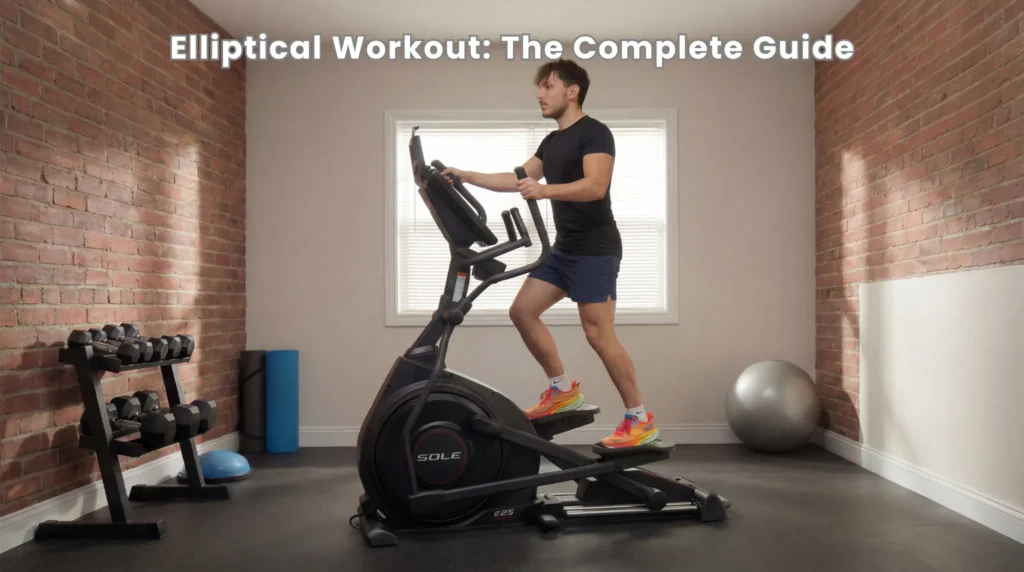
An elliptical workout is one of the most effective and joint-friendly forms of cardio available. It engages both upper and lower body simultaneously, burns a meaningful number of calories per session, and adapts to nearly any fitness level - from complete beginners to competitive athletes returning from injury.

Over more than 15 years in fitness, I have logged hundreds of hours on elliptical machines and tracked the elliptical workout benefits closely: reduced joint stress compared to running, consistent cardiovascular gains, and the flexibility to go easy or go hard in the same session. This guide covers structured plans, HIIT protocols, beginner routines, and targeted programs for weight loss, runners, and seniors.
If you are starting fresh or trying to break through a plateau, this guide has a program that fits.
Elliptical Workout Benefits - What the Research Actually Shows
Many people think of the elliptical as the "easy" cardio machine. The research says otherwise.
The elliptical machines we carry span a range of resistance levels and stride lengths for different training goals.
A 12-week controlled study comparing elliptical training to treadmill running and stair-climbing found that VO2max improved from 36.9 to 39.6 ml/kg/min in women who trained on the elliptical - gains equivalent to treadmill training when intensity and volume were matched (1). A 2021 comparison study confirmed that heart rate and oxygen consumption on the elliptical were statistically equivalent to the treadmill and stepper across all tested intensities, from 60% to 80% of peak workload (2). Your cardiovascular system works just as hard during an elliptical machine workout as it does during a treadmill session - what changes is how much your joints absorb.
Research on older and younger adults also found that a single 30-minute elliptical session raised heart rate substantially and improved leg flexibility in both groups (3). These elliptical workout benefits extend across the fitness spectrum. The benefits of elliptical workout training go well beyond simple calorie burn - they include long-term joint protection, cardiovascular conditioning, and full-body muscle engagement in a single session.
I find that a commonly overlooked factor is that intensity on the elliptical is self-regulated more easily than on other machines. This allows users to sustain longer sessions at a “challenging but repeatable” effort level, which is often more important for long-term fat loss than short bursts of extreme intensity. The ability to consistently hit the same effort week after week is what drives adaptation.
If you have questioned 'is the elliptical a good workout' compared to running, this data provides a clear answer. Many people also ask 'is an elliptical a good workout' during injury recovery - again yes, because the low-impact mechanism preserves joint health while maintaining cardiovascular stimulus.
Core elliptical workout benefits:
- Cardiovascular improvement comparable to running (VO2max, cardiac efficiency)
- Significantly reduced joint impact versus running
- Full-body engagement through movable handlebars
- Adjustable resistance and incline for ongoing progressive overload
- Accessible to deconditioned individuals, rehabilitation patients, and older adults
Looking to upgrade your equipment? Our guide to the best elliptical machine covers the top-rated models across all price ranges.
What Does the Elliptical Work Out? - Muscles Targeted
The elliptical works out more muscle groups than most people expect.
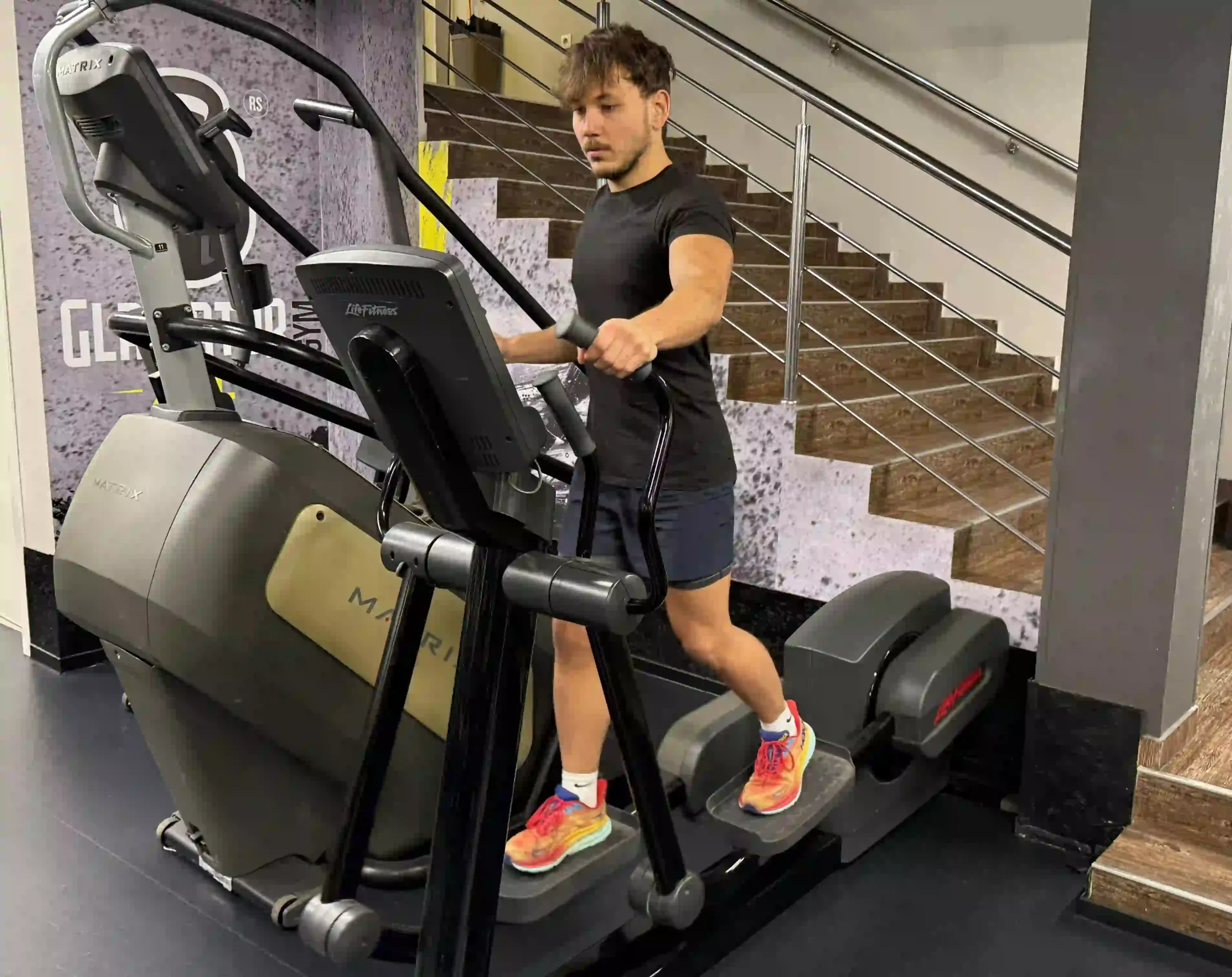
The primary muscles engaged in a standard elliptical trainer workout are the quadriceps, hamstrings, glutes, and calves. EMG research found that elliptical training produced greater quadriceps activation compared to treadmill walking, stationary cycling, and standard walking - one of the most effective non-impact options for lower-body conditioning (4). A separate biomechanical study confirmed higher gluteal muscle activation on the elliptical versus walking across multiple hand positions and speeds (5).
One important clarification: the elliptical does reduce lower-extremity muscle activation compared to treadmill running. One study measured a reduction of up to 60% in lower-extremity muscle load versus running (6). This is a feature, not a flaw - it is the mechanism behind the reduced joint stress. You still build cardiovascular fitness and work major muscle groups, but the mechanical demand per stride is lower.
When you actively use the movable handlebars during your elliptical trainer workout, the muscle activation extends to:
- Chest and anterior shoulders (pushing motion)
- Upper back - rhomboids, lats, rear deltoids (pulling motion)
- Biceps and triceps
- Core stabilizers throughout the entire stride cycle
To engage these muscles effectively, keep a light grip and drive the push-pull rhythm with your arms, not just your legs. The handles should move because you are pushing and pulling them, not because you are gripping them for balance.
One important performance tip: the more stable your core is during movement, the more efficiently your limbs can generate force. Beginners often compensate with upper-body tension or handle pulling, but advanced users rely on core stability to transfer force smoothly between upper and lower body, increasing both efficiency and endurance
For a compact option suited to active workstations, our guide to the best under desk elliptical covers the top low-profile models.
Beginner Elliptical Workout - Building Your Foundation
A beginner elliptical workout should focus on three things: learning proper form, building a sustainable aerobic base, and avoiding the early burnout that derails most new trainees.
If you are still learning the equipment, my guide on how the elliptical machine works covers the mechanics and setup before you focus on training structure.
Proper form for your beginner elliptical workout
Stand tall with a slight forward lean from the hips, not the waist. Keep your core lightly engaged throughout the stride. Push your feet through the full elliptical arc rather than letting the machine carry them. On the handlebars, hold lightly - balance comes from your core, not from pressing down on the handles.
Starting parameters and building progression
Starting parameters for a beginner elliptical workout:
- Resistance: Level 1-3
- Incline: 0-2%
- Duration: 15-20 minutes
- Frequency: 3 days per week with full rest days in between
- Target effort: conversational pace (short sentences, no gasping)
The elliptical workout for beginners also benefits from a clear session goal. Before you start, decide whether you are focusing on duration, pace, or resistance - and track just that one metric for the session. A key principle for any elliptical workout for beginners is adjusting one variable at a time. In weeks one and two, keep resistance and incline fixed and just build session duration. In week three, try raising resistance by one level. In week four, experiment with incline. Changing all three simultaneously in the first month leads to early fatigue and inconsistency.
Most beginner elliptical workout sessions should start at 15 minutes, not 30. Many fitness guides skip straight to 30-minute sessions, which discourages beginners who find them genuinely hard to complete. Starting at 15 minutes and adding 2-3 minutes per session produces sustainable progression.
A structured elliptical workout plan for beginners should include reverse pedalling from week two onward. Backward striding loads the hamstrings and glutes differently than forward pedalling and is one of the best form drills for developing full posterior chain awareness on the machine.
One common beginner mistake: most new users set the stride length too long or too short for their natural gait. Spend the first two to three sessions adjusting the stride setting until each stride feels smooth. Most elliptical workout machines allow stride adjustment even mid-workout.
For seniors or those with mobility concerns, our guide to the best elliptical for seniors covers accessible models with enhanced stability features.
Elliptical Workout Plan - A 4-Week Progressive Program
A structured elliptical workout plan consistently outperforms random cardio sessions. Progressive overload - gradually increasing resistance, incline, or duration - is what drives cardiovascular adaptation and keeps results coming month after month.
Here is a 4-week elliptical workout plan built on progressive overload:
Week | Sessions/Week | Duration | Resistance | Incline | Format |
Week 1 | 3 | 20 min | Level 3-4 | 0% | Steady-state aerobic |
Week 2 | 3-4 | 25 min | Level 4-5 | 1-2% | Steady-state + 2x 5-min moderate push efforts |
Week 3 | 4 | 30 min | Level 5-6 | 2-3% | 1 interval session/week (2 min hard, 2 min easy x5) |
Week 4 | 4 | 30-35 min | Level 6-7 | 3-4% | 2 interval sessions + 2 steady-state sessions |
In my opinion a subtle but powerful progression method is to increase only one variable at a time: resistance, duration, or incline, rather than all three simultaneously. This controlled progression ensures your body continues adapting without introducing unnecessary fatigue or inconsistency.
After completing week 4, you have two options: increase the resistance baseline by one to two levels and run the plan again, or transition into a HIIT-focused program.
Customizing your elliptical machine workout plan:
Starting from a sedentary baseline: begin at resistance 2, incline 0, and add an extra week before advancing.
Already active but new to the elliptical: start at week 2 and progress faster through the plan.
Include 2-3 minutes of reverse pedaling per session from week 2 onward to shift more load to the hamstrings and glutes.
The elliptical workout routine should be scheduled on non-consecutive days where possible. Three to four sessions per week is the proven sweet spot for cardiovascular improvement without accumulated fatigue. Back-to-back sessions at low intensity are manageable, but they reduce the adaptation window between efforts.
For elliptical workout routine variety, alternate the arm handle usage. Some sessions, actively push-pull the handles throughout. Other sessions, rest hands on the stationary grips to shift all effort to the lower body. This variation changes caloric output and muscle emphasis without changing any settings.
For a comparable look at structured cardio programming, our treadmill workout guide covers pacing and progressive structure in the same format.
Elliptical HIIT Workout - Maximum Results, Minimum Time
An elliptical HIIT workout is one of the most time-efficient cardio protocols available. A hiit elliptical workout lasting 20-25 minutes can match or exceed the caloric output of 40-45 minutes of steady-state cardio, largely due to the post-exercise oxygen consumption (EPOC) effect - elevated calorie burn that continues for several hours after the session ends.
A 12-week pilot study found that three elliptical HIIT workout sessions per week significantly improved VO2max, reduced fasting blood glucose, decreased body fat percentage, and improved waist-to-hip ratio in prediabetic and type 2 diabetic participants (7). These are meaningful metabolic changes from a protocol averaging under 30 minutes per session.
Basic HIIT elliptical workout
- Warm-up: 5 minutes at resistance 3, easy pace
- Work interval: 30-40 seconds at near-maximum effort (resistance 8-10)
- Recovery interval: 60-90 seconds at resistance 3, easy pace
- Rounds: 8-10
- Cool-down: 5 minutes at resistance 3
- Total time: approximately 22-25 minutes
Advanced elliptical HIIT workout
- Warm-up: 5 minutes
- Work interval: 45 seconds at near-maximum effort
- Recovery: 45 seconds at easy pace
- Rounds: 12-15
- Cool-down: 5 minutes
- Total time: approximately 27-30 minutes
The hiit elliptical workout for weight loss approach works best when combined with resistance training. The elliptical builds aerobic base and burns calories; resistance training preserves muscle mass and increases resting metabolic rate. Use a HITT elliptical workout two to three times per week, and complement it with two strength sessions.
One important point on elliptical HIIT workout recovery: space sessions with at least one full rest day between each. Daily HIIT without adequate recovery leads to diminishing returns within three to four weeks. Two to three sessions per week is the standard evidence-based recommendation.
For weight-loss focused programming, our guide on elliptical for weight loss goes deeper into calorie targets and weekly program structure.
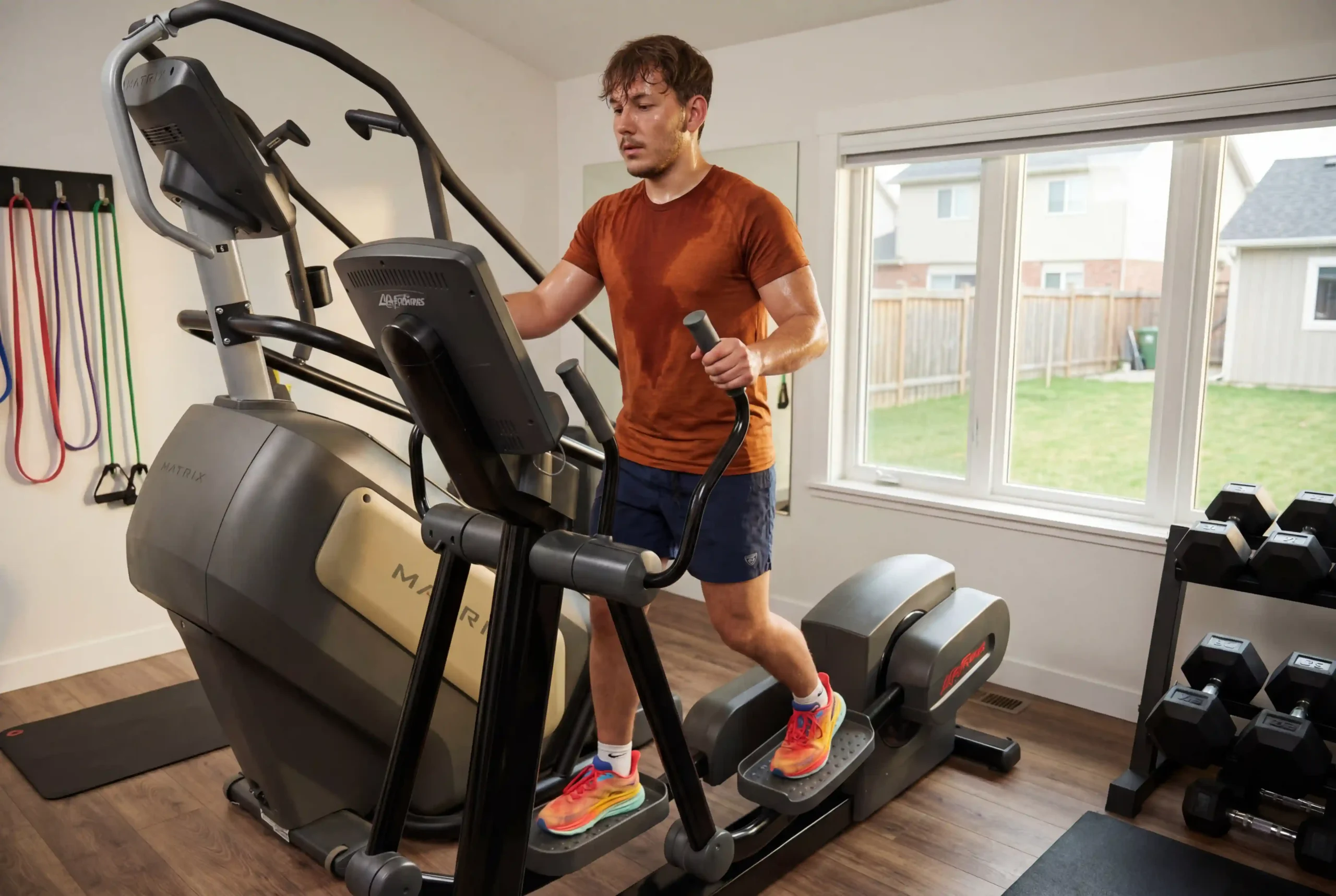
Pro tip: One advanced technique is to slightly extend the recovery interval only when needed, instead of reducing intensity during work intervals. This preserves the quality of your high-effort intervals, which are the primary driver of metabolic and cardiovascular adaptation in HIIT training.
30-Minute Elliptical Workout - The Full-Body Cardio Session
A 30-minute elliptical workout is the most practical session length for most people balancing training with daily life. It is long enough to produce meaningful cardiovascular stimulus and short enough to fit consistently into a packed schedule.
For an evidence-based look at the elliptical as a cardio tool, I cover the research on heart rate, VO2max, and how it compares to other machines.
Here is a structured 30 minute elliptical workout you can use as a standard session:
Segment | Duration | Resistance | Incline | Notes |
Warm-up | 5 min | Level 3 | 0% | Easy forward pedaling |
Build phase | 5 min | Level 5 | 2% | Steady pace, arms engaged |
Work block 1 | 5 min | Level 7 | 3% | Moderate-high intensity |
Reverse interval | 3 min | Level 5 | 0% | Backward pedaling for hamstrings/glutes |
Work block 2 | 5 min | Level 7 | 4% | Higher incline than block 1 |
Maintenance | 5 min | Level 5 | 2% | Steady-state pace |
Cool-down | 2 min | Level 3 | 0% | Easy pedaling, full recovery |
This elliptical cardio workout structure uses both forward and reverse pedaling, which together target quads, hamstrings, glutes, and calves more completely than forward-only sessions. The incline progression from block 1 to block 2 adds cardiovascular challenge without requiring you to change resistance mid-set.
Tips for maximizing a 30-minute session:
- Use the movable handlebars throughout, not the stationary rails.
- Increase resistance during work blocks rather than pedaling faster. Higher resistance forces more muscle engagement per stride.
- Keep your head up and avoid staring at the console. Looking down shifts posture forward and reduces core activation.
- Track average heart rate rather than speed. Heart rate is a far better indicator of training stimulus.
If you also train on a treadmill at home, our guide to the best treadmill for home covers the top models with comparable training flexibility.
A high-level adjustment is to prioritize resistance increases over speed increases. Faster pedaling often leads to reduced control and lower force output, while higher resistance forces more muscular engagement per stride, which is more effective for both calorie burn and strength endurance.
Elliptical Interval Workout - Building Endurance and Stamina
An elliptical interval workout differs from HIIT in one key way: the intervals are moderate rather than near-maximum intensity. An elliptical interval workout targets 70-80% of maximum heart rate on work intervals and drops to 55-65% on recovery intervals, rather than the 90-100% push of pure HIIT.
This approach builds aerobic endurance without the systemic fatigue that comes from high-intensity sessions. It suits athletes with long training weeks, people building base fitness over several months, and anyone who finds pure HIIT hard to recover from consistently.
Standard elliptical interval workout protocol
- Warm-up: 5 minutes at resistance 3-4
- Work interval: 3 minutes at resistance 7-8
- Recovery interval: 2 minutes at resistance 3-4
- Rounds: 5-6
- Cool-down: 5 minutes
- Total session: 35-40 minutes
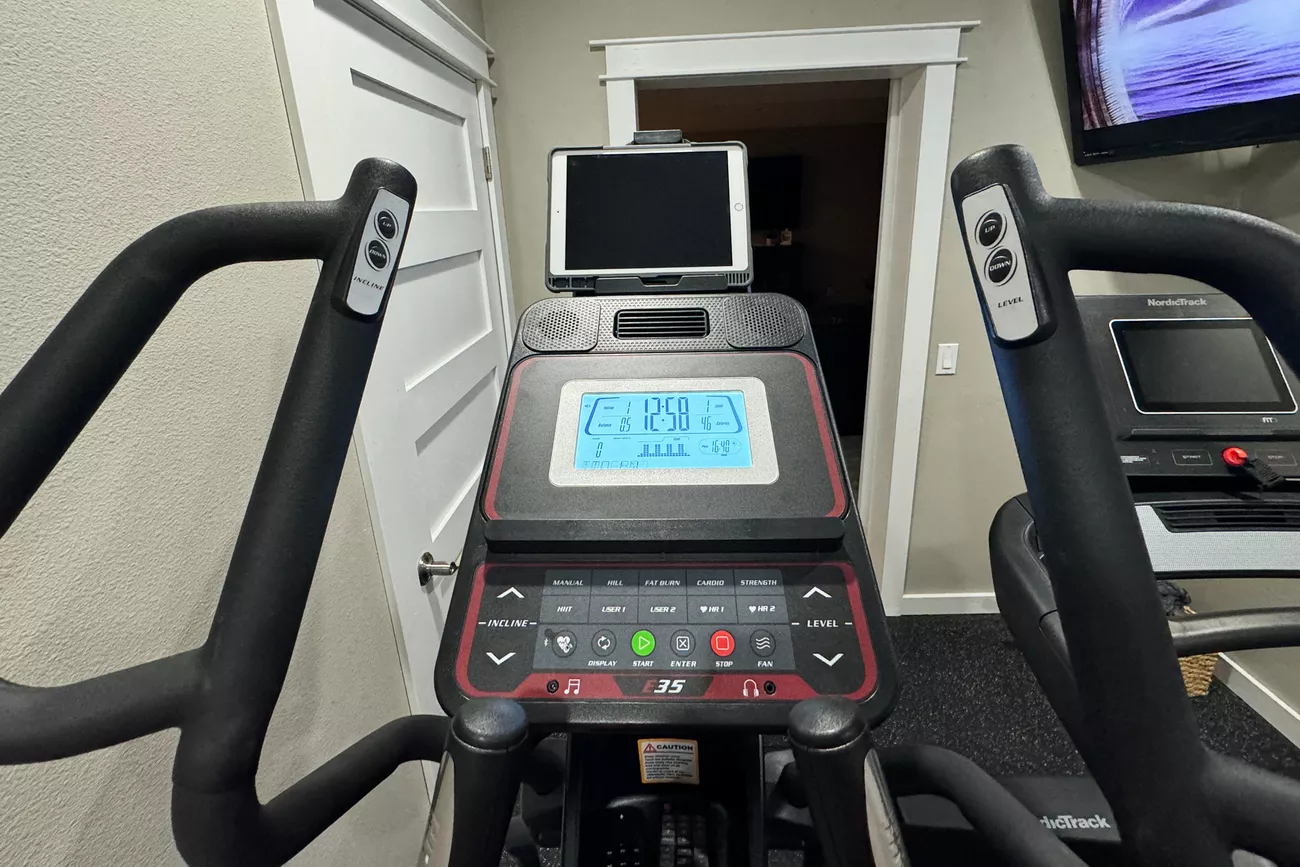
I often see that one often-overlooked progression method is increasing work interval duration before increasing intensity. Extending the work phase from 3 to 4 minutes forces your cardiovascular system to sustain effort for longer periods, which improves endurance more effectively than simply increasing resistance.
Monthly endurance progression for your elliptical trainer workout
Month | Rounds | Work: Rest Ratio | Notes |
Month 1 | 5 | 3:2 | |
Month 2 | 6 | 3:2 | |
Month 3 | 6 | 4:2 | Add one minute to each work interval |
Month 4 | 7 | 4:2 |
This is also where elliptical workout apps add the most value. Tracking actual heart rate during intervals ensures you are working at the right intensity rather than going by feel alone. Polar, Garmin, and Apple Fitness apps all sync with most modern elliptical workout machines and generate session summaries useful for tracking weekly progress.
For a broader look at cardiovascular conditioning research, our article on treadmill benefits covers the overlapping evidence base for aerobic training adaptation.
Elliptical Workout for Weight Loss - What Actually Works
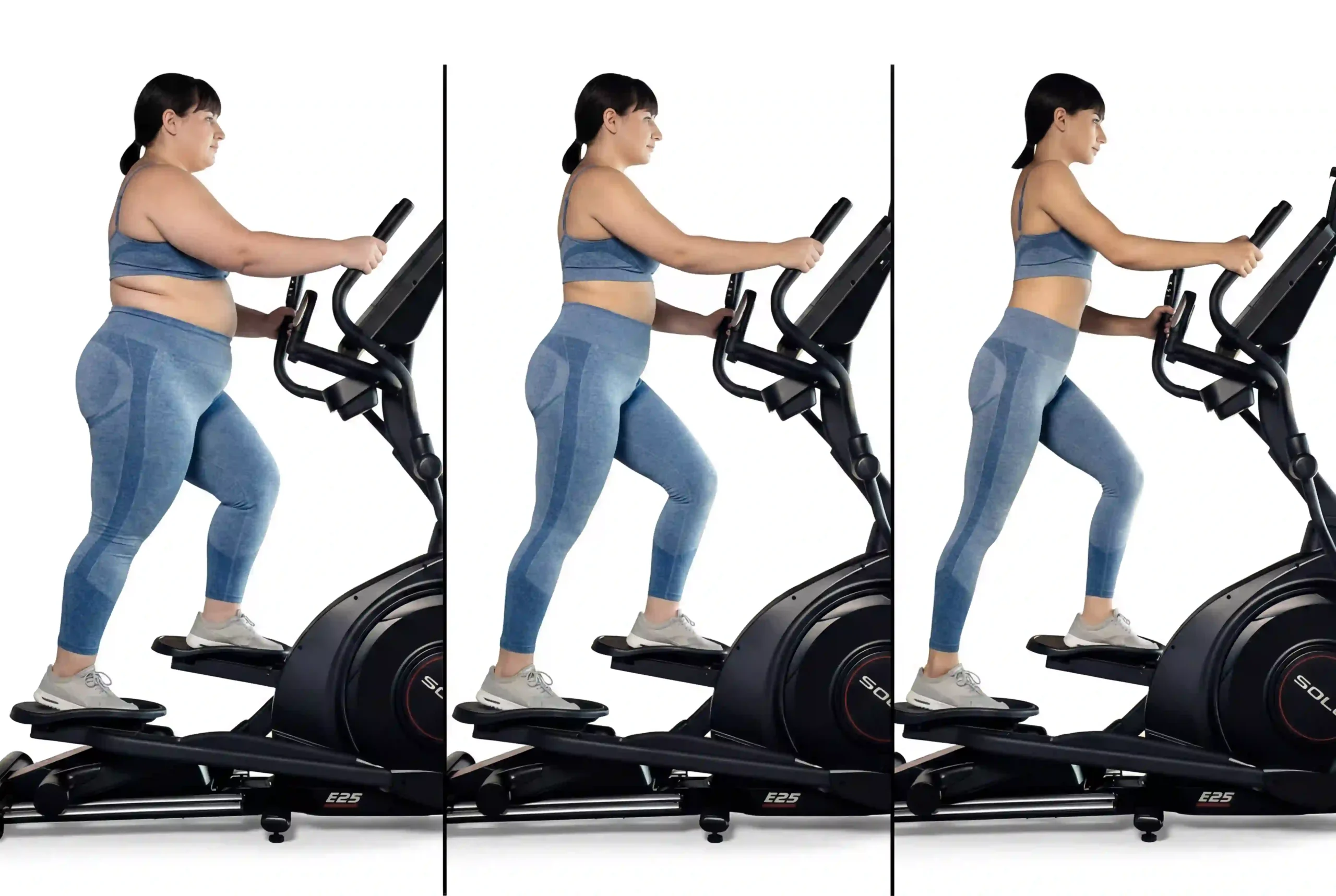
The elliptical workout for weight loss is effective when it is part of a broader plan rather than the only tool you rely on.
Calorie burn for a 30-minute moderate-intensity elliptical workout for weight loss typically ranges from 250-400 calories, depending on body weight, resistance level, and handlebar usage. A 45-minute session at higher intensity can push that to 400-600 calories. These are real numbers, but they underscore the core principle: the elliptical workout for weight loss works through consistency and accumulated weekly output, not through any single extraordinary session.
What makes the elliptical workout for weight loss particularly practical is the ability to sustain longer sessions without the joint soreness that comes from daily running. Many people can complete five elliptical sessions per week without accumulated discomfort - whereas running five times per week at an equivalent calorie-burn level becomes difficult to sustain month after month.
Key strategies for a fat burning elliptical workout:
- Use resistance, not just speed. Higher resistance means more muscle activation per stride and higher calorie burn per minute.
- Include at least two interval-style sessions per week alongside steady-state sessions.
- Track total weekly calorie burn rather than individual session output. Consistency across sessions compounds far more than occasional high-intensity efforts.
- Do not neglect nutrition. A weight loss elliptical workout program cannot outpace a poor diet. A realistic target is a 300-500 calorie daily deficit from a combination of exercise and dietary adjustment.
The best elliptical workout for weight loss is the one you sustain and progressively build on. The 4-week plan earlier in this guide provides the progressive structure that drives meaningful calorie-burn increases over time.
For those comparing cardio modalities for weight management, our article on elliptical vs treadmill walks through the evidence on calorie burn, muscle activation, and long-term sustainability.
Elliptical Workout for Runners - Smart Cross-Training
An elliptical workout for runners serves one primary purpose: maintaining cardiovascular fitness during periods when running volume needs to be reduced due to injury, fatigue, or planned recovery blocks.
The physiological rationale is well-supported. Heart rate and oxygen consumption on the elliptical are equivalent to treadmill running at matched intensities (2). A runner who replaces two run sessions per week with elliptical workout for runners sessions can preserve VO2max and cardiovascular conditioning while substantially reducing mechanical load on tendons, joints, and connective tissue.
How to structure an elliptical workout for runners:
Match your planned running session duration on the elliptical. A planned 45-minute easy run becomes a 45-minute easy elliptical session.
For interval days, replicate effort levels rather than speeds. An 800-meter repeat effort translates to a 3-minute high-resistance interval.
Aim for the same target heart rate zones on the elliptical as you would in the equivalent running session.
Use the elliptical during taper weeks to maintain leg turnover and aerobic stimulus while reducing pounding volume.
Reverse pedaling is particularly useful for runners. Backward striding loads the hamstrings and hip extensors in a way that more closely mimics the hip drive mechanics of running than forward pedaling alone. Including 5-10 minutes of reverse work in each elliptical workout for runners session improves posterior chain engagement and gait-specific conditioning.
For related research on reverse-direction movement patterns and their biomechanical benefits, our article on benefits of walking backwards on treadmill covers the supporting science.
Elliptical Workout for Seniors - Safe, Effective Cardio
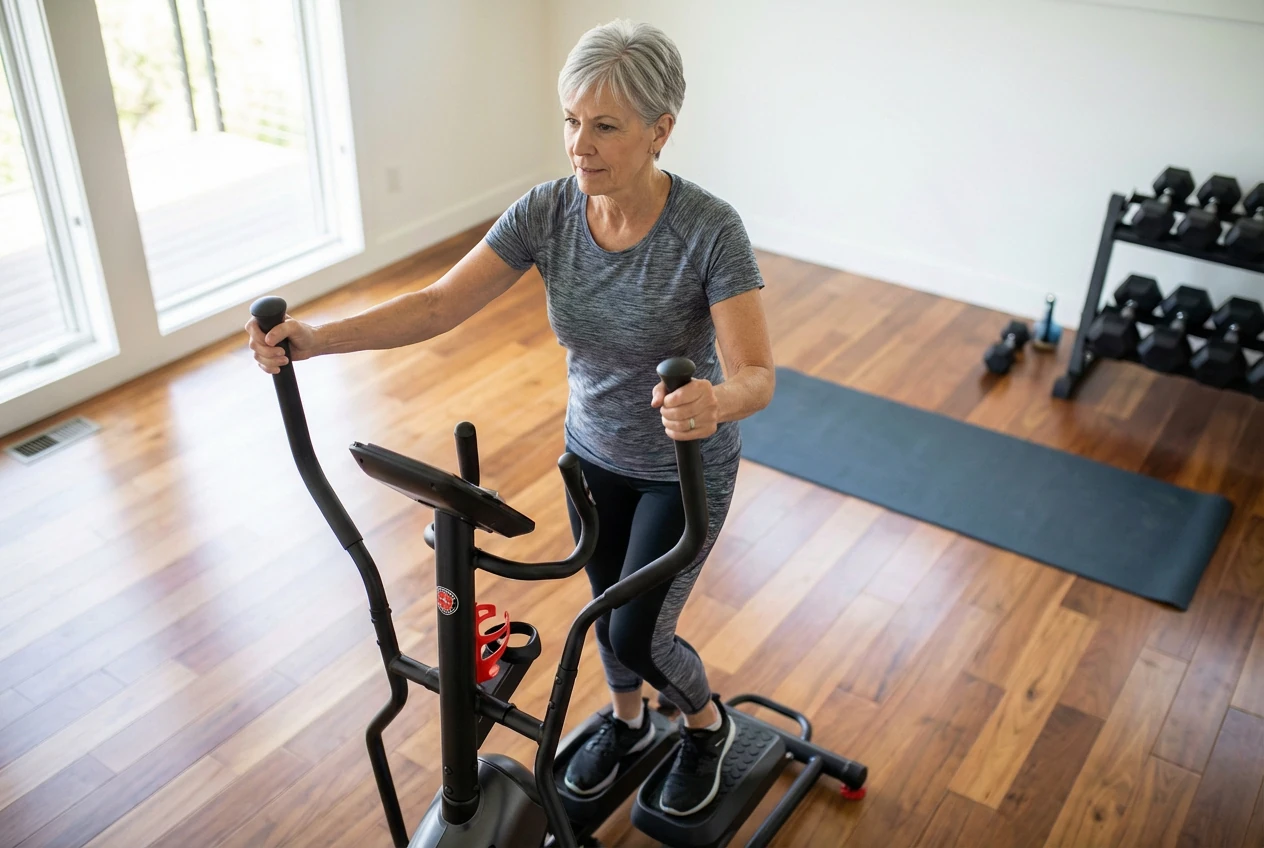
The elliptical workout for seniors addresses a specific challenge: maintaining cardiovascular fitness and lower-body strength while managing the joint limitations that accumulate with age.
The Teeter FreeStep recumbent cross trainer is one seated option built around that kind of joint limitation.
The joint-protective mechanism of the elliptical is particularly relevant here. Because the foot remains in contact with the pedal throughout the stride, there is no impact phase - the spike in ground reaction force that occurs with every running foot strike simply does not happen. When choosing a home cardio workout machine elliptical designs consistently outperform running for older adults managing knee osteoarthritis, hip pain, or general joint sensitivity.
Research supports the clinical application. A randomized controlled trial found that incorporating elliptical training into post-operative rehabilitation after total hip replacement significantly improved knee extensor strength, walking speed, and stride length compared to standard walking-only rehabilitation (8). These are meaningful functional outcomes from a low-impact elliptical machine workout.
Practical adjustments for senior elliptical training:
- Use a shorter stride length setting to reduce hip and knee range of motion demands
- Keep resistance lower and prioritize duration over intensity in early weeks
- Hold the stationary handles initially if balance is a concern
- Work up to 20-30 minutes of elliptical workout machines use over the first three to four weeks
- A 2023 study confirmed that even a single 30-minute elliptical session improved flexibility and cardiovascular markers in older adults (3)
Another important consideration is balance confidence. Using the stationary handles at first is completely acceptable, and gradually transitioning to lighter grip use can help build both coordination and independence without increasing fall risk.
A good elliptical workout for seniors is one that is consistent rather than intense. Three 20-minute sessions per week at moderate resistance produce more cardiovascular benefit over time than one hard session followed by days of recovery soreness.
For those evaluating machine alternatives, our comparison of the arc trainer vs elliptical explains the key mechanical differences and which populations benefit more from each design.
Common Elliptical Workout Mistakes to Avoid
Even on a machine as forgiving as the elliptical, poor technique reduces results and increases long-term injury risk.
Leaning too heavily on the handles
Leaning too heavily on the handles is the most common mistake in an elliptical machine workout. Pressing down on the stationary rails reduces the weight your lower body has to support, cutting calorie burn and lower-body muscle activation. The handles should be held lightly for guidance - your balance comes from your core. If you need to lean heavily, reduce the resistance.
Only pedaling forward
Only pedaling forward wastes one of the elliptical's best features. Including reverse pedaling in your best elliptical workout sessions shifts emphasis to the hamstrings and glutes in a way forward pedaling does not replicate. Even two to three minutes of reverse work per session meaningfully improves posterior chain engagement.
Setting resistance too low
Setting resistance too low to maintain a fast cadence is widespread on elliptical workout machines. Speed matters less than resistance on the elliptical. A slower, high-resistance stride produces more muscle activation and cardiovascular load than a fast, minimal-resistance stride. Aim for a controlled pace where you feel meaningful resistance in your legs on every push.
Skipping the warm-up
Skipping the warm-up leads to early fatigue and suboptimal performance. Five minutes at easy resistance before any elliptical machine workout session primes the cardiovascular system, raises muscle temperature, and improves stride coordination. Sessions without a warm-up typically feel harder from the first minute and generate less total training output.
Neglecting progressive overload
Neglecting progressive overload creates a plateau within six to eight weeks. The best elliptical workout for long-term results always incorporates progressive challenge. If your best elliptical workout sessions have looked the same for months, increase resistance, add incline, or transition to structured intervals. The body adapts to a fixed stimulus and stops improving in response to it.
For a deeper look at exercise adaptation and why progression drives results, our guide on elliptical machine benefits covers the underlying physiology.
In my experience staying at the same resistance week after week leads to rapid adaptation. Once your body becomes efficient at a given workload, calorie burn decreases at the same effort level. Regularly increasing resistance, incline, or interval difficulty is essential to continue progressing.
Getting the Most from Your Elliptical Workout in 2026
The elliptical workout rewards structure, progressive planning, and a basic understanding of what actually drives improvement.
Start with a beginner elliptical workout if you are new: 15-20 minutes at low resistance, three days per week. The right elliptical workout for beginners sets a sustainable foundation - start easy and build gradually rather than pushing hard in the first week. Build to 30 minutes over four weeks. Once you can complete a steady-state 30-minute elliptical workout at moderate resistance without stopping, add interval sessions. Progress to the 4-week elliptical workout plan in this guide.
If you have been on the elliptical for months without progress, the answer is almost always the same: increase resistance, add incline, or switch to a structured elliptical interval workout or HIIT protocol. Comfort on a cardio machine is a sign of adaptation, not achievement.
A fitness watch review covers heart rate zone monitors that alert you when effort has dropped below your target intensity, preventing the passive-use trap that stalls most elliptical training.
For runners, athletes, and anyone managing joint limitations, the elliptical trainer workout is a proven alternative that delivers real cardiovascular results. The research is consistent: this machine produces VO2max improvements, full-body muscle engagement, and metabolic adaptations comparable to higher-impact options - without the cumulative joint wear.
For a dedicated breakdown of the full range of outcomes this machine delivers, my post on what an elliptical machine is good for covers the cardiovascular, muscular, and joint-protection benefits with the underlying research.
If you are also building a home cardio setup, our guide to the best under desk treadmill covers another effective low-impact machine worth considering alongside the elliptical.
Extra expert insight: The elliptical is not limited by the machine. It is limited by how it is used. Small changes in resistance, posture, and effort distribution can significantly change the physiological outcome of the same session.
For readers who are still in the process of selecting a machine, my guide on how to pick an elliptical covers the resistance range, drive type, and stride length specifications that determine how much control you have over those variables.
FAQs
Is elliptical good to lose weight?
The elliptical is a good machine for weight loss because it burns a meaningful number of calories per session - typically 250-400 calories in 30 minutes at moderate intensity - while placing significantly less stress on your joints than running. The low-impact nature of the machine makes it easier to sustain four to five sessions per week over months without accumulated soreness, which is the consistency that actually drives long-term fat loss.
Is 20 minutes on the elliptical a good workout?
Twenty minutes on the elliptical is a good workout when performed at moderate to high intensity, with resistance and incline set high enough to challenge your cardiovascular system. A 20-minute HIIT session alternating between high-resistance work intervals and easy recovery intervals can produce a training stimulus comparable to 35-40 minutes of steady-state cardio.
What are the disadvantages of elliptical?
The main disadvantages of the elliptical include lower bone-loading stimulus compared to running, reduced lower-extremity muscle activation (up to 60% less than treadmill running in some studies), and the common tendency to lean on the handles, which reduces calorie burn and lower-body engagement. The elliptical also does not replicate running mechanics as closely as treadmill training, which matters for runners using it as cross-training.
Is it okay to do the elliptical every day?
Doing the elliptical every day is generally manageable if you vary session intensity, because the low-impact design reduces the cumulative joint stress that makes daily running problematic for most people. To avoid overtraining fatigue, alternate moderate-intensity steady-state sessions with lighter recovery sessions, and include at least one full rest day per week if you are also doing resistance training.
How long should I do elliptical to see results?
Most people see measurable cardiovascular improvements - better endurance, lower resting heart rate, and increased aerobic capacity - within four to six weeks of consistent elliptical training three to four times per week. For visible body composition changes, allow eight to twelve weeks of consistent training combined with appropriate caloric management, as body composition adapts more slowly than cardiovascular fitness.
References
- Egaña M, Donne B. Physiological changes following a 12 week gym based stair-climbing, elliptical trainer and treadmill running program in females. J Sports Med Phys Fitness. 2004;44(2):141-146.
- Bosch AN, Flanagan KC, Eken MM, Withers A, Burger J, Lamberts RP. Physiological and Metabolic Responses to Exercise on Treadmill, Elliptical Trainer, and Stepper: Practical Implications for Training. Int J Sport Nutr Exerc Metab. 2021;31(2):135-142. doi:10.1123/ijsnem.2020-0155
- Topp R, Etnoyer-Slaski J, Greenstein J. Heart Rate Response and Flexibility Following Single Bout of Training Using a Seated Elliptical Trainer Among Younger and Older Adults. Clin Nurs Res. 2023;32(4):723-732. doi:10.1177/10547738221141390
- Prosser LA, Stanley CJ, Norman TL, Park HS, Damiano DL. Comparison of elliptical training, stationary cycling, treadmill walking and overground walking. Electromyographic patterns. Gait Posture. 2011;33(2):244-250. doi:10.1016/j.gaitpost.2010.11.013
- Moreside JM, McGill SM. How do elliptical machines differ from walking: a study of torso motion and muscle activity. Clin Biomech (Bristol). 2012;27(7):738-743. doi:10.1016/j.clinbiomech.2012.03.009
- Eken MM, Withers A, Flanagan K, Burger J, Bosch A, Lamberts RP. Muscular Activation Patterns During Exercise on the Treadmill, Stepper, and Elliptical Trainer. J Strength Cond Res. 2022;36(7):1847-1852. doi:10.1519/JSC.0000000000003743
- Fex A, Leduc-Gaudet JP, Filion ME, Karelis AD, Aubertin-Leheudre M. Effect of Elliptical High Intensity Interval Training on Metabolic Risk Factor in Pre- and Type 2 Diabetes Patients: A Pilot Study. J Phys Act Health. 2015;12(7):942-946. doi:10.1123/jpah.2014-0123
- Hasebe Y, Akasaka K, Otsudo T, Hall T, Yamamoto M. Effects of incorporating elliptical trainer exercise during rehabilitation on physical function and self-reported outcomes after total hip arthroplasty: a randomized controlled trial. J Phys Ther Sci. 2022;34(3):230-235. doi:10.1589/jpts.34.230