
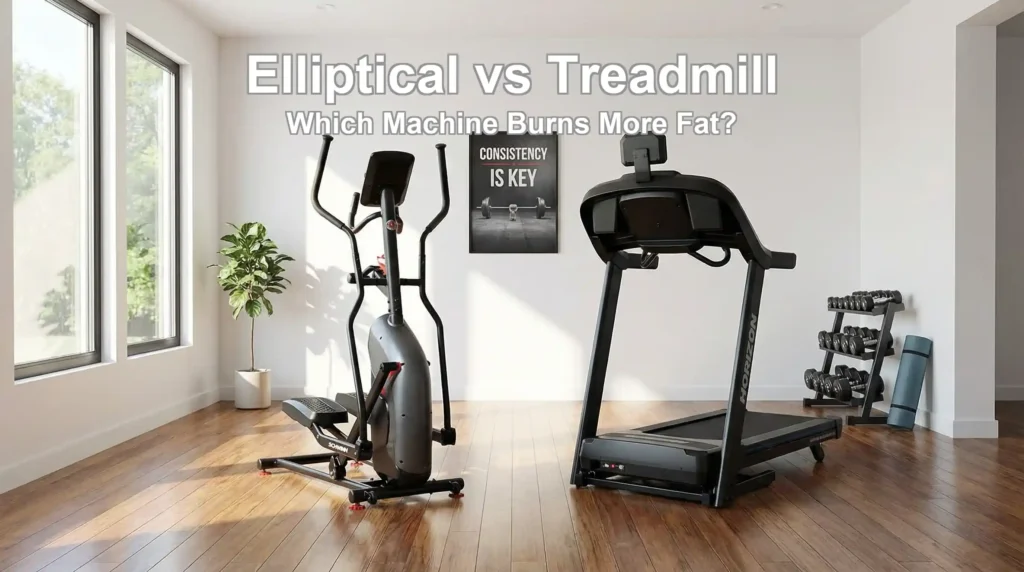
The elliptical vs treadmill debate is one of the most departed topic in 2026, and for good reason. Choose the wrong machine for your body and goals, and you could spend months training ineffectively, or worse, end up with a joint injury that sets you back entirely. Both machines dominate gym floors because they each solve different fitness problems.

Over 15 years working in fitness and testing more than 60 cardio machines, I have tracked how the treadmill vs elliptical comparison plays out across calorie burn, joint impact, fat loss, and long-term adherence. This guide breaks down the research, the real-world data, and the practical decision points.
Elliptical vs Treadmill - The Key Differences That Actually Matter
The elliptical vs treadmill comparison starts with a single mechanical difference that produces cascading effects on every training variable. A treadmill simulates walking, jogging, or running on a motorized belt. Your feet leave the surface with every stride and land with significant impact force. An elliptical machine guides your feet through a fixed oval motion, which keeps them in contact with the pedals throughout the full movement. No footstrike. No impact.
That single mechanical fact changes calorie burn, joint stress, muscle recruitment, training specificity, and long-term sustainability. Understanding those downstream effects is the only way to make an evidence-based decision.
Our elliptical catalog lists additional models with their available specifications.
Here is a side-by-side overview across the factors that matter most:
Factor | Elliptical | Treadmill |
Impact level | Zero impact | High impact (2-3x body weight per stride) |
Calorie burn | Moderate to high | High |
Muscle recruitment | Full body (with handles) | Primarily lower body |
Fat oxidation | Moderate | Higher |
Joint stress | Minimal | Moderate to high |
Training specificity | Cross-training | Running, walking, hiking |
HIIT capability | Yes | Yes |
Rehabilitation | Excellent | Limited |
Cardio variety | Resistance + incline | Speed + incline |
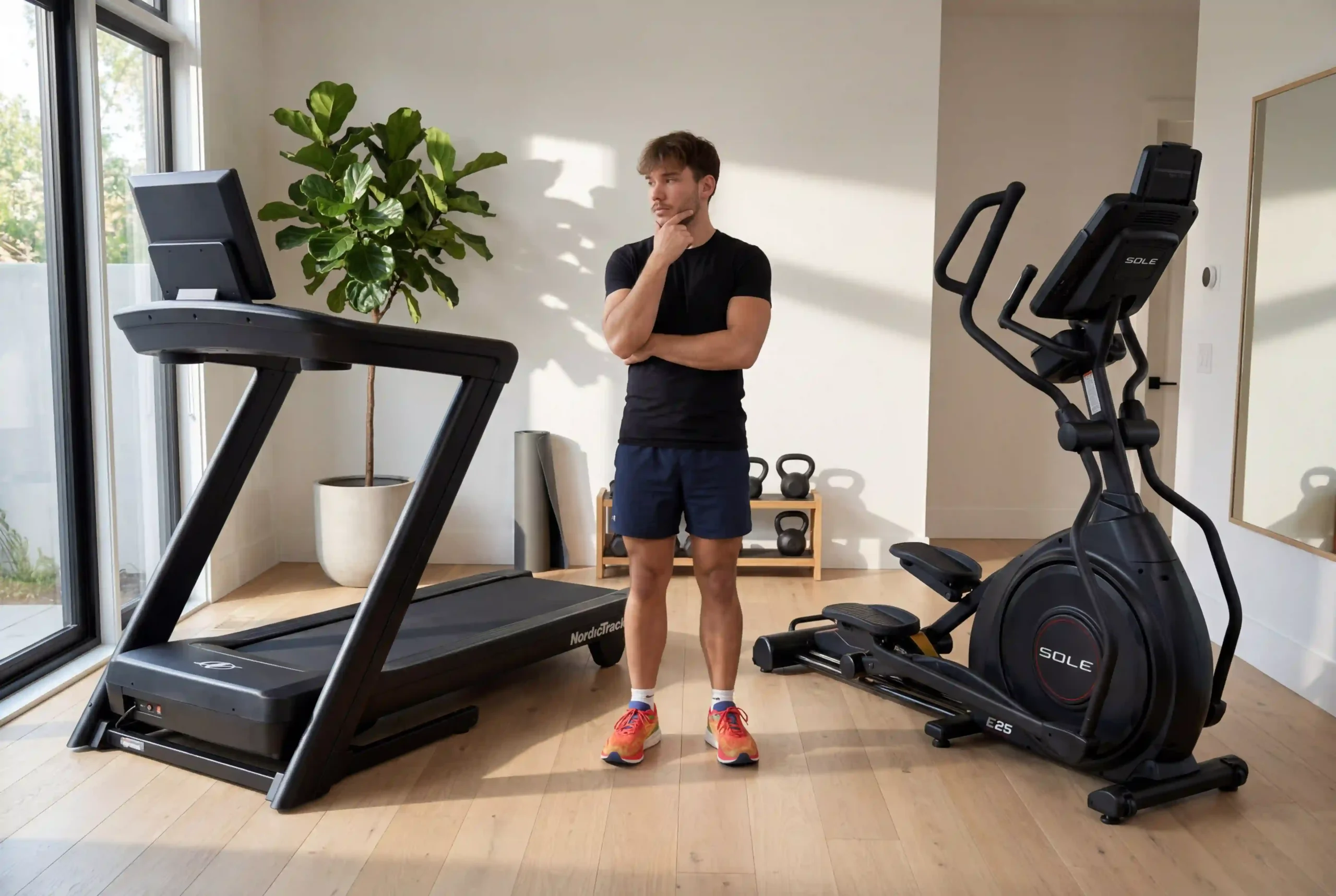
Neither machine is universally superior. The elliptical machine vs treadmill choice depends on what your body can handle, what you are training for, and how much impact your joints can tolerate week after week.
If you are leaning toward the treadmill side of this comparison, shop our treadmill picks to compare motor and incline specs directly.
For a detailed review of every top-rated elliptical model tested at every price range, our best elliptical machine guide covers what our testing found across the full lineup.
Elliptical vs Treadmill Calories - How the Numbers Actually Stack Up
The elliptical vs treadmill calories question is the first thing most people want answered, and the data is more nuanced than most sources suggest.
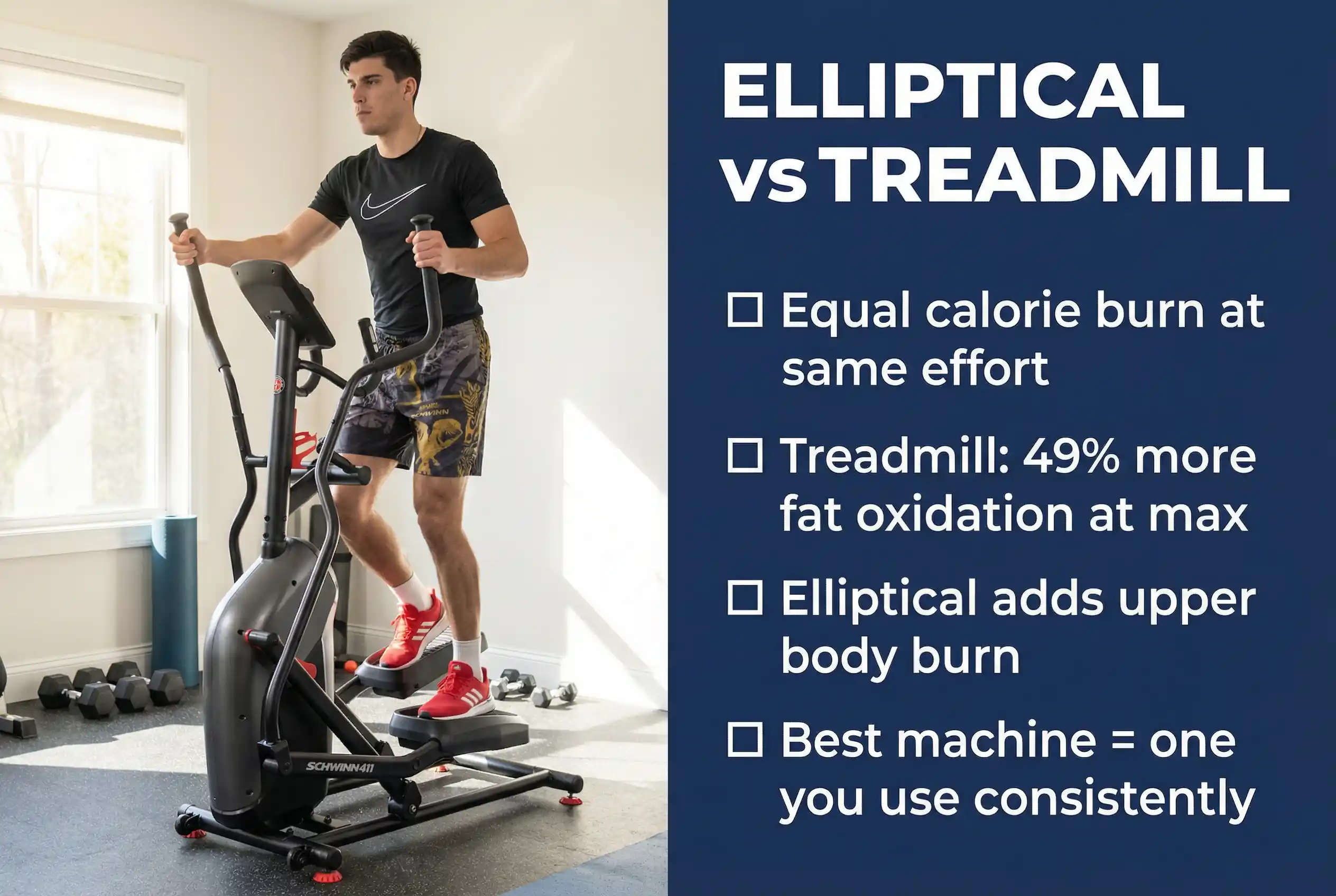
At matched effort levels - same perceived exertion on both machines - calorie burn is nearly identical. A peer-reviewed study comparing self-selected exercise intensity found no statistically significant difference in total energy expenditure between treadmill and elliptical, with treadmill users burning approximately 569 kJ and elliptical users burning around 636 kJ over the same session duration (1). The elliptical actually trended slightly higher because active use of the arm handles adds upper body engagement to total metabolic demand.
The elliptical vs treadmill calories picture shifts at maximum effort. A 2024 study comparing seven different cardio machines found the treadmill produced the highest energy expenditure and oxygen consumption of all machines tested, with the elliptical placing behind the stair climber for total calorie output (2). At absolute maximum intensity, the treadmill wins.
What determines calorie burn on each machine:
- Intensity and perceived effort (the single biggest variable on either machine)
- Body weight (heavier users burn more calories on both machines)
- Elliptical resistance setting (higher resistance increases calorie expenditure significantly)
- Treadmill incline (a 5% grade adds 50-100 calories per 30-minute session)
- Active use of elliptical arm handles
- Session duration and interval structure
The practical takeaway from the elliptical vs treadmill calories comparison: at moderate effort, expect roughly similar burn. At maximum intensity, the treadmill edges ahead. For most users over time, the machine that allows higher-quality effort without joint pain or injury will produce better total calorie outcomes across weeks and months.
For readers also curious how treadmill running compares to outdoor running on effort and calorie cost, my treadmill vs outdoor running comparison covers the physiology, biomechanics, and 9.6% calorie gap that runners should account for when training indoors.
For structured protocols designed to maximize calorie burn and cardiovascular output on the treadmill, our treadmill workout guide covers interval and steady-state sessions for every fitness level.
Treadmill vs Elliptical for Weight Loss - What the Fat Oxidation Data Shows
The treadmill vs elliptical for weight loss comparison moves beyond calorie burn into fat utilization - and that is where the data gets more decisive.
Research published in the Journal of Sports Science & Medicine directly measured maximal fat oxidation across treadmill, elliptical, and rowing machine exercise. The treadmill produced 0.61 grams of fat oxidized per minute, compared to 0.41 grams per minute on the elliptical - a 49% higher fat-burning rate (3). For someone specifically targeting fat loss, this difference compounds over weeks and months of consistent training. For readers exploring the rowing machine as a full-body complement to treadmill and elliptical training, my comprehensive rowing machine benefits covers the cardiovascular and calorie burn outcomes documented across all three modalities.
The adherence counterargument:
The elliptical vs treadmill for weight loss debate cannot be resolved by fat oxidation data alone. Long-term adherence is the strongest predictor of weight loss success, and the machine you will use five days a week for years outperforms the theoretically superior machine that causes overuse injuries and gets avoided. Many people with joint sensitivity simply cannot sustain high-frequency treadmill running without developing knee pain, shin splints, or hip issues.
The treadmill vs elliptical for weight loss comparison also shifts based on training intensity. At moderate intensity, the gap narrows. At high intensity, the treadmill's fat oxidation advantage becomes more pronounced. Users who can push hard on both machines will see greater fat loss on the treadmill over matched training periods.
Summary of the treadmill vs elliptical weight loss comparison:
- Treadmill: higher fat oxidation per session, better for users with healthy joints
- Elliptical: lower per-session fat oxidation but more sustainable for joint-sensitive users
- Both machines: effective for weight loss when paired with consistent training and appropriate calorie management
The elliptical vs treadmill for weight loss can be answered for most beginners and intermediate users like this: start with the machine your joints tolerate, build consistency first, and layer in intensity over time. For the programming strategies that maximize elliptical effectiveness for body composition goals, our elliptical for weight loss guide covers calorie targets and weekly structures.
Elliptical vs Treadmill for Weight Loss - The Training Volume Advantage
The elliptical vs treadmill for weight loss question also involves training volume tolerance over the long term. The elliptical allows more frequent training sessions without the recovery cost that treadmill running demands on joints and connective tissue. An experienced runner may need 48 hours of recovery after a hard treadmill session. That same person can return to the elliptical the following morning with minimal residual joint fatigue.
This means the elliptical often enables higher total weekly training volumes for users managing joint sensitivity, which can offset the lower per-session fat oxidation rate. Weekly calorie expenditure, not single-session efficiency, drives fat loss over months.
How user profile changes the elliptical vs treadmill weight loss outcome:
User Profile | Better Choice | Key Reason |
Athletes and experienced runners | Treadmill | Higher achievable absolute intensity |
Beginners and post-injury users | Elliptical | Better long-term adherence, comparable cumulative results |
Joint-sensitive users, any level | Elliptical | More sustainable frequency, less recovery cost |
Healthy joints, 45+ min sessions available | Treadmill | Higher per-session fat oxidation at sustained effort |
The treadmill vs elliptical for weight loss comparison also changes based on available training time. A 20-minute high-intensity treadmill session may produce better fat loss results than a 20-minute moderate elliptical session.
A 45-minute elliptical session at sustained moderate resistance may produce better cumulative results for someone who cannot sustain 45 minutes on the treadmill without joint pain. The elliptical vs treadmill weight loss debate ultimately comes down to which machine you will actually use consistently over six to twelve months. That answer is different for every person.
For those for whom neither machine fits long-term, or who are considering the rowing machine as a third option, my guide on rowing machine for weight loss covers the evidence and practical structure for 8-12 week rowing programs.
For a complete breakdown of how treadmill training drives fat loss and what programming variables matter most, our treadmill weight loss guide covers the protocols backed by the strongest evidence.
Elliptical vs Treadmill - Muscles Used and How Each Machine Works Your Body
The following comparison reveals one of the most significant mechanical differences between the two machines.
My elliptical machine guide covers how the drive system, stride length, and flywheel weight affect your workout in practice.
Treadmill muscle activation
Running and walking on a treadmill primarily target the calves, hamstrings, quadriceps, and hip flexors. The glutes activate powerfully during the push-off phase of each running stride, particularly at an incline. The treadmill's repetitive impact loading also stimulates bone density in a way the elliptical cannot replicate - which matters for long-term skeletal health in older adults and those managing osteopenia.
For a look at how rowing fits into this bone-loading hierarchy relative to impact exercise, my guide on rowing machine and osteoporosis covers how the spinal compressive stimulus from rowing relates to the periosteal loading that running produces.
Elliptical machine vs treadmill for quad engagement
An electromyographic study published in Gait & Posture found that elliptical training produced greater rectus femoris (quadriceps) activation and more balanced co-activation of the hamstrings compared to treadmill walking. The elliptical machine vs treadmill difference in quad recruitment stems from the fixed pedal path, which removes the natural stride variability of running and locks the quad into a more consistent contraction cycle (4). The fixed pedal path, which feels less natural than running, actually forces more consistent quad firing throughout the movement cycle.
Upper body engagement
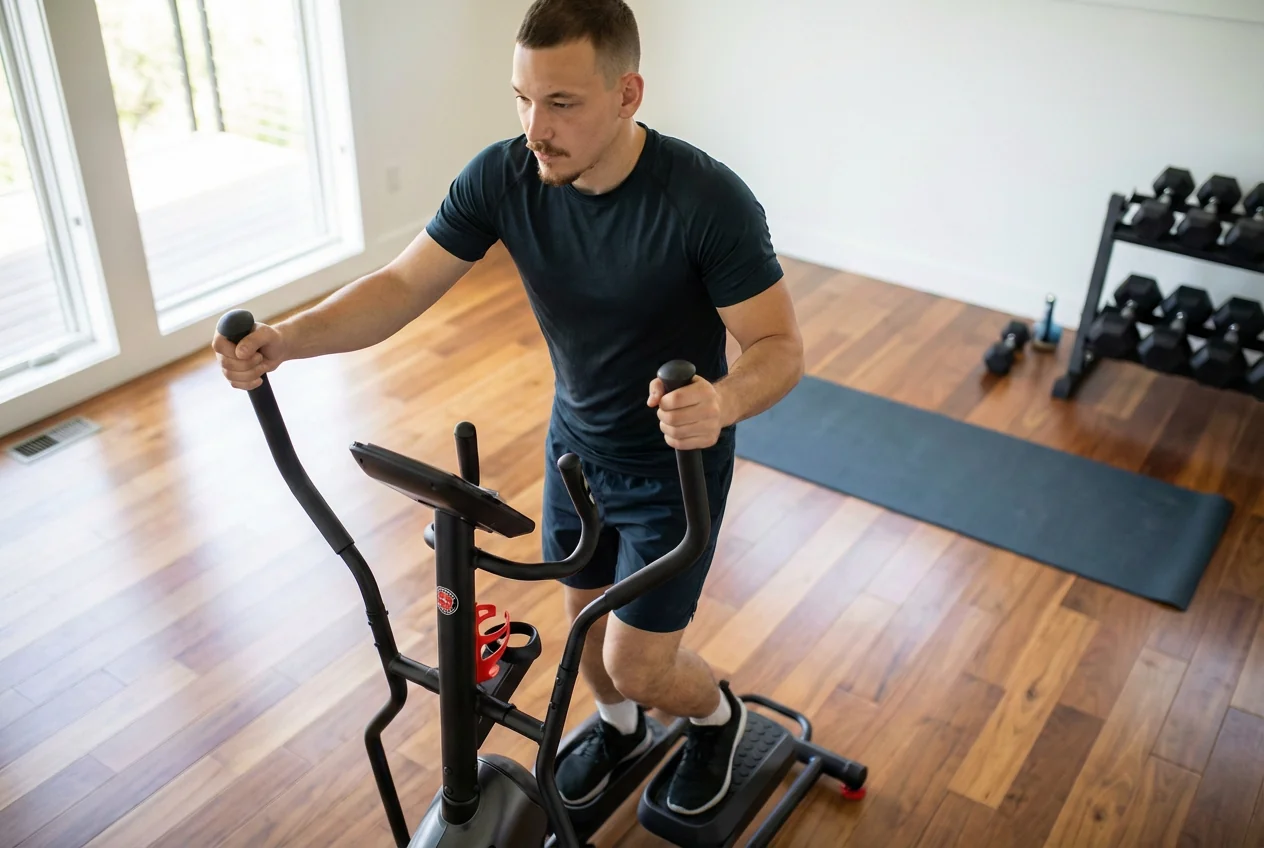
Active use of the arm handles adds chest, shoulder, upper back, and bicep engagement to the elliptical workout. This elevates heart rate, increases calorie burn, and makes the elliptical a genuine full-body cardio option. The treadmill drives primarily from the lower body with arms in a natural swing pattern that contributes minimal metabolic work.
Elliptical vs treadmill for glutes
For maximum glute activation, incline treadmill walking and running produce explosive gluteus maximus contractions that the elliptical's smooth pedaling cycle cannot fully replicate. If glute development is a primary goal, the treadmill at an incline or running speed holds a clear advantage. The elliptical provides consistent moderate glute engagement throughout the pedal cycle - less peak activation, but steady and maintained across the full session.
Our elliptical workout guide includes resistance and incline protocols specifically designed to increase posterior chain and glute engagement on the elliptical.
Joint Impact - Are Ellipticals Really Better for Your Knees?
Joint health is the number one reason people choose the elliptical over the treadmill, and the mechanical reasoning is sound. The elliptical vs treadmill joint impact difference is real and clinically significant.
Running generates ground reaction forces of 2-3 times your body weight with every footstrike. For a 170-pound person, each running stride transmits 340-510 pounds of force through the ankle, knee, and hip. Over a 30-minute treadmill run at 150 strides per minute, that is roughly 4,500 high-impact loading events on each joint per session. Multiply that across three or four weekly sessions over a year, and the cumulative loading becomes significant for joints with reduced cartilage integrity.
The elliptical eliminates this impact entirely. Feet stay in contact with pedals throughout the full motion cycle. No footstrike. No transmitted force spike. This is why physical therapists consistently recommend elliptical training during rehabilitation from knee replacement, anterior cruciate ligament surgery, stress fractures, and hip impingement protocols.
A 2022 study found that elliptical training reduced muscular loading effort by up to 60% compared to treadmill running, confirming its effectiveness as a low-impact alternative that still delivers a meaningful cardiovascular training stimulus (5).
What about healthy joints?
For users with healthy knees, treadmill running appears safe for long-term training. A systematic review of 15 studies found no significant cartilage volume loss from running, and transient decreases in cartilage thickness post-run were entirely reversible (6).
The key distinction is joint health status at baseline. Healthy joints tolerate treadmill running well. Already-compromised joints benefit significantly from the elliptical's zero-impact loading.
Who benefits most from choosing the elliptical:
- People with diagnosed knee or hip osteoarthritis
- Anyone recovering from lower limb surgery or a stress fracture
- Runners wanting to add cardio volume without increasing weekly impact load
- Older adults managing age-related joint degeneration
For machine recommendations tailored to joint-friendly cardio training, our best elliptical for seniors guide covers the features that matter most for low-impact long-term use.
Cardiovascular Benefits - How Both Machines Compare for Fitness Gains
From a pure cardiovascular fitness standpoint, the elliptical vs treadmill question becomes less decisive. Both machines are highly effective for improving aerobic capacity.
My guide on treadmill health benefits goes deeper on what consistent training does for your heart, joints, and metabolism over time.
A 2022 overview of systematic reviews - covering 11 meta-analyses and 179 primary studies - found that exercise training consistently increased VO2max across all tested intensity levels and modalities, including both treadmill and elliptical-type exercise (7). What predicted VO2max gains more than machine type was total training volume, work-to-rest interval structure, and individual baseline fitness level.
The elliptical vs treadmill benefits distinction from a cardiovascular standpoint comes down to training style:
- HIIT training: equally effective on both machines; heart rate response similar at matched intensity
- Steady-state cardio: both machines produce equivalent aerobic adaptations over time
- Running specificity: the treadmill trains the neuromuscular patterns that transfer to outdoor running; the elliptical does not
- Long-duration moderate sessions: the elliptical is often more comfortable for 45-90 minute sessions because joint fatigue accumulates more slowly
The treadmill vs elliptical benefits debate also includes a mental component that physiology alone cannot capture. Users who find one machine monotonous and avoid it gain zero cardiovascular benefit. Sustainable engagement with any machine beats theoretically optimal training that gets skipped due to discomfort or boredom.
For the research-backed breakdown of what treadmill training specifically does to cardiovascular health over time, our treadmill benefits guide covers the physiological evidence.
Elliptical vs Incline Treadmill - A Comparison That Changes the Standard Narrative
The elliptical vs incline treadmill comparison is one of the most underexplored topics in cardio training, and it fundamentally changes the standard narrative about which machine burns more calories.
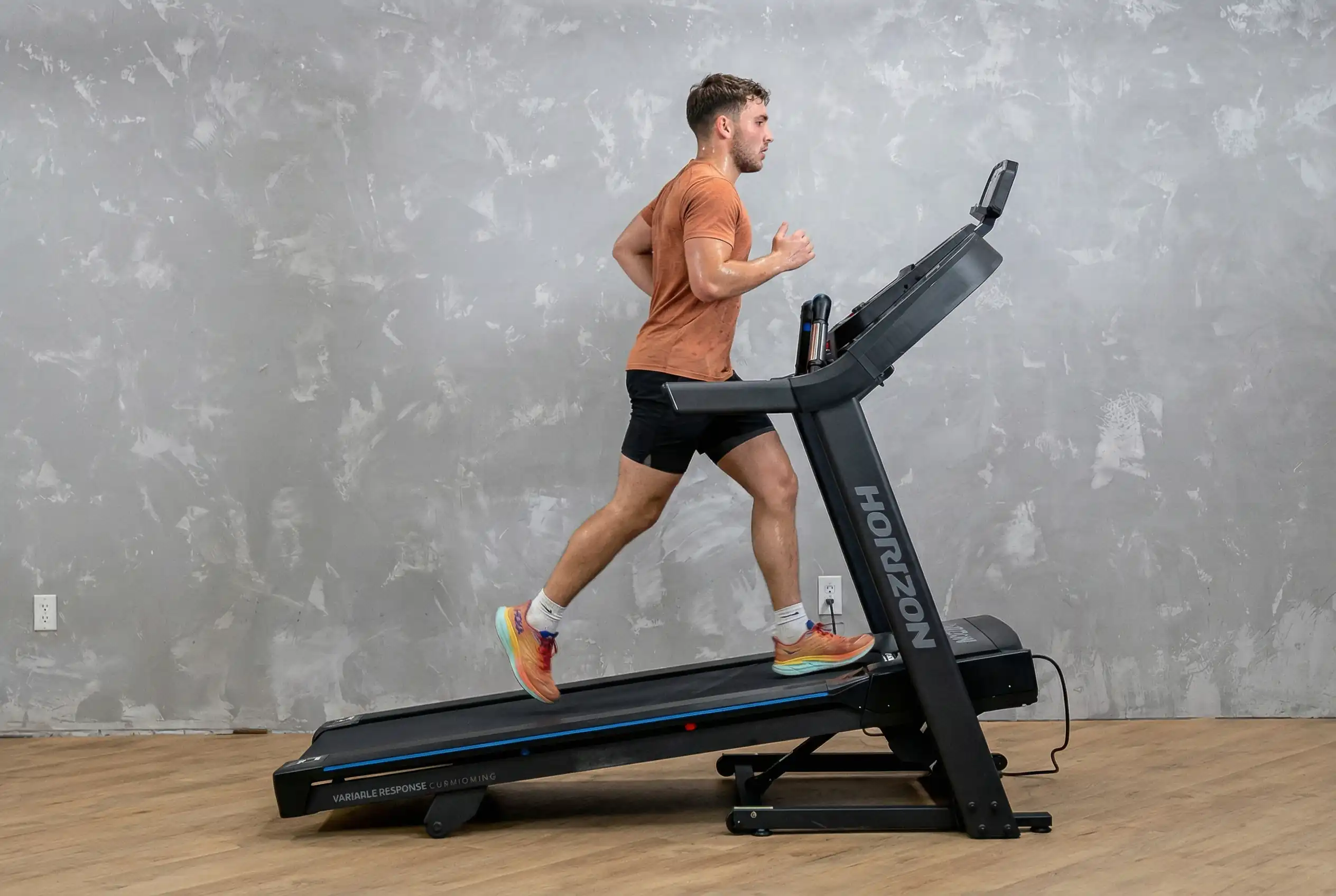
Most comparisons pit the elliptical against flat treadmill walking or moderate running. Adding a significant incline to the treadmill changes the equation. A flat treadmill walk at 3.0-3.5 mph burns approximately 200-250 calories per hour for a 155-pound person. That same person walking at 3.5 mph with 12% incline burns 450-500 calories per hour, approaching elliptical calorie output at moderate resistance settings.
The MERACH UltraWalk W60 walking pad tops out at that same 12% grade for readers who want the desk-pace version of this incline boost.
The elliptical vs incline treadmill calorie comparison, therefore, depends heavily on what incline setting is being used and what resistance level the elliptical is set to. At 10% incline on the treadmill versus low elliptical resistance, the incline treadmill wins. At matched moderate-to-high effort on both machines, the elliptical vs incline treadmill calorie difference narrows significantly.
The incline treadmill vs elliptical muscle comparison also shifts at high grades. Walking at a 10-15% incline activates the glutes and hamstrings far more aggressively than flat treadmill walking, producing a training stimulus closer to uphill trail running. Combined with a lower impact force than running (walking still has footstrike, but at a lower force than running), the incline treadmill offers a meaningful middle-ground option.
For a detailed comparison of what the incline treadmill actually delivers relative to flat running in terms of cardiovascular intensity and caloric output, my post on how the incline treadmill compares to running covers the research across both training methods.
When the incline treadmill outperforms the elliptical:
- Maximum glute and hamstring activation is the primary training goal
- Training for hiking, mountain terrain, or events involving elevation gain
- The calorie burn of an elliptical is desired, but the walking motion is preferred
When the elliptical still wins over the incline treadmill:
- Post-surgical recovery, where any footstrike loading is contraindicated
- Full upper body engagement alongside lower body cardio training
- Complete elimination of footstrike impact, regardless of incline level, is required
Our best incline treadmill guide covers the top models available and which ones handle steep incline training most reliably at each price point.
Treadmill vs Elliptical vs Bike - When a Third Machine Changes the Equation
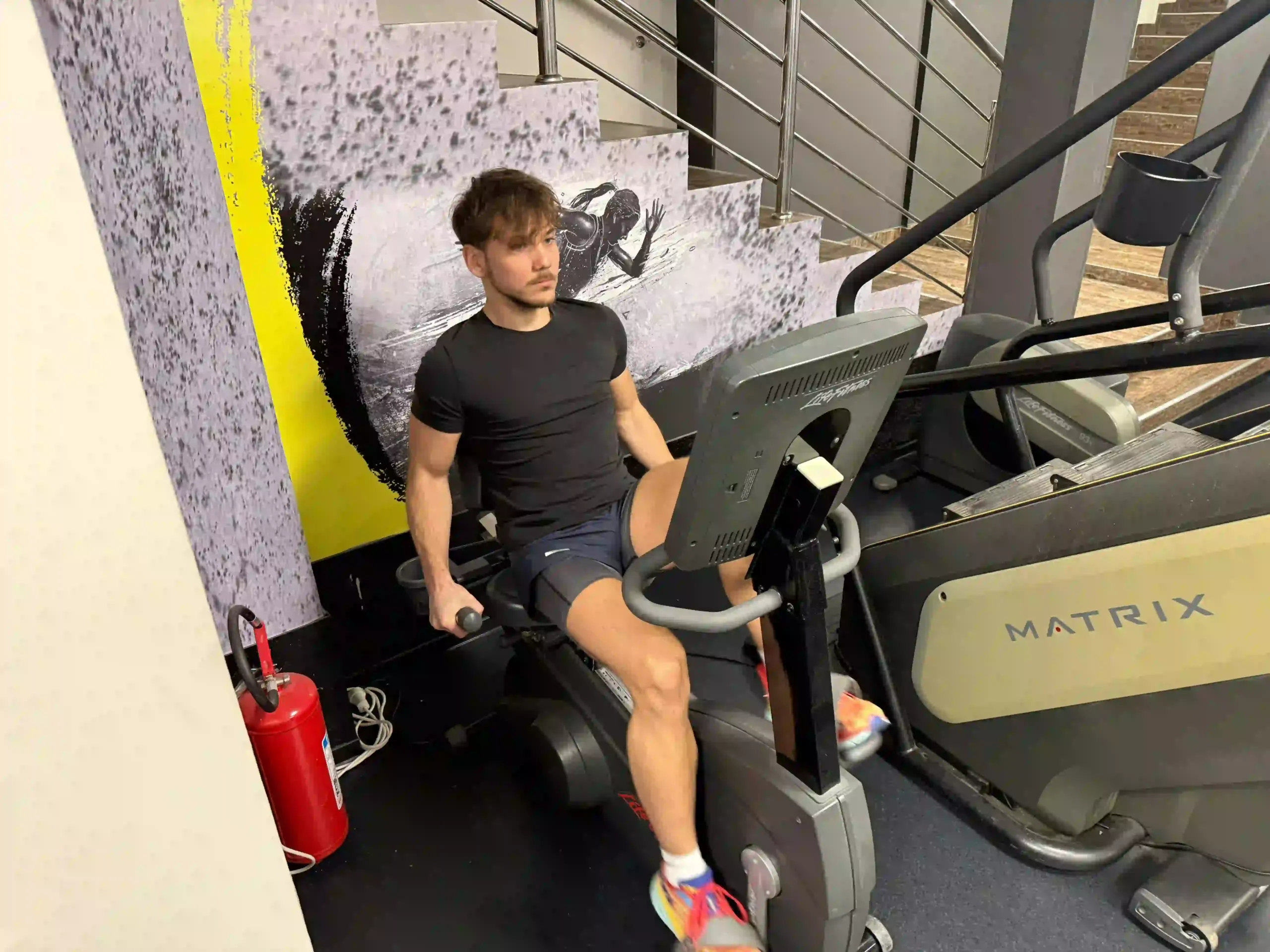
The treadmill vs elliptical vs bike comparison matters most for people selecting a single machine for home use or planning a multi-machine gym rotation.
Stationary bike profile:
- Lowest joint impact of the three: the seated position removes loading from ankles and knees entirely
- Burns fewer calories than a treadmill or an elliptical at equivalent perceived effort for most users
- Ideal for active recovery days and users with significant lower limb joint issues
- High-intensity cycling on a Peloton or spin bike can rival treadmill calorie burn at maximum effort
The elliptical vs treadmill vs bike question often comes down to joint health and training goals. For most users with healthy joints focused on fat loss and running performance, the treadmill comes first in the elliptical vs treadmill vs bike hierarchy.
For joint-sensitive users who still want a full-body option, the elliptical vs treadmill vs bike choice leans toward the elliptical. For users with severe lower limb conditions, the bike provides the most accessible entry point.
The elliptical vs treadmill vs bike calorie hierarchy
At maximum effort: treadmill leads, followed by elliptical, then bike, for most users at equivalent perceived effort. At moderate effort: treadmill and elliptical produce similar burn; bike trails.
The treadmill vs elliptical vs bike calorie rankings shift when you factor in resistance settings. A spin bike at maximum resistance rivals the treadmill at high effort. A low-resistance elliptical trails the bike at easy effort. The treadmill vs elliptical vs bike comparison, therefore, has no fixed hierarchy - intensity and resistance settings are the decisive variables.
Cross-training rotation strategy
Many fitness coaches recommend rotating across machines throughout the week to balance impact load with training stimulus:
- High-intensity day: treadmill intervals (maximum running specificity and calorie burn)
- Moderate-intensity day: elliptical steady-state (joint recovery while maintaining cardiovascular stimulus)
- Active recovery day: stationary bike (minimal joint loading, active movement)
The bike vs elliptical vs treadmill choice for a single home machine purchase depends on injury history and primary goal. Users with healthy joints training for running performance should prioritize the treadmill. Users with joint sensitivity should choose the elliptical. Users with significant hip or knee conditions may find the bike the only genuinely pain-free option.
The elliptical vs treadmill vs stairmaster comparison follows similar logic - the stairmaster provides intense lower body stimulus and high calorie burn with moderate joint impact, falling between the treadmill and elliptical in impact level and training specificity.
For a full evidence-based breakdown of both machines, including calorie data from a seven-machine study and lower-body muscle activation research, my stairmaster and treadmill comparison covers fat loss, joint impact, and who each machine suits best.
For office workers who want to add movement during seated work, our best under-desk treadmill guide covers the walking pad and compact treadmill options that make daily movement accessible without a gym setup.
Under Desk Elliptical vs Treadmill - Movement for the Office
The under desk elliptical vs treadmill question addresses a growing category of compact machines designed for use during work hours. Both break up sedentary desk time, but they work differently in practice.
Under desk elliptical:
- Compact pedal unit fits under most standard desks
- Nearly silent operation: usable during video calls and meetings
- Seated use only - no standing desk required
- Burns approximately 150-300 calories per hour at a moderate pace
- Zero footstrike impact throughout use
Under desk treadmill:
- Larger motor housing and belt footprint
- More noise at walking speeds (typically 1-3 mph)
- Requires a standing desk for proper ergonomic use
- Burns slightly more calories at equivalent session duration
- Some footstrike impact at walking speeds, though low compared to running
The under desk treadmill vs elliptical choice typically comes down to desk setup and noise tolerance. Seated workers who want to add movement without disrupting calls or concentration find the under desk elliptical integrates more seamlessly. Standing desk users who want to walk during low-cognitive-demand tasks like reading or listening typically prefer the treadmill format.
The WalkingPad Foldable Walk-and-Jog Under-Desk Pad covers that steady 1 to 4 mph pace for standing-desk sessions.
The 1 mile on elliptical vs 1 mile on treadmill calorie comparison extends to desk use as well - the elliptical covers distance through pedal revolutions rather than actual foot travel, so distance metrics are less comparable than session duration and resistance level.
Our best under desk elliptical guide covers the top pedal units available and what to look for in quiet operation, resistance range, and build quality.
How to Choose Between an Elliptical and a Treadmill - A Decision Framework
The elliptical vs treadmill decision simplifies significantly when matched to specific user situations.
If you are leaning toward the treadmill, my treadmill buyer's guide covers the specs that matter most before committing.
Choose the treadmill when:
- You are training for outdoor running events - road races, trail runs, or charity walks
- Fat oxidation is the primary goal, and your joints are healthy
- Bone density maintenance matters (treadmill walking and running provide a weight-bearing stimulus that the elliptical cannot replicate)
- You enjoy running, and impact does not cause pain or recurring injury
- Training specificity for athletic performance is a priority
Choose the elliptical when:
- You have existing knee, hip, ankle, or lower back issues
- You are returning from lower limb surgery or stress injury
- You want upper-body engagement combined with cardiovascular training
- Overuse injuries have disrupted your consistency in the past
- You want to add cardio volume without adding to your weekly impact load
A seated option like the VANSWE recumbent elliptical cross trainer works well for that kind of limitation.
Consider both when:
- Budget and space allow for two machines
- You want to alternate between impact and non-impact sessions throughout the week
- You are cross-training alongside other high-impact sports like running, basketball, or tennis
The benefits of elliptical vs treadmill resolve differently based on individual context. A 60-year-old managing knee osteoarthritis and a 28-year-old training for a marathon have fundamentally different needs, even if both want to improve cardiovascular fitness. The correct machine for one is genuinely wrong for the other.
The elliptical trainer vs treadmill debate also extends to training goals that extend beyond cardio - if strength training, sport-specific performance, or bone health are priorities alongside cardiovascular fitness, the treadmill's weight-bearing nature gives it an advantage that the elliptical cannot match.
For a deeper look at what the research says about the physiological benefits of consistent elliptical training, our elliptical machine benefits guide covers the cardiovascular and musculoskeletal evidence.
Quick Reference - Elliptical vs Treadmill by Training Goal
Goal | Better Choice | Primary Reason |
Running performance | Treadmill | Training-specific neural patterns |
Maximum fat burn | Treadmill | 49% higher fat oxidation rate |
Joint-friendly cardio | Elliptical | Zero footstrike impact |
Full-body cardio | Elliptical | Active arm handles add upper body |
Post-injury rehabilitation | Elliptical | Low impact, cardiovascular stimulus |
Glute and posterior chain | Treadmill (incline) | Greater explosive activation |
Long-duration sessions | Elliptical | Lower cumulative joint fatigue |
Bone density | Treadmill | Weight-bearing stimulus |
Cross-training variety | Either | Match to recovery vs. intensity day |
Office desk movement | Under desk elliptical | Compact, quiet, seated-compatible |
The Right Machine for Your Long-Term Fitness Journey
The elliptical vs treadmill debate does not have a single universally correct answer - and any source claiming otherwise is oversimplifying what the evidence shows. Both machines are clinically validated cardio tools with meaningfully different strengths.
My guide on elliptical cardio effectiveness covers the peer-reviewed evidence behind what the machine actually delivers for cardiovascular fitness.
The treadmill produces higher fat oxidation, burns more calories at maximum effort, and is the only cardio machine that directly prepares your neuromuscular system for outdoor walking and running. The elliptical offers complete footstrike impact elimination, full-body engagement, and long-term sustainability for users managing joint issues or building training volume after injury.
For a detailed breakdown of the full range of benefits the elliptical delivers across cardiovascular health, joint protection, and muscle engagement, my post on what the elliptical machine is good for covers each outcome with the supporting research.
In 15-plus years of testing fitness equipment, the pattern I see most consistently is this: the best machine is the one you will use four to five days a week for the next five years. A treadmill collecting dust because running causes knee pain is far less effective than an elliptical used every morning before work. Make the decision based on your joints, your goals, and your lifestyle - not on which machine produced slightly better numbers in a single controlled study.
Understanding fitness tracker basics can help you compare the cardiovascular output each machine generates, since wrist-worn sensors measure heart rate and calorie burn across both platforms.
For additional comparison context, our arc trainer vs elliptical guide covers the arc trainer as a third option that falls between the treadmill and elliptical in impact level and training stimulus.
For readers who have settled on the elliptical and now need to choose a specific model, my elliptical selection guide covers the key specifications, including stride length, resistance system, and drive configuration, that determine long-term training fit.
FAQs
Is 30 minutes on the elliptical better than walking on a treadmill?
The comparison between 30 minutes on the elliptical and treadmill walking depends entirely on intensity. At equivalent effort levels, 30 minutes on the elliptical generally burns more calories than 30 minutes of casual flat treadmill walking because the arm handles add upper body engagement to total metabolic demand. Adding resistance on the elliptical or incline on the treadmill equalizes the calorie burn further, making effort level the more important variable than machine choice.
What burns more belly fat, an elliptical or a treadmill?
Neither machine burns belly fat specifically, since spot reduction is not physiologically possible, and total calorie deficit from combined diet and exercise determines where the body loses fat over time. That said, treadmill running produces a higher rate of fat oxidation per session based on published research, meaning the body burns a larger proportion of fat as fuel during treadmill exercise compared to elliptical training at matched effort.
How long on an elliptical equals 10,000 steps?
Reaching the equivalent of 10,000 steps on an elliptical typically requires approximately 30-45 minutes of moderate-intensity pedaling, depending on stride length and resistance settings. Most wearable fitness trackers undercount elliptical steps because the smooth, low-impact motion lacks the wrist acceleration patterns associated with walking, so using the machine's built-in step counter or tracking by calorie output provides a more accurate measure of session volume.
Are ellipticals better for knees than treadmills?
Ellipticals are generally better for knees than treadmills because they eliminate the repetitive footstrike forces that running generates with every stride. Each running step on a treadmill produces a force equal to 2-3 times body weight through the knee joint, while the elliptical's guided pedal motion keeps feet in continuous contact with the surface, removing these high-impact loading events entirely. For anyone with a diagnosed knee condition or recovering from knee surgery, the elliptical is the more joint-protective option.
What are the disadvantages of elliptical?
The main disadvantages of the elliptical include lower fat oxidation compared to treadmill running, reduced training specificity for outdoor activities, and a motion pattern that some users find monotonous over extended sessions. The elliptical also fails to provide the weight-bearing stimulus needed to maintain bone density in older adults, since feet never leave the pedals, and the lower mechanical loading makes it a less effective tool for building the impact tolerance required for running performance.
What is better than an elliptical?
The machine that outperforms an elliptical depends entirely on the goal. For fat oxidation and running performance, the treadmill consistently produces better results. For cardiovascular training with similarly low impact and strong full-body engagement, the rowing machine delivers comparable cardiovascular stimulus with the added benefit of significant posterior chain activation. Our arc trainer vs elliptical guide covers the arc trainer as a popular alternative that falls between the elliptical and stairmaster in training intensity and joint impact.
Who should not use an elliptical?
Most healthy adults can safely use an elliptical, but individuals with severe balance disorders or active neurological conditions affecting coordination may find the continuously moving pedal platform difficult to manage safely. IMPORTANT: Anyone with recent hip replacement surgery should confirm with their orthopedic surgeon before using an elliptical, since the hip flexion angle during pedaling may conflict with post-operative range-of-motion restrictions. People whose rehabilitation protocol specifically limits hip flexion past a certain degree should also seek medical clearance before beginning elliptical training.
This content is for informational and educational purposes only. It is not a substitute for professional medical advice, diagnosis, or treatment. Always consult with your healthcare provider before starting any new fitness program or using fitness technology for health monitoring.
References:
- Brown GA, Cook CM, Krueger RD, Heelan KA. Comparison of energy expenditure on a treadmill vs. an elliptical device at a self-selected exercise intensity. J Strength Cond Res. 2010;24(6):1643-1649. doi:10.1519/JSC.0b013e3181cb2854
- Prieto-Gonzalez P, Yagin FH. Energy expenditure, oxygen consumption, and heart rate while exercising on seven different indoor cardio machines at maximum and self-selected submaximal intensity. Front Sports Act Living. 2024;6:1313886. doi:10.3389/fspor.2024.1313886
- Filipovic M, Munten S, Herzig KH, Gagnon DD. Maximal Fat Oxidation: Comparison between Treadmill, Elliptical and Rowing Exercises. J Sports Sci Med. 2021;20(1):170-178. doi:10.52082/jssm.2021.170
- Prosser LA, Stanley CJ, Norman TL, Park HS, Damiano DL. Comparison of elliptical training, stationary cycling, treadmill walking and overground walking. Electromyographic patterns. Gait Posture. 2011;33(2):244-250. doi:10.1016/j.gaitpost.2010.11.013
- Eken MM, Withers A, Flanagan K, Burger J, Bosch A, Lamberts RP. Muscular Activation Patterns During Exercise on the Treadmill, Stepper, and Elliptical Trainer. J Strength Cond Res. 2022;36(7):1847-1852. doi:10.1519/JSC.0000000000003743
- Dong X, Li C, Liu J, Huang P, Jiang G, Zhang M, Zhang W, Zhang X. The effect of running on knee joint cartilage: A systematic review and meta-analysis. Phys Ther Sport. 2021;47:147-155. doi:10.1016/j.ptsp.2020.11.030
- Crowley E, Powell C, Carson BP, Davies RW. The Effect of Exercise Training Intensity on VO2max in Healthy Adults: An Overview of Systematic Reviews and Meta-Analyses. Transl Sports Med. 2022;2022:9310710. doi:10.1155/2022/9310710