


Affiliate Disclosure: Tech Fitness Lab is a proud participant in the Amazon Services LLC Associates Program.
For older adults who want to start from a chair, the Cubii JR1 is the simplest pick: seated, quiet and cord-free. For a full seated workout with the arms, choose the Teeter FreeStep LT1; for steady, active users who want to stand, the Schwinn 411.
The best elliptical for seniors is the one an older adult can get on and off with confidence and will use most days. For many readers that means a seated machine; for steady, active readers it can be a standing upright.
I evaluated seven machines for older adults, from seated pedal units that sit in front of a chair to a recumbent cross trainer and compact standing uprights. I compared how you get on and off each one, the workout range, the build and warranty terms, the space each needs and how each model holds up in ownership.
Start with the comparison table to find your type, then read the review of each machine you are weighing.
Our Top 3 Picks (If You’re Short on Time)
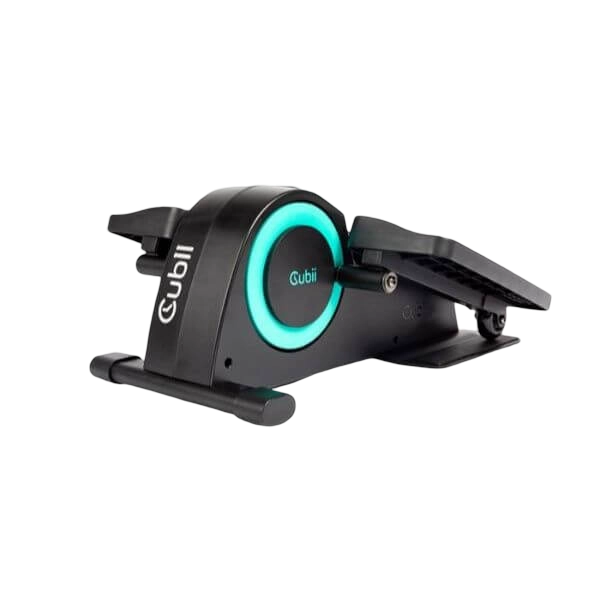
1. Cubii JR1 Under Desk Elliptical
- Seated, with no step-up and no power cord
- 8 resistance levels, listed to 300 lb
Skip if you want to work your arms or train standing.
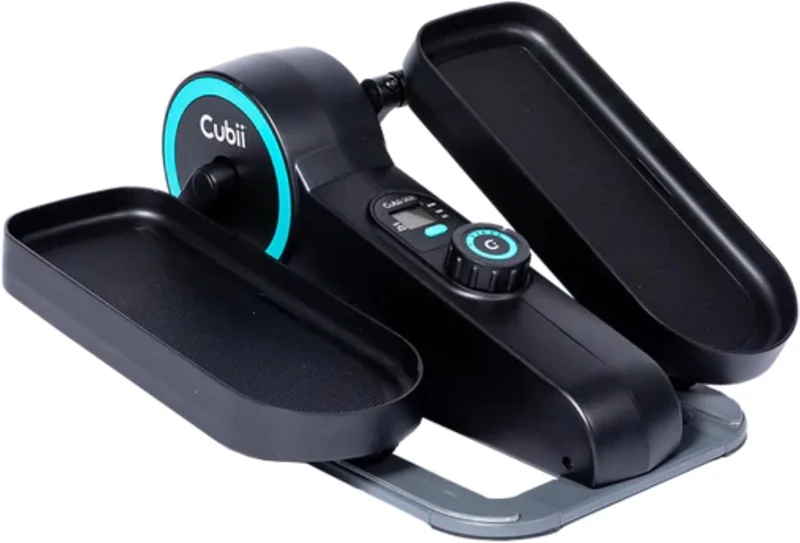
2. Cubii Move
- Seated, about 17.6 lb and 9.7 inches tall
- 6 resistance levels, rated to 300 lb
Skip if you want firm resistance or a unit that arrives assembled.
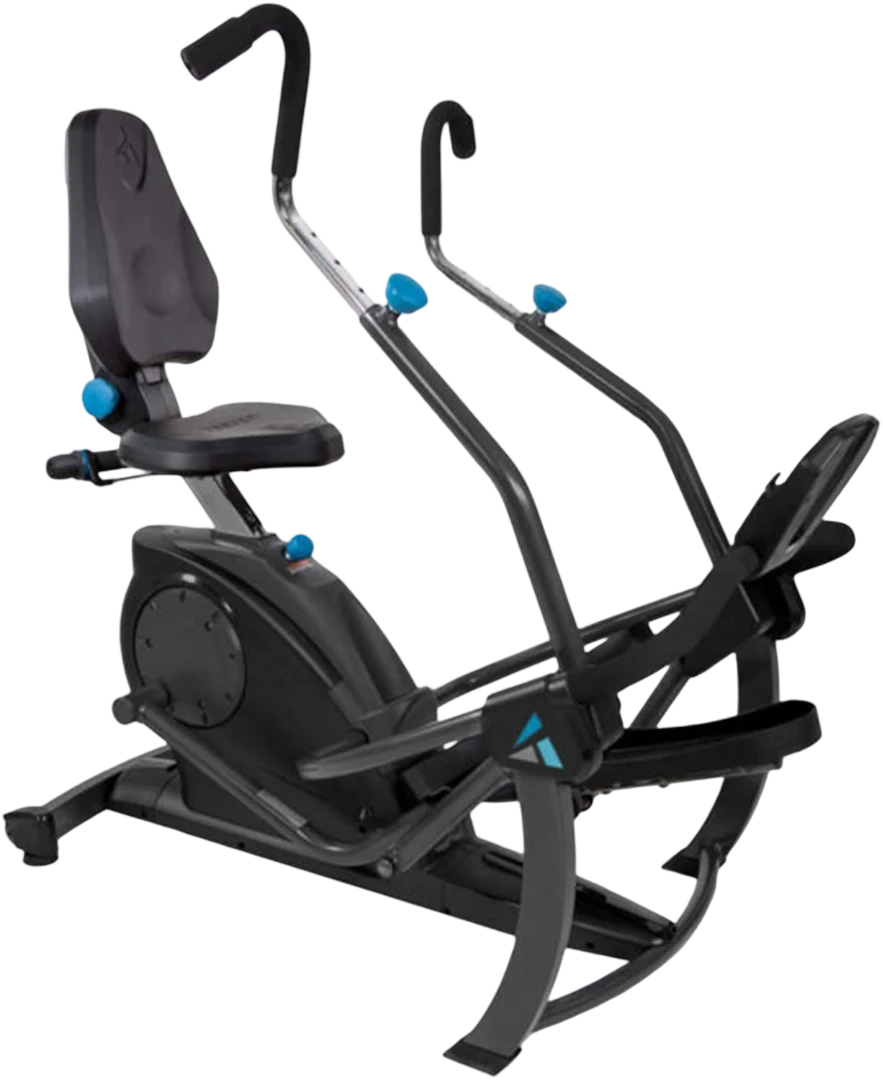
3. Teeter FreeStep LT1 Recumbent Cross Trainer
- Seated stepping with linked arm handles
- 13 magnetic levels, rated to 300 lb
Skip if you have little floor space.
| Model | Best for | How you use it | Resistance | User limit | Warranty |
|---|---|---|---|---|---|
| 1Cubii JR1 | Daily seated pedalling | Seated, from a chair | 8 levels | 300 lb (listed) | 1 yr, 2nd yr if registered |
| 2Cubii Move | Light seated pedalling | Seated, from a chair | 6 levels | 300 lb | 1 yr, 2nd yr if registered |
| 3Teeter FreeStep LT1 | Full seated workout | Recumbent seat | 13 levels | 300 lb | 2 yr structure, 1 yr parts |
| 4Putnen Under Desk Elliptical | Legs that need help | Seated, motor-driven | 12 speeds, 3 programs | 500 lb (listed) | 2 yr (listed) |
| 5Schwinn 411 | Active, steady users | Standing, 17 in pedal peak | 16 levels | 300 lb | 10 yr frame |
| 6Sunny SF-E324005 | A low step-up | Standing, 13 in pedal peak | 16 levels | 300 lb | 3 yr frame, 180 days parts |
| 7Doufit EM-01 | Narrow rooms | Standing | 8 levels | 250 lb (listed) | Not listed |
A figure marked listed is not confirmed by the maker; the others are the maker's own.
How We Evaluated These
- I evaluated how you get on and off each machine first: from your own chair, into a built-in seat, or a step up onto raised pedals.
- I rated the workout range: resistance, arm work, programs, and whether a motor moves the legs for you.
- I assessed each maker's user limit, warranty terms and manual as signals of build, and marked figures that come only from a listing.
- I compared size, weight and power needs against real rooms, and rated how each model holds up in ownership.
- Safety: none of the seven models appears in the CPSC elliptical recall records searched on November 21, 2026; the Schwinn recall there covers the 460, another model.
- Getting on and off25%
- Workout range20%
- Build and warranty20%
- Space and setup15%
- Owner feedback20%
Best Elliptical for Seniors: 7 Seated, Recumbent and Upright Machines Compared
What older adults need from an elliptical differs from what a younger buyer needs. Getting on and off comes first: how high the pedals sit, whether there is a seat, and whether there is a fixed handle to hold. Then come a user limit that fits your body, controls you can read and reach, and a workout range that matches what you want to do.
No single machine is right for every reader, so this list runs from pedal units you use from your own chair to a recumbent cross trainer and standing uprights. No machine here is a treatment for a joint, bone or balance problem, and no study cited on this page tested any of these seven models for falls or balance.
If you have not been active, or have a health condition, MedlinePlus advises you to talk with your health care provider to make sure you are healthy enough for exercise. With a joint condition, a joint replacement or a balance problem, check with your doctor or physical therapist which format suits you before you order.
1. Cubii JR1 Under Desk Elliptical
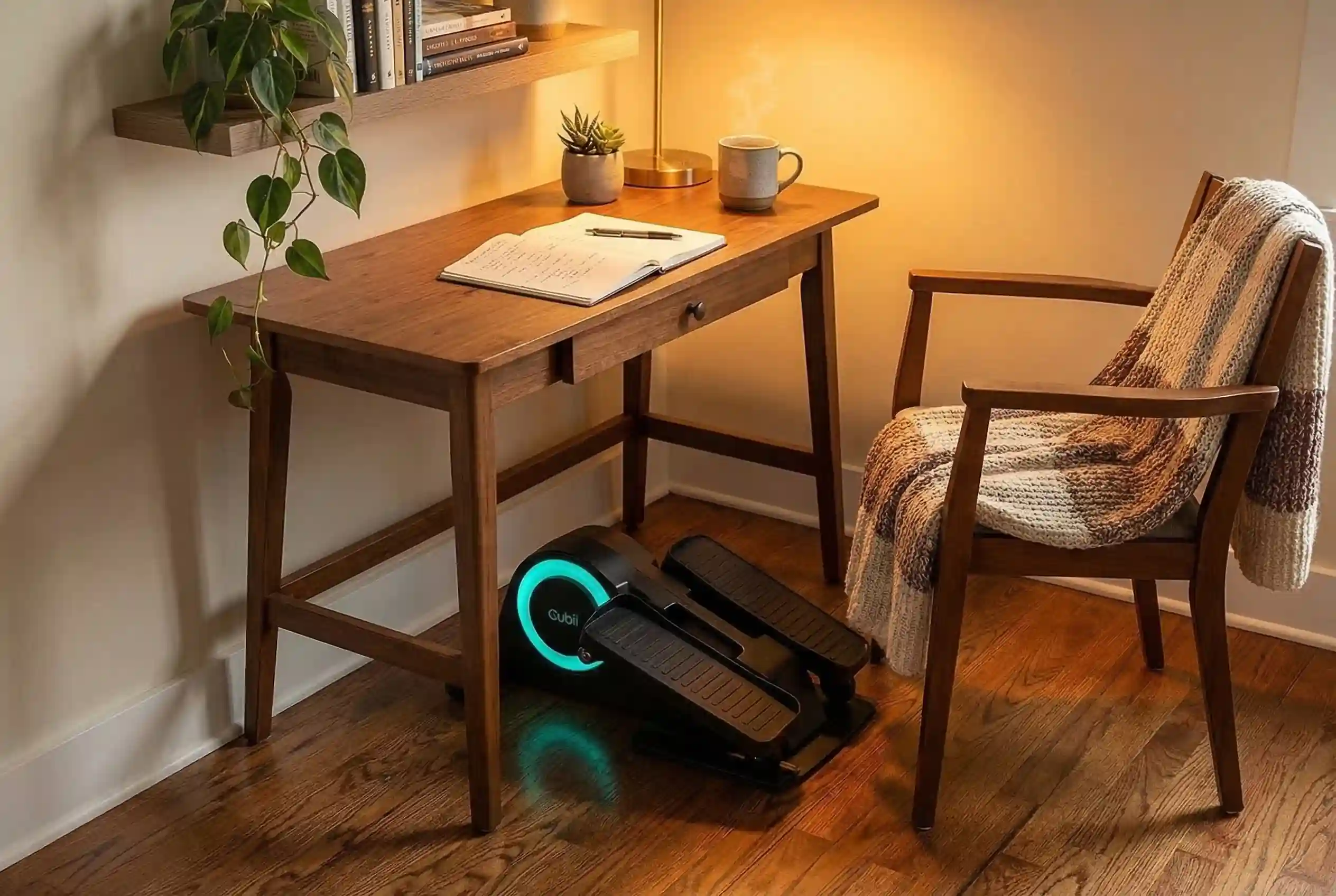
The Cubii JR1 is a seated elliptical: you set it on the floor in front of a sturdy chair and pedal with your feet, so there is no step onto a machine and nothing to balance on. For an older adult who wants to start moving every day, that is the reason to pick it over the standing machines on this page. It has 8 resistance levels, a small display that counts strides, distance and calories, and no power cord.
Cubii JR1 Specs
Type | Seated under-desk elliptical, no power cord |
Resistance Levels | 8 |
Use | Seated only, from a sturdy chair |
Product Weight | 25.4 lb (listed) |
Dimensions | 23.2 x 17.6 x 10 in (listed) |
Max User Weight | 300 lb (listed) |
Display | LCD with strides, distance and calories (battery) |
Connectivity | None; you type the figures into the Cubii app |
Assembly | Quick: attach the pedals |
Warranty | 1 year, plus 1 year if registered online |
- Seated design puts the pedals in front of your own chair, with no step-up and nothing to balance on
- 8 resistance levels for light to moderate seated pedalling
- Built-in LCD counts strides, distance and estimated calories with no app needed
- Free Cubii app for keeping a log; the JR1 does not pair by Bluetooth, so you enter the figures by hand
- About 25 lb and 23 inches long, so it stores in a closet or beside a chair
I rate the JR1 first for a reader who has stopped exercising because standing machines feel risky. You sit in a chair you already trust, set your feet on the pedals and move. The pedal path is fixed, so the machine guides each foot through the same loop on every stroke, and there is no belt or moving platform to keep pace with. The listed user limit is 300 lb, the same figure as the Cubii Move, the Teeter LT1, the Schwinn 411 and the Sunny, and above the Doufit's listed 250 lb. Height matters less here than on the standing machines, because your chair sets your posture, but your knees rise with every stroke, so the space above your knees is the figure to check.
What do 8 levels mean in use? Seated pedalling at a pace you choose is light work, and the resistance decides how firm each stroke feels. In 20 adults in their late sixties, pedalling a portable elliptical while seated added about 1.4 kcal a minute over resting at a self-chosen pace (Lerma and colleagues, Journal of Aging and Physical Activity, 2017; the device is not named in the abstract). That is a small amount of energy, so treat the JR1 as a way to turn sitting time into moving time, not as a replacement for a brisk walk or a full workout on the Teeter or the Schwinn 411. The calorie figure on its display is an estimate.
Three practical points decide whether the JR1 works where you plan to use it. First, knee room: the knees rise with each stroke, so a keyboard tray or a low desk gets in the way, and you may need to lower the chair or move the unit forward. Measure from the floor to the underside of the desk before you order. Second, the floor: on wood or tile the unit can creep forward as you push, and a rubber mat under it stops that. Third, the chair: a chair on wheels rolls back with each push, so pick a chair without wheels, or one whose wheels lock.
The JR1 needs no outlet: the display runs on a battery and there is no motor, so there is no cord to trip over beside the chair. Assembly is quick; the pedals go on and it is ready. At 25.4 lb it is awkward to carry from room to room, so give it one spot. The JR1 no longer appears on Cubii's own list of current seated ellipticals, which shows the Go, the Total Body and the Move, so check that the seller still supports it.
Why We Chose This
Why it is here: the JR1 removes the step that stops many older adults from starting, getting on a machine. It works from your own chair, runs quietly, needs no outlet and carries the same 300 lb figure as the Cubii Move, the Teeter LT1 and the Schwinn 411. I rate it level with the Move and the Putnen as the easiest machines here to get on and off.
Against the other seated picks, the JR1 sits between the Cubii Move and the Putnen. The Move is lighter and lower, at about 17.6 lb, but has six resistance levels against the JR1's eight. The Putnen moves your legs for you with a motor, which suits a reader with very weak legs, but it needs an outlet and early faults are its weak point. The JR1 asks you to do the work, quietly and with no cord, which in my view makes it the better daily machine for anyone who can pedal on their own and wants more resistance than the Move. It cannot match the Teeter LT1 for a full-body workout: it moves the legs only.
Cubii's warranty runs one year from purchase, plus a second year when you register the unit online within 90 days, and in the US the maker may refuse claims for units bought from unauthorized sellers. Before you order, check that the seller is Cubii or an authorized seller, and keep the receipt.
If you have arthritis or a sore knee, check with your doctor or physical therapist before you start, begin at level 1, and if you feel pain, stop right away, as MedlinePlus advises. The JR1 is not a treatment for a joint condition; it is a way to move more while you sit.
Pros
- Seated, with no step-up onto a machine
- Runs with no power cord; the display uses a battery
- Quiet enough for shared rooms, beside a TV or a phone call
- Quick to put together out of the box
- Listed 300 lb user limit, matching the Move, the Teeter LT1 and the Schwinn 411
- 8 resistance levels for light to moderate seated pedalling
- Free Cubii app for keeping a log of your sessions
Cons
- Needs knee room under a desk, and the display figures must be typed into the app by hand
What it means: measure the space under your desk, or plan to use it in front of a sturdy chair away from the desk.
The simplest daily start from your own chair.
The Cubii JR1 is the easiest way on this page to add daily movement from a chair: quiet, cord-free and listed to 300 lb. Pick it if you can pedal on your own; skip it if you want an upper-body or standing workout.
2. Cubii Move
Cubii's Move is the lighter of the two Cubii seated ellipticals on this page: you set it on the floor in front of a sturdy chair or a sofa and pedal, with six resistance levels on a knob and no power cord. It weighs about 17.6 lb, stands 9.7 inches tall and is rated by Cubii to 300 lb, for seated use only.
- Type
- Seated compact elliptical, no power cord
- Resistance Levels
- 6, set with a knob
- Use
- Seated only, from a chair or reclined on a sofa
- Product Weight
- About 17.6 lb
- Dimensions
- 21.7 x 19.7 x 9.7 in
- Max User Weight
- 300 lb
- Display
- LCD: strides, calories, distance, time, RPM (LR44 battery)
- Connectivity
- None; you type the figures into the Cubii app
- Assembly
- Base frame, pedal tubes and pedals; two people recommended
- Warranty
- 1 year, plus 1 year if registered within 90 days
- Six resistance levels on a knob, from level 1, the lightest, to level 6
- Seated use only, from an upright chair or reclined on a sofa
- Display tracks five readings: strides, calories, distance, time and RPM
- About 17.6 lb and 9.7 inches tall, light enough to lift into a cupboard
Weight and height are what set the Move apart from the JR1. At about 17.6 lb it is nearly 8 lb lighter than the JR1's listed 25.4 lb, and at 9.7 inches it is a little lower, so it is the manual seated unit here that an older reader can most easily lift out for a session and put away after. In my view that makes it the better Cubii for a reader who does not want a machine on show in the living room. The trade is resistance: six levels against the JR1's eight.
Getting on is the same as with any seated unit: you sit first and then place your feet, so nothing moves under you while you settle. Cubii builds the Move for seated use only and warns never to stand on the pedals, whatever your weight. Its own safety list also asks you to keep your balance on the chair as you start, stop and assemble the unit, which is why a sturdy chair without wheels matters more than the machine itself. Wear closed-toed shoes, as Cubii asks, and keep both feet on the pedals while you pedal.
What do six levels mean in use? You turn the knob from level 1, the lightest, to level 6, the firmest, and Cubii recommends starting at level 1 and raising the effort gradually over time. I rate the range as light seated work: the legs are likely to feel the upper levels the next day, yet a dial that makes little difference is a risk to watch, so try level 1 and level 6 inside the return window. A reader who wants firmer resistance from a chair should take the JR1, and one who wants the arms to work as well should look at the Teeter.
Knee room is the figure to check. The frame is 9.7 inches tall on a floor area of 21.7 by 19.7 inches, and your knees rise above it with every stroke. Cubii's fix, when the knees meet the desk, is to push the unit further away and lower the chair, with your back straight. Leave at least 24 inches clear behind the training area, and set the unit on a solid, level floor, never on a loose rug. Sliding on a smooth floor is a risk to watch, so set a rubber mat under the unit.
Why We Chose This
Why it is here: it is the light, manual way to pedal from your own chair, with no cord, a 300 lb limit in Cubii's own manual and the same warranty terms as the JR1. For an older reader who wants to store the unit between sessions, I'd pick it over the heavier JR1.
Against the JR1, its Cubii sibling, the Move gives up two resistance levels and wins on weight, height and the display, which adds time and RPM. Both carry 300 lb and both need knee room. Against the Putnen, the Move asks you to drive every stroke yourself and needs no outlet, which is the right design for a reader who can pedal unaided. Against the Teeter, it is a pedal unit rather than an exercise machine: legs only, at a light effort.
Living with it is quiet while the unit is new, so it suits a TV room or a phone call. A squeak from parts rubbing is the likely weak point after some months. Cubii's care steps for the Move answer most of it: wipe the unit with a damp cloth, with special attention to the rubber padding on the wheel tracks, and tighten the pedals and the crank arm screws regularly with the allen key, because loose pedals slowly work undone and make noise. Use no lubricants, cleaners or solvents: Cubii warns that lubricants can damage the unit.
Assembly is a short job with a few awkward steps. The base frame screws to the underside of the body, with its rubber pads under the resistance knob, the two pedal tubes push into the crank arms and lock with the allen key, and the pedals screw on until they no longer wobble. Cubii recommends two people for it, and that is good advice for an older reader working on the floor; the frame fits only one way round, so check the drawing before you drive the screws.
Cubii covers the Move for one year from purchase and adds a second year when you register it online within 90 days. In the US and Canada, Cubii may refuse claims for units bought from unauthorized sellers, so buy from Cubii or a seller it authorizes and keep the receipt and the serial number. A cracked frame and rough welds are risks to watch on this model: lift the unit now and then and look over the frame and the pedal arms. Keep the box as well, which Cubii recommends in case of a return or a warranty claim.
The display wakes when you press its button or start pedalling, switches off after four minutes without movement and runs on one LR44 button cell, so there is nothing to charge or plug in. There is no Bluetooth: figures go into the Cubii app only when you type them in, the same as on the JR1. Cubii asks anyone with joint or bone problems, a heart condition or blood pressure medication to consult a physician before starting, and to stop and consult a physician if you feel faint, dizzy or in pain. I'd pick the Move for a reader who wants a quiet unit to lift and store; I'd skip it for firm resistance or a unit ready out of the box.
Pros
- Light at about 17.6 lb, easy to lift into a cupboard
- Works from your own chair, upright or reclined on a sofa
- Six resistance levels by knob, starting very light at level 1
- Display tracks five readings: strides, calories, distance, time and RPM
- Quiet stroke when new, suited to a TV room or a call
- Up to two years' cover when registered within 90 days
- No power cord needed; the display runs on a button cell
Cons
- Six resistance levels, two fewer than the JR1, keep the effort light
What it means: pick the JR1 if you want more resistance to progress against, or the Teeter for a full workout from a seat.
The light seated pick that is easy to lift and store.
The Cubii Move is the light seated pick: six levels, about 17.6 lb, a 300 lb limit and up to two years of Cubii cover. Pick it if you will lift it in and out of storage; pick the JR1 for more resistance.
3. Teeter FreeStep LT1 Recumbent Cross Trainer
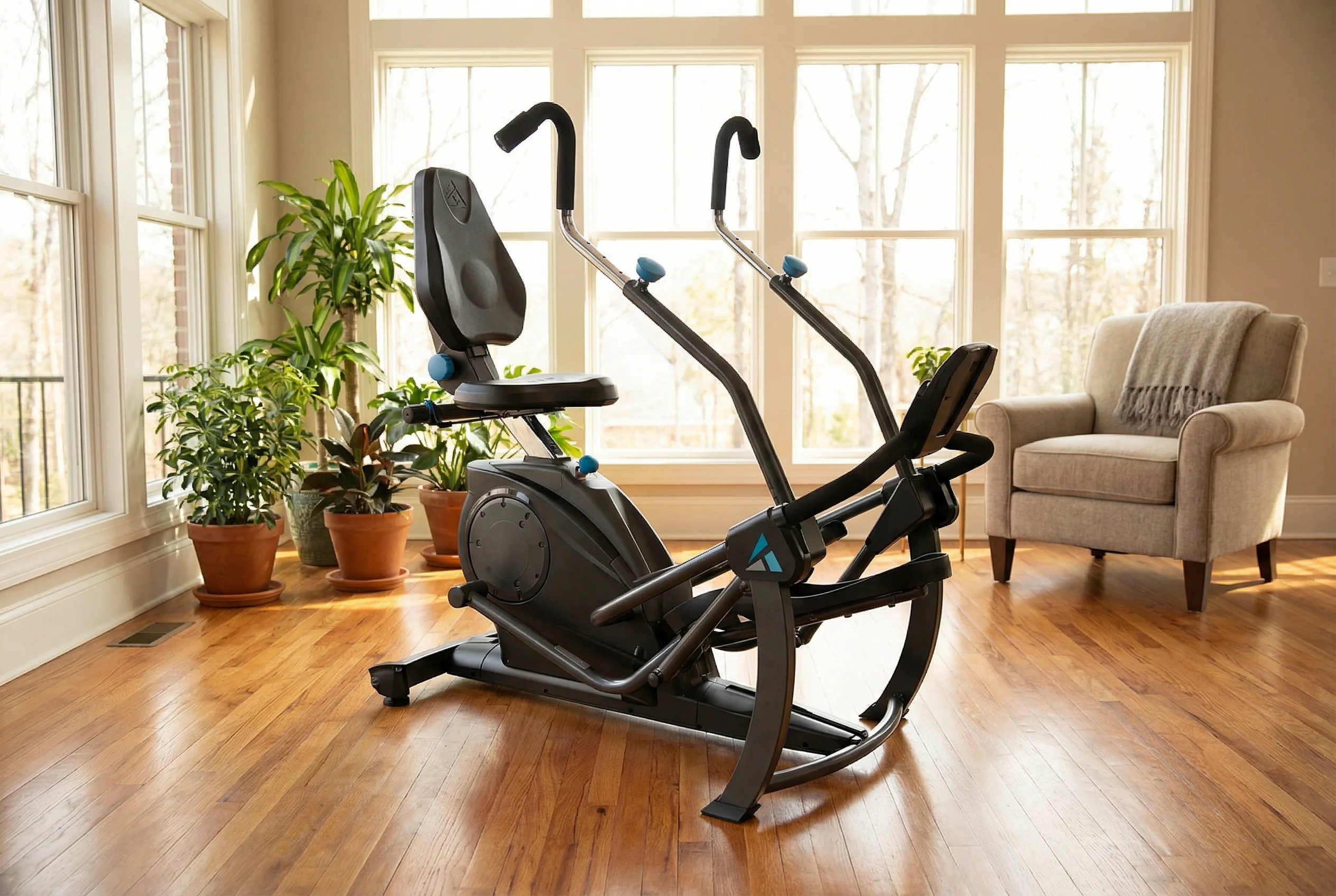
The Teeter FreeStep LT1 is the one recumbent cross trainer on this page: you sit in a reclining seat, push two foot pedals in a stepping motion and work two long handles at the same time. Teeter describes the stride as licensed from commercial physiotherapy steppers; that is the maker's marketing, not a medical finding. It has 13 levels of magnetic resistance and fits users from 4 ft 11 in to 6 ft 6 in, up to 300 lb.
For the complete spec sheet, check the Teeter FreeStep product listing.
Teeter FreeStep LT1 Specs
Type | Recumbent cross trainer, stepping pedals |
Resistance Levels | 13 (magnetic) |
Motion | Seated stepping with linked arm handles |
Dimensions | 62.1 x 32.5 x 55.4 in |
User Height Range | 4 ft 11 in to 6 ft 6 in |
Max User Weight | 300 lb |
Seat | 3-position recline, height adjustable |
Handles | 4-position handles |
Machine Weight | 106.9 lb |
Warranty | 2 yr structural, 1 yr mechanical and electrical parts |
- Seated stepping motion with the feet on pedals and the hands on linked handles
- Reclining, height-adjustable seat with three recline positions
- 13 magnetic resistance levels, which Teeter rates from 0 to 110 lb
- Four handle positions to change the arm work
I rate the LT1 for the older adult who wants a full workout and wants to stay seated for it. You sit down first and then place your feet, so you never stand on a moving pedal, and the seat adjusts for height and recline to set your leg reach. Teeter states a height range of 4 ft 11 in to 6 ft 6 in, the only full range a maker gives here; Sunny states only a 6 ft 4 in maximum for its upright. The user limit is 300 lb, the same as the Cubii Move, the Schwinn 411 and the Sunny. The motion is a step rather than a circle: both feet push on linked pedals while the arms work the handles. Getting into the seat still means lowering yourself onto a machine, so a reader with weak hips should have a hand on something fixed and take the first sessions slowly.
What the resistance means in use: Teeter rates the 13 magnetic levels from 0 to 110 lb. The resistance level sets how strong the magnetic drag is; at any one level, the drag grows as you move faster, so slowing down is the quickest way to ease off. Because arms and legs are linked, the arms can share the work on a day the legs feel heavy, and Teeter says you can isolate the legs or the arms to vary a session. That is the widest workout of the seated picks: the two Cubii units and the Putnen move only the legs.
Space is the cost. At 62.1 by 32.5 inches and 106.9 lb it is the largest and heaviest machine here, too heavy for most older adults to move alone, though it has transport wheels. The console runs on batteries, so it needs no outlet, which lets you place it by a window or in a living room rather than next to a socket. Plan the spot before delivery, and leave room beside the seat to sit down.
Check the model name before you order. This Amazon link sells the LT1, Teeter item SE2001, and Teeter's LT1 warranty is 2 years on the structure and 1 year on mechanical and electrical parts. The LT3, item SE2301, has Teeter's ComfortSelect seat with depth adjustment and longer cover: 3 years structural and 2 years on parts. The two share the 13 levels, the 300 lb limit and the height range, so the LT1 gives you the same workout, and the LT3 adds a better seat and longer cover. The product title on Amazon says up to 350 lb, while Teeter rates the LT1 to 300 lb: use 300 lb.
Why We Chose This
Why it is here: it is the only machine on this page that works the arms and legs from a seat, and it has the most resistance levels of the seated picks. For an older adult who wants more than light pedalling but does not want to stand, I'd pick it first.
Against the Schwinn 411, the LT1 trades the standing 18 inch stride, three more resistance levels and the 10-year frame term for a seat you sit down into, which is the right trade for anyone who feels unsteady on moving pedals. Against the Cubii and the Putnen, it is a full exercise machine rather than a pedal unit for a desk, and it needs a corner of its own. In my view it is the best recumbent elliptical for seniors on this list, and the only one. It is a large step up in size and weight, so it suits a reader who will make it their main cardio machine.
Teeter calls the FreeStep zero-impact and describes PT-quality exercise at home; neither is a medical finding, and no study cited on this page tested this machine. If you have a joint condition or a recent joint replacement, ask your doctor or physical therapist which motion and how much resistance suit you, and start at the lowest level.
Set the seat with care in the first session. The height setting decides how far your legs reach at the front of each step, and the three recline positions decide how far back you sit. A reader new to the machine should start upright enough to see the console and reach the handles without stretching, then try a deeper recline once the motion feels routine. The four handle positions change where your hands sit, which matters for a reader with stiff shoulders.
Upkeep and setup follow the manual for your model, and Teeter publishes the LT1 and LT3 as separate items, so make sure the manual you read matches the SE2001. The machine arrives as a large box that needs assembling. With the console on batteries and the resistance set mechanically, there is no cord or power supply to look after, which keeps day-to-day care to cleaning and checking the hardware.
Pros
- Sit down, then step, with no standing on moving pedals
- Arms and legs together through linked handles
- 13 magnetic resistance levels, rated 0 to 110 lb by Teeter
- Recline and height adjustment on the seat
- Wide stated height range, 4 ft 11 in to 6 ft 6 in
- Battery console, no outlet needed
- Four handle positions to vary the arm work
Cons
- Large and heavy at 62.1 by 32.5 inches and 106.9 lb, with shorter warranty cover than the LT3
What it means: give it a fixed spot, and choose the LT3 if longer cover matters to you.
A seated, arms-and-legs workout for a main cardio machine.
The Teeter FreeStep LT1 is the pick for an older adult who wants a full arm-and-leg workout from a seat. It needs floor space and carries 2 years of structural cover; the LT3 adds a better seat and a longer warranty.
4. Putnen Under Desk Elliptical Machine
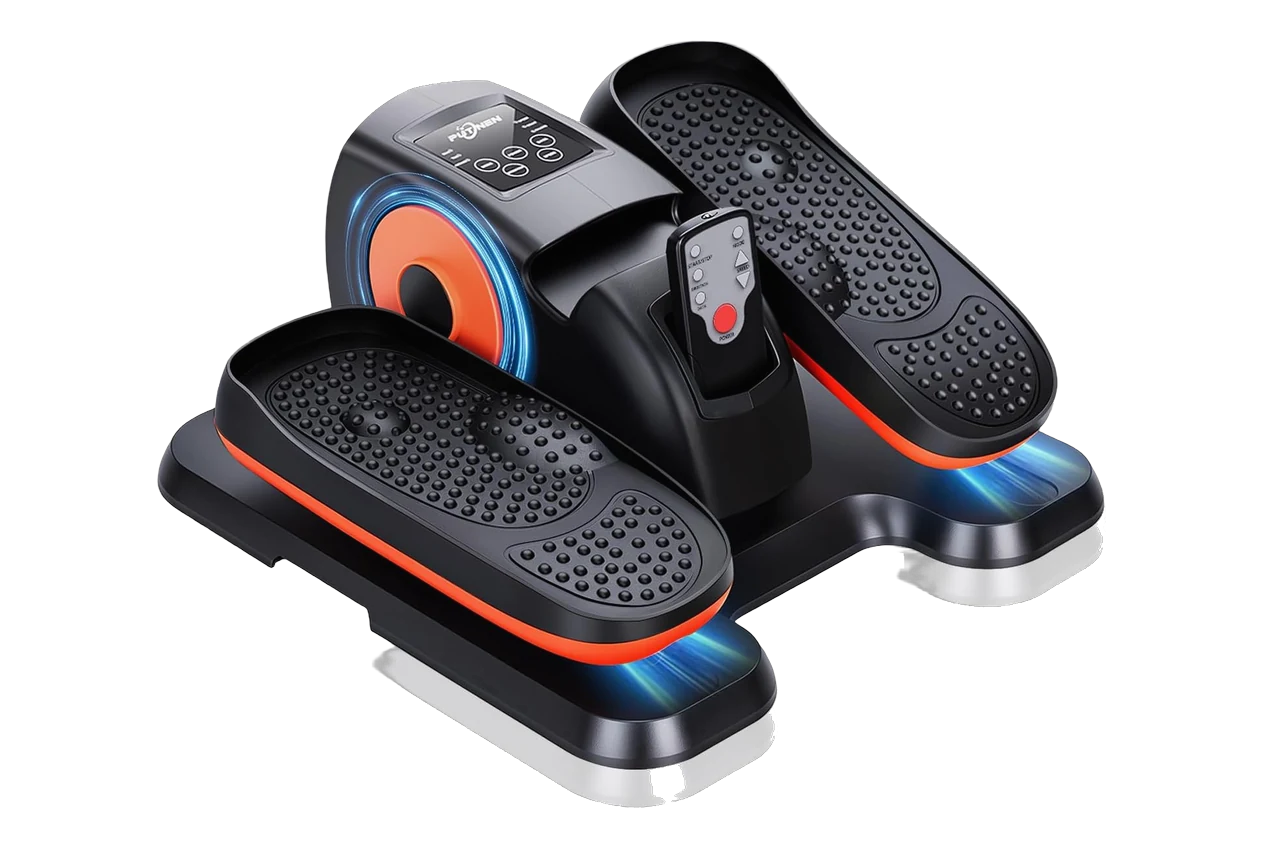
The Putnen is the only motorized machine on this page: plug it in, rest your feet on the pedals, and the motor moves them at one of 12 speeds or through three automatic programs, forward or backward. That makes it the best under desk elliptical for seniors whose legs are too weak to start or keep a pedal stroke going on their own. It weighs 8.1 lb, arrives assembled and is run from a remote, so you never bend forward to change a setting.
Putnen Specs
Drive System | Electric motor, plugs into an outlet |
Speed Levels | 12 speeds plus 3 auto programs (P1 to P3) |
Dimensions | 14.8 x 13.8 x 6.3 in (listed) |
Product Weight | 8.1 lb (listed) |
Max User Weight | 500 lb (listed recommendation) |
Control | Remote (2 AAA batteries, not included) |
Pedal Direction | Forward or backward |
Display | LCD: speed, distance, count, time, calories |
Assembly | Arrives assembled |
Warranty | 2 years (listed) |
- Motor drives the pedals, so the legs move without you starting each stroke
- 12 speeds and 3 programs; the programs change speed and switch direction on their own
- Remote control changes speed and mode without bending forward
- 8.1 lb unit, light enough to move from chair to chair
I rate the Putnen for a different reader from every other pick here: someone who wants leg movement but cannot drive the pedals for long, or a family member choosing for a parent with very little leg strength. The motor does the work at the speed you set. You can let your feet ride along, or push with the motion to add effort, and the forward and backward directions change the way the knees and ankles move through the loop. The listed 500 lb recommendation is the highest figure on the page, but it belongs to a seated pedal unit, so it says nothing about standing use, which this machine is not built for.
A motor changes the safety picture. On a manual unit, the pedals stop when you stop pushing. Here they keep turning until you switch the motor off, so keep the remote within reach, start at the lowest speed with your feet already on the pedals, and stop the motor before you lift your feet off. The programs change speed and switch direction on their own, which is pleasant once you expect it and startling the first time, so try each program once before you use it daily. Anyone with reduced feeling in the feet or legs, or recovering from surgery, should check with a doctor or physical therapist before using a powered pedal unit.
Out of the box it runs quietly, and it plugs in and starts with no assembly. Two things to plan for. Set it on a rubber mat, because sliding on carpet or tile is a risk to watch. And it needs an outlet near the chair, so plan a cord route that nobody trips over, then place the unit where you already sit for long stretches, beside a recliner or a desk chair. At 14.8 by 13.8 inches it is the smallest machine here and fits in front of almost any seat.
The weak point is reliability. A clicking or grinding noise can develop with use, and an early electrical or pedal fault is the likely trait to watch: run every speed, both directions and all three programs inside the return window. Putnen gives a 2-year manufacturer warranty and a three-month return service, so keep the order record as your proof of purchase, because warranty support runs through the seller.
How should a session look? The three programs, P1 to P3, vary the speed and switch the pedals between forward and backward on their own, so they are the easy way to get variety without touching the remote. Manual mode holds one of the 12 speeds until you change it, which suits a reader who wants a steady, predictable pace. For someone with very weak legs, the lowest manual speed with the feet resting on the pedals is the gentlest start the machine offers.
Why We Chose This
Why it is here: it is the only pick that moves the legs for you. For an older adult who cannot keep a pedal stroke going, or who tires after a few minutes on the Cubii, a motor-driven unit makes regular leg movement possible from a chair, run from a remote.
Against the Cubii JR1, the Putnen wins on weight (8.1 lb against 25.4 lb), on the remote and on doing the work for you, and loses on independence from an outlet and on how well it is likely to hold up. If you can pedal on your own, I'd pick the Cubii; if you cannot, the Putnen is the one that will get used. It is not a training machine like the Teeter or the Schwinn 411: at a motor-set pace the effort stays light. Putnen's own words about circulation and joint flexibility are marketing claims, not tested results.
For a caregiver, the remote decides how well this works day to day. If the person using it cannot work small buttons reliably, set the speed and program for them and stay nearby for the first sessions. The remote needs two AAA batteries that are not in the box, so buy them with the unit. The LCD shows speed, distance, count, time and estimated calories, which is enough to keep a simple log of minutes per day.
Against the Cubii Move, the Putnen is the opposite design: the Move needs your legs to drive every stroke against its six levels and needs no outlet, while the Putnen drives the pedals for you and plugs in. Both are small enough to sit in front of a favourite chair, and the Putnen is the lighter of the two. For a reader whose strength varies from day to day, the Putnen's lowest speeds are the more forgiving start; for a reader who wants effort, the Move or the JR1 gives more of it.
Pros
- Motor moves the pedals when your legs cannot
- Remote control from the chair, with no bending forward
- 12 speeds and 3 programs, forward or backward
- Arrives fully assembled and ready to plug in
- Lightest unit here at 8.1 lb
- Quiet when running well, fine for TV time
- 2-year listed warranty and a three-month return service
Cons
- Early noise and electrical or pedal faults are its weak point, and it needs an outlet
What it means: test every speed and program inside the return window, and keep the order record.
Motor-driven leg movement from a chair, run by remote.
The Putnen is the pick when the legs need help to move at all: a motor, a remote and 12 speeds, from your own chair. Test it fully inside the return window, because reliability is its weak point.
5. Schwinn 411 Compact Elliptical
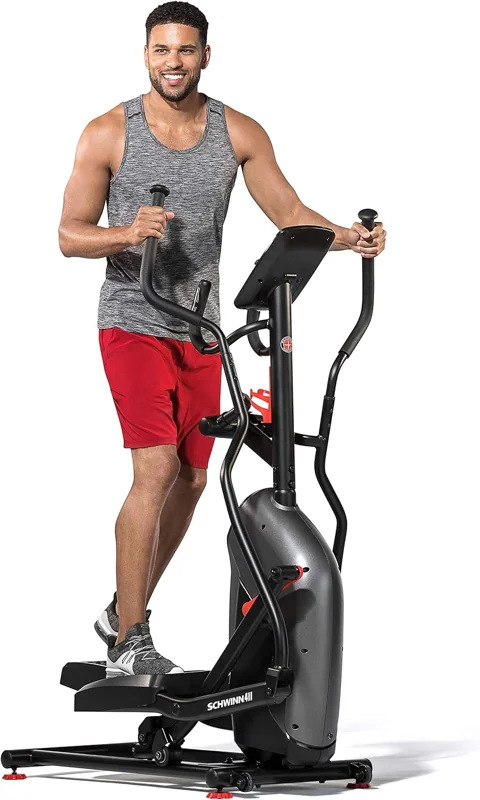
The Schwinn 411 is the standing pick on this page: a compact elliptical with an 18 inch stride on rear rails, 16 resistance levels, moving and fixed handlebars and a console with interval, challenge and heart-rate programs, rated to 300 lb. It is the best elliptical machine for home for seniors who already exercise and stand steadily on moving pedals, and its pedals reach 17 inches at their highest.
Schwinn 411 Specs
Type | Compact standing elliptical on rear rails |
Resistance Levels | 16 |
Stride Length | 18 in |
Incline | None |
Max Pedal Height | 17 in |
Max User Weight | 300 lb |
Machine Weight | 100 lb |
Dimensions | 53.8 x 24 x 62.5 in |
Programs | Quick start, HIIT interval, challenge and heart-rate programs |
Warranty | 10 yr frame, 2 yr mechanical, 1 yr electronics, 90 days labor |
- Fixed handlebars under the console to hold while you step on and off
- Moving handlebars with contact heart-rate sensors, linked to the pedals
- 16 resistance levels set with buttons on the console
- HIIT interval program of 30-second sprints and 90-second recoveries, 12 to 96 minutes
Mounting comes first on the 411, and Schwinn gives exact steps for it. To get on, move the pedal nearest you to its lowest point, grasp the static handlebars under the console and step up onto that low pedal, then place the other foot. To get off, bring the pedal you will step down from to its highest point and stop the machine completely, then, holding the static bars, swing the upper foot down with your weight on the lower one. The pedals and the moving handlebars are linked, so steady yourself only on the static bars. For more standing options, compare the best elliptical machines for home use.
Slowing down needs care too. The 411 has no free-wheel: the pedals and the flywheel turn together, so Schwinn asks you to reduce pedal speed in a controlled way before you stop, never by stepping off a moving pedal. Schwinn also states plainly that exercise on this machine requires coordination and balance. That is the honest test for an older reader: if a step up to a pedal at 17 inches, holding a fixed bar, already feels routine, the 411 fits; if it does not, the Teeter or a seated unit is the safer start.
Who it fits by body: Schwinn rates it to 300 lb, the same as the two Cubii units, the Teeter and the Sunny. The 18 inch stride is the longest stated on this page, and the motion feels partly like a stepper rather than a long running glide, which suits a walking pace. Check the ceiling as well. Schwinn asks for height clearance for the user's height plus the maximum pedal height: a 6 ft user on a pedal at its 17 inch peak stands 89 inches, about 7 ft 5 in, from the floor to the top of the head, which matters in a basement.
What the console gives you: 16 resistance levels on buttons, a quick-start mode that begins at level 4, an interval program, several challenge programs and a heart-rate program that reads your pulse from the contact sensors in the handlebars or a Bluetooth chest strap, which is not supplied. Schwinn advises that the sprint periods of the interval program be followed only if your fitness allows, and that anyone with a pacemaker or other implanted device ask a doctor before using a Bluetooth heart-rate strap. The lowest level is likely to feel firm for a beginner, so a reader returning to exercise should keep the first sessions short. Displayed calories and heart rate are for reference only.
Build and long-term ownership: the frame is sturdy for a compact machine, and the roller wheels that run on the rails are the likely weak point, with wheels that wear or break early. Schwinn's daily step answers it: before each use, look the machine over for loose, broken or worn parts, and do not use it until they are repaired. The US warranty is 10 years on the frame, 2 years on mechanical parts, 1 year on electronics and 90 days of labor, for machines sold through an authorized agent and used in the US or Canada; you must tell Nautilus within 30 days of finding a problem. Getting through to support is likely to take time, so register the machine and keep proof of purchase. Check current terms before you order.
Upkeep is a weekly habit. Unplug the machine and wait 5 minutes before any cleaning, wipe it down after each workout, and each week check that the rollers run smoothly, clean the rails and rollers with a damp cloth, and wipe the rails with silicone lubricant on a dry cloth, never a petroleum-based product. Tighten every bolt monthly or after 20 hours of use. With that routine it runs quietly; skip it and the rollers squeak.
Why We Chose This
Why it is here: it is the highest-scoring standing machine on this page, with fixed bars named in its own mounting steps, the longest stated stride, 16 levels and a 10-year frame term. For a steady, active older adult who wants to stand, it is my pick.
Against the Teeter LT1, the 411 gives you a standing stride, more levels and longer frame cover, and asks you to step up onto a pedal; the Teeter lets you sit down first. Against the Sunny SF-E324005, the 411 has a much longer stride, fixed bars in its maker's mounting steps and a 10-year frame term against 3 years, while the Sunny has the lower stated step, 13 inches at most against 17. Against the Doufit, it is a better documented, sturdier machine in a frame 3.5 inches wider. I'd pick it only if standing on moving pedals already feels routine.
Living with it: the frame is 53.8 inches long, 24 wide and 62.5 tall, and Schwinn asks for a workout area of at least 48 by 77.8 inches, with 24 inches clear along the side you get on from and behind the machine. At 100 lb it rolls on transport wheels once you tip it with the transport handle, a job for one or more people depending on their strength, and the floor must be level: Schwinn's levelling step has you stand on the back of the rail for about 20 seconds, so ask a helper. The console runs from a wall outlet through an adapter, has no on and off switch and sleeps after about 5 minutes; it does not remember custom settings after it shuts down.
Assembly takes one to two hours, and the parts come in one large, heavy box, so plan on a second person to bring it in. The console links by Bluetooth to Schwinn's Explore the World app, which includes three free courses and asks for a subscription for more, and to other fitness apps; check current terms. Schwinn's warranty excludes a machine placed in a commercial or institutional setting, so a senior living community should look elsewhere. I'd pick the 411 for a steady reader who wants to stand and train; I'd skip it for anyone unsure on a raised pedal.
Pros
- Fixed handlebars for mounting, named in Schwinn's own steps
- 18 inch stride, the longest stated on this page
- 16 resistance levels plus interval, challenge and heart-rate programs
- 10-year frame warranty in Schwinn's US terms
- 300 lb user limit in Schwinn's manual
- Sturdy, compact standing frame at 53.8 by 24 inches
- Runs quietly with care, a weekly silicone wipe on the rails
Cons
- The pedals reach 17 inches at their peak, and the roller wheels are its likely weak point
What it means: mount only with the pedal at its lowest and both hands on the fixed bars, and check the rollers every week.
The standing pick for steady, active older adults.
The Schwinn 411 is the standing elliptical for active older adults who are steady on their feet: fixed bars for getting on, an 18 inch stride, 16 levels and a 10-year frame term. Choose a seated pick if a 17 inch step feels uncertain.
6. Sunny Health & Fitness SF-E324005 Smart Upright Elliptical
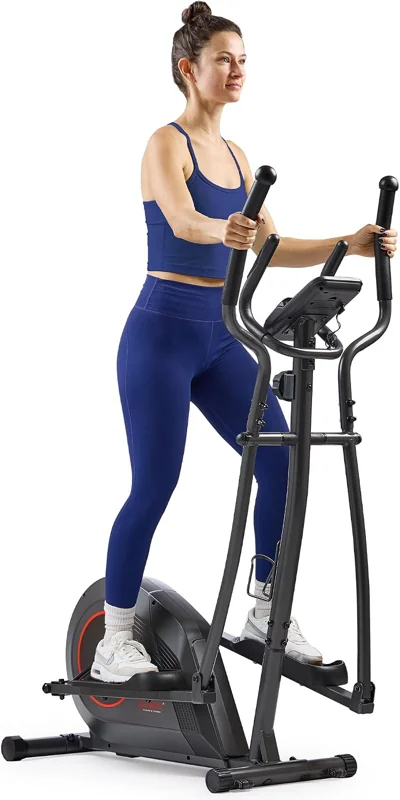
The Sunny Health & Fitness SF-E324005 is a compact upright elliptical with 16 levels of magnetic resistance on a twist knob, moving arms, pulse sensors and a free SunnyFit app link. Sunny rates it to 300 lb and 6 ft 4 in, and its pedals sit 7.1 to 13 inches off the floor, a lower step than the Schwinn 411's 17 inch peak.
Sunny Health & Fitness Specs
Model Number | SF-E324005 |
Resistance Levels | 16 (magnetic, twist knob) |
Stride Length | 11.4 in or 12 in (Sunny gives both) |
Pedal Step Height | 7.1 in to 13 in |
Max User Weight | 300 lb |
Max User Height | 6 ft 4 in |
Product Weight | 61.8 lb |
Dimensions | 47.2 x 25.6 x 58.5 in |
Connectivity | SunnyFit app by Bluetooth (free) |
Warranty | 3 yr structural frame, 180 days other parts |
- Low pedal step height of 7.1 to 13 inches, as Sunny states it
- 16 magnetic resistance levels on a twist knob in front of you
- Pulse sensors built in for a heart-rate reading without a strap
- Free SunnyFit app connection by Bluetooth for logging workouts
- Transport wheels and floor stabilizers for moving and levelling the frame
The step height is the figure that sets this Sunny apart. Sunny gives a pedal step height of 7.1 inches at the lowest point and 13 inches at the highest, the lowest stated for a standing machine on this page (Doufit gives none). The pedals are non-slip and there is a short fixed bar under the console as well as the moving arms. Sunny gives no mounting steps for this model, so I'd step on only with the near pedal at its low point, both hands on the fixed bar, and never on the moving arms.
Who it fits by body: Sunny rates it to 300 lb and to a user height of 6 ft 4 in. The stride is short. Sunny gives it as 11.4 inches in its product text and 12 inches in its specification list, and either way it is the shortest stated stride here, against 18 inches on the Schwinn 411. A short stride suits a smaller user at a walking pace; a taller user can feel cramped, and knees touching the moving handles is a risk to watch, so check the clearance in the first sessions if you are 5 ft 11 in or taller.
What the resistance gives you: 16 magnetic levels on a twist knob in front of the console, the same count as the Schwinn 411 and twice the Doufit's 8, driven by a belt and an 11 lb flywheel. Level 1 is the gentle start for a reader coming back to exercise. The moving arms let the upper body share the work. The pulse sensors give a heart-rate reading without a strap, and the app links by Bluetooth; Sunny calls the SunnyFit app free, with no membership fees, so check current terms before you rely on a feature.
Build and ownership: the frame is likely to feel sturdy, and a noise is likely to develop after some weeks of use, so tighten the bolts after the first sessions and follow the manual for your model when a sound appears. A cracked pedal bolt is a risk to watch: look over the pedal mounts every few weeks. Sunny covers the structural frame for 3 years and other parts and components for 180 days, so a worn part after six months is likely to be yours to replace; check current terms before you order.
Why We Chose This
Why it is here: of the standing machines on this page, it has the lowest stated step height, maker limits of 300 lb and 6 ft 4 in, 16 levels and a 3-year frame term. It suits a steady older adult of small to average height who wants an upright with a low step.
Against the Schwinn 411, the Sunny steps up lower and is shorter and lighter, at 47.2 inches and 61.8 lb against 53.8 inches and 100 lb, while the 411 has the much longer stride, fixed bars in its maker's mounting steps and a 10-year frame term. Against the Doufit EM-01, the Sunny gives twice the levels, a stated user limit, a stated step height and a warranty term, in a frame about 5 inches wider. I'd pick it over the Doufit for nearly every reader.
Living with it: the frame is 47.2 inches long, 25.6 wide and 58.5 tall at 61.8 lb, with transport wheels and floor stabilizers for levelling. Assembly is likely to take a few hours alone, with steps that are easier with a second pair of hands, so plan on help. The display's calorie figure is an estimate; use it to compare your own sessions. A display that does not reset is a risk to watch, so check every reading inside the return window.
If you have a balance problem or a joint condition, check with your doctor or physical therapist whether a standing machine suits you before you order. I'd pick this Sunny for a steady, smaller reader who wants a standing workout with a low step and 16 levels; I'd skip it for a tall reader who wants a long stride, who is better served by the Schwinn 411.
Pros
- Low stated step height, 7.1 to 13 inches
- 16 magnetic resistance levels on a twist knob
- Rated to 300 lb and up to 6 ft 4 in by Sunny
- Pulse sensors built in for a heart-rate reading
- Free SunnyFit app link by Bluetooth
- 3-year structural frame warranty from Sunny
- Transport wheels and stabilizers for moving and levelling it
Cons
- The stride is short at 11.4 or 12 inches, and a noise is likely to develop after some weeks
What it means: it suits a reader of small to average height; taller readers should look at the Schwinn 411.
A low-step upright for small to average heights.
The Sunny SF-E324005 is a compact upright with the lowest stated step height of the standing picks, 16 levels and a 300 lb limit. Its short stride suits small to average heights; taller readers should look at the Schwinn 411.
7. Doufit EM-01 Compact Elliptical Trainer
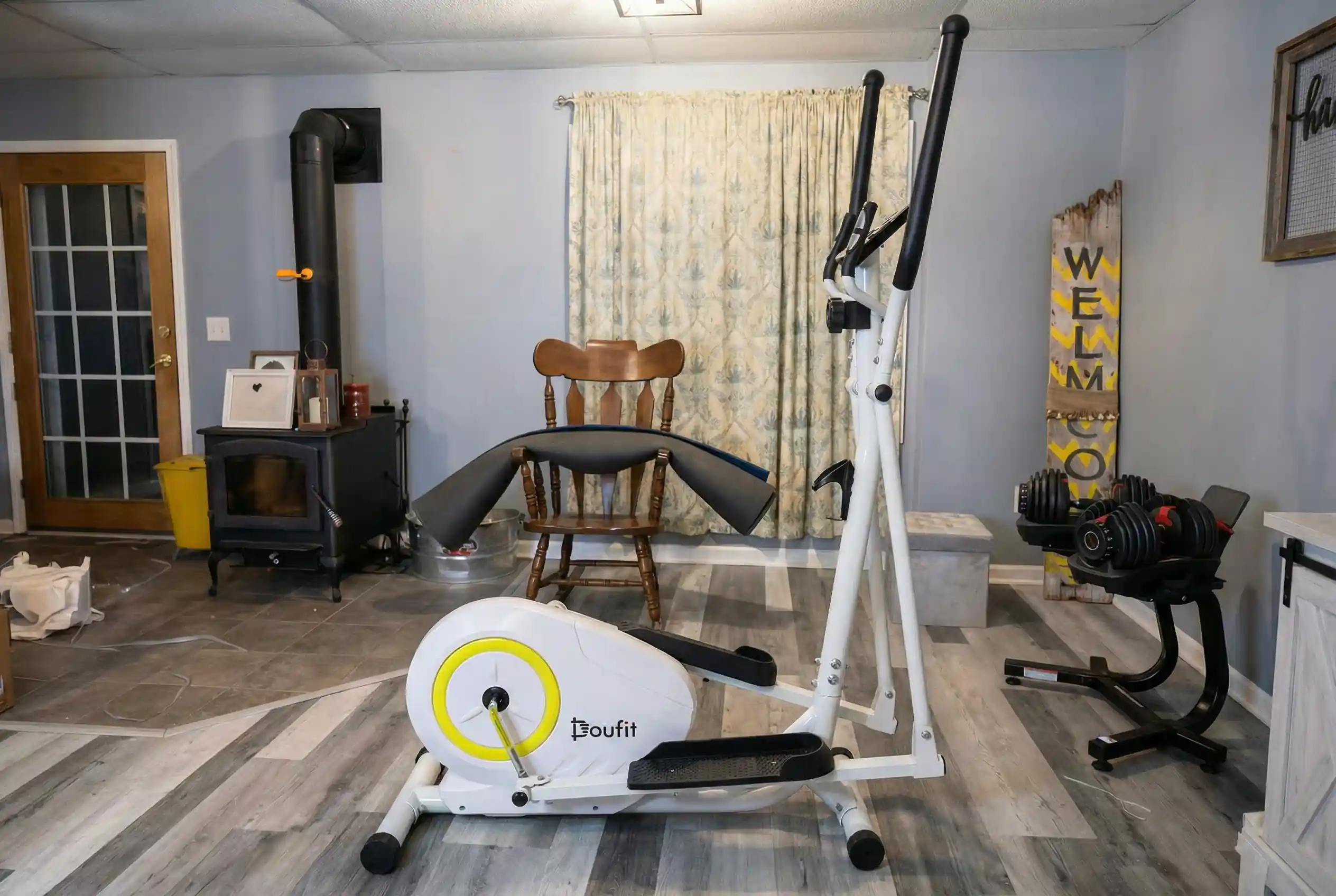
The Doufit EM-01 is a standing elliptical with moving handlebars in a narrow frame, listed at 20.5 inches wide and 50 inches long, with 8 levels of magnetic resistance, pulse sensors and transport wheels. For an older adult who wants to stand and use the arms in a tight space, it is the narrowest standing option here.
Doufit EM-01 Specs
Resistance | Magnetic |
Resistance Levels | 8 |
Stride Length | Not listed by Doufit |
Dimensions | 50 x 20.5 x 61.8 in (listed) |
Product Weight | 28.5 kg, about 63 lb (listed) |
Max User Weight | 250 lb (listed; also listed as 130 kg) |
Handlebars | Moving, with pulse sensors |
Pedals | Large, textured |
Display | LCD: time, speed, distance, calories, pulse |
Warranty | Not listed; ask the seller |
- Standing elliptical with moving handlebars in a 20.5 inch wide frame
- 8 magnetic resistance levels for a gradual range
- Large textured pedals for secure footing in proper shoes
- Transport wheels for rolling it to storage
I rate the EM-01 for a smaller, steady older adult who wants a standing workout with the arms in a small room. The pedals are large and textured, which helps footing, and the handles carry pulse sensors, so you can see a heart-rate reading without a chest strap. The movement is short: arms and legs travel less than on a full-size machine, and Doufit lists no stride length, so a taller user can feel cramped. I'd wear supportive shoes with non-slip soles on it rather than soft slippers.
The frame is the weak point. It wobbles, and a squeak can develop as the bolts settle. Tighten every bolt fully at assembly, follow the maker's assembly video closely, and check the bolts again after the first sessions. Doufit gives two weight limits, 250 lb in one place and 130 kg (about 287 lb) in another; plan on 250 lb, and on a lighter frame than either number suggests.
Getting on takes care because there is no seat and the pedals sit above the floor. Doufit gives no mounting steps and no pedal height for this model, and the moving handles travel with the pedals, so they are not a fixed hold. I'd set it beside a wall or sturdy furniture for the first sessions and keep the resistance low until the motion feels routine.
Assembly is manageable with the maker's video and takes an hour or two. The unit weighs about 63 lb as listed and rolls on its transport wheels to a corner. Rust on the handles is a risk to watch. No warranty term is stated for this model, so ask the seller what is covered before you order and keep the order record.
The 8 magnetic levels give a gradual range, and the top level is likely to feel limited for a fit user, so a reader who wants room to progress should look at the Teeter, the Schwinn 411 or the Sunny. A reader returning to exercise should keep sessions short at first, at a moderate effort of about 5 or 6 on a scale of 0 to 10, and use the pulse reading to compare one session with the next.
Why We Chose This
Why it is here: it is the narrowest standing elliptical on the page, with moving handlebars and pulse sensors, for a room where a full-size machine will not fit. It suits a smaller, steady user who wants a standing, arms-and-legs workout and accepts a lighter frame.
Against the Schwinn 411, the EM-01 is narrower and lighter, at 20.5 inches and about 63 lb against 24 inches and 100 lb, with half the resistance levels, no stated warranty and a lighter build. Against the Sunny SF-E324005, it is about 5 inches narrower, but the Sunny has twice the levels, a stated 300 lb limit, a stated step height and a 3-year frame term. I rate it lowest on this page, mainly for the frame and the missing warranty terms; I'd pick it only when width is the limit and the user is light and steady.
Treat the calorie figure on the EM-01's display as an estimate. In the studies that checked, the display read higher than the lab measurement: on one Precor EFX 883 tested with 34 adults, the reading was about 100 kcal higher per 30 minutes at moderate intensity. Other machines, including this one, were not tested, so use the figure only to compare one session with the next.
Against the seated units, the EM-01 earns its place by working the arms and asking the legs to hold you up, which is a fuller workout for a reader who is steady standing. It also gives up what makes the Cubii and the Putnen easy to use daily: you cannot sit down on it, and getting on is a step up onto moving pedals. For a reader whose balance varies from day to day, I'd pick a seated unit over this one.
Pros
- Narrowest standing frame here, 20.5 inches wide
- Moving handlebars with pulse sensors for arm work and a heart-rate reading
- Large textured pedals for secure footing
- 8 magnetic resistance levels
- Transport wheels for storage
- Clear assembly video from the maker
- LCD shows five readings: time, speed, distance, calories and pulse
Cons
- The frame wobbles and can squeak, the movement is short, and no warranty term is listed
What it means: it suits a lighter, shorter, steady user; heavier or taller users should look at the Schwinn 411 or the Sunny.
A narrow standing elliptical for a small, steady user.
The Doufit EM-01 fits a standing, arms-and-legs workout into a 20.5 inch wide frame. The frame is light and the movement short, so it suits a smaller, steady user; confirm warranty cover with the seller first.
Why Cubii JR1 Might Be the Best Choice
I'd pick the Cubii JR1 first for a reader who has found it hard to start, because it asks for the least effort to begin a session. You sit in your own chair, put your feet on the pedals and move, with no step-up, no cord and very little noise.
The Teeter LT1 gives a fuller workout from a seat, and the Schwinn 411 has more room to progress. The JR1's strength is that it fits into the day: it goes in front of the chair you already sit in, so a session can start during the news or a phone call.
- Suits readers who want to stay seated, from a sturdy chair
- Works while you watch TV, read or take a call
- Logs to the free Cubii app, with the figures entered by hand
How to Choose the Best Elliptical for Seniors
Choosing the best elliptical for seniors starts with one question: do you want to sit or to stand? The same checks apply whether you are buying for yourself or for a parent or grandparent. The machines here fall into three groups:
- Seated pedal units - the Cubii JR1, the Cubii Move and the Putnen: used from your own chair, legs only, with no step-up
- Compact standing machines - the Schwinn 411, the Sunny SF-E324005 and the Doufit EM-01: moving handles in a smaller frame. For a compact model listed with an incline, look at the YOSUDA 3-in-1 Compact Elliptical.
- Recumbent cross trainer - the Teeter FreeStep LT1: arms and legs from a seat, and the most floor space
Knowing which of these types of ellipticals fits your situation narrows the choice quickly. For a small room, the best compact elliptical for seniors is often a seated unit rather than a short standing frame, because a seated unit needs no step-up at all.
Our full elliptical selection includes additional models beyond this list.
Step-Over Height - The Safety Factor
How high you lift a foot to get onto the machine is the first thing to check. On a standing elliptical you step onto a pedal above the floor: Schwinn gives a maximum pedal height of 17 inches for the 411, and Sunny gives a step height of 7.1 to 13 inches for the SF-E324005. A seated pedal unit and a recumbent cross trainer remove that step: you sit first, then place your feet. Doufit gives no pedal height, so judge the EM-01 in person before the first session.
Getting on and off is also where a standing machine asks the most of your balance, and a literature search found no trial of standing elliptical training for balance or falls in older adults. What the research does support is regular light activity: a 2015 systematic review of 15 studies in adults aged 65 and older found that 11 reported gains in flexibility, balance, lower-limb strength or depressive symptoms with low-intensity exercise (1). None of those programs is evidence for any one machine here. Choose the format you can get on and off without strain.
Stride Length - Matching the Machine to Your Body
Stride length matters on the standing machines, where it sets how far each foot travels. No maker or study cited here gives a stride length for a given height, so:
- Check the maker's stride figure - for the exact model, not the product title
- Try the motion if you can - or check the return terms before you order
- Taller users - a short stride can feel cramped on the compact standing machines here
Seated pedal units have no stride in this sense: your chair sets your position, and knee room under the desk is the figure to check. For session plans, there are these elliptical workouts.
Resistance Range - Building Cardiovascular Fitness Progressively
For an older adult, the bottom of the resistance range matters as much as the top. On the Schwinn 411 the lowest level is likely to feel firm for a beginner, while the seated units start very light. On a magnetic machine, the resistance level sets how strong the magnetic drag on the flywheel is; at any one level, the drag grows as you pedal faster, so slowing down is the quickest way to ease off.
How much to aim for: US guidance says "adults need at least 150 to 300 minutes of moderate-intensity aerobic activity, like brisk walking or fast dancing, each week" and muscle-strengthening activity at least 2 days a week. Moderate effort is about 5 or 6 on a scale of 0 to 10, and vigorous effort begins at 7 or 8, on the CDC's scale. Any machine here can count toward that total at a moderate effort; the seated units sit at the light end.
Frame Stability - Why This Is a Safety Concern for Older Adults
A frame that rocks or shifts makes every session less steady. Check the user limit first: the Cubii Move, the Teeter LT1, the Schwinn 411 and the Sunny SF-E324005 are rated to 300 lb by their makers, the Cubii JR1 is listed at 300 lb, the Doufit is listed at 250 lb, and the seated Putnen lists 500 lb as a pedal unit you sit behind. Then look for:
- A stated user limit - from the maker, not only from a product title
- A base that sits flat - level it on delivery so it does not rock
- A mat under seated units - on wood or tile, where small units can slide
Bone health is a separate question. A systematic review for the WHO guidelines found that physical activity programs probably improve lumbar spine bone mineral density in adults aged 65 and older, with programs that combine several exercise types or use resistance exercise appearing most effective (2). It did not single out ellipticals, and no machine on this page treats low bone density. For a senior living community, look for a commercial-use warranty, a seat or step-through access, and a user limit above your heaviest resident; Schwinn's warranty on the 411, for one, excludes commercial and institutional settings.
Seated vs. Standing - Choosing the Right Posture for Your Needs
Standing machines work the legs while you hold your own balance, and the moving handles add the arms. Seated units and the recumbent cross trainer take balance out of the session: you sit first, then move. A seated elliptical for seniors works best in front of a sturdy chair that does not roll. If leg strength is very limited, a motorized pedal unit like the Putnen moves the legs at a set speed, but check with your doctor or physical therapist before you start.
For a reader with osteoporosis or osteopenia, a 2023 position statement based on 50 randomized trials puts resistance and impact training at the core of exercise for bone strength and fall risk (3); aerobic machines are not its main recommendation. A seated elliptical can still be part of a weekly routine, but it does not replace the strength work your doctor or physical therapist may prescribe.
A sitting elliptical machine for seniors and a recumbent cross trainer differ in one way that matters: the recumbent has its own seat, so the whole body is supported, while a pedal unit relies on your chair. Choosing the best under-desk elliptical for seniors comes down to knee room, noise and whether you need a motor.
Retail names vary. An elliptical exerciser for seniors, a seated elliptical and an under-desk elliptical usually describe the same kind of pedal unit, like the Cubii JR1, the Cubii Move or the Putnen. A recumbent cross trainer is different because the seat is built into the machine.
Recumbent Cross Trainer vs Recumbent Bike
A recumbent cross trainer pairs a supported seat with linked arm handles and a stepping foot path, so the upper body works too. In my view the Teeter FreeStep LT1 is the best recumbent cross trainer for seniors on this list, and the best recumbent elliptical cross trainer here for a reader who wants long seated sessions. Another option to compare is the Sunny recumbent cross trainer.
A recumbent bike moves your legs in a circle with fixed handles, so it trains less of the upper body, but the low seat is just as easy to get on. If you mainly want seated leg cardio with back support, recumbent exercise bikes are a fair alternative. If you want an elliptical bike for seniors that also works the arms, choose a cross trainer.
Choosing an Elliptical After an Injury or Joint Surgery
The best elliptical for injuries is the one your surgeon or physical therapist clears you for; the knee research is summed up in the guide on whether the elliptical is good for knees. After a hip or knee replacement, getting on is the step to plan, so a machine you sit down on first, a recumbent cross trainer or a seated pedal unit, removes the step-up. Start at the lowest resistance, follow your surgeon's or physical therapist's timeline before you add intensity, and if you feel pain, stop right away, as MedlinePlus advises.
Noise Levels and Apartment Suitability
Noise matters when you share walls or train early. The Cubii JR1 runs quietly, and the Cubii Move is quiet when new though a squeak is likely after some months; the Putnen runs quietly when new, though a clicking or grinding noise can develop; the Schwinn 411 runs quietly as long as its rails get the weekly silicone wipe; and on the Sunny a noise is likely to develop after some weeks.
When a squeak starts, check the bolts first, then clean the rails or tracks, and use a lubricant only where the manual for your model calls for one. Schwinn's 411 manual names silicone lubricant on a dry cloth and rules out petroleum-based products, while Cubii's Move manual rules out lubricants altogether.
Space Planning - What the Product Page Does Not Tell You
Plan for the space a machine needs in use, not only its size in the box. By model:
- Seated pedal units - about 23 by 18 inches for the Cubii JR1, 21.7 by 19.7 inches for the Cubii Move (with 24 inches clear behind) and 14.8 by 13.8 inches for the Putnen, plus your chair
- Compact standing machines - the Sunny is 47.2 by 25.6 inches and the Doufit is listed at 50 by 20.5 inches; leave room to step on and off
- Schwinn 411 - 53.8 by 24 inches, in a workout area of at least 48 by 77.8 inches with 24 inches clear along the access side and behind
- Teeter FreeStep LT1 - 62.1 by 32.5 inches, plus room beside the seat to sit down
Measure the room where you will use the machine every day. A unit beside the chair you already sit in is easy to reach for; one in a spare room is easy to forget. The most portable elliptical machine for seniors here is the Putnen at 8.1 lb, and the Cubii Move, at about 17.6 lb, is the lightest unit that needs no outlet.
How Long Should Seniors Use an Elliptical - Evidence-Based Duration Guidelines
The US physical activity guidelines give the weekly target and the pace of change, not a week-by-week elliptical plan. Their advice is to increase activity gradually:
- Start short - the guidelines give an example of 5 to 15 minutes, 2 to 3 times a week, for people starting from little activity
- Add time and days first - and raise the resistance later
- Allow more time - older adults may need longer to adapt, the guidelines note
- Work toward the weekly target - at least 150 minutes of moderate-intensity activity, counted across all your activities
For readers with heart disease, exercise is best planned with the care team. In a randomized trial of 235 patients aged 70 or older after an acute coronary syndrome, a tailored program of four supervised sessions plus home exercise improved grip strength, gait speed and quality of life at 6 months and 1 year compared with health education alone (4); it did not test ellipticals. If you have heart disease, train only as your care team directs. Go to the hospital right away or call 911 or the local emergency number if you have chest pain during or after exercise.
Elliptical vs Treadmill for Seniors
An elliptical keeps your feet on the pedals, and a treadmill asks you to walk on a moving belt. A treadmill suits a reader who wants to practise everyday walking; an elliptical or a seated unit suits a reader who prefers a fixed foot path. Either counts toward the weekly target at a moderate effort. If balance is a concern, a seated or recumbent machine is where I'd start. The full elliptical vs treadmill comparison covers joint load and energy use.
Overall Verdict
Which elliptical is best for seniors depends on how you want to move. For older adults who want to start from a chair and can pedal on their own, I'd pick the Cubii JR1: quiet, cord-free and simple, or the lighter Cubii Move if you will put it away between sessions. For a full seated workout, the Teeter FreeStep LT1 scores highest on this page. For a steady, active reader who wants to stand, the Schwinn 411 has the most room to grow, and for legs that need help to move, the Putnen.
- Cubii JR1 Under Desk Elliptical [Best Seated Elliptical] - quiet, cord-free pedalling from your own chair, for readers who can pedal on their own.
- Cubii Move [Best Lightweight Manual Elliptical] - quiet, cord-free seated pedalling in a unit of about 17.6 lb that is easy to lift and store.
- Teeter FreeStep LT3 [Best Recumbent Cross Trainer] - this link sells the FreeStep LT1: a seated, arms-and-legs workout for readers who do not want to stand.
The best elliptical machine for seniors is the one you can get on and off without strain. If you are unsure, start with a seated unit or the Teeter, and move to a standing machine only when getting on and off feels routine.
Frequently Asked Questions
What is the best exercise machine for seniors at home?
The best exercise machine for seniors at home is one that matches your balance, strength and space: a seated pedal unit or a recumbent machine for readers who prefer to sit, and an upright elliptical, treadmill or bike for steady, active readers. If you have not been active, or have a health condition, talk with your health care provider to make sure you are healthy enough for exercise.
Is elliptical good for seniors?
An elliptical can suit older adults who are steady on their feet, and seated or recumbent versions suit those who prefer to sit. No machine is a treatment for joint, bone or balance problems, so check with your doctor or physical therapist if you have one.
Is 30 minutes of elliptical a day enough?
Thirty minutes on five days adds up to 150 minutes, the low end of the US guidance of 150 to 300 moderate-intensity minutes a week for adults. If you are starting from little activity, build up gradually and add time before you add resistance.
Can I use an elliptical if I have bad knees?
Whether an elliptical suits your knees is a question for your doctor or physical therapist, because no machine protects or treats the knee. If you get the go-ahead, start at the lowest resistance, and if you feel pain, stop right away.
How long should a senior use an elliptical?
Build up gradually: the US guidelines give an example of starting with 5 to 15 minutes, 2 to 3 times a week, and adding time before intensity. If you have a heart condition, have had joint surgery or are starting after a long inactive spell, set your session length with your doctor or physical therapist.
Which is harder on knees, a treadmill or an elliptical?
Measured knee loads do not show the elliptical as gentler than walking in every case: in three people with knee replacements, knee force on the elliptical was not lower than treadmill walking and was below jogging. Ask your doctor or physical therapist which suits your knees, and choose the machine you can use without pain.
Is elliptical good for osteopenia?
An elliptical can be part of a weekly routine, but the exercise best supported for bone in people with osteopenia or osteoporosis is resistance and impact training, so it should not be your only exercise. Ask your doctor or physical therapist to plan the mix, especially before any impact work.
 Tech Fitness Lab
Author
Milutin Tucakov
I am in the final year of my degree at the Faculty of Sport and Physical Education in Novi Sad. I am a certified lifeguard with first aid training and I compete in Brazilian Jiu-Jitsu. I write about safe use: the limits and setup steps in the manual, and what the warranty really says.
References
- Tse ACY, Wong TWL, Lee PH. Effect of low-intensity exercise on physical and cognitive health in older adults: a systematic review. Sports Med Open. 2015;1(1):37. doi:10.1186/s40798-015-0034-8
- Pinheiro MB, Oliveira J, Bauman A, et al. Evidence on physical activity and osteoporosis prevention for people aged 65+ years: a systematic review to inform the WHO guidelines on physical activity and sedentary behaviour. Int J Behav Nutr Phys Act. 2020;17:150. doi:10.1186/s12966-020-01040-4
- Bae S, Lee S, Park H, et al. Position statement: exercise guidelines for osteoporosis management and fall prevention in osteoporosis patients. J Bone Metab. 2023;30(2):149-165. doi:10.11005/jbm.2023.30.2.149
- Campo G, Tonet E, Chiaranda G, et al. Exercise intervention improves quality of life in older adults after myocardial infarction: randomised clinical trial. Heart. 2020;106(21):1658-1664. doi:10.1136/heartjnl-2019-316349